Tittenhurst Park

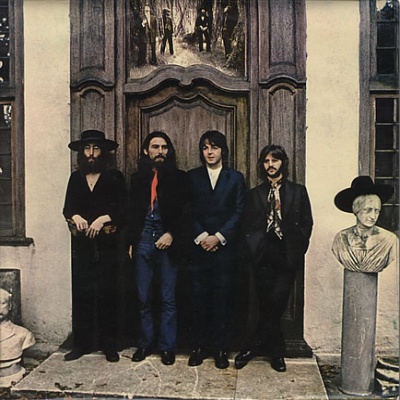
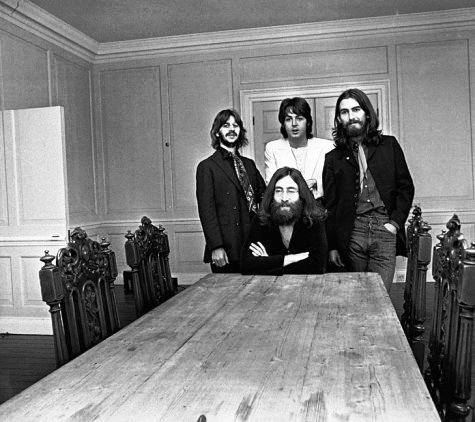
Stumbled upon an interesting article on the BBC website about John Lennon’s former home Tittenhurst Park near Ascot, Berkshire in England. It reminded me how much it has formed a part of the imagery surrounding record covers in my collection, and probably in yours. These albums, along with videos and publicity shots taken at Tittenhurst, have gone into the collective consciousness. Fans will know of this mansion house because although Lennon and Yoko Ono only lived there for around two years it featured in many a photo session, song video and documentary about John Lennon and the Beatles. There were in fact a huge number of photographs taken there – probably the most famous being the front and rear cover images for the Beatles best-of album known variously as The Beatles Again/Hey Jude (released in 1970 in the USA), and as Hey Jude (released in 1979 in the UK): This image, also taken at the house, was used for the rear cover: The next most famous images from Tittenhurst Park (which by the way is on London Road at a place called Sunningdale – one blogger has dedicated an entire blog to the house) came about when Lennon recorded his Imagine album there in 1971. When the song ‘Imagine’ was released as a single it was accompanied by this now legendary video which begins with John and Yoko walking through the fog-filled extensive grounds of Tittenhurst, and ends in an all-white main room inside the house:

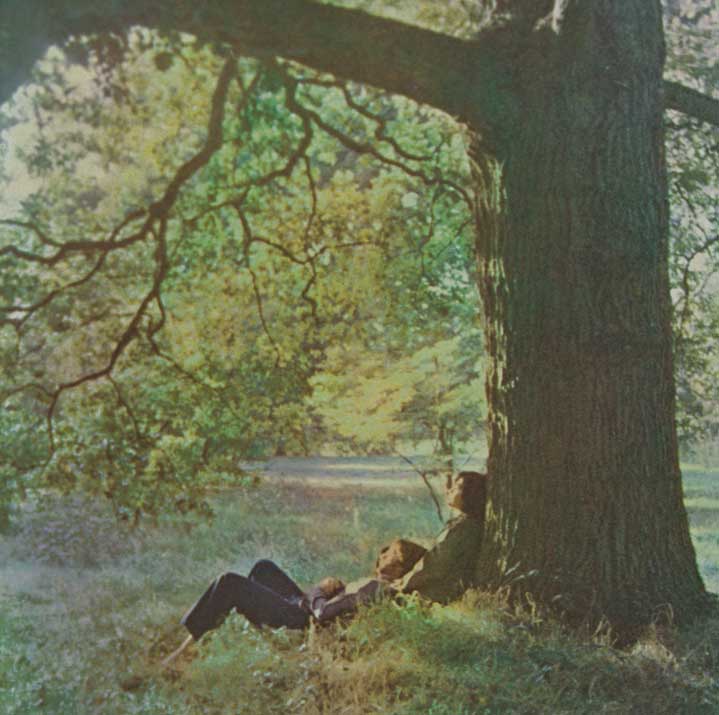
There’s also a fantastic scene from Gimme Some Truth, the documentary on the making of the Imagine album, where John talks to a young man who turns up at the house and invites him in for breakfast. And of course the cover photograph for Plastic Ono Band (1970) was also taken in the grounds of the manor – beside the man-made lake the Lennon’s had constructed on the property:

There’s a fairly comprehensive article about Tittenhurst Park in Wikipedia. John subsequently sold the property to Ringo Starr. Lennon biographer Philip Norman wrote:

“Ringo had…recently bought Tittenhurst Park, in the same obliging spirit that a Liverpool pal might take over some old banger of a car. John hated the thought that his rolling parklands and lake had gone forever, and drew comfort from Ringo’s promise that a bedroom would always be kept for him there.” (“John Lennon – The Life”. Harper Collins, 2008)

Sadly the events of 1980 meant that was no longer a requirement. The house and grounds were again sold in 1988 to present owner, Sheikh Zayed bin Sultan Al Nahyan, President of the United Arab Emitrates and ruler of Abu Dhabi. On Friday, August 22, 1969 the Beatles final photo session as a band was at Tittenhurst. The dream was over.

(See also “John Lennon’s Rolls Royce“, and the Kenwood site which goes into great detail about the house Lennon owned prior to purchasing Tittenhurst Park)

“Penny Lane” Trumpeter Dies

David Mason, the musician who played the now famous trumpet parts for the Beatles “Penny Lane”, has died. In January, 1967 he provided just a short couple of sections for the song – but they are solos from a virtuoso which are so impressive and important in making “Penny Lane” so loved by so many.

David had been Principal Trumpet of the Royal Philharmonic Orchestra, the Philharmonia Orchestra, the Covent Garden Opera, and the English Chamber Orchestra.

Here’s the story of how “Penny Lane” came about:

And of course the song itself in full:

Vale David Mason. And thanks for the music.

McCartney’s “The Family Way” to get proper CD Release

Interesting news last week that Paul McCartney’s very first solo work outside the Beatles is to get a decent CD release in July this year.

McCartney wrote the original soundtrack music to the 1966 British movie “The Family Way“, starring Hayley Mills and Hywell Bennett. He was assisted with orchestrations and arrangements by Beatles producer George Martin. The news of a new CD release got me scrabbling through the collection to find my vinyl copy:

This is the Australian pressing – which came out on Decca Records originally in 1967 (though my copy is a re-issue). In the UK the LP also came out on Decca, while in the US it was released on the London label. The LP has 13 tracks but interestingly (as you can see on the label image above) there are no titles for any of them.

“The Family Way” will be released on CD on July 26 by specialist soundtrack label Varèse Sarabande, based in California. It takes a bit of a search to find any references to the forthcoming CD on their website. You have to go to the “Vintage News” section and there’s information contained there when you scroll a fair way down the page…..

It’s very interesting to hear the music now with the benefit of hindsight. It would have been composed by McCartney just after the release of “Revolver”, and just before he went into the studio to record “Sgt Pepper”:

The original 1967 soundtrack recording of “The Family Way” contains both the above McCartney themes, the main theme and “Love in the Open Air” – plus eleven more score cues suited to the on-screen action. Varèse Sarabande says that for his composition McCartney was initially inspired by the sound of brass bands, familiar to his childhood in the North of England.

Steve Marinucci in his Beatles Examiner column says the new single-disc release will be taken from the original mono master tapes and will feature sleeve notes by Chip Madinger, author of a new book on the Beatles solo work called “Eight Arms To Hold You“.  The CD will also include a previously unreleased stereo mix of “A Theme From ‘The Family Way'”, a rarity that in 1966 appeared as the b-side of a 1966 UK/US 7-inch single by a band called the Tudor Minstrels.

Are You A Beatles Autograph Hunter?

I’m not, but I was kind of intrigued reading this article about a forthcoming auction of an autographed copy of the Beatles US LP “Meet The Beatles!” from 1964.

Signed on the rear cover by all four Beatles on the eve of their legendary Ed Sullivan Show TV appearance, the record comes from the estate of  Dr Jules Gordon who treated an ailing George Harrison at New York’s Plaza Hotel, the hotel where the Beatles were staying during their first US visit.

George was suffering from a very sore throat and Dr Gordon, the house physician at the hotel, was called upon to treat him. In fact, at one stage it looked like he might not be able to perform at all on the TV show – which broke the band big time in the US.

The auction is being conducted by Case Antiques. Their May 21 auction is billed as a “Fine Art and Antique Auction” – and hidden away on page 15 of the 37-page internet listing, in amongst the furniture and artworks, is the signed Beatles album. To save you time here’s a link to that page. Click on the album to bring up some more pictures and details. The auction listing describes the item as:

“Very good condition. 12-1/4″ H x 12-1/4″ W. Provenance: From the estate of Dr. Jules Gordon, the New York physician who treated George Harrison for a sore throat on February 8, 1964, the day before their American television debut on the Ed Sullivan Show. Refer to the New York Times Article dated February 9, 1964 by Thomas Buckley which names Dr. Gordon and describes the doctor’s treatment of Harrison as well as events surrounding their New York appearance”:

Its sobering to think that a simple sore throat could very well have changed the course of popular music history….

Yoko Ono – “Fly”

You might be wondering why I’ve just purchased a 40 year-old vinyl copy of the 2LP set “Fly” by Yoko Ono….

I’ve pretty much always liked the Beatles, and have had a variety of their records in my collection for over 40 years now. What really got me started on collecting seriously though (and this is about fifteen years ago now) was a fascination with their Apple Records label and an attempt to learn all I could about company and to get vinyl copies of all the artists they signed to that label over the years it was active and under the band’s direct influence.

That has meant hunting down discs as diverse as British modern classical composer John Tavener (“The Whale” and “Celtic Requiem”); The Modern Jazz Quartet (“Space” and “Under the Jasmine Tree”); Billy Preston (“Encouraging Words” and “That’s the Way God Planned It”), as well as the soundtracks of obscure films like “Cometogether” and “El Topo“.

The hunt is still continuing and as Yoko Ono was on Apple Records her work has been part of the process for me. But until now I didn’t have a copy of her 1971 double LP Apple release called “Fly”.

Continue reading

It’s Official – “McCartney” and “McCartney II” Re-Issue Details

After quite a bit of speculation confirmed details have finally been released on the official Paul McCartney site about the two latest titles in the Paul McCartney Archives series.

“McCartney” (1970) and “McCartney II” (1980) will both be re-issued in a range of forms on June 12 (June 13 in the United States).

Both will come out in the deluxe linen book format (to match the already released “Band on the Run” re-issue from last year). They will both be available as a two-CD “standard” edition, and both will also be released as 2-LP, 180 gram audiophile vinyl albums for collectors:

The “McCartney” deluxe re-issue will be a 2 CD plus 1 DVD set contained within a 128 page bound book.

The “McCartney II” deluxe set will contain 3 CD’s plus 1 DVD. Each will contain previously unreleased material, including music, film footage and bonus tracks.

The McCartney official site has the complete track listings.

The new disc sets will come out on the Concord Records/Hear Music label.  The label has embarked on an extensive re-issue series its calling the Paul McCartney Archive. In late 2010 the first of the releases was Paul McCartney and Wings 1973 album “Band on the Run“.

Budget Beatles

For many years now Apple Records have pursued a deliberate policy of maintaining the entire Beatles recorded catalogue as a premium product and brand.

Compact Discs (and vinyl LP’s in an earlier time) are very rarely discounted or put on “sale” with discounted prices. They always come with a high recommended retail price. The long-running fight with iTunes (which saw Beatle songs unavailable for download for years) only added to this perception in the marketplace giving the Beatles product an aura of exclusivity stretching right back through their entire back-catalogue.

However, that doesn’t mean that the Beatles music, both as a group and as individual artists, has never been re-packaged and offered at a discount prices over the years.

In the vinyl days this came in the form of a small number of selected albums being re-issued on the Music for Pleasure label in Britain and Europe, on the Fame label in Britain and Europe, and on the Axis label here in Australia. Many of these titles came with unique covers and labels, making them collectable items for fans.

The Music for Pleasure (or MFP) label was set up in Britain as a joint venture between EMI Records and the Paul Hamlyn group – which was better known as a book publisher. The result of the deal meant that these titles were largely sold in supermarkets and department stores rather than the traditional record shops of the day. As a result of the EMI connection most titles on the label came from the rich and extensive EMI back-catalogue of artists, both classical, jazz and popular.  The complete listing of all releases can be found here.

The first Beatles album to be re-released as an MFP title was “At the Hollywood Bowl” from 1977. The cover has a variation in the typeset and the way the title is displayed, and of course there’s that MFP logo in the top right-hand corner:

The Beatles album “Rock’n’Roll Music”, initially issued as a gatefold double album on the Parlophone (UK) and Capitol (US) in 1976 was re-issued on the MFP budget label in Britain in 1980 and instead of being a double LP, you could buy these as two separate discs, “Rock’n’Roll Music Vol. 1” and “Rock’n’Roll Music Vol. 2”:

Also in 1980 came three re-issues of solo Beatles work. John Lennon’s “Mind Games” (originally released in 1973); George Harrison’s “Dark Horse” (originally from 1974); and Ringo Starr’s self-titled “Ringo” (also originally from 1973). Lennon’s “Mind Games” had a unique cover – a kind of mash up image from the original LP:

George’s “Dark Horse” got a unique treatment (using the image from the rear of the 1974 release), while Ringo’s LP front cover looked much the same, with the addition of his name in large letters across the top:

1981 saw an MFP re-issue of Lennon’s “Rock’n’Roll” album (with a slightly different cover to the original – the neon sign above his head was larger). Also in 1981 came Ringo’s compilation “Blast From Your Past”, and a second George Harrison MFP release “The Best of George Harrison” – with quite a different cover:

The budget Fame label (another EMI subsidiary which released both vinyl and CD’s as budget items between 1983 and 1994 in Britain and in Europe) issued just one actual Beatles title, the compilation “A Collection of Beatles Oldies”. This appeared on vinyl in 1983 and the front cover is distinguished only by a very small “Fame” logo written diagonally across the top right-hand corner of the LP. The rear cover is also the same as the original Parlophone one (but with  Fame logo at the bottom), and the LP came out with a Fame label:

Fame also re-issued three Beatles solo works on vinyl: the John Lennon “Plastic Ono Band” (in 1984); Paul McCartney’s self-titled “McCartney”; and George Harrison’s “Extra Texture”. Each of these came out using the green Apple label on the record itself. Here’s the cover of a German Fame pressing of “Extra Texture”. Again, note the Fame logo on the top right-hand side:

In 1987 and 1988 Fame also released the Paul McCartney and Wings titles “Wildlife”, “Red Rose Speedway”, “Venus and Mars” and “London Town” – all these (as far as I can tell) were issued on CD only.

In Australia EMI’s budget label was called Axis Records and it followed along the same lines as MFP. Axis released a range of very similar Beatles and solo titles, although it had some interesting and unique cover variations – and of course a label variation. The Beatles “A Collection of Beatles Oldies” was joined on Axis Records by their “Rock’n’Roll Music” compilation – again made available in two separate volumes like the MFP release – but with a slightly different cover to the British releases:

The Australian Axis “Rock’n’Roll Music” LP covers are pretty much the same as the budget Capitol US releases of these titles. There were a couple of Axis label variations for this title as well.

Axis also produced vinyl re-issues of Lennon’s “Plastic Ono Band”, “Mind Games” and “Rock’n’Roll” albums; Harrison’s “Dark Horse” and “The Best Of George Harrison”; McCartney and Wings “Wildlife”; and Ringo Starr’s “Ringo”. Note the Axis logo top right-hand side, and the title of the LP is printed as well on the top left:

The Axis “Best of George Harrison” got the same cover as the US Capitol records budget release. This cover image was also used by Parlophone/EMI for the official Australian LP, but is different to the UK’s Music For Pleasure re-issue, and different again from the CD release of the same title:

So, that’s a quick trawl through the collection for budget Beatles items. It’s not exhaustive, and if you’d like to add or comment please do by using the email beatlesblogger@gmail.com or by using the comment box below, or now by tweeting us onTwitter. We’re at beatleblogger.

The Rough Guide to the Beatles

Got the opportunity to wander through a second-hand bookshop in Sydney (Australia) the other day, and what should I see sitting all on it’s lonesome on a shelf? A little book called “The Rough Guide to the Beatles”.

The “Rough Guides” book series cover a wide range of topics, starting with travel and then extending out into all sorts of reference book territory, from The Rough Guide to Android, through to World Music and everything in-between. Of course if they wanted to be serious about covering music they had to have a guide to the most influential musical group of the twentieth century: The Beatles.

The other good thing about the book I found this week in the second hand shop was its price sticker of just A$7.95. Even with the very favourable exchange rate we have here at the moment that translates to just US$8.25 – very good buying in anyone’s language or currency. And its a great little find content-wise. Author Chris Ingham (who has also written books about Frank Sinatra, Billie Holiday and Metalica, along with countless articles about music and interviews with musicians) has done an excellent job of pulling together the story and the essential facts around the Beatles, their music and the main players in their world. The Rough Guide adds in lots of other incidental information about the band and their recordings which makes it great reading – even for a devoted Beatles fan.

The First Edition (2003) looks like this:

My copy (2nd Edition – 2006) looks like this:

It also comes out with this picture of the band on the cover (3rd Edition with expanded content) as well:

If you’d like a bit of a look inside you can see about 17 pages or so (plus the Index) here.

The Rough Guide to the Beatles has sections on the post-Beatles Beatles (or as Ingham calls it “Being and ex-Beatle”); their movies, promos, cartoons and biopics; the 50 essential songs you have to have (“The Canon”); and a great little chapter called “Beatleology” containing a range of trivia and oddball information. It’s a book you can dip into and learn something new. Well worth it if you can track down a copy for yourself.

Lennon Letters to Be Published, and an Anniversary

Stumbled across two articles today, one from Rolling Stone magazine pointing out that this weekend marks the 41st anniversary of the Beatles breakup.

Author David Browne writes in Rolling Stone that in the process of researching a forthcoming book he needed to get the sequence of events of the breakup correct – and about how he got on the trail of the actual documents involved. This led him to Britain’s National Archives “…an hour outside London, home to historical documents dating back 1000 years, and I had to look at them in a windowless room, locked from the outside. I wasn’t allowed to photograph any of the papers and could only use a pencil to take notes.” In his article “The Real Story Behind the Beatles’ Last Days” Browne steps us through the sad chronology of events. For the text of Paul’s complete press release announcing his departure from the band click here.

It was the beginning of the end when this letter (below), a year before the split, was sent to Lee Eastman (Linda McCartney’s father) who was then representing Paul’s interests:

The second article is about the publication next year of a book that will collect together John Lennon’s letters, postcards and notes.

Reuters Canada reports on plans for the book which it says will be called “The Lennon Letters” and will be edited by Beatles biographer Hunter Davies. Compiled in cooperation with Yoko Ono, the book is the first ever such collection and will include hundreds of letters and postcards the Lennon wrote to friends, family, newspapers and organisations.

In a press release the publishers, Little Brown and Company, said:

He lived — and died — in an age before emails and texts. Pen and ink were his medium. John wrote letters and postcards all of his life; to his friends, family, strangers, newspapers, organisations, lawyers and the laundry — most of which were funny, informative, campaigning, wise, mad, poetic, anguished and sometimes heartbreaking….many of the letters are reproduced as they were, in his handwriting or typing, plus the odd cartoon or doodle.

A postcard to Ringo from John and Yoko (from “Postcards from the Boys”, Ringo Starr, 2004)

Apple Moves to Finally Own the Original Apple Logo

In what will be a sad end to a long-running trademark war, Apple Computers is taking action to finally get to own what we always thought was a unique symbol associated with the Beatles – the original Apple Corps logo.

This one came to my notice about mid-March – and as a Beatles collector with a fondness for the Beatles Apple Records label I find it interesting and so have done a bit more research.

As Shelley Germeaux wrote in her regular John Lennon Examiner column last month, this comes as a result of a 23 year-long legal battle between the two companies. The Beatles and Apple Corps actually lost their legal rights to the famous Granny Smith apple logos as part of a 2007 settlement.  Apple Inc. is now just taking the required steps to formally trademark for themselves the two logos that have, since 1968, symbolised the Beatles company and especially their recordings. From the trademark documentation submitted last month come these two images:

Two trademark applications have been filed with the European Trademarks Office under 14 International Classifications and indicate that Apple Inc. will have control over the use of the logos across a very wide range of products and services including computer hardware, online social networking, mobile phones, musical instruments, games, clothing/headgear, advertising, education and broadcasting – to name just a few. If you really want the full bottle on the trademark story go to Patently Apple – its got more of the actual documentation filed last month and further links…

Its interesting to note that while the Apple Computer logo was inspired by the Beatles, the original Beatles Apple logo in turn was itself directly inspired by a Belgian painter, the surrealist René Magritte (1898-1967). Paul McCartney owns one of his paintings called Le Jeu de Mourre (The game of mora), which dates from 1966:

The Belgian Beatles Society page says that in an interview with Johan Ral in 1993, Paul McCartney recalled:

“….I had this friend called Robert Fraser, who was a gallery owner in London. We used to hang out a lot. And I told him I really loved Magritte. We were discovering Magritte in the sixties, just through magazines and things. And we just loved his sense of humour. And when we heard that he was a very ordinary bloke who used to paint from nine to one o’clock, and with his bowler hat, it became even more intriguing. Robert used to look around for pictures for me, because he knew I liked him. It was so cheap then, it’s terrible to think how cheap they were. But anyway, we just loved him … One day he brought this painting to my house. We were out in the garden, it was a summer’s day. And he didn’t want to disturb us, I think we were filming or something. So he left this picture of Magritte. It was an apple – and he just left it on the dining room table and he went. It just had written across it “Au revoir”, on this beautiful green apple. And I thought that was like a great thing to do. He knew I’d love it and he knew I’d want it and I’d pay him later. […] So it was like wow! What a great conceptual thing to do, you know. And this big green apple, which I still have now, became the inspiration for the logo. And then we decided to cut it in half for the B-side!”

That story seems to be true because as recently as last year, Paul McCartney himself told it again to David Jenkins at the Telegraph newspaper in London.

Taking Magritte for inspiration, the Apple record labels were designed by a fellow named Gene Mahon, an advertising agency designer. The Beatles Collection website has a great summary of how this all came about:

“[It was Gene Mahon who] proposed having different labels on each side of the record. One side would feature a full apple that would serve as a pure symbol on its own without any text. All label copy would be printed on the other side’s label, which would be the image of a sliced apple. The white-colored inside surface of the sliced apple provided a good background for printing information.
The idea of having no print on the full apple side was abandoned when EMI advised Apple that the contents of the record should appear on both sides of the disc for copyright and publishing reasons. Although Mahon’s concept was rejected for legal (and perhaps marketing) reasons, his idea of using different images for each side of the record remained. Mahon hired Paul Castell to shoot pictures of green, red and yellow apples, both full and sliced. The proofs were reviewed by the Beatles and Neil Aspinall, with the group selecting a big green Granny Smith apple to serve as the company’s logo. A sliced green apple was picked for B side. Alan Aldridge provided the green script perimeter print for labels [on UK, EU and Australian releases – this does not appear on US labels] and, in all likelihood, the script designation on the custom record sleeve.”