Russian Fans Celebrated in Major New Book About Beatlemania in the Soviet Union

The people of Russia and the former Soviet Union have long had their access to Western art, culture and information suppressed and curated by the State. Just look at what’s going on in the country right now.

Consequently it’s always been hard to be a Beatle fan, especially when bans on Western popular music were actively policed and the consequences for flouting the laws could be devastating. Just take a look at this post from earlier this year. As we said then: there was a time when you had to be tough and take risks as an individual to be a fan in public. The KGB (a.k.a. the Soviet secret service and other authorities) came down very hard on anyone who dared to say they “….loved Lennon more than Lenin”.

Witness also the lengths that Beatle fans went to in order to listen to their favourite band’s music, right down to covertly cutting tracks onto old x-ray film. This became known as “music on bones” and you can check out our article on that here.

Subsequent to the fall of the Soviet Union things have become a little easier but it’s still been a relatively rocky road for Russian fans compared to those of us in the West.

Now comes a book that tries to sum up what it was like to be a Beatle fan across those years and into the solo Beatle years as well. It’s not about the Beatles themselves, but about how they were loved in the USSR. The English translation of the book’s title says it all really: How We Loved the Beatles: The History of Beatlemania in the USSR.

By the way, the author Dmitry Karasyuk is a totally blind man.

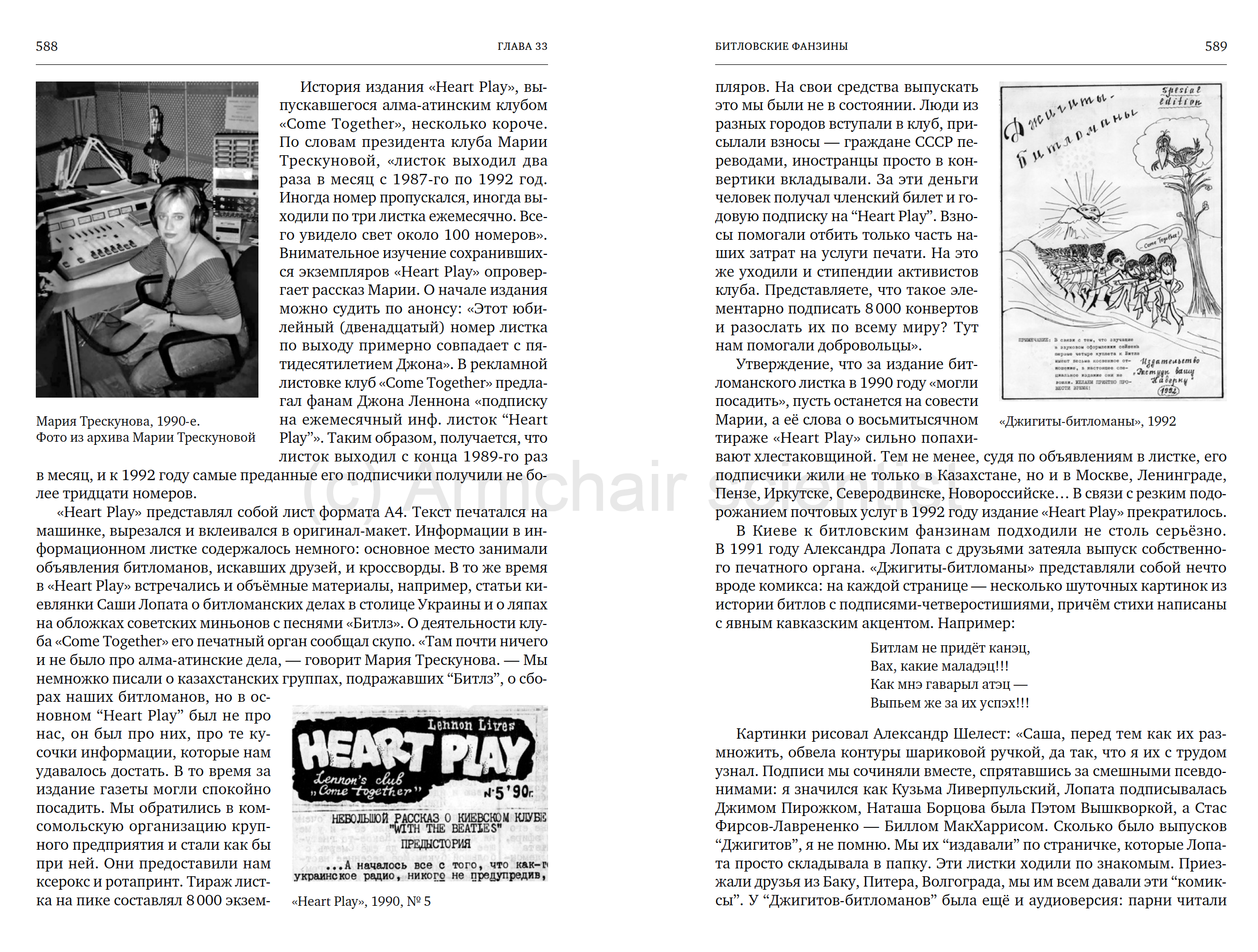
You should know that How We Loved the Beatles: The History of Beatlemania in the USSR is in Russian, and at 760 pages it is quite some undertaking. It contains many memoirs (funny and tragic) of both famous and very ordinary people. There are also many personal memories, and many, many photographs from fan archives. Almost every page has images or memorabilia related to the times. Here are just two random samples:

At the end of the book there is a short description in English. This is worth reading as its an excellent overview of the sort of information this book contains and what it is trying to achieve (click on image to see a larger version):

We mentioned how tough it was being a Beatle fan in the USSR. Here’s just one story from the book to help illustrate that – a story with a real twist in the tail:

In the early 1970s a young man buying Beatle records was detained at a flea market and taken to the local police station. There one of the police officers (police in the USSR were called militsiya) had an “educational conversation” with him (i.e. he gave him a slap on the wrist) saying that it was not good for a young builder of communism to listen to such enemy capitalist music. Later the young man happened to meet that same militsiya on the street. And the policeman asked: “If I give you a tape could you please record some Beatles music on it for me?”

Another very interesting section of How We Loved the Beatles: The History of Beatlemania in the USSR contains chapters about the Melodiya and Antrop companies which eventually released Beatle and solo records in the USSR – both officially, and not so officially.

The author spoke with former employees of Melodiya. They talk about how Beatle tracks finally came to appear on records in the 1970s, how Beatle and solo records were officially released in the 1980s, and where the sources for these releases came from.

The author also found Andrey Tropillo, the founder of Antrop Records, and in a long interview with him Tropillo tells how he created/launched the company, how and where he pressed vinyl, how they made alternative sleeves, and much more. And how, in the end, Antrop turned into Santa.

It’s not known whether the publisher will eventually translate the entire book into English. This, we’re told, is quite a challenge because there’s a lot of original Soviet youth slang which can’t be translated into other languages “in all its beauty”.

This love of all things Beatles endures. This young woman (whose name is Jane Enenko) is in the book. She hails from remote Siberia, and was invited on stage during a 2015 Paul McCartney tour:

We realise How We Loved the Beatles: The History of Beatlemania in the USSR is aimed at a very special market. The fact that it is written in Russian dictates that. But it is such a labour of love, and so comprehensive in it’s scope, we thought it very worthy of a mention here.

Russian-speaking fans of The Beatles living outside of Russia can buy the book from the German online store Esterum: Russian books worldwide, which is located in Frankfurt. It is also available from this online book store in the EU – in Riga, Latvia.

FYI here’s the rear cover. (Click on the link to see a larger version and to read the text – if you understand Russian!)

Very Rare US Beatle Single

A very rare Beatle single is going on show at Jack White’s Third Man Records in Nashville:

The record label posted on Instagram: “You can’t do that!” is probably what the Capitol Records pressing plant manager yelled at the rogue employee who created this unheard of (and unauthorized) yellow-and-black split color version of the Beatles’ 1964 single “Can’t Buy Me Love.” Likely pressed surreptitiously after hours, Third Man recently purchased this insanely rare record at auction. Expect to see this single on display soon at Third Man Records.

Maybe this is where they got the colour scheme idea for their very rare, limited production run (only 333 copies made) of Paul McCartney’s McCartney III LP?

And for their less rare McCartney III “Splatter” edition?

Want to visit Third Man Records?

McCartney’s ‘The Lyrics’ Wins British Book Award

Paul McCartney, no stranger to the odd prestigious award, has just won another.

His book The Lyrics:1956 to the Present has taken out the award for Best Non-Fiction Lifestyle book in the 2022 British Book Awards (otherwise known as The Nibbies):

Strangely Sir Paul’s acceptance speech (pre-recorded and played to the audience at the awards ceremony) could not be included in the YouTube clip.

Here’s some more info on the other books that were on the shortlist.

The judges wrote that The Lyrics was: “A work of art”; “a unique piece of publishing”; and a book that “belongs in a museum, not just our bookshelves.” They praised the two-volume set as a “fantastic visual diary”, singling out the original hand-written lyrics.

The book was supported by a free exhibition at the British Library and McCartney in Conversation at the Southbank Royal Festival Hall.

Publishers Allen Lane coordinated a global launch, simultaneously in 11 languages, attaining extensive broadsheet and radio coverage. Plus the book was released in multiple translations.

‘Live at the BBC’ – How a Fan Helped Make Beatle History

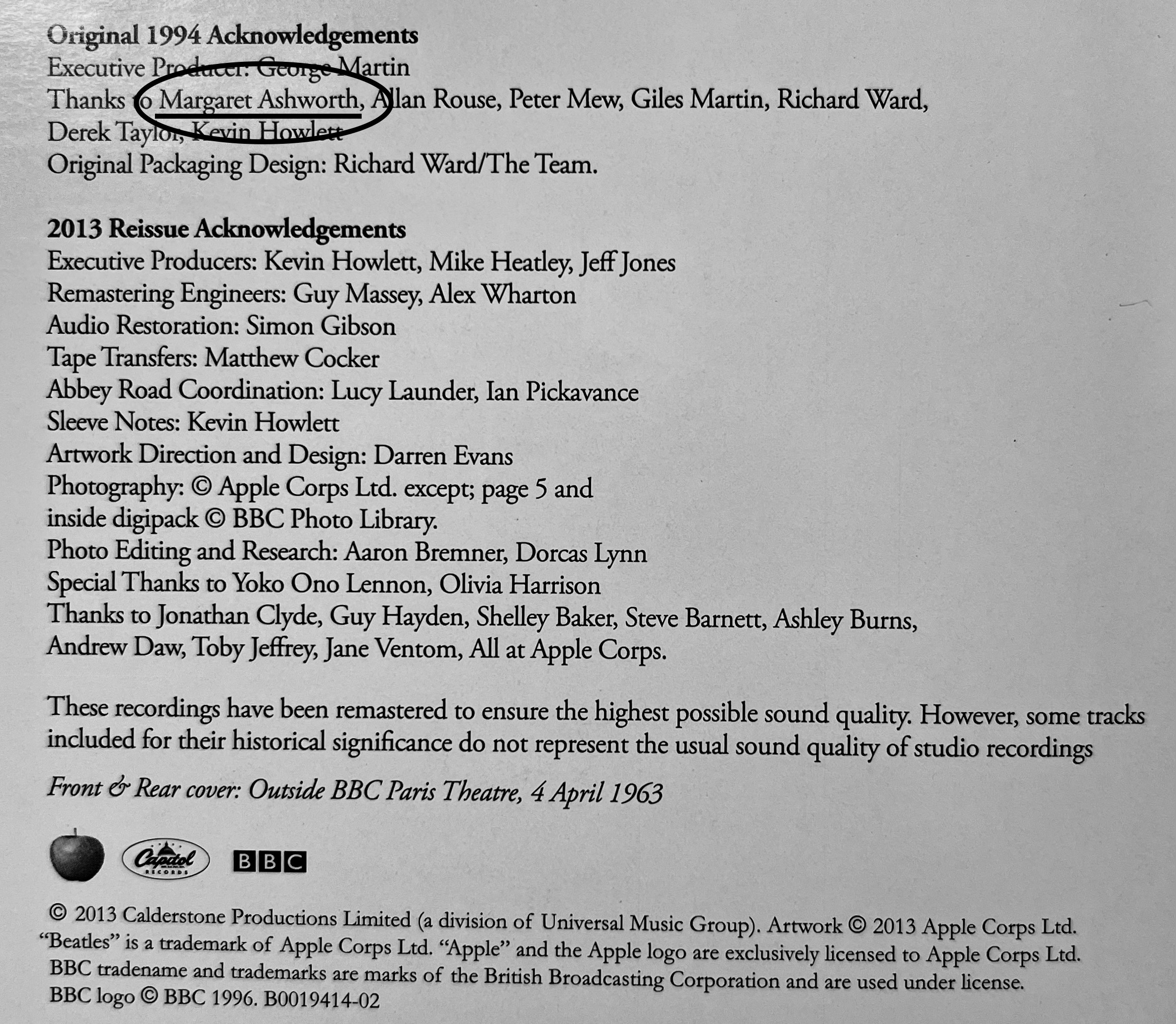
It’s reasonably well known in Beatle circles that when it came to compiling the 1994 album Live at the BBC (later re-issued in remastered form and accompanied by a second volume in 2013), Apple and EMI relied heavily on some previously unknown 1963 recordings made off the radio by a teenage fan named Margaret Ashworth.

Margaret was credited prominently in the liner notes of both. Here’s Volume 1:

And here are the credits for Volume 2:

Her name was there for all to see, and we knew she was the source of many songs and performances previously thought to be completely lost, or only available in very poor quality. But we didn’t really know the whole back story. She’s not even given a single mention in Kevin Howlett’s comprehensive book on the subject, The Beatles: the BBC Archives: 1962-1970.

Now, for the first time, Margaret Ashworth – a veteran journalist (now retired) who worked at the Daily Mail newspaper – has written extensively about just how she was able to come to the rescue of The Beatles and made a new release of their live radio performances possible.

Check out her Mail on Sunday article ‘How a besotted Beatles superfan who made amateur bedroom recordings of the band’s 1960s hits ended up with a personalised thank you on their hit BBC album three decades later‘, and also her personal music blog post on the subject ‘How I made a Beatles album (with a little help from my friends)‘. It covers similar ground but, goes into much more detail. They’re both great reads.

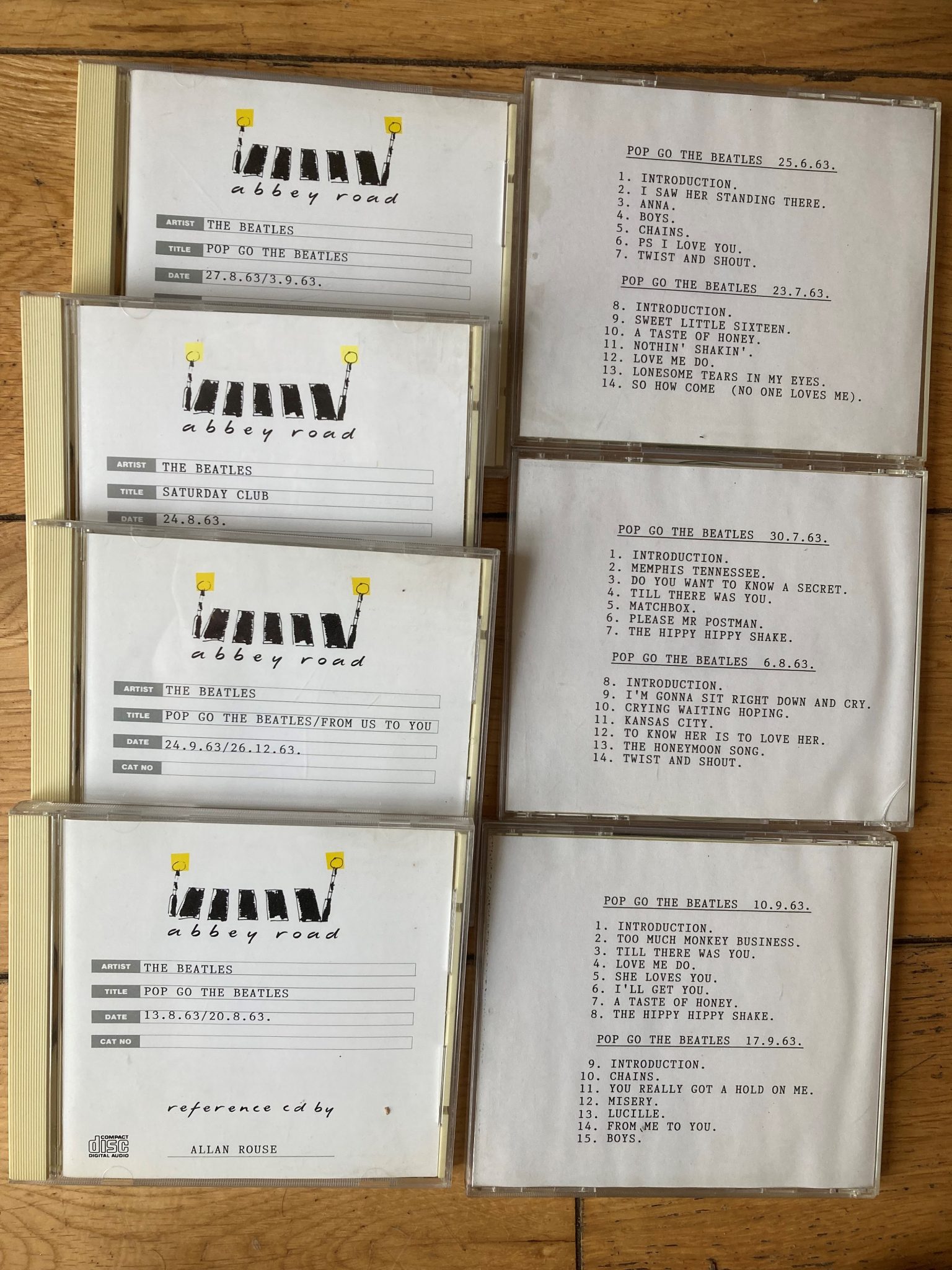
Realising that her homemade tapes were gold, the engineers at EMI immediately made seven sets of CDs of the full Pop Go The Beatles programs. They presented Margaret with one set:

When the album Live at the BBC was originally released in 1994, Margaret Ashworth says she could easily tell which of the tracks came from her tapes. Here’s one of them, ‘Ooh! My Soul’. It is the track the producers and engineers used to test the quality of her recordings when she first took them to the Abbey Road studios:

It’s so good to now have this story told in full, and by the Beatle fan who made it happen.

Beatles With Records – Part 30

It has really been quite some time since we’ve done a Beatles With Records post.

Our Beatles With Records series is exactly that: photographs of the band actually holding those things they sold so many of: records and CDs. These can be Beatle discs, or discs by other artists.

The posts prompted quite a few readers to send in additional photographs, and also to do some amazing detective work on the sometimes mysterious records the Beatles are holding in photos. Sometimes the albums are easy to guess. Then there are others where you can only see a fragment of a cover, or the rear image of a sleeve, making it very difficult to identify – especially when the record is by an unrelated artist.

One recent photo to come to light is definitely in that latter camp. It comes from the recently released book by Paul McCartney’s brother, Mike McCartney (a.k.a. Mike McGear).

His book, published by Genesis Publications, is called Mike McCartney’s Early Liverpool and it contains some never-before-seen early photos of The Beatles, including this gorgeous one of John and Paul (and most probably George too, on the left). It is called Mathew Street, 1962 and hey are no doubt standing outside the famous Cavern Club:

This one had us intrigued. Paul is clearly looking at some 45’s, and John has under his arm what at first appears to be an LP of some kind. Further investigation though reveals it not to be a record but a bag containing a record from Liverpool’s NEMS record store. NEMS of course was owned by the family of their manager, Brian Epstein.

Wouldn’t it be great to know which LP John had purchased? What it is will probably never be known….

A couple of other items of interest have surfaced.

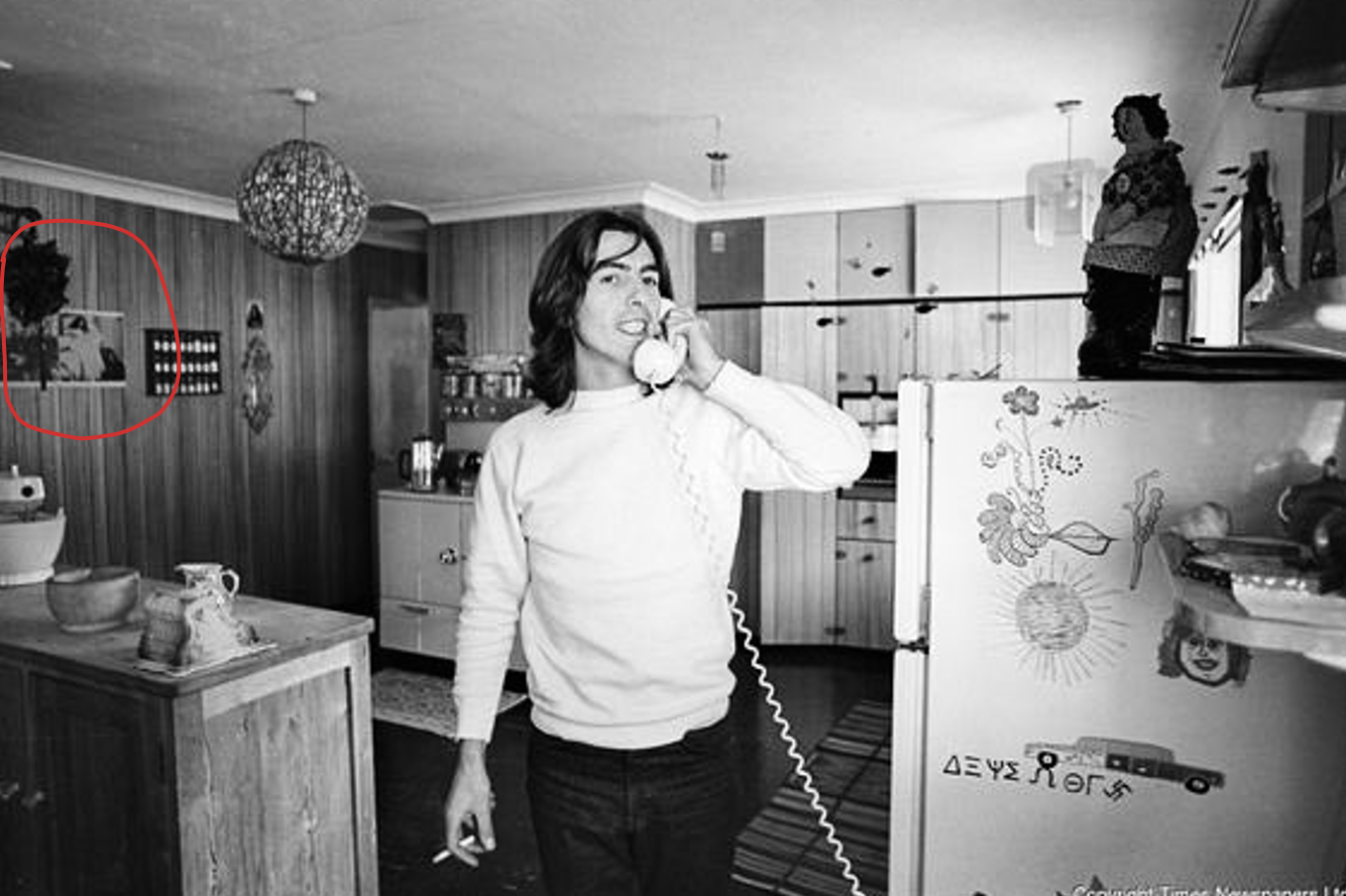
This one shows George Harrison in his kitchen at home at Kinfauns:

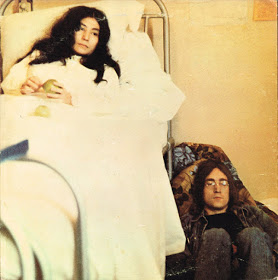
Quite interesting to see pinned up on the wall behind him a John Lennon/Yoko Ono album cover:

Here it is again, a different angle from the same photo shoot (click on image for a larger version):

It is Unfinished Music No.2: Life With The Lions, an experimental album on the Zapple label from 1969:

It appears to be an album slick opened out containing the rear cover image as well:

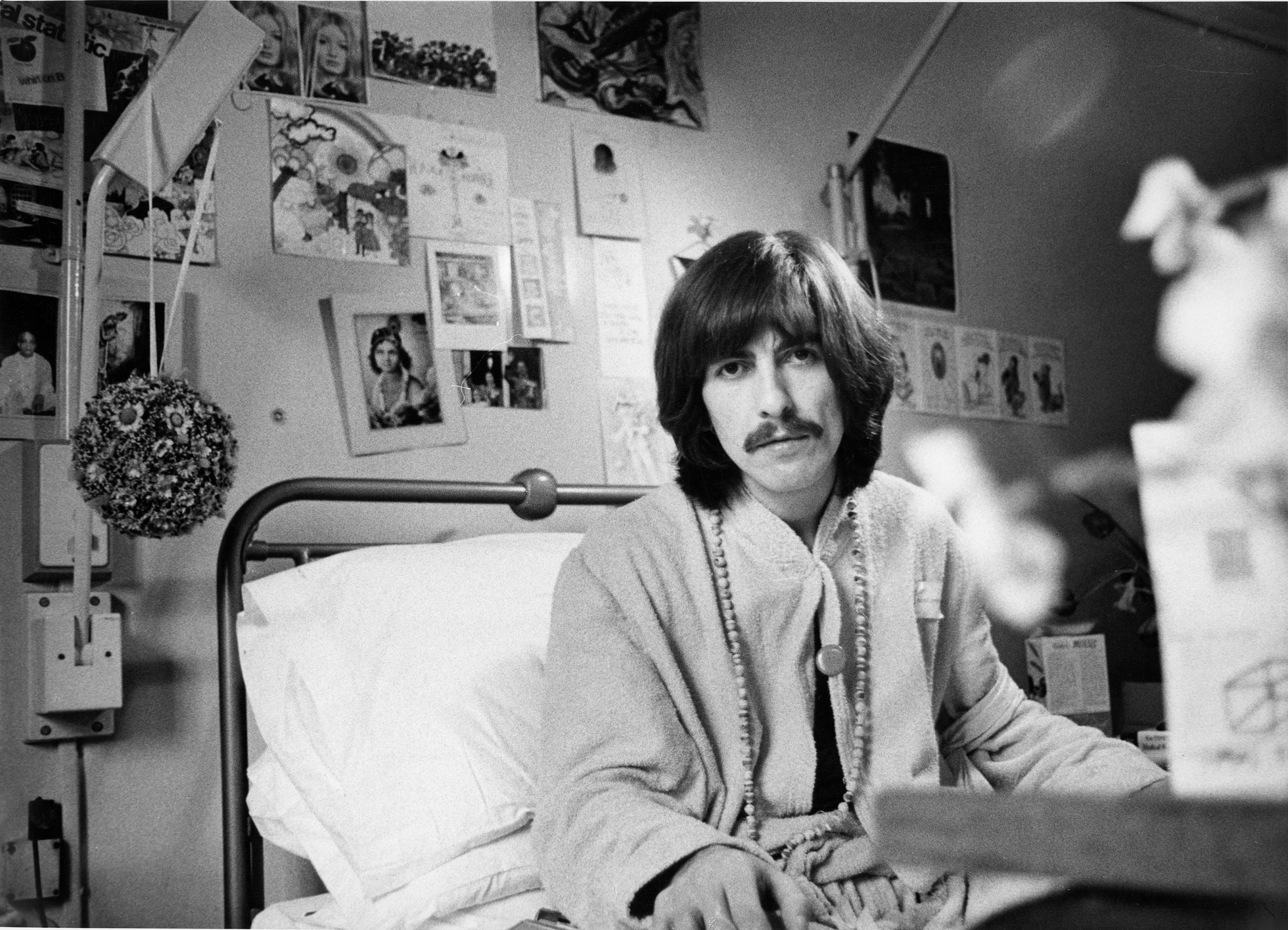
George seemed quite fond of putting up album covers, or elements of album covers, on his walls. If you look at the top left of this photo – taken in what seems to be a hospital ward – you can see two prints of the Linda Eastman photograph of Apple artist Mary Hopkin. That image was used for the front cover of the Hopkin LP Postcard:

(Turns out that George was at London’s University College Hospital, where he got his tonsils removed in February, 1969)

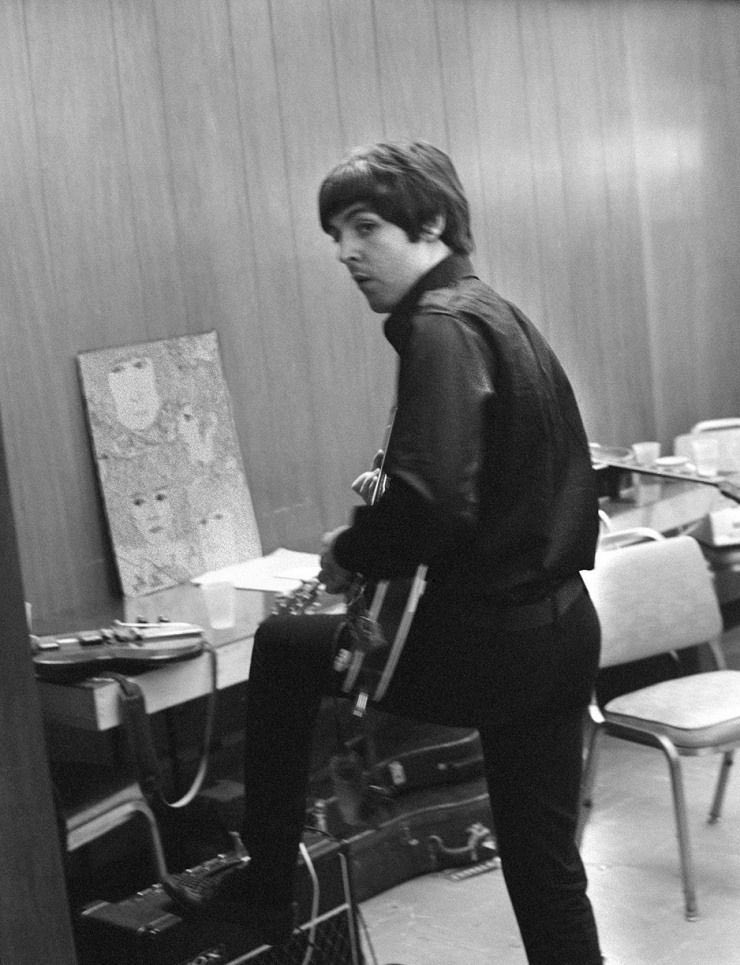
Here’s an image of Paul McCartney with what could be an early rendering of the Klaus Voormann cover for the Beatles Revolver LP. Either that or an attempt by a fan to replicate Voormann’s amazing artwork:

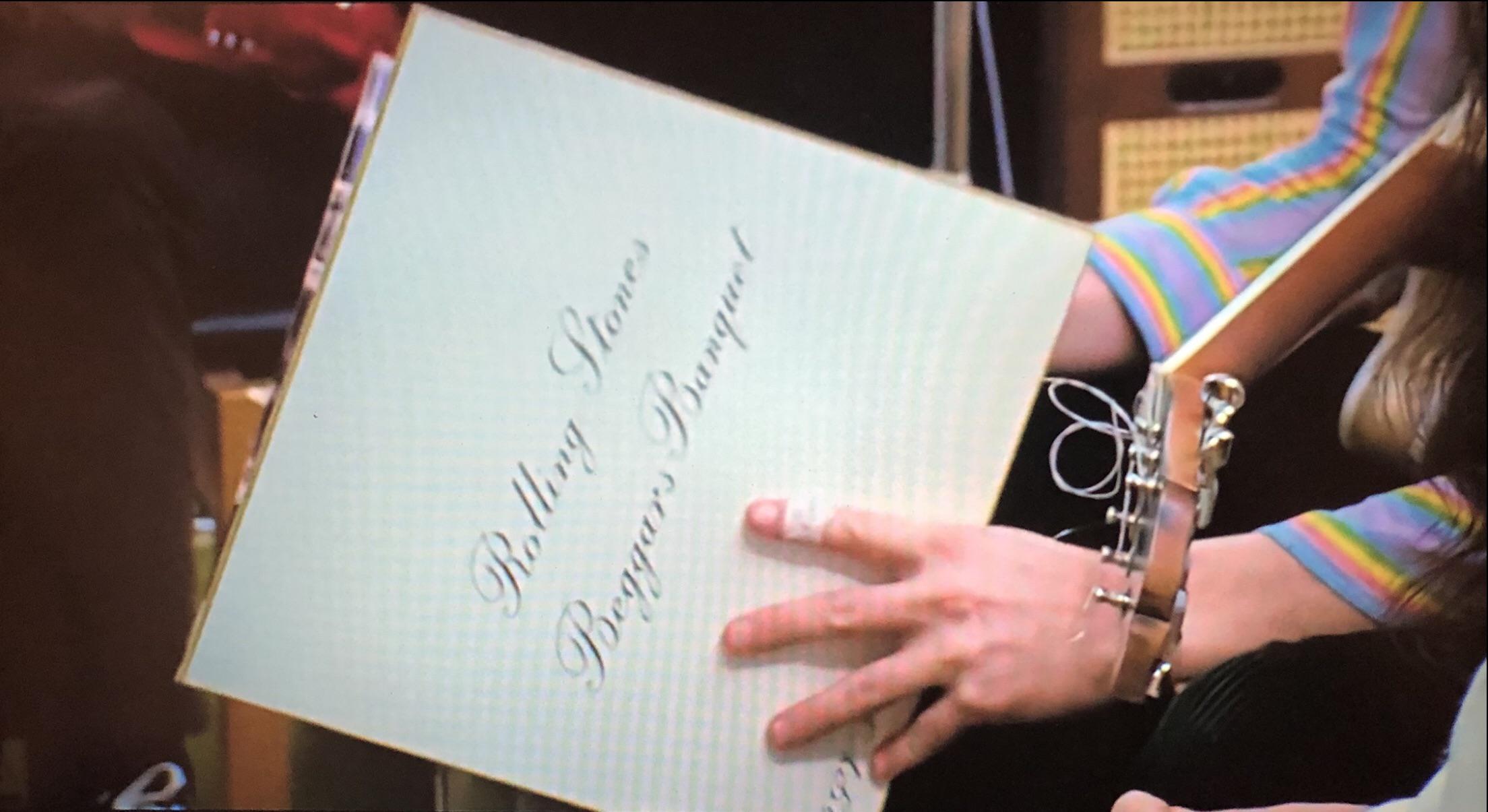
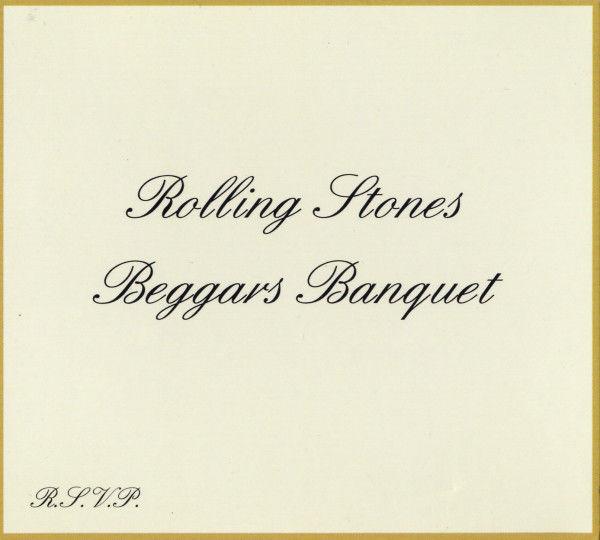
And finally, a still taken from the incredible Peter Jackson/Disney+ 3-part series Get Back on the making of the Let It Be album, this image of John Lennon taking a look at the latest Rolling Stones LP of the day:

See the other instalments of The Beatles With Records here.

Harrison Estate and Dark Horse Sign Further Publishing and Album Release Deals with BMG

You might recall that back in 2020 the mega music distributor and publisher BMG announced that it had formed a multi-faceted, worldwide distribution partnership with Dark Horse Records, the George Harrison-founded record label now led by his son, Dhani Harrison.

Well, there have been some developments.

Last week there was a rather intriguing press release from BMG announcing that they’ve now secured the publishing rights to the entire George Harrison song catalogue, including his Beatle, solo, and Traveling Wilbury compositions.

Plus the company has secured the rights to distribute some existing – and additional – interesting legacy artists on the the Dark Horse record label.

Here’s the official 2-page press release. We’ve highlighted those bits that grabbed our attention:

So, while there’ll be new publishing deals being done by BMG/Dark Horse for George Harrison’s compositions, it also looks like we can expect a range of interesting physical releases on the Dark Horse label.

These will include another EP from Billy Idol, and the new studio album from former Tom Petty and the Heartbreakers keyboardist Benmont Tench. There’s also likely to be a slew of back-catalogue re-issues from the great Leon Russell.

Interesting times indeed.

See also our articles on the six BMG/Dark Horse Records already released so far: Joe Strummer’s Assembly LP, Billy Idol’s The Roadside EP, the Billy Idol Happy Holidays Christmas album, Ravi Shankar’s Chants of India LP, and Joe Strummer’s two Record Store Day 12″ singles: ‘Junco Partner’ and ‘Johnny Appleseed’.

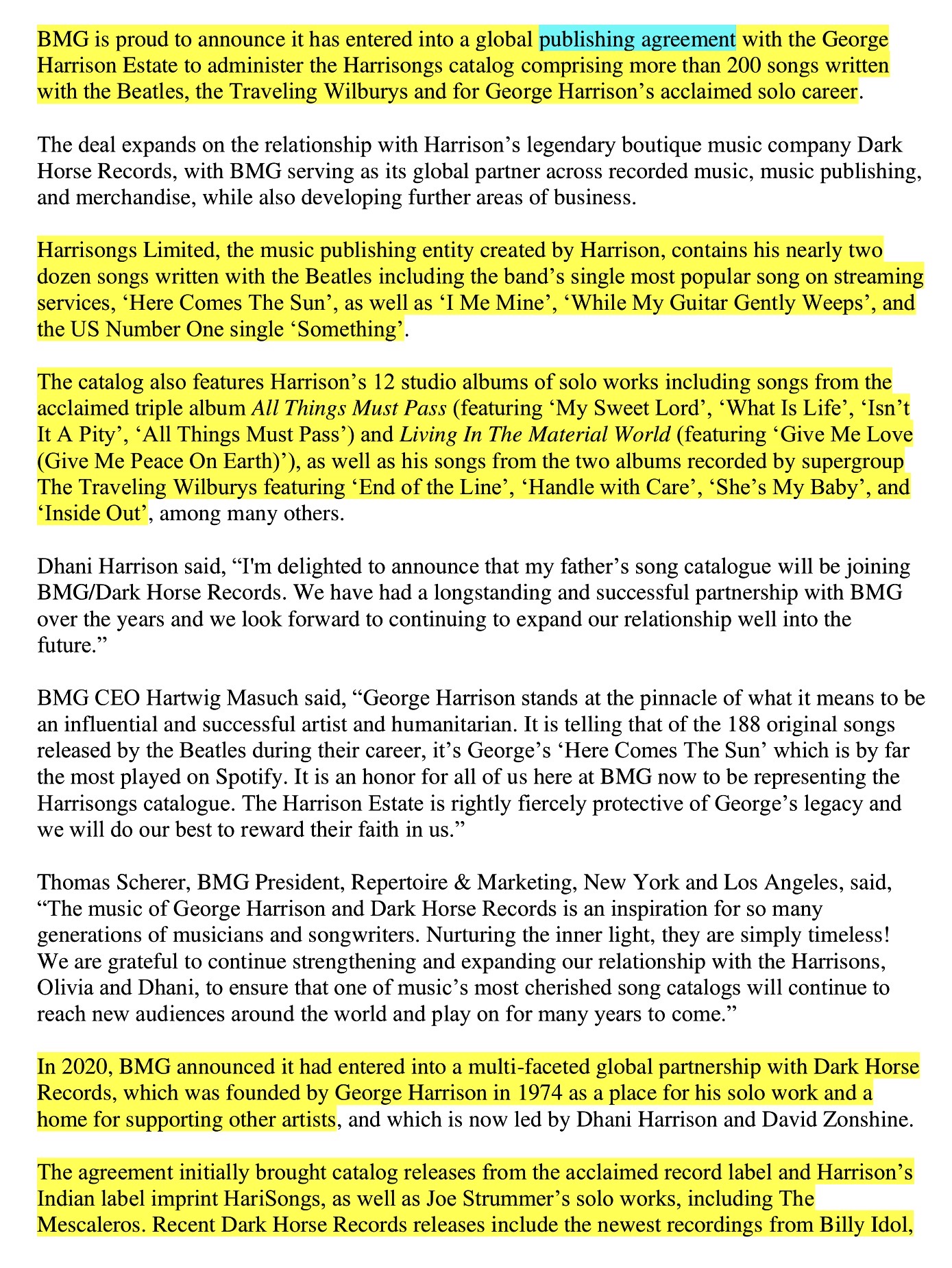
War Is Over! (If You Want It)

Thoughts and prayers are with the people of Ukraine at the moment.

Ringo’s New Book – ‘Lifted’

Ringo Starr has a new book out. It is called Lifted – Fab Images and Memories From My Life and Across the Universe.

Speaking about the book Ringo said: “I am not writing this book as a Beatle historian. I’m writing this book as a Beatle — and there’s only a couple of us who can do that.”

Asked about it’s origins, Starr explains: “I didn’t keep all these photos. These fantastic images came back to me in recent years from here, there and everywhere — online and off — and have somehow helped me get back to seeing my life with The Fab Four through fresh eyes. A lot of the photos in this book I spotted on my phone and on my computer and “lifted” them because they brought back so many fabulous memories.”

“So this a book full of Beatle images that many people haven’t seen and stories that I’m sharing with a little help from my longtime writer friend David Wild. We’ve all been through a pretty tough time for a lot of people who’ve been locked down, and this book has really lifted my spirits and took me back to where I once belonged in a whole new way. And in the end, that’s why this new book is called Lifted. The Beatles changed my life forever. So it’s about getting back and giving back.”

Lifted is only available online from the Julien’s Auction House site, and there are two editions to choose from.

The standard ‘Collectors Edition’ costs US$59.00. It is a handsome-looking coffee table style hardback. It seems to have a been popular seller as it’s already in a 2nd Edition print run on the Julien’s site.

There is also a ‘Signature Edition’ that costs US$495.00 and is limited to 1000 copies. The same ‘Collectors Edition’ book comes presented in a velvet outer bag and the book – each one signed and numbered by Ringo – is contained in a custom box.

Proceeds from the sale of Lifted will go to the charity The Lotus Foundation, which does good work across a range of worthy causes.

Ringo has been out and about promoting the book, especially on social media. Here’s a photo we lifted from Instagram:

If the name Julien’s Auctions sounds familiar, it is the company that managed the 2015 once-in-a-lifetime auction, curated by Ringo and his wife Barbara Bach, featuring thousands of items from their London estate, and their Beverly Hills and Monaco residences.

There were artworks, clothing and jewelry, furniture, memorabilia, musical instruments (including seven drum kits owned and played by Ringo), gold records, cars, and much, much more. There was even Ringo’s personal UK 1st mono pressing of The Beatles White Album, No: 0000001. It sold for US$790,000!

You can get an overview of what was on offer here. And the full list of all lots is here. They are fun to look through. Interestingly, a portion of the proceeds from this auction also went to The Lotus Foundation.

Tough Times Being a Beatle Fan in Soviet-era Russia

The topic of Beatles collecting and fandom in Soviet-era Russia has been explored on the web of late.

Andrey, a long-time friend of our page, alerted us to this comprehensive article recently posted (in Russian) on the beatlespress.com.ua site.

If you don’t read Cyrillic writing (and we don’t!), then Andrey has provided a link to a video in English on the very same topic:

Bottom line is that you had to be tough to be a Beatle fan in public in the late 1960’s/early 1970s. The Soviet secret service, the KGB, came down very hard on any young people who dared to say they “….loved Lennon more than Lenin”.

Their lives could – and were – turned upside down. Indeed, in the example cited where a group in the Ukraine turned out on the street to celebrate something as innocuous as Paul McCartney’s birthday, seven people were arrested and sentenced to 15 days jail for “disturbing public order”.

In addition, six were expelled from their university studies and from the Young Communist League – the latter almost certainly guaranteeing their failure in any future career. Younger high school students were forced to repeat whole years of study. There were ramifications also for their parents who were publicly humiliated in the Soviet media.

While we were pondering all this and how much we in the West take our freedoms for granted, we also stumbled upon this great video on a closely related subject. Its just been uploaded on the Parlogram Auctions YouTube Channel and is a study on how Beatle fans in the Soviet Union and behind the Iron Curtain listened to The Beatles – including the spooky “music on bones” records we’ve written about before.

Meet the British Bobby Who Ended The Beatles Last Show

This is timely, and a lovely recollection 52 years on.

Daniele Hamamdjian from Canada’s CTV News speaks to Ray Dagg.

He was one of the police officers sent into the Apple building – on Savile Row in London – to shut down The Beatles’ famous rooftop concert in 1969.