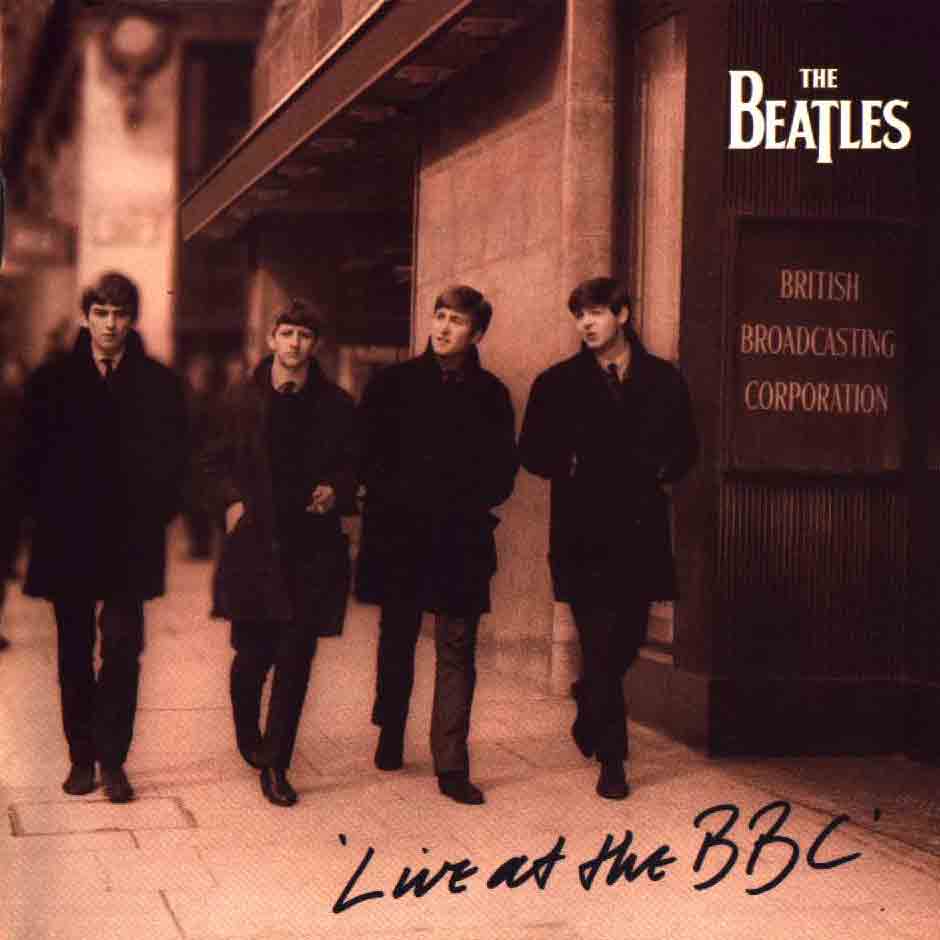
Three Copies of “Q” Magazine

I needed to visit Australia’s national capital Canberra for work the other day and ended up staying overnight. That meant driving back to Sydney on a Saturday morning and so I had time to call into the large-ish New South Wales country town of Goulburn, which is just off the freeway on the way home.

Goulburn, I had discovered on a previous trip, has a very large second-hand book and record shop just off the main street called The Argyle Book Emporium. When I say big I’m talking an extensive old rambling period building with room after room literally filled floor-to-ceiling with books. One room at the rear is devoted to music. There’s a small selection of music-related books and magazines, and boxes and boxes of records and CDs. Its a bit frustrating as these boxes are just randomly grouped together. They’re not split out into Male Vocal, Female Vocal or Groups for example. Not even 50s, 60s ,70s and 80’s. Just everything mixed in together – making finding anything of interest a needle-in-a-haystack affair….

I didn’t have a lot of time and so I gave the LPs just a cursory flip through. I looked at a couple of boxes at the front which were easy to get to and didn’t find anything. What was more interesting was a very large pile of “Q” and “Rolling Stone” magazines. A collector had obviously off-loaded a lot of past editions that were no longer wanted. The “Rolling Stone” magazines had been pretty well picked over. Nothing really of interest to the avid Beatles collector. However, in the “Q” magazine pile I found these three editions: 

This slideshow requires JavaScript.

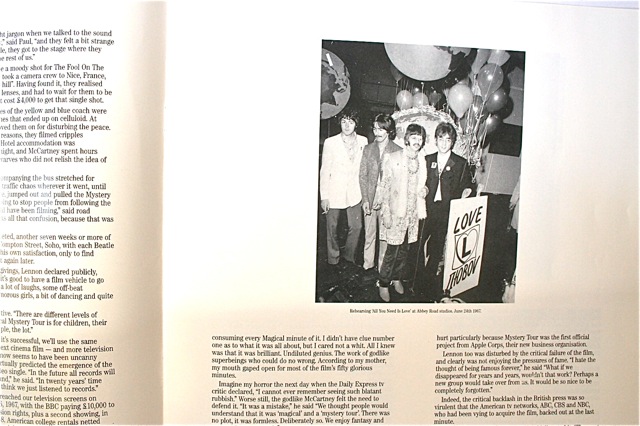
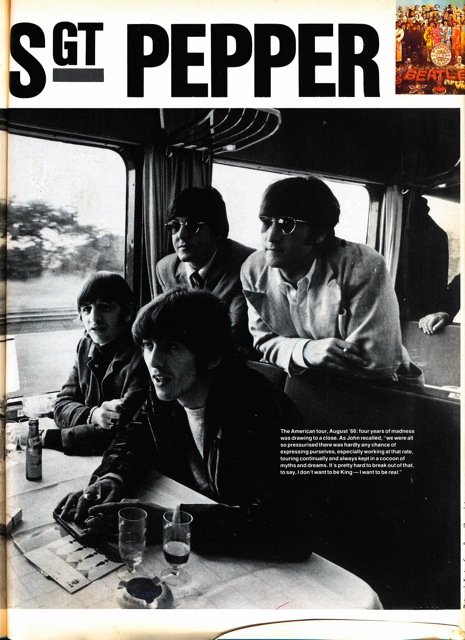
The first dates way back to June 1987 – a time when we were all celebrating the 20th Anniversary of “Sgt Peppers”. Inside there are ten pages of photos and text:

Sadly, there was a “Sgt Pepper Part II” article that was due to be published in the following month’s magazine. It wasn’t on the pile of mags I found in Goulburn….oh well.

The next “Q” magazine I found featured an extensive article about Paul McCartney from July 1989. The headline on the front cover screams: He sings! He plays! He writes his own songs! For  PAUL McCARTNEY OPPORTUNITY KNOCKS! * Now available for live work! *.  Inside there’s a nine-page article about Paul. It begins: “He never expected to be doing this when he was 46 – “We thought 25 was the end of the line” – but Paul McCartney has stoutly refused to give up his day job. Engaged in rustic rehearsals for his first British tour in 10 years, and with a fresh solo album on offer [“Flowers In The Dirt”], he’s preparing once again to be public property. With mixed feelings…”. In the article there’s reference to the number of times McCartney makes reference to his father, Jim McCartney….”a Liverpool cotton broker and part-time musician who brought Paul up after his mother’s death (when McCartney was 14), and who died himself in 1976. One song on McCartney’s new album “Flowers In The Dirt”, is called “Put It There”, after a favourite phrase of his Dad’s”.

Finally, the “Q” magazine with that awesome David Bailey portrait of Paul and John on the cover. It comes from August 1999. Its a pretty simple premise on the part of “Q”. As the century draws to a close why not run a reader poll asking who are the 100 greatest stars of the 20th Century. According to “Q” readers back then the top ten are (were):

10. Michael Stipe; 9. Liam Gallagher; 8. Noel Gallagher; 7.Madonna; 6. David Bowie; 5. Elvis Presley; 4. Bob Dylan; 3. Kurt Cobain; 2. Paul McCartney; and and number one the runaway winner (according to “Q” by a long way)…..John Lennon.

It is kind of fitting to look back and read a magazine like this (from 1999) in this year (2010) when Lennon would have turned 70, don’t you think? Kind of cements the fact that his presence could in fact be enduring. That now, a further eleven years down the track, his music is still around and he’s still held in very high regard by many. There’s an additional article right at the end of the poll headed: “John Would Have Been Proud”. It says: “Yoko Ono, the keeper of the Lennon flame and the Lennon vat of money, telephoned Q as soon as she heard about the readers’ tsunami-sixed endorsement of her late husband’s transcendental magic and generation-straddling stature….”. That article is illustrated with this beautiful photograph:

Enough said.

(see also “Nine Copies of Rolling Stone”)

Harrison/Shankar – “Collaborations” Announced

And so, the ever-growing list of forthcoming releases swells with yet another interesting title….

George Harrison’s Dark Horse Records has just announced a new box-set package called “Collaborations”. And yes, it too is coming in October.

From the official press release:

Dark Horse Records announced today the October 19th release of a limited edition deluxe box set, entitled “RAVI SHANKAR GEORGE HARRISON – COLLABORATIONS“. The release honors the sitar master’s 90th birthday.

“Collaborations” is a 3 CD and 1 DVD uniquely numbered limited edition box set. All compositions were composed by Ravi Shankar and produced by George Harrison over a period of 20 years.

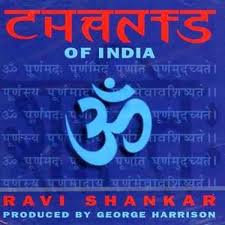
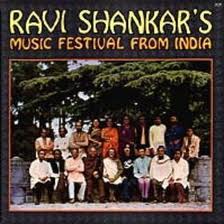
The DVD is a rare concert performance of the Ravi Shankar’s “Music Festival From India”, recorded at London’s Royal Albert Hall in 1974. The albums include the acclaimed “Chants Of India” (1997), “The Ravi Shankar Music Festival From India” (studio version 1976), and “Shankar Family & Friends” (1974). The 56-page book includes a foreword by Philip Glass, a history of George and Ravi “in their own words”, and rare photographs from both family archives.

"Chants of India" - original cover (1997)

"Music Festival from India" - original cover (1976)

"Shankar Family and Friends" - original cover (1974)

The official website has the full press release. Steve Marinucci has details in his Examiner column, and Wog Blog also has information on his site.

I could be wrong, but I think this is the first time that “The Ravi Shankar Music Festival From India” and “Shankar Family & Friends” have been issued on CD.

Speaking of Ravi Shankar, the master sitar player (who had such an influence on George Harrison and the Beatles) has embarked on a huge archival project of his own – with a series of discs being released on his East Meets West label.

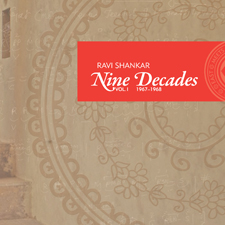
The first in the series is a single disc CD titled “Nine Decades, Vol. 1: 1967-1968”:

"Nine Decades" - out now

The next release in the series will be the soundtrack to the movie “Raga” – which was originally issued on Apple Records in 1971 and features George Harrison. Details about the release schedule so far is here, and it looks like the “Raga” release will be a CD and DVD double which is good.

"Raga" - original cover (1971)

“Raga” is due in the “American fall” – which is a bit vague but I guess that could mean yet another October release?

October is going to be one very expensive month for us die-hard, complete-ist collectors. We’ll have to put out hands in pockets for the 70th birthdate Lennon “Gimme Some Truth” material; the remastered Apple Records catalogue; the Shankar/Harrison “Collaborations”, and “Raga” now as well. That’s not to mention “Band on the Run”, the first of the Paul McCartney re-issues on Concord Records that is due sometime in August…..

Apple Records – Re-releases Announced

I’ve been away traveling for a while without ready access to a computer and so have missed updating the blog with a significant announcement by Apple about some forthcoming non-Beatles re-releases. So, in case you missed it, here’s a catch-up post.

I’ve been buying records on the Apple label since I was a teenager. They were all Beatles releases of course as at the time that was the extent of my interest and my knowledge of the Beatles record label’s activities. It wasn’t until about fifteen years ago that I realised that alongside their Beatles releases the record label also issued a wealth of other artists, and so I began trying to catch up on these and started to collect the entire Apple catalogue in earnest. I’m still engaged in that quest. There are a lot of original records out there still to track down…..

As one fellow blogger put it “…part of what makes Apple so fun to collect is that the label’s artist roster in the late 60s and early 70s was so varied. Apple covered everything, from the Modern Jazz Quartet, to the folk of Mary Hopkin, to the avant-garde orchestration of John Tavener. The label also released a handful of film soundtracks, and launched the careers of some pretty high-profile artists such as James Taylor and Badfinger.”

Well, when I got back from my travels the other day I found this emailed press release (dated July 6) from Apple Corps Ltd in my inbox:

Badfinger, Billy Preston, Mary Hopkin, James Taylor, and more. Apple Records catalogue remastered and reissued on CD and digital download – Classics Set For Release on October 26th

Launched by The Beatles in 1968, as the new outlet for their own recordings as well as the music of an eclectic roster of artists – James Taylor, Badfinger, Billy Preston, Mary Hopkin, Doris Troy, and Jackie Lomax among them – who were all personally brought to the label by The Beatles (individually and/or collectively), Apple Records made popular music history from the very moment it opened its doors.

Four decades later, Apple Corps Ltd. and EMI Music raise the curtain on remastered CD and digital download releases of 15 key albums from the Apple Records catalog. All 15 titles will be released on October 26th. Most of the physical CDs will include bonus material. Together, the 15 albums represent the first ever Apple Records releases to be available via digital download.

In the revolutionary spirit of 1968, The Beatles’ explosive musical output (characterised by their double-LP White Album) was only exceeded by their fascination with what they saw and heard going on around them. Five years into The Beatles’ reign, Apple Records afforded them the unique opportunity to sign new (and established) artists who appealed to each of them. In turn, the introduction of an artist on The Beatles’ record label was an imprimatur taken very seriously by fans across the universe.

Apple Records’ utopian artist-orientated mission immediately set it apart, as the first operation of its kind in the major-label sphere. Diversity was celebrated, and artists were encouraged to record and release their music in a friendly creative environment. Apple developed a distinctive graphic aesthetic, from its legendary ‘apple-core’ logo to its advertising and merchandising, in the process setting a subtle new benchmark for the industry to follow.

From 1968 to 1973, Apple Records bedazzled the world with a rainbow spectrum of releases – and fans were unusually well-informed about individual involvements of The Beatles with nearly every project. 1968’s self-titled debut album by Boston-based singer-songwriter James Taylor, for example, features Paul McCartney and George Harrison on “Carolina In My Mind”. Paul was instrumental in bringing the Welsh chanteuse Mary Hopkin to Apple, and produced her debut single, “Those Were The Days”. Badfinger, also from Wales, was still known as The Iveys when they recorded “Come And Get It”, written and produced by Paul (for The Magic Christian movie soundtrack).

The Beatles had been fans of Billy Preston ever since seeing him in Little Richard’s band in Hamburg in 1962. George went on to produce and play on Preston’s Apple debut, That’s the Way God Planned It. Harrison was one of the producers and played (along with Ringo Starr) on Doris Troy’s self-titled Apple album. George also produced and played (with Paul and Ringo) on Jackie Lomax’s debut album, Is This What You Want? featuring the Harrison composition, “Sour Milk Sea”.

John was much taken with the music of The Modern Jazz Quartet, who released the only two jazz albums in the Apple catalogue. Ringo was intrigued by the music of contemporary British classical composer John Tavener, and his Apple album, The Whale has become one of the most sought-after Apple collectibles of all time.

Each of the 15 albums in this bumper batch of Apple Records releases has been digitally remastered at EMI’s Abbey Road Studios in London by the same dedicated team of engineers behind The Beatles’ recent remastered catalogue releases of 2009.

For details about the release, visit www.applerecords.com

Many Thanks

thebeatles.com

The releases (15 titles in all) are:

  • James Taylor (1968) by James Taylor
  • Magic Christian Music (1970) by Badfinger
  • No Dice (1970) by Badfinger
  • Straight Up (1972) by Badfinger
  • Ass (1974) by Badfinger
  • Post Card (1969) by Mary Hopkin
  • Earth Song, Ocean Song (1971) by Mary Hopkin
  • That’s The Way God Planned It (1969) by Billy Preston
  • Encouraging  Words (1970) by Billy Preston
  • Doris Troy (1970) by Doris Troy
  • Is This What You Want? (1968) by Jackie Lomax
  • Under The Jasmine Tree (1968), and Space (1969) by the Modern Jazz Quartet (a 2-on-1 CD)
  • The Whale (1970), and Celtic Requiem (1971) by John Tavener (a 2-on-1 CD)

It has to be said that this is not the first time these titles have been re-issued by Apple. There was another major campaign between 1991-1993 when they were all released for the first time on CD. That campaign also saw them released as vinyl LPs, complete with the original artwork and lots of bonus tracks, additional photographs, etc….So, for many collectors it will be a case of having to decide whether or not to get these 2010 releases a second time. What’s new is that they have all been freshly re-mastered by the engineering team at Abbey Road (who did the recent Beatles re-masters), and that they’re to be available as digital downloads for the first time making these re-issues the first Apple product ever available in that form. Can an announcement about the Beatles catalogue being digitally down-loadable be far behind?

To mark that 1991-1993 release campaign Apple Records released this special apple-shaped extended play CD.

Nine Copies of Rolling Stone Magazine

Up on the very top shelf of a closet in my study there’s a large pile of old music magazines – mostly Rolling Stone magazine. They’ve been there, oh, for at least 16 or 17 years. Sitting quietly, gathering dust.

About a week ago it suddenly occurred to me that there could probably be some Beatles-related treasure hidden away in there.

Really don’t know why I’d never thought of this before. And so I got them down from the shelf this weekend and had a browse. This post, in chronological order, is about what I found.

(July 1979) Issue 295 Paul McCartney by Paul Gambacini

These are all the Australian editions of Rolling Stone, and back in 1979 it was still very much like a newspaper in appearance. No staples to hold it together and printed on flat, newsprint style paper. The cover story about Paul (above) is by veteran DJ, writer and rock historian Paul Gambacini. The cover portrait of Paul McCartney is by Julian Allen, June, 1979. Gambacini’s  byline says: “The leader of Wings looks back at yesterday”, and he writes: “I have known Paul McCartney for over five years, since just before the release of ‘Band on the Run’…Not surprisingly, McCartney at that time was desperate to avoid talking about the Beatles, especially about the never-ending reunion rumors…In the years since, Paul has let down his defenses. Anecdotes about the Beatles now flow, in addition to reminiscences of the pre-Beatles days. He seems pleased with his past. This is a product of being happy with his present.” The article coincided with the release of Wings “Back to the Egg”.
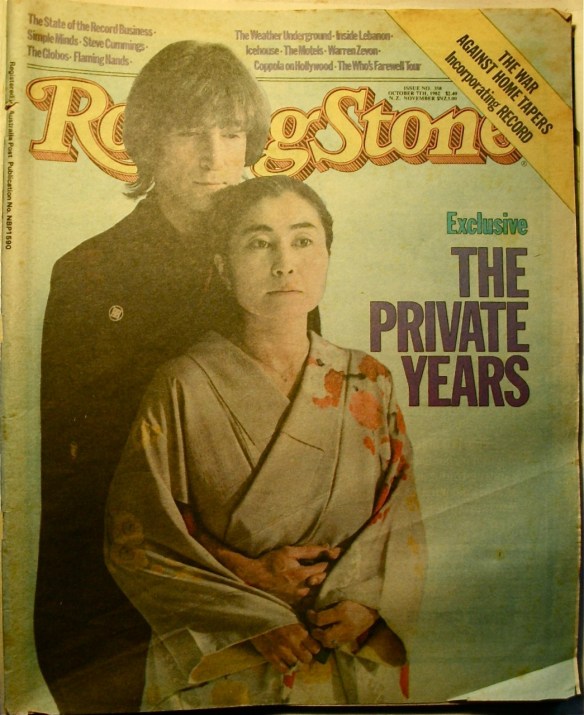
(October 1982) Issue 358 Exclusive: The Private Years

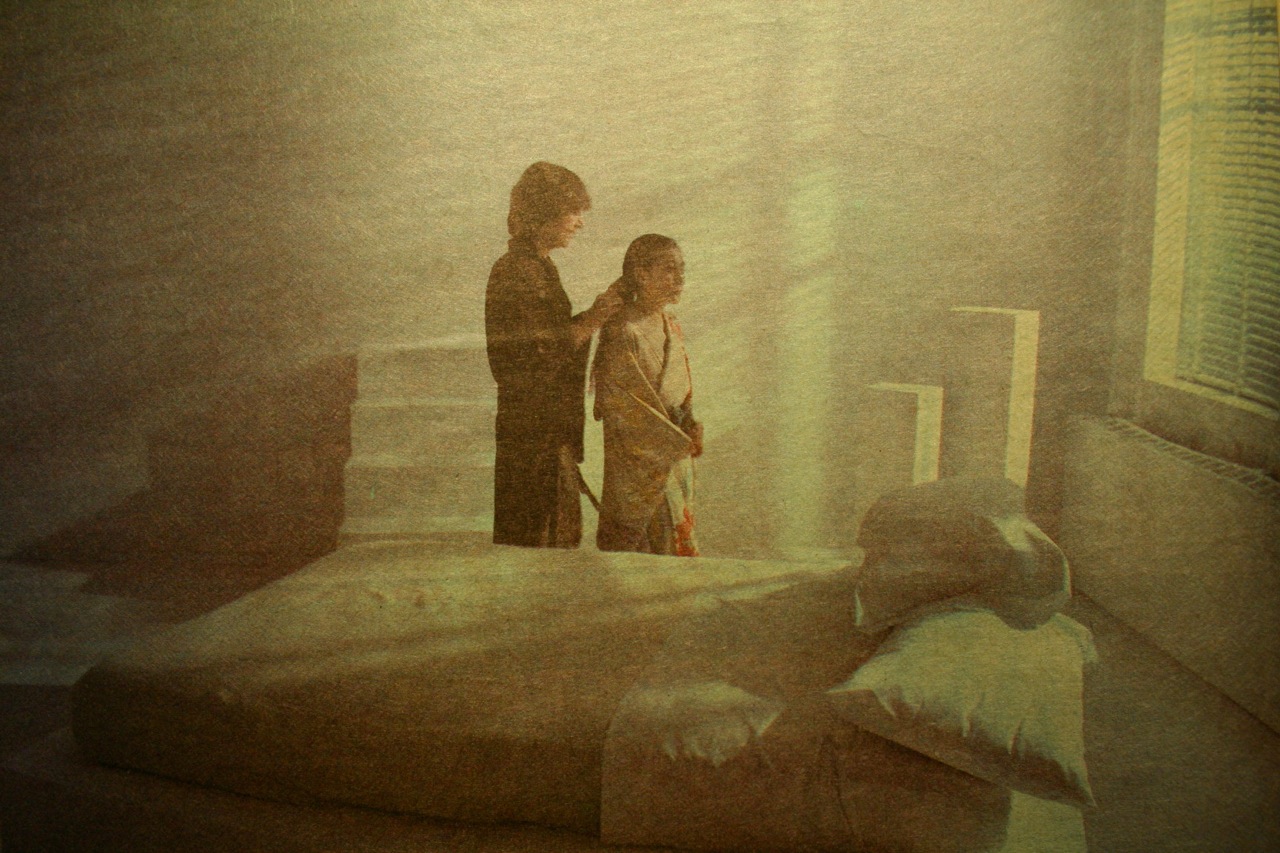
Of course John and Yoko frequently made the cover of Rolling Stone, and there have been some striking images of them published. Who could forget the most famous Annie Leibovitz shot of the pair? But this one comes a close second I reckon. Its by Allan Tannenbaum and it is a beautiful contemplative study that perfectly accompanies an article by Chet Flippo (which was an extract from the book “The Ballad of John and Yoko”, first published by Rolling Stone Press in October, 1982) detailing the years from 1975 to 1980 when John Lennon dropped out of rock & roll, retreating to his white bedroom in the Dakota building in New York. Inside, the article is accompanied by another touchingly composed Tannenbaum photograph:

John and Yoko, New York City, November 1980 (Tannenbaum)

See more Allan Tannenbaum photographs from the same session here.

In November, 1987 Rolling Stone celebrated twenty years on newsstands with a 20th Anniversary Special Edition. In it they re-published a selection of Letters to the Editor from across the 20 years. This one, from 1974, is telling: “John Lennon has given more to America that Nixon and Ford….He fought for peace a long time before it came to the attention of the government that “the people of America” wanted peace. Lennon was concerned about America, and now they’re deporting him. Nixon has admitted he’s a crook; why don’t we deport him?” – Lynn Grubbs, Malvern, Arkansas. And then this, from 1981, sadly again about John Lennon: “We’ve come a long way in seventeen years, from shooting presidents to murdering musicians.” – Jon Grabill, Wayland, Massachusetts…..this was the cover of that special edition:
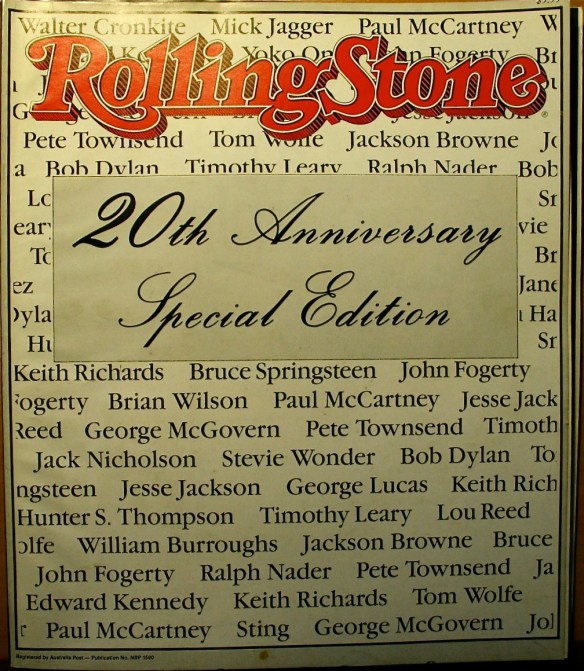
(November 1987) 20th Anniversary Special Edition.

The special edition was comprised of a series of previously-published Rolling Stone articles. There’s one on Paul McCartney by Anthony DeCurtis, and one on Yoko Ono by David Fricke. There are some image galleries as well from across the twenty years, but they only include one photograph of John Lennon.
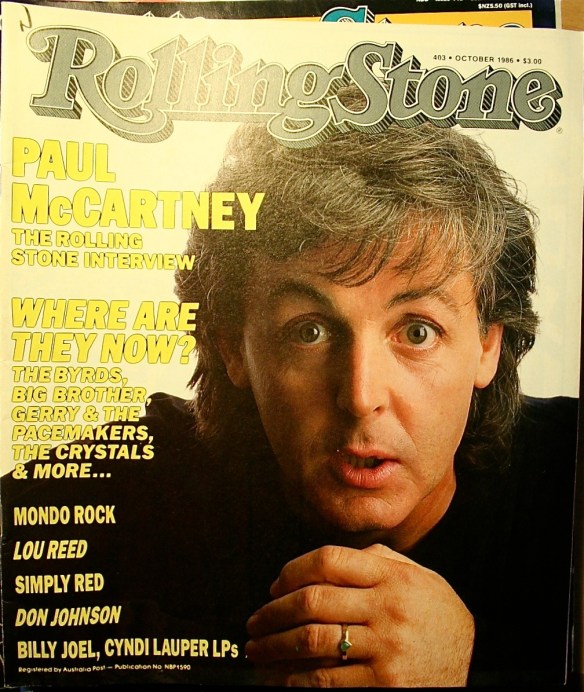
(October 1986) Issue 403 Paul McCartney - The Rolling Stone Interview

October, 1986 saw another Paul McCartney cover shot (above) – with very grey hair and an interesting heart-shaped ring on Paul’s wedding finger…? The Rolling Stone interview was by Kurt Loder, who begins: “It is Monday in London, two days before the royal wedding, and Soho Square is filled with flowers, sunshine and fresh-faced young tourists. Some loll on the grass, sharing joints. Others peer up expectantly at the etched-glass windows of an art-deco-style town house across the street, where, in an airy third floor office, Paul McCartney presides over the bustling affairs of MPL Communications, the company that manages the professional projects of the singer and his wife, Linda.”
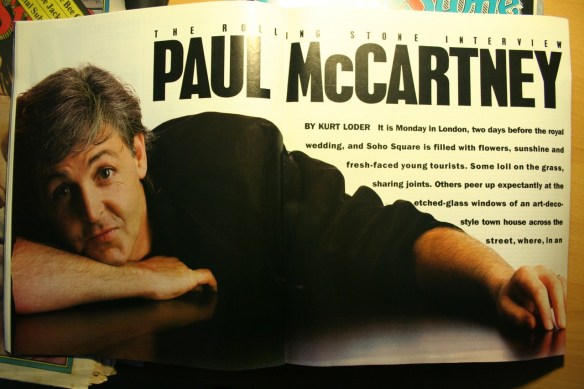
Inside Rolling Stone, Issue 403

The McCartney’s were doing publicity for “Press To Play”, the fifteenth album he’d released since he announced the breakup of the Beatles in 1970…..Loder observed “After eight years of largely lackadaisical releases on Columbia, he is back with Capitol – the Beatles’ old label – and he seems serious about rehabilitating his somewhat tattered artistic reputation.”

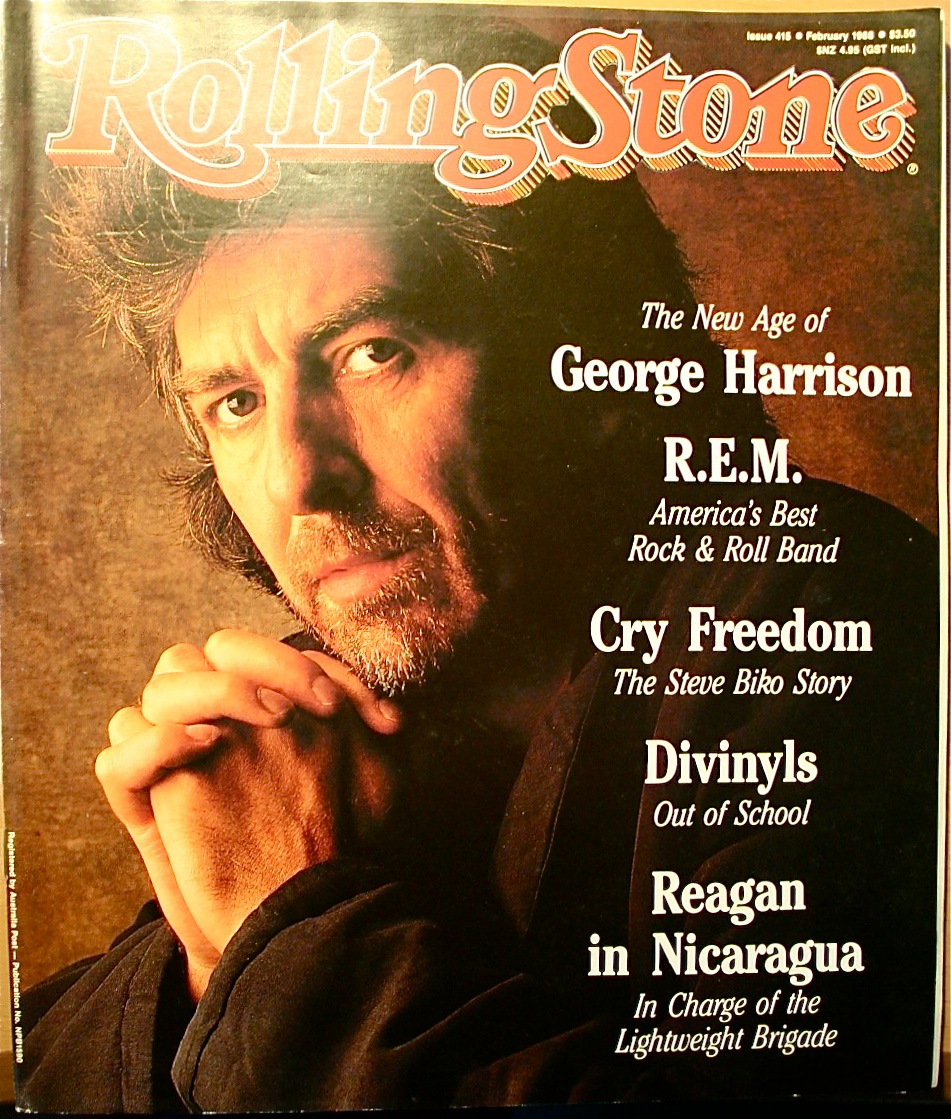
(February 1988) Issue 415 The New Age of George Harrison

In 1988 George had a new record to push. “Cloud Nine”, his first record in five years, had just been delivered to Warner Brothers Records. The article, by Anthony DeCurtis, is a really good read about George, the production of the album (with ELO’s Jeff Lynne), his past, and where he was at in 1988. “After years of tending his garden, his movie company and his son, the elusive ex-Beatle has reemerged with a great album”.

The front page of Issue 424 has an image of John Lennon and the words “Lennon – A Special Photo Album and the inside story on Goldman’s book”:

(November 1988) Issue 424 Lennon - A Special Photo Album and the inside story on Goldman's book

Inside is a revealing article by David Fricke and Jeffrey Ressner called “Imaginary Lennon – The True Story Behind Albert Goldman’s Character Assassination of John Lennon”. That title pretty much says it all… Albert Goldman’s controversial book “The Lives of John Lennon” had just been released, and his publishers claimed it to be “…a startling and revolutionary portrait”. Fricke and Ressner write however that it is not “the definitive biography”. “In fact,” they say, “the book is riddled with factual inaccuracies, embroidered accounts of true events that border on fiction and suspect information provided by tainted sources.” The magazine devotes five and a half pages to taking apart Goldman’s work. The article is worth digging out if you can. As if to balance that, Issue 424 also has six pages of candid Lennon photographs from another book (“Imagine: John Lennon” by Andrew Solt and John Egan). Here’s a terrific, early shot of Lennon, Paul McCartney, drummer Pete Best and George Harrison – taken by Paul’s brother, Mike McCartney:

Early Beatles (Mike McCartney)

Issue 443, in April 1990 also contained a wealth of rare early photographs, though it was the B52’s who made it onto the front cover. You have to look pretty closely for the Beatles reference:
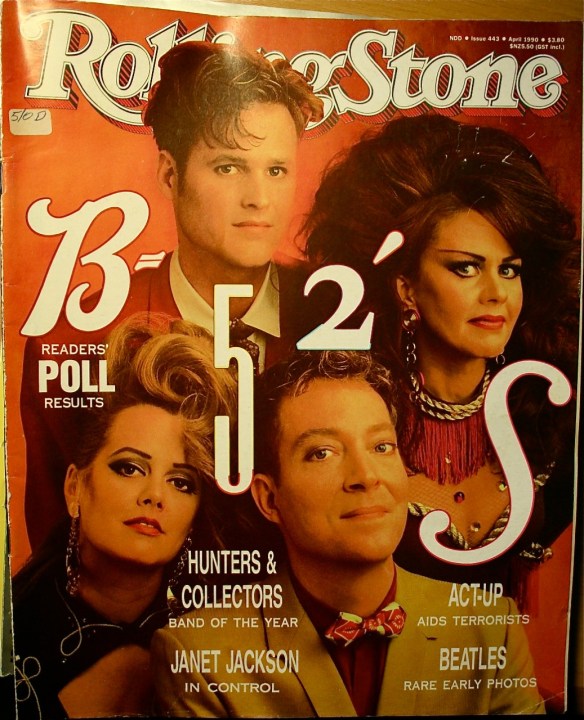
(April 1990) Issue 443 The Beatles Rare Early Photos

This contains never-before-published photographs that chronicle the Fab Four’s first American tour in 1964. They are all taken by Curt Gunther, and I think you’ll agree they are impressive. I’d never seen these before and will certainly be seeking out the book they come from. Here are just a few from the Rolling Stone eight page spread:

Fans from Harrisburg, Pennsylvania at Indianapolis airport (Curt Gunther)
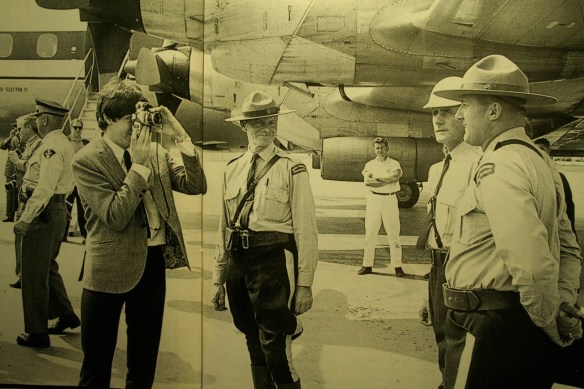
Paul photographs Canadian Mounties at Malton Airfield, Toronto (Curt Gunther)
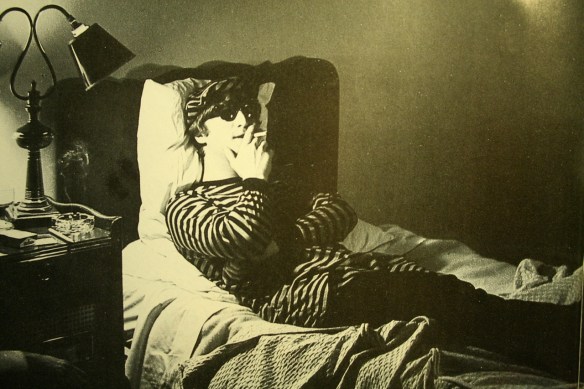
Lennon in bed, King Edward Hotel, Toronto (Curt Gunther)

All the photos above were reproduced in Rolling Stone, but come from the book “Beatles ’64: A Hard Day’s Night in America” released in 1989. Photographs by Curt Gunther, text by A.J.S.Rayl.  There are also some fantastic Gunther images here from the Genesis Books publication “Mania Days: The Beatles 1964 US Tour”

October, 1990 saw Rolling Stone release another special issue. This time it was The Sixties – The Age of the Beatles. And it was an excuse for a psychedelic-look, Beatles-inspired cover:
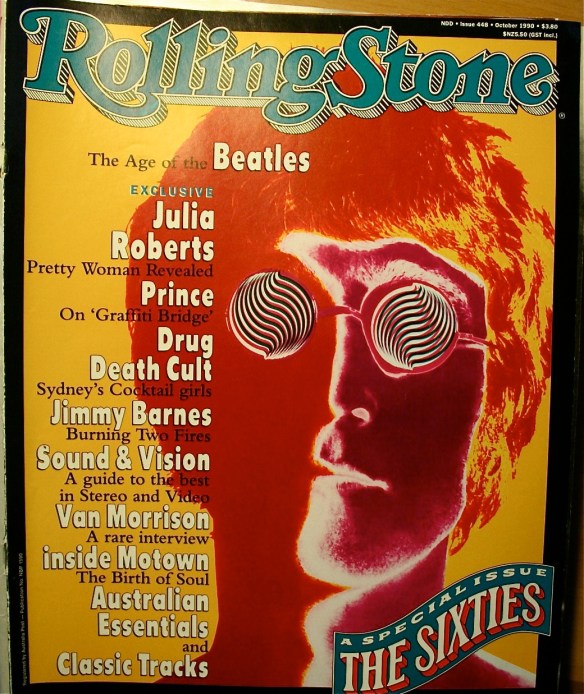
(October 1990) Issue 448 A Special Issue: The Sixties - The Age of the Beatles

Mikal Gilmore in his feature article “The Sixties” spends a lot of time on the Beatles and their impact throughout that turbulent decade: “In short, the Beatles were a rupture – they changed modern history, and no less craftsman than Bob Dylan understood the meaning of their advent. ‘They were doing things nobody else was doing. But I just kept it to myself that I really dug them. Everybody else thought they were just for the teenyboppers, that they were gonna pass right away. But it was obvious that they had staying power. I knew they were pointing the direction that music had to go….'”.

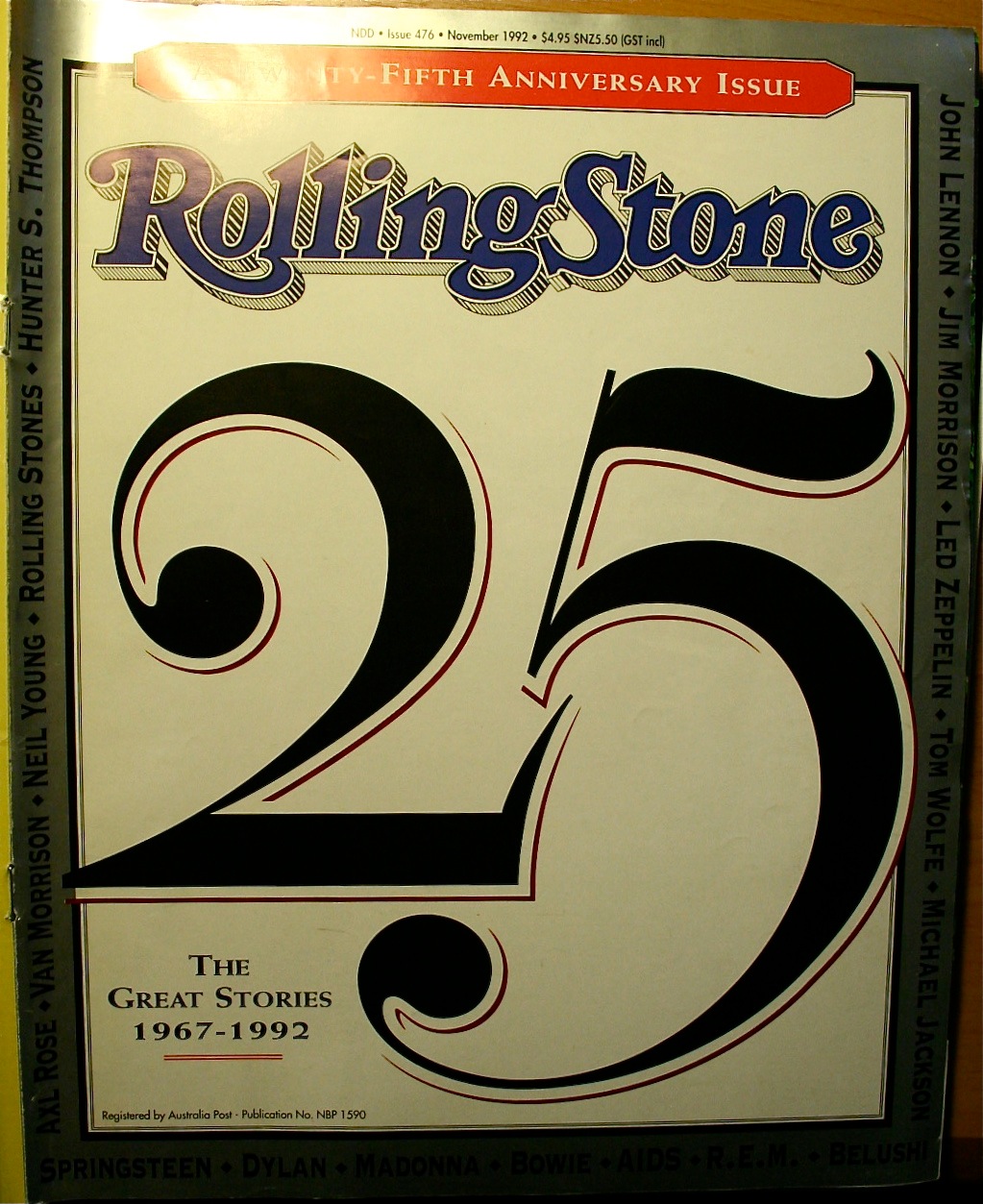
The final magazine to pop out of the large pile was from November, 1992, issue 476, a 25th Anniversary Special Edition, subtitled “The Great Stories 1967-1992”.
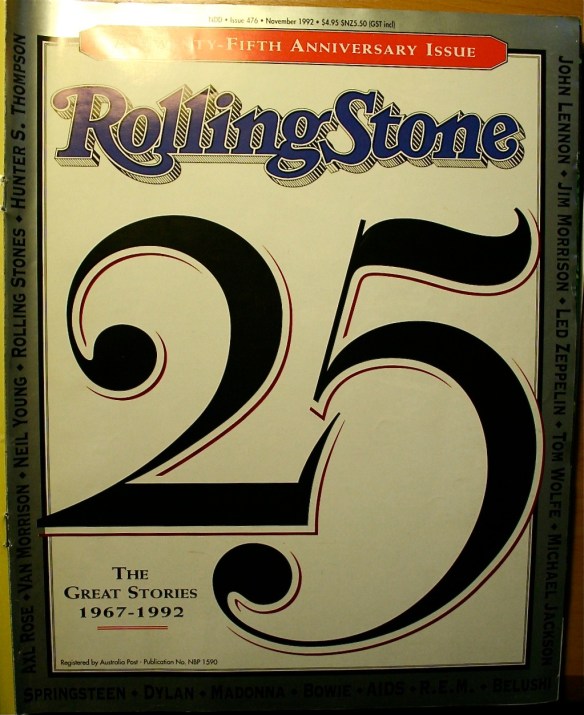
(November 1992) Issue 476 25th Anniversary Special Edition

Like the special Twentieth  Anniversary edition (above) this one contained some of the all-time great articles ever written by Rolling Stone‘s staff writers and contributors over the past quarter of a century. There are pieces on Led Zeppelin, the Rolling Stones, Springsteen, Bowie, Van Morrison, REM, Madonna, Neil Young, Michael Jackson and (of course) Bob Dylan, but probably pride of place was given to the now legendary interviews with John Lennon by Jann S. Wenner – a 30,000 word verbal splurge in which the ex-Beatle spoke openly, fully and truthfully about the Beatles and announced their breakup:

The Jann Wenner interview with John Lennon in Issue 476

Originally from Rolling Stone Issues 74 and 75 in 1971, this was Lennon talking about the demise and aftermath of the Beatles as he saw it – for the first time.  You can listen to extracts and read transcripts at Jann Wenner’s own page.

So, that it. An accidental journey through the past through random editions of Rolling Stone magazine – mags that have been hidden away in a cupboard at home for over 17 years…..

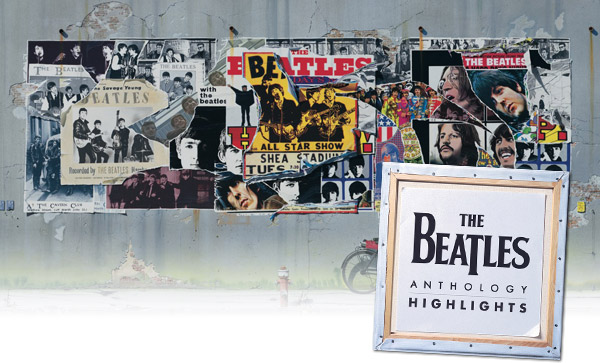
Beatles “Love” – A Further Collectable Variation

Following my post on some of the release variations I have in my collection of the Beatles “Love” CDs and LP, I had a note from Ned in the United States who has a very interesting and unique CD single from the “Love” releases.
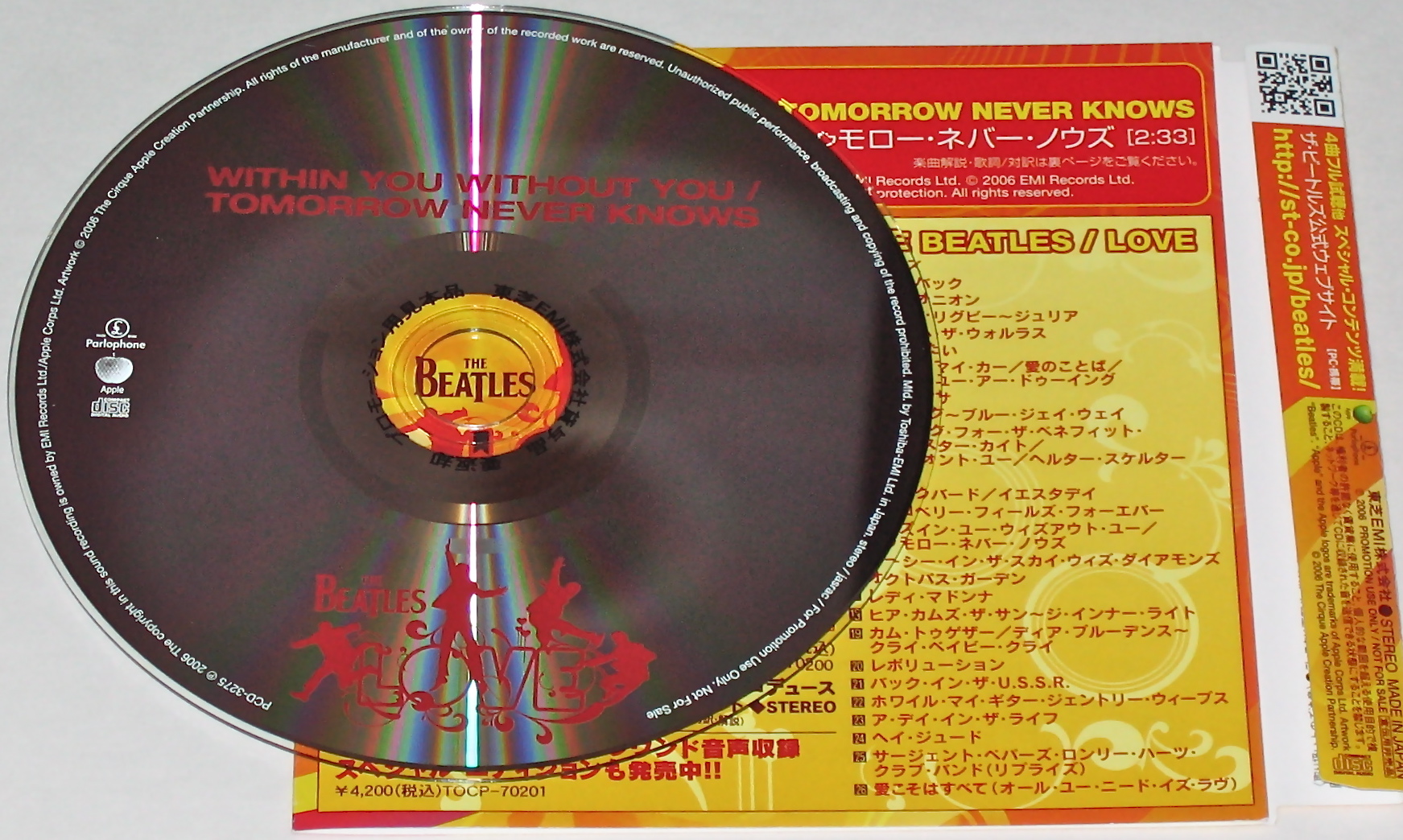
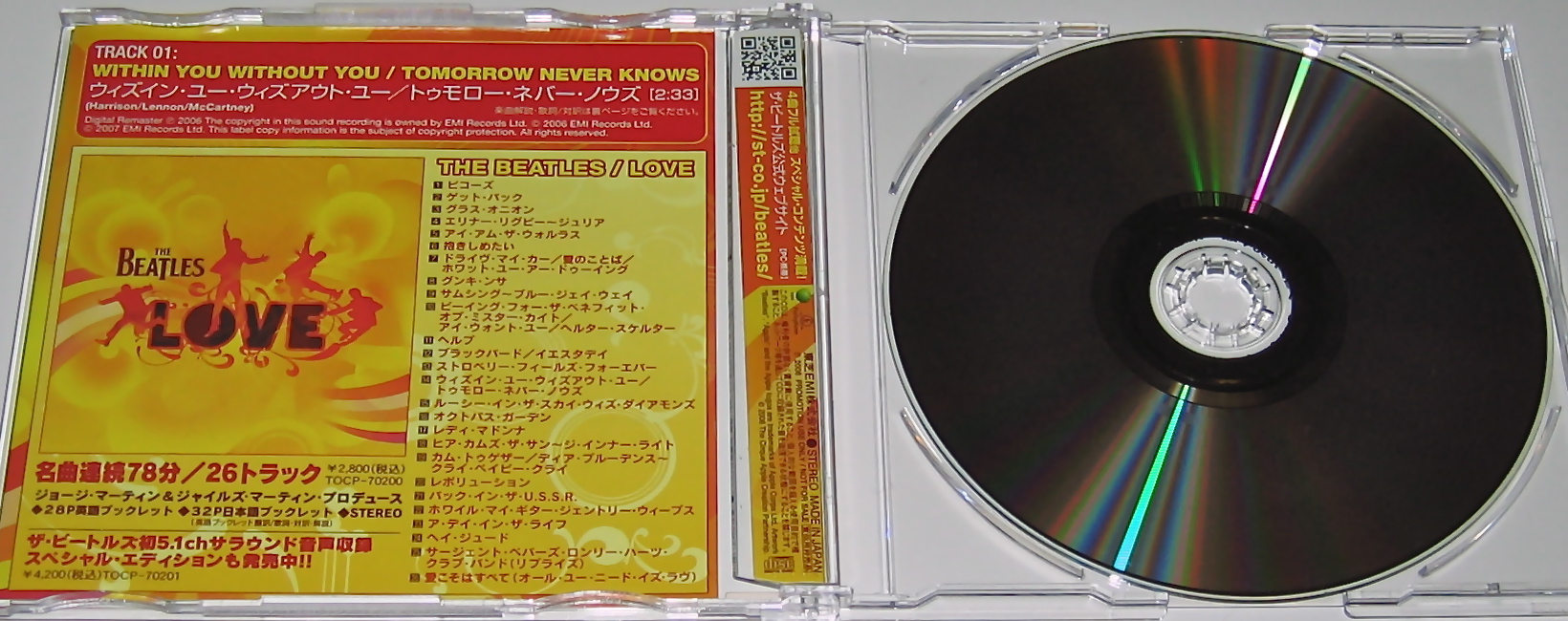
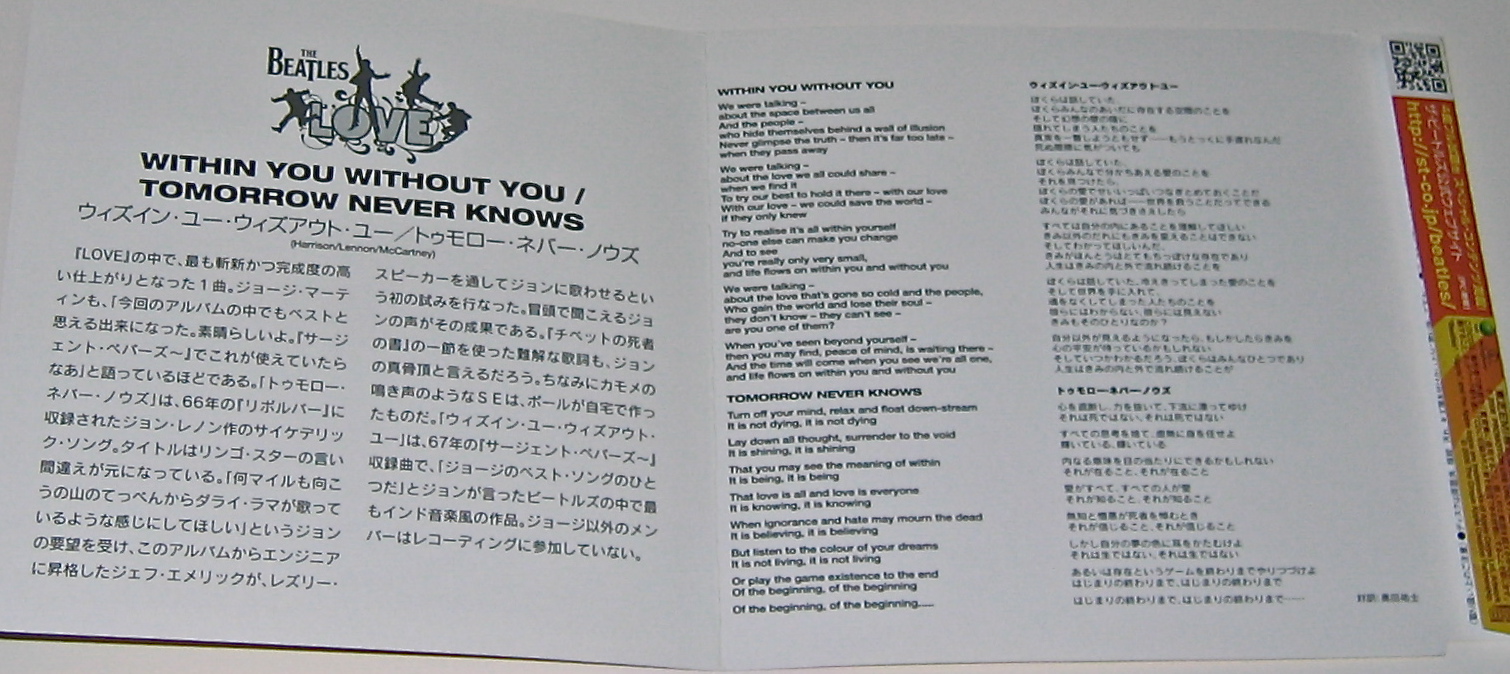
He has in his collection this rare Japanese promo CD single:

LOVE rare promo single - front cover

As you can see above, it has the familiar bright yellow “Love” cover art work – but it contains just one track from “Love” called “Within You Without You/Tomorrow Never Knows”, a mash-up mix by George and Giles Martin of the basic track and vocal from “Within You Without You” (originally released on “Sgt Pepper”), and the drum track from “Tomorrow Never Knows” (taken from “Revolver”).  Giles Martin said “This was the first thing we did (for the “Love” project). We played it for them (Paul and Ringo) and they said ‘we want more like that!’  We had to remind them, ‘Fellas, you know that on most songs you did actually change chords!”  George Martin said at the time: “‘Within You’ is not the most memorable song, but it’s much more interesting with that rhythm.”
According to Ned this CD single was created for Japanese radio stations and issued by EMI Japan without the full knowledge of EMI’s London office. When they found out it was withdrawn shortly after release, thus making it a very collectable item. “It is absolutely NOT an unauthorized release but remains the only CD single issued from the “Love” project”, says Ned.

LOVE single - inside

It has a nice insert that lists the other tracks on the full CD release:

LOVE single - booklet

Ned writes: “I mail ordered this from Japan right at the time of the opening of the show in Vegas.  I believe it ran me around US$20 – including shipping.  I have no idea what the value is now as I only collect what I like and not what might be worth something someday.  Apparently, Yoko Ono had (has) the same collecting philosophy and it has served her well.
Ned has two other favorite Beatles-related items. One is a still-sealed, 4 CD Lennon box from 1990 with a blank space on the back cover art where the song “Imagine” should be listed (the song is on the disc, however). “I bought this one from a woman going through a bad divorce.  She only wanted US$15 for it.  Even though I was very much interested I IMPLORED her to ask for more because I knew she could get it.  However, she insisted because, to her, it represented her former husband.  (Years earlier, I had regretfully sold my copy…and I was desperate to get a copy back in my possession).”
The other item is a withdrawn, mid-80’s CD release of Lennon’s Shaved Fish – manufactured in Japan for the U.S. market – that has slightly different artwork on it. “It was withdrawn because EMI either failed to use “No-Noise” on the master tapes or the tapes they did use were from inferior sources.  Either way, the hiss is more apparent than the common one.  But the fact that it was quickly pulled off the market makes it of interest”, says Ned.

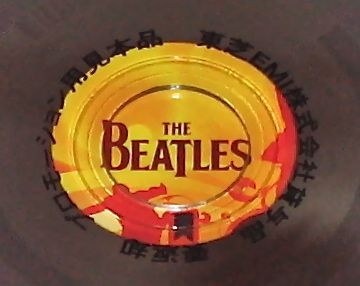
But back to the “Love” promo CD. “Promo Sample” is printed in Japanese around the hub. The catalogue number on the disc is PCD-3275.

LOVE single - the Japanese promo writing around hub

Sincere thanks to collector Ned for all the info and photos. Here’s a clearer picture of the black  promo writing around the center of the CD single’s hub:

LOVE single - promo hub close-up

Dezo Hoffmann – The Beatles Conquer America

I was in Lismore in New South Wales last week (it’s a small-ish Australian country town in the north of the state). Once I’d completed my work business there I had about 40 minutes to spare before my plane home, so I went for a walk around the town’s CBD. You can probably guess that I can’t resist a second hand/old wares shop when I find one. Especially the one I did find, which was advertising “All Books Half Price”.

Inside this store was a treasure trove. Not only are most walls lined chock-full with old books of all sorts, but there’s antique furniture, old toys, art works, advertising signs, glassware, ornaments and all sorts of collectables.

They had a crate of old records and, while there were some interesting things there from other artists, no Beatles or Beatles-related sadly. “Do you have a music section in the books?”, I asked. “Well, we haven’t got much, but its over there.”, said the sales assistant, pointing to my right.

They actually had four Beatles books.  1. A hardback copy (in pretty good condition) of Peter Brown’s book “The Love You Make – An Insider’s Story of the Beatles” (1983);  2. An original paperback of a book based on the film “Help!” (1965) written by Al Hine (in just reasonable condition);  3. An original paperback called “Love Me Do – The Beatles Progress” (1964) by Michael Braun, similar in vintage and condition to the “Help!” book; and 4. “The Beatles Conquer America”, a book of photographs taken by Dezo Hoffmann.
I already have Peter Brown’s book and, while tempting as they are collectable items, the two old paperbacks were not in the greatest condition. Also, even at half price were reasonably expensive. So, I went for the Dezo Hoffmann book:

Front Cover - The Beatles Conquer America

For a book that came out in 1984 it was in almost mint condition. It contains some absolutely fantastic and rare photographs, and at the half-price cost of just A$7.50, it was a bargain addition to the collection. The black and white photographs were all taken between January 14 and February 22, 1964 when Dezo Hoffmann accompanied the Beatles from London to New York, Washington, Miami, and then back to London. It was their first American tour, and the Beatles as a pop phenomenon was really kicking into gear…

Rear cover - The Beatles Conquer America

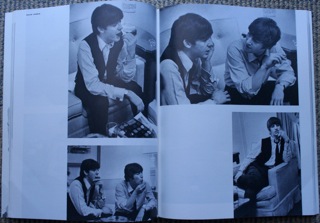
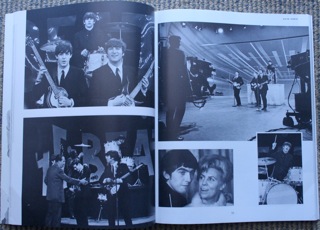
The book also contains photos from a short tour to Paris prior to the US visit. Dezo Hoffmann was a Beatles insider – having taken an interest in photographing the band from well before their meteoric rise to fame. As such he got unique access – as seen throughout this book. Dezo also writes a short description of the background to each photograph. Here’s a quick flip through just a couple of the pages:

There is very much a “fly on the wall” feel to these photographs. They capture the Beatles at ease and enjoying themselves away from the fans, enjoying performing, and just soaking up the success that was coming their way.

If you don’t think you’ve ever seen a Dezo Hoffman image of the Beatles before, you might know this one:

Click here for a larger image and some official info on this release. In looking around for additional information on Dezo Hoffmann I found an interesting page about how his original shot outside the BBC was manipulated for this now famous cover.

As well as historic photographs, Dezo Hoffmann also took many informal home movies on location with the Beatles:

More Artwork for April Lennon Singles Release

I wrote earlier this month about a special limited edition John Lennon release for Record Store Day which is on April 17.

At the time not much was known but since then some more detailed artwork for the project has come to light. The three singles will be housed in a paper “bag” with three postcards and a poster.

The poster will look like this:

And there’s a custom 45 rpm single hub:

I got these images from a New Jersey record store site called “Vintage Vinyl” – so thanks to them. Their site is interesting because it reveals the huge number of other special releases for the day. They’ve got a page full of limited release or specially produced product just for Record Store Day, including items from Bruce Springsteen, Bon Ivor and Peter Gabriel, Neil Young, the Sex Pistols, and the Rolling Stones.

(Incidentally, Vintage Vinyl have that special Beatles Remastered gift box I wrote about in January. On their front page they have have a link to a deal where you can buy any 2 Beatles Remastered CD’s and get the box thrown in free).

Label Variations – Part Two – Let It Be

Late last year I posted a couple of label variations from my collection of Sgt. Pepper’s Lonely Hearts Club Band vinyl LP’s.

That page has been getting a few hits, so here is another selection – this time for Let It Be. Again, a couple of vinyl label variations from around the world. I don’t have as many copies of Let It Be as I do Sgt. Pepper, but am still looking!

I guess the place to start is with the original UK Apple version:

The original UK green Apple

As you’ll probably know, in the UK the very earliest copies of Let It Be were released in a lavish box-set and came with a thick book of text, dialogue extracts and photographs from the film “Let It Be”. Those box-sets, which had the catalogue number PCS-1, now fetch very good prices and in good condition are very collectable. While the box-set’s number was PCS-1, the record inside and all subsequent releases actually had the catalogue number PCS 7096, which you can see in the image above. After stocks of the box-set sold out Let It Be was only ever available as a single sleeve album.

In Australia early copies also came in a similar box-set with the book, and it had the green Apple label. The only real variation was that the catalogue number for the box was PXS-1, and the record number was PCSO 7096.

The first Australian pressing – with green Apple label

Meanwhile, across the Tasman Sea, New Zealand Beatle fans also got a box-set and book for a short time (though I’ve never actually seen one of these from NZ) and then a single sleeve cover after that. Their pressing has New Zealand’s particular version of the green Apple:

An early example of the New Zealand pressing

As you can see, in New Zealand the catalogue number was PCSM 7096. You can click here for a comprehensive list of which countries around the world got the box-set and book, plus some further info on variations.

In the United States they did something different again. For some reason it was decided not to provide the book and box set, and only make the record available in a gate-fold cover. Inside the gate-fold were just a small selection of the photographs from the book that was released in other markets. The other big variation was that the record label itself was not green, but red:

The US pressing – with unique red Apple

I believe that this version of Let It Be was very widely bootlegged in a very accurately reproduced cover and so there are consequently a lot of very good fakes out there, complete with the red Apple label. There is some information here on how to tell if you have a fake. My copy has a fairly washed-out looking label and I suspect it may well not be an authentic original….I’m going to do some more digging.

Later US copies went from the Apple to Capitol labels:

The purple US Capitol label

Among my Let It Be copies I have a couple of Asian pressings. They can be hard to identify exactly because in some territories they imported the covers from the UK and just inserted locally pressed vinyl. That’s particularly true with pressings from Hong Kong because at the time it was a British protectorate with lots of ties back to the “mother” country. I think this Apple label below is a Hong Kong pressing, but I’m not sure…

What I think is a pressing from Hong Kong

This next one is a little easier to identify – it actually says on the back cover it is made and printed in Malaysia. Having said that, the record label is very similar (with a few variations) to the suspected Hong Kong pressing above:

A Malaysian pressing – with green Apple

This next one is probably the most different and unusual. I picked this up in 1992 – the year of it’s release. Its the Russian pressing on the AnTrop label. I think this particular record was produced in St Petersburg because around the AnTrop logo are the words “consummari in unum St.Petersburg” (Thank you to the fantastic Beatles On Vinyl, site which has an absolute wealth of information about every Russian/USSR Beatles release):

The AnTrop Records Russian pressing of Let It Be

Finally, up almost to the present day and the most recent US vinyl pressings of the album – the so called “Limited Edition” re-issues from Capitol/Apple in the United States a few years ago. For these they resurrected the green Apple but with the variation of a white background instead of the usual black. Notice the Parlophone logo also appears on the right-hand side:

The US Capitol/Apple re-issue

Finally, an very unusual one sent in by Andrey, who is a collector who lives in Russia. This one is a rare one – “Let It Be” from Guatemala:

Well, that’s a quick trawl through just some of the different label variations for Let It Be on vinyl. Of course vinyl copies of the album are still readily available in the UK, though I don’t have a copy. In fact the whole Beatles catalogue is still in print on vinyl there.

I wonder if Apple Records will come good on the rumours that were circulating last year when the new Remastered CD’s and box sets came out? There was talk that a vinyl box-set was in preparation – on audiophile-quality, 180 gram vinyl. Nice!

See also:  Label Variations – Part One – Sgt. Pepper

See also: Label Variations – Part Three – McCartney’s Choba B CCCP

Composing Outside the Beatles – DVD

Despite the somewhat literal and unimaginative title, this recent release is a really a very interesting documentary study of John Lennon and Paul McCartney’s careers immediately following the break-up of the Beatles.

I’d read about this DVD by chance and had been looking around on Ebay for a copy. I dropped in to my favourite shop – Red Eye Records – and there it was on the shelf for a reasonable price. Well, reasonable compared to the prices I’d seen for British or US copies on Ebay, plus postage, plus the uncertainty of “will it ever arrive?”….a bird in the bush as they say.

So, I got it at Red Eye, and watched it last weekend – which was a wet weekend and perfect for being a couch potato and settling in in front of the TV for a couple of hours.

Nicely put together, it traces the first few years of Lennon and McCartney trying to make their ways as solo entities outside the protective shell that used to be the Beatles. It compares them as composers and performers, examining their early singles and album releases. There is much more time and effort during the documentary placed on John Lennon’s output than that of Paul – but this is probably because the overall theory of the documentary is that Lennon was by far doing more serious and worthy work, and being more commercially successful than his former band-mate and co-writer.

There are nice shots of original album covers and single releases as the discussion panel (which includes Klaus Voorman, Paul Gambaccini, drummers Alan White and Denny Seiwell, and writers Johnny Rogan, John Blaney and Steve Turner amongst others) commenting on and appraising the relative strengths and weaknesses of each solo release between 1967 and 1972.

The front cover of "Composing Outside the Beatles"

The packaging of the DVD is impressive. It’s in the digi-pack style with opening “pages” revealing the DVD disc inside. It is glossy and has good production values with great photos and printed information.

The DVD cover open to the first of the tri-folds

Its a tri-fold digi-pack that finally opens out like this:

The tri-fold inner fully open

As you can see they have really taken some care with the presentation, including printing the DVD disc itself so that it matches the printing of the inner cover exactly. Here’s the rear cover:

The rear cover of "Composing Outside the Beatles"

So, “Composing Outside the Beatles” really has a strong slant towards John – both in the comments by the interviewees and the ratio of time spent on each. But maybe this is just a reflection on the times where Paul was struggling to be a musician outside the Beatles while John appeared to leap into it with a bit more style (as well as critical and commercial success). If you are interested there’s a further review here.

Goodbye, Abbey Road

I just got home and opened my emails to find this post by Brandonblog, a guy who writes with great wit and authority on music matters. Couldn’t really say it better myself, so here are Brandon’s words as-is:

Just heard news of the ultimate bit of Beatles memorabilia, although, you can bet it isn’t about to be offered on ebay.

If Michael Jackson were still around, he’d probably be vying for it but, most likely, it will go to some cashed-up entrepreneur who will want to open it up for tours. Let’s hope it isn’t turned into a restaurant: “Would sir like the Savoy Truffle? Or, the Yellow Matter Custard, perhaps?”

Anyhoo, for better or worse – and I fear it may be the latter – EMI is about to sell the historic Abbey Road Studios where the Fabs recorded the greater bulk of their astonishing legacy.

But it wasn’t just The Beatles who recorded there. Abbey Road also played host to the likes of Pink Floyd who delivered their landmark opus, ‘Dark Side Of The Moon’ in those hallowed studios.

How cool would it be if the British Government chipped-in for it and registered Abbey Road with The National Trust? Former Kinks frontman, Ray Davies recently lamented the gradual disappearance of his city’s iconic landmarks in the song he recorded with Chrissie Hynde, “Postcard From London”.  Imagine what he must think of this.

In it’s current financial predicament, I can’t blame EMI one bit but if Abbey Road is allowed to disappear, or to be so transformed as to become virtually unrecognizable, then England will lose something of significant cultural value.

Let’s hope not. 

Brandon accompanied his post with this groovy photograph – an angle of the boys in concert that I’d certainly never seen before…