Beatles USB Apple – not the First Apple-shaped Product Released….

I’ve always had a fascination with the Beatles and their music. From the very first days of being old enough to buy my own records I’ve had at least some copies of their albums and singles in my collection – mostly vinyl, starting with Sgt Pepper, The White Album, Abbey Road, and Let It Be, plus the odd single here and there.

But the way I got into seriously collecting a wider range of related records, CDs and books was when I became intrigued by their Apple Records label and the eclectic stable of artists they signed up – both the well-known and the more obscure. Its a quest I’m still on. There are some titles and artists out there on Apple Records that I still don’t have…

In launching Apple Records in 1968 the Beatles produced what was then and is now an exceptionally rare promotional box-set of the very first Apple singles called “Our First Four”.  According to Richard DiLello in “The Longest Cocktail Party”, his 1972 memoir about being an Apple Records “house hippie”, this was a presentation box containing the first four 45 rpm vinyl singles from the label. It was “….a box made of plastic, 10 by 12 inches in matte black with a recessed lid carrying the Apple sticker that announced it as Our First Four, 3 Saville Row, W1.” It contained The Beatles “Hey Jude/Revolution” (R 5722), Mary Hopkin – “Those Were the Days” (APPLE 2), Jackie Lomax – “Sour Milk Sea” (APPLE 3), and The Black Dyke Mills Band – “Thingumybob” (APPLE 4).  Richard DiLello again: “There was a single coloured folder containing the biographies and photographs of the artists with the records in a polythene sleeve. The name of the person to whom the box was going was printed on the outside Apple sticker. This was primarily an inter-industry gift presentation package for the benefit of Capitol Records and selected disc jockeys and journalists.” Here’s a website that has a photo of one of these extremely rare boxes – although I’m not sure how authentic it is. DiLello says in his book that one of these boxes was presented to Stanley Gortikov, President of Capitol Records in 1968. Others were hand-delivered to the Queen Mother at St James’s Palace; Her Majesty the Queen at Buckingham Palace; Princess Margaret at Kensington Palace; and to British Prime Minister Harold Wilson at Number 10 Downing Street, London.

In 1991, when it came time for Apple to conduct a big re-issue program of all the Apple album releases, they decided to do something similar (but not exactly the same – and certainly not as rare) with a special Limited Edition CD.

The Apple EP

The Apple E.P. (1991) CD

As you can see it’s an official, apple-shaped CD release to mark the re-issuing of the Apple LP catalogue on both CD and vinyl – back in 1991.

When you open the “apple” it looks like this:

Apple EP

The Apple EP opened to reveal the 4-track CD

Inside is a 4-track compact disc with a song each from Mary Hopkin – “Those Were the Days”; Billy Preston – “That’s the Way God Planned It”; Jackie Lomax – “Sour Milk Sea”; and Badfinger – “Come and Get It”. Not exactly the same tracks as Our First Four, but still two tracks written by Beatles (“Sour Milk Sea” by George Harrison and “Come and Get It” by Paul McCartney):

Apple EP - rear cover

The Apple E.P. - rear cover with track details

As well tracks 1 and 4 were produced by Paul McCartney, and tracks 2 and 3 were produced by George Harrison.

OK, so there is no “Hey Jude”/”Revolution”,  but there is still a pretty large Beatle quotient here. And for me its a reminder that the current Beatles USB (containing all the remastered Beatles albums in high quality digital format) is not the first time that Apple has used an apple-shaped object to market product.

Apple EP CD

The artwork for the Apple EP compact disc (1991)

Its also not the first time that Apple has collected together four songs from artists in their stable and released an EP for promotional purposes. In 1969, not that long after Our First Four, they gave permission for the British ice cream company Walls to issue a vinyl EP:

Walls Ice Cream EP

The Walls Ice Cream EP from 1969

Click here for more information on this release.

As for the Apple re-issue program from 1991, I have quite a few of the vinyl LP re-issues from that time (complete with bonus tracks and original and additional artwork) and will post some pictures and info on these in the future.

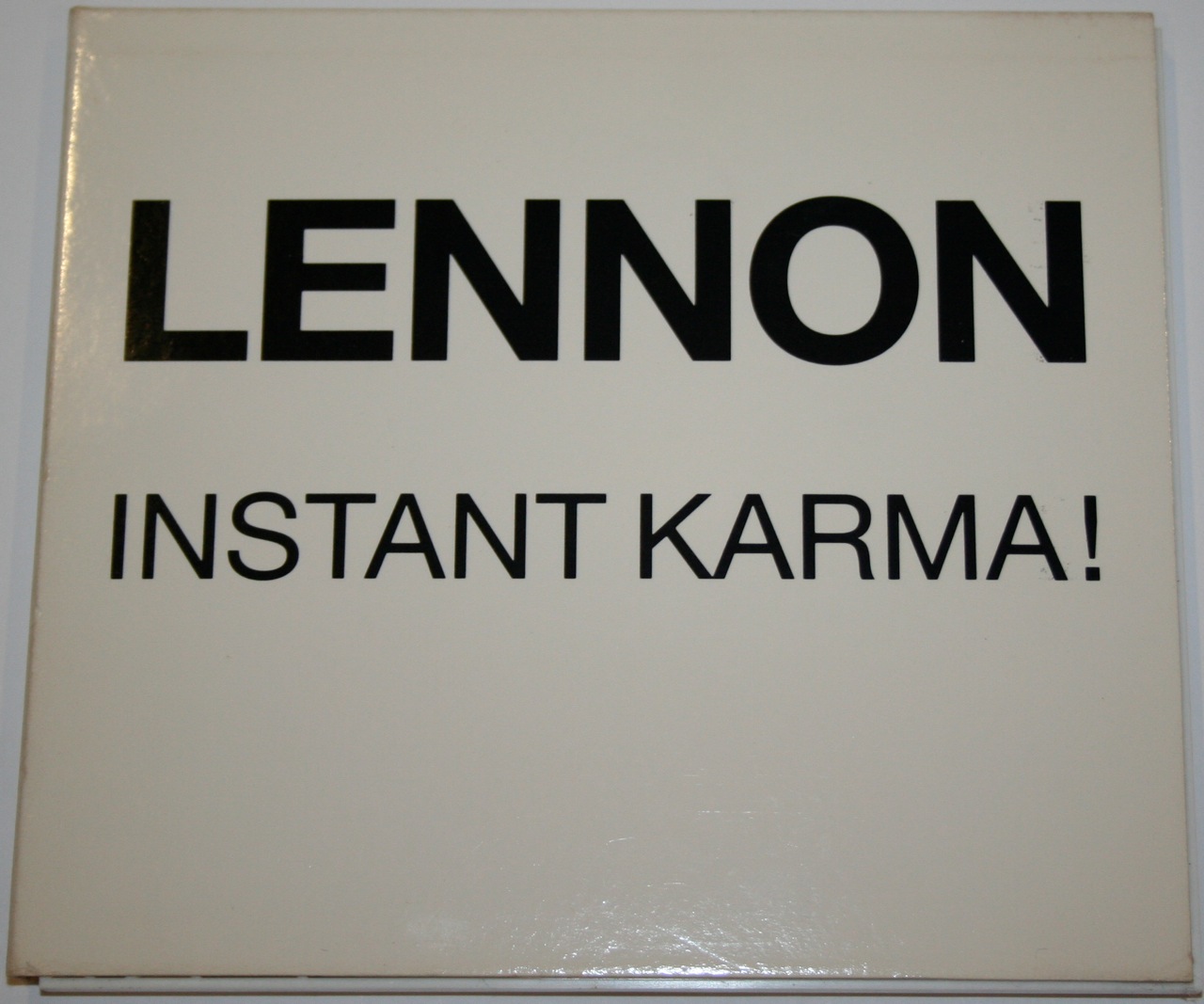
John Lennon “Lennon” 4 CD Box Set

It never ceases to amaze me how many variations there are out there of particular Beatles or Beatles-related items. I guess that’s part of what makes collecting interesting….

Some are big differences, and include completely revised or unique artwork or track running orders, others are small and subtle. This one, sent to me by Beatlesblog reader Ned in the United States, is a case in point. Ned writes: “One favorite Beatles-related item of mine is a still-sealed, 4 CD “Lennon” box from 1990 with a blank space on the back cover art where the song “Imagine” should be listed (the song is on the disc, however) that I bought from a woman going through a bad divorce. She only wanted US$15 for it. Even though I was very much interested I IMPLORED her to ask for more because I knew she could get it.  However, she insisted because, to her, it represented her former husband.  (Years earlier, I had regretfully sold my copy due to being laid off and needed to pay my bills. I was desperate to get a copy back in my possession after my work life returned to normal).”

Ned sent me a photo of this unusual John Lennon collectors item. Check out the space in the listing on Disc 2:

Its a strange little mistake or variation….who knows why “Imagine” was left off that particular print run? And Ned having a still-sealed copy makes it pretty collectable too. (By the way, it was Ned who sent the additional photos of the Japanese Beatles “Love” rarity from a previous post).

To compare, here’s my copy of the Lennon set:

“Imagine” is definitely still there. This 4 CD “Lennon” box set was released by Parlophone/EMI in 1990. It was compiled by Mark Lewisohn, one of the band’s insiders and a long-time writer and commentator on official Beatles releases and their history. Wikipedia has a song list for each CD. As you can see, most songs were previously released, but there are a couple of hard-to-find tracks, like the three live from Madison Square Garden with Elton John (“Whatever Gets You Through the Night”, “I Saw Her Standing There” and “Lucy In the Sky With Diamonds”) recorded 24 November, 1974.  I believe these three songs had only ever been previously released on a vinyl single in 1975.

The box set comes with a nice (if plain) 70-page booklet:

Booklet - Front

The booklet has the words to each song, a song index, small images from the album each track comes from, plus some nice photos – both black and white, and some in colour:

Booklet - inside

Each of the jewel cases has an individual image of Lennon. Here’s the one used for Disc 1:

The printing on each CD follows a similar theme, but each jewel case spine, rear artwork and the actual CD disc is a slightly different colour. For example here are discs 1 and 2:

The 4 CD set came out in 1990 and followed the 1989 single CD release “The John Lennon Collection”. In Australia at least EMI released this 4-track EP CD in a gate-fold Digipak to promote both:

As you can see, they used the rear of the cover to promote both the single disc “John Lennon Collection”, and the 4 CD box set:

So, thanks to Ned for another unusual and collectable Beatles-related item.

There is a new set of John Lennon box sets and anniversary releases on the way. Called the Gimme Some Truth  project, these remasters will mark what would have been Lennon’s 70th birthday and will be released in October, 2010.

McCartney and Obama – The Gershwin Award

Paul McCartney was in the East Room at the White House this week to receive the Library of Congress Gershwin Prize for Popular Song from US President Barack Obama. It’s just the third time the award has been presented.

From Glen Levy at TIME Magazine:

“It’s sure to be a pop culture reference point for years to come: Sir Paul McCartney performed for the Obamas at the White House on Wednesday in light of the Beatle being presented with the third annual Gershwin Prize for Popular Song. He followed in the formidable footsteps of Stevie Wonder and Paul Simon.

You would imagine that the possibility for puns in pieces such as these would be endless when it comes to the songs he could sing but Macca simply rocked up and dedicated his very own track, “Michelle”, to the First Lady herself. After serenading Mrs Obama with the lyrics, “I love you, I love you, I love you,” McCartney joked that he could be the “first guy ever to be punched out by a president.” (if that had been the case, he surely would have screamed “Help!” See what I mean when it comes to the puns?)

McCartney was no slouch with his own zingers either, unable to resist the following funny: “After the last eight years, it’s great to have a president who knows what a library is.” (Paul McCartney will be here all week ladies and gentlemen).  Want proof? “I don’t think there could be anything more special than to play here,” he commented, before making the following offer: “Lunchtimes, we could come around … We’re cheap.” Back to the day job and he reeled off a string of classics including “Got To Get You Into My Life, “Eleanor Rigby” and “Let It Be.”

Obama praised the British legend for his contribution to U.S. culture, saying the Beatles had “helped to lay the soundtrack for an entire generation, ” as well as adding, “That’s right, we stole you, Sir Paul.”

If this wasn’t enough, the likes of Stevie Wonder, Elvis Costello, Emmylou Harris, the Jonas Brothers, Jack White, Dave Grohl, Lang Lang and Faith Hill were among the eclectic, star-studded line up with Jerry Seinfeld on hand to add the official comedy (the show will be broadcast as a PBS special on July 28). The night ended with the Obamas up on stage, singing along to “Hey Jude.” The White House has never hosted a cooler evening. See for yourself here.”

The set list for the night was:
Paul McCartney – Got To Get You Into My Life
Elvis Costello – Penny Lane
Dave Grohl – Band On The Run
Corinne Bailey Rae and Herbie Hancock – Blackbird
Emmylou Harris – For No One
Faith Hill – The Long and Winding Road
Jonas Brothers – Drive My Car
Lang Lang – Celebration on the piano
Jack White – Mother Nature’s Son
Stevie Wonder – We Can Work It Out

Paul McCartney – Ebony And Ivory (a duet with Stevie Wonder)
Paul McCartney – Eleanor Rigby
Paul McCartney – Michelle
Paul McCartney – Let It Be
Paul McCartney – Hey Jude
(The concert and award speeches were taped by PBS and will be televised as a 90 minute TV special on July 28th in the US).

McCartney – Big Q Magazine Feature

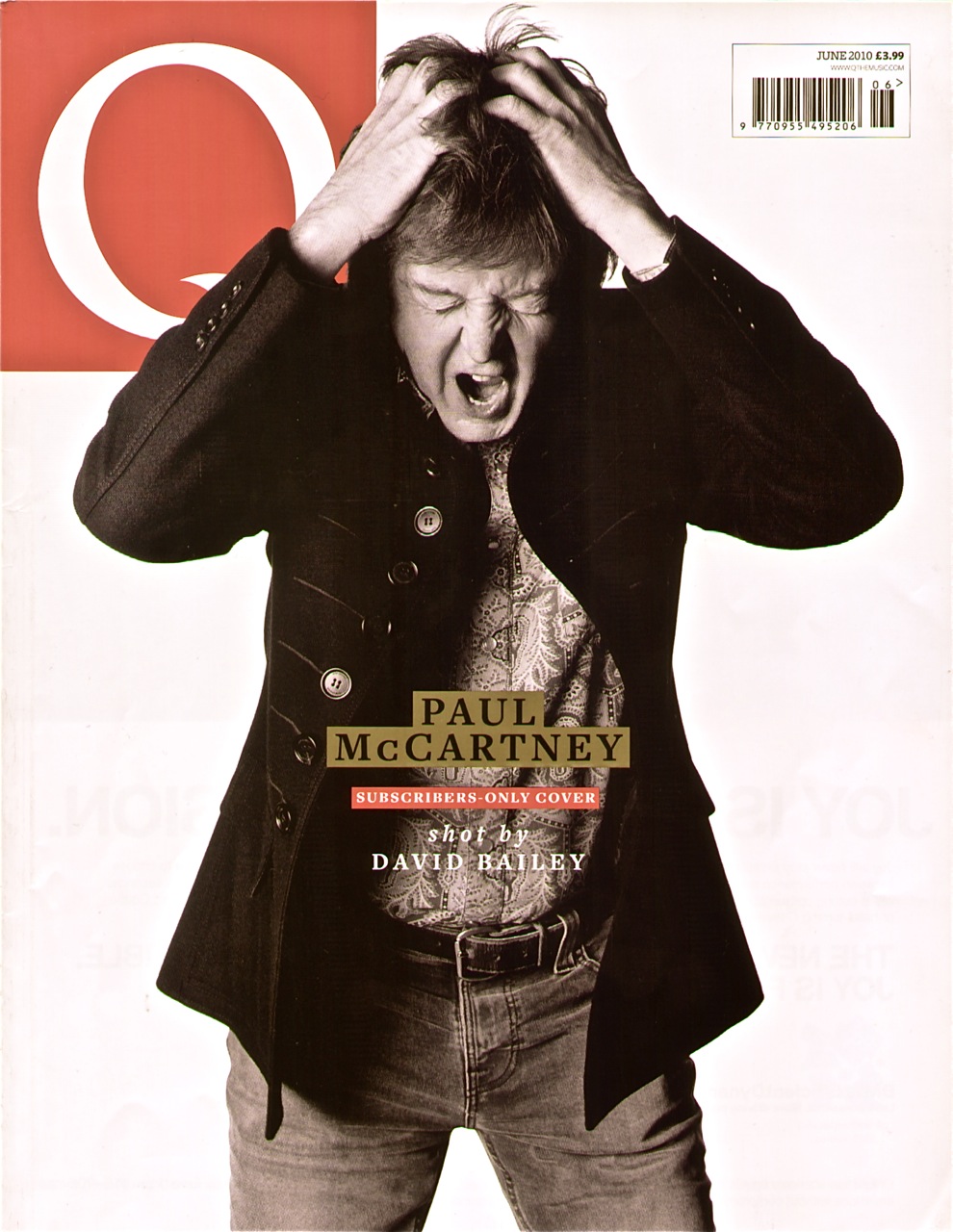
The current (June, 2010 – Issue 287) edition of “Q” magazine has a front cover featuring an angry Paul McCartney:

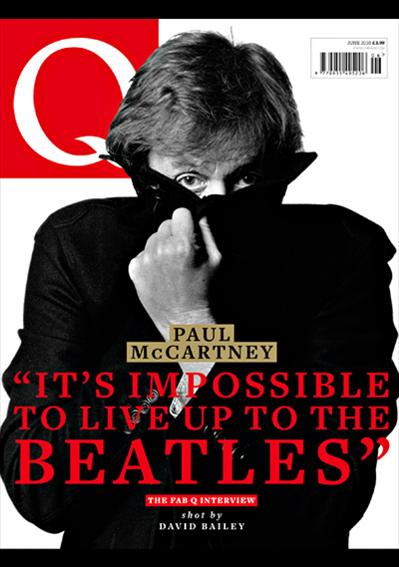
This is a collector cover – one released just for subscribers to the magazine, something that publishers seem to be doing lately to get people to buy product from them rather than just down-loading or getting a copy from the newsagent. I think the newsagent copy will look like this:

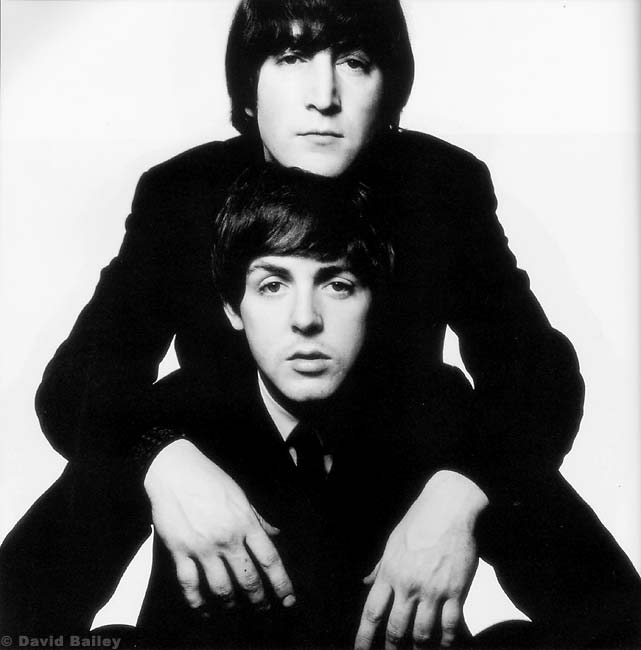
The magazine contains a 26-page special feature on Paul McCartney – and its highly recommended reading. The dramatic cover photo(s), and some shots inside, are by David Bailey – who is not new to photographing the Beatles. His work in the Sixties helped define the decade – Swinging London in particular – and he photographed the Beatles from time-to-time. Here’s a photo he took a LOT earlier:

Inside the current “Q” magazine Editor-In-Chief, Paul Rees, gets to spend a month on the road with the man, interviewing him in England and the USA. We get a look at some really interesting and previously un-seen Linda McCartney photographs, and there’s a couple of pages about Paul the avant-garde member of the Fab Four. This is followed the likes of Brian Wilson, Chris Martin, Jamie Callum, Dave Grohl and Paul Weller, to name just a few giving their favourite Paul song recommendations. And finally an in-depth feature on what happened to Wings in Lagos, Nigeria during the making of 1973’s “Band on the Run”. Some really scary stuff….not the greatest place to choose to record an album, but what an album it turned out to be.

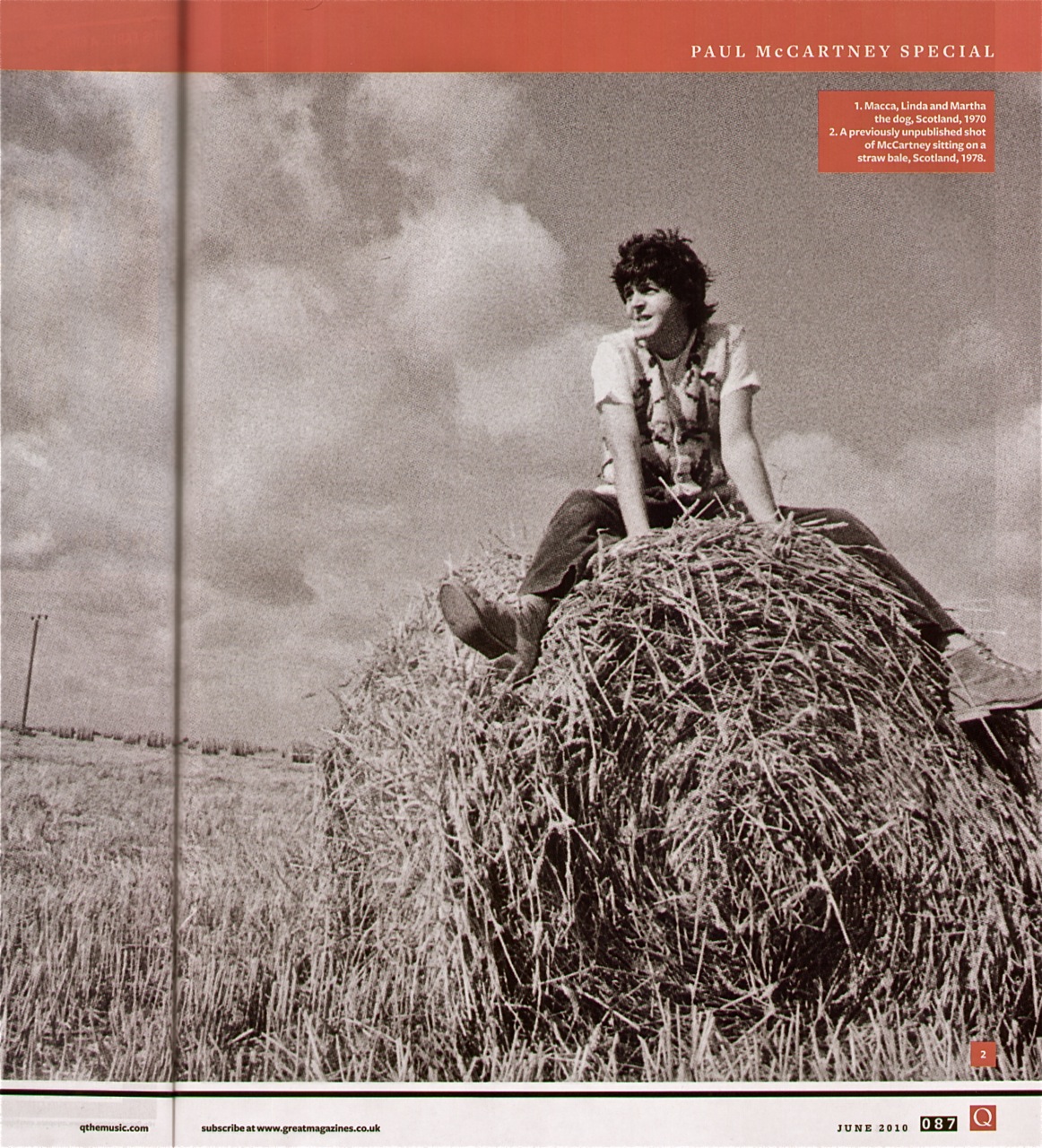
One of the best sections in the magazine is the one featuring the many rare photos by Linda McCartney. This one, of McCartney sitting on a straw bale at his farm in Scotland in 1978, is previously unpublished:

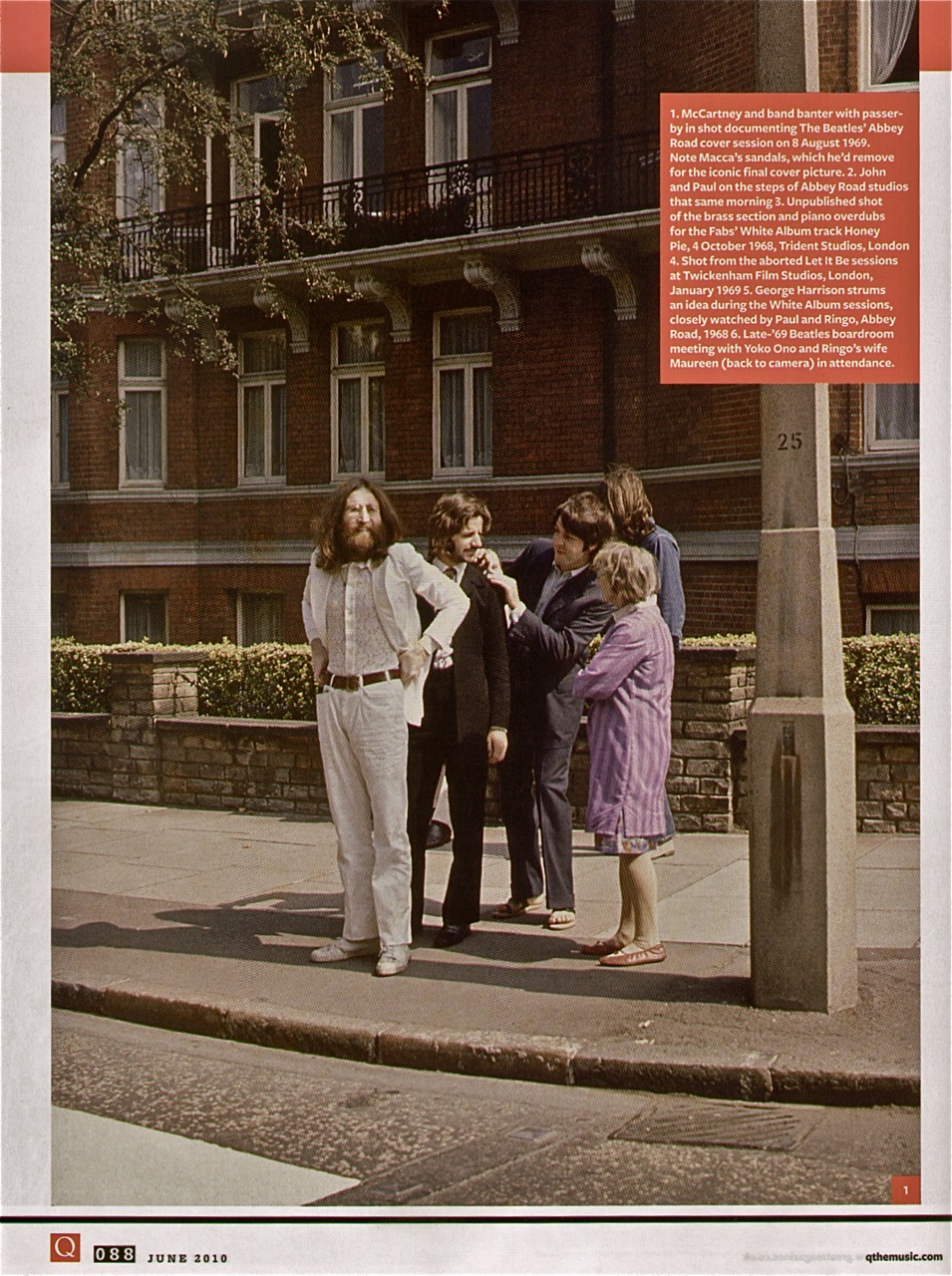
The other one I really like is a candid photograph taken during the shoot for the famous “Abbey Road” cover. The caption says: “McCartney and band banter with passer-by in a shot documenting The Beatles’s Abbey Road cover session on 8 August 1969. Note Macca’s sandals, which he’d remove for the iconic final cover picture”:

Its all pretty good stuff and I reckon well worth the cover price (no matter which cover you get).

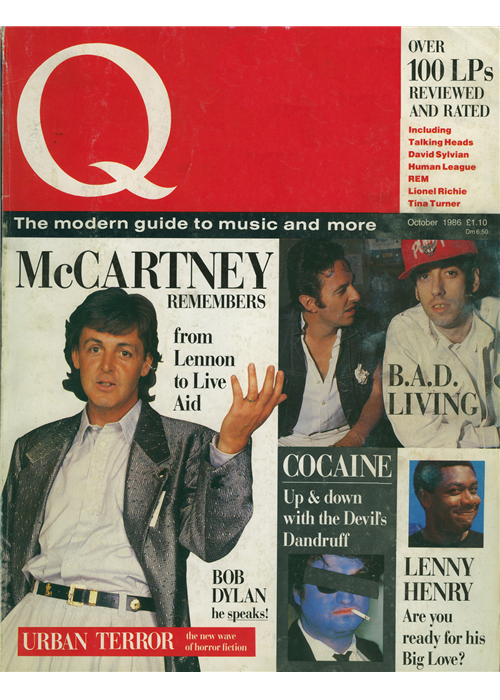
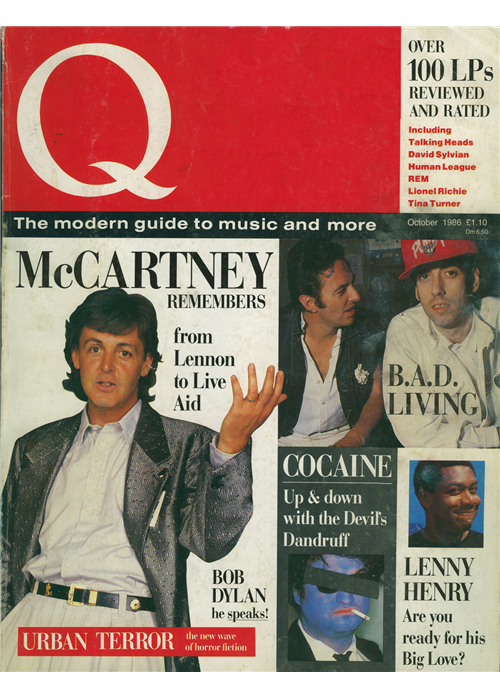
Postscript: In a spooky co-incidence, I just found out that the very first issue of “Q” magazine, dated October 1986, also had Paul on the front cover…..Issue 001 included articles on Paul McCartney, Big Audio Dynamite, Cocaine, Bob Dylan, Lenny Henry and John Blake.


The Penguin John Lennon – Plus a Couple of Other Things

Had a trip to Canberra, Australia’s national capital, this weekend and a chance to browse some second-hand book and record stores.

The trip turned up a couple of unexpected items – but that’s always the way with these things, isn’t it?

While in Canberra itself I found a CD/DVD store in the downtown “Civic” area advertising “20% OFF ALL STOCK”. That is just too good an invitation to walk past. Didn’t find a lot of interest to the Beatles collector in me – except for a heavily discounted, brand-new copy of  “All You Need Is Cash”, a film by Eric Idle’s Beatles parody group The Rutles. I’d never seen the film, and for A$6.40 it was a bargain. More on this soon in a separate post….

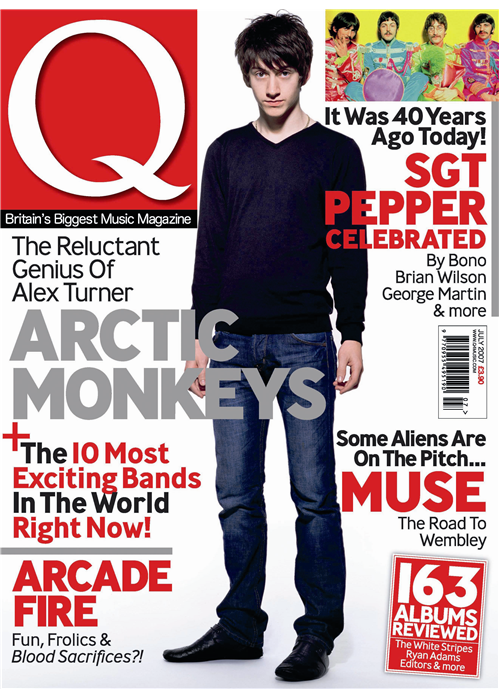
Also, strolling past a newsagent shop in the Canberra suburb of Kingston, I saw a table outside with old magazines that they were just throwing out – for free. Buried under the pile was a copy of “Q” magazine from July 2007, with a feature article for the fortieth anniversary of the release of the Sgt Pepper called “It Was Forty Years Ago Today….Sgt Pepper Celebrated”:

In it the likes of Bono, Brian Wilson, George Martin, Dhani Harrison, Jeff Lynne and others take one track from the album and write about why they love it, when they first heard it, or what it means to them. The magazine was still in its plastic outer wrap – and so in absolutely perfect condition. Not bad for free! Also with “Q” in the pile was a March, 2007 copy of a magazine called “Sound On Sound”, which on the front cover describes itself as “the UK’s biggest selling music recording magazine”. I’d not seen this title previously, but the front cover carried the photo below and an extensive article on the making of the Beatles “Love” album:

That’s George Martin and his son Giles, and they take the magazine through the detail of producing the Beatles‘ 2007 release “Love” (see this post, and this post for more details). If you’d like to read the article, “Sound on Sound” have now published it here in full online. The magazine is also in perfect condition. Not bad for free!

And finally, on the way home we stopped in the town of Berrima, just outside of which is a legendary second-hand book store called Berkelouw. They call it the Berkelouw Book Barn, and thats just what it is – a huge barn of a place absolutely filled to the rafters with shelf after shelf of pre-loved books. In the music section, I found (on hand and knee – it was of the very bottom shelf!) this little book to add to the collection:

The Penguin John Lennon

It is “The Penguin John Lennon”, a paperback (or soft cover) which gathers together in one volume John Lennon‘s two humorous prose works “John Lennon In His Own Write” (from 1964), and “A Spaniard in the Works” (from 1965), plus some great original line drawings by John. I believe this edition above (with this cover by David Nutter) came out in 1973, but “The Penguin John Lennon” has been out since about 1966. You may have seen it with this cover:

The book has an Introduction written by Paul McCartney, who says at the bottom of the page: “P.S. I like the drawings too”.  He must have, because one of the first drawings in the book was used for the cover of the Beatles “Free As A Bird” CD single – thirty years later in 1995:

Nine Copies of Rolling Stone Magazine

Up on the very top shelf of a closet in my study there’s a large pile of old music magazines – mostly Rolling Stone magazine. They’ve been there, oh, for at least 16 or 17 years. Sitting quietly, gathering dust.

About a week ago it suddenly occurred to me that there could probably be some Beatles-related treasure hidden away in there.

Really don’t know why I’d never thought of this before. And so I got them down from the shelf this weekend and had a browse. This post, in chronological order, is about what I found.

(July 1979) Issue 295 Paul McCartney by Paul Gambacini

These are all the Australian editions of Rolling Stone, and back in 1979 it was still very much like a newspaper in appearance. No staples to hold it together and printed on flat, newsprint style paper. The cover story about Paul (above) is by veteran DJ, writer and rock historian Paul Gambacini. The cover portrait of Paul McCartney is by Julian Allen, June, 1979. Gambacini’s  byline says: “The leader of Wings looks back at yesterday”, and he writes: “I have known Paul McCartney for over five years, since just before the release of ‘Band on the Run’…Not surprisingly, McCartney at that time was desperate to avoid talking about the Beatles, especially about the never-ending reunion rumors…In the years since, Paul has let down his defenses. Anecdotes about the Beatles now flow, in addition to reminiscences of the pre-Beatles days. He seems pleased with his past. This is a product of being happy with his present.” The article coincided with the release of Wings “Back to the Egg”.
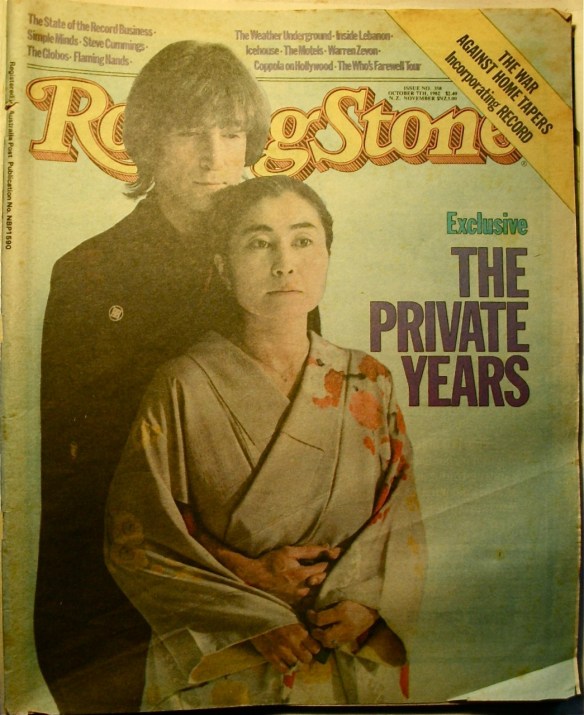
(October 1982) Issue 358 Exclusive: The Private Years

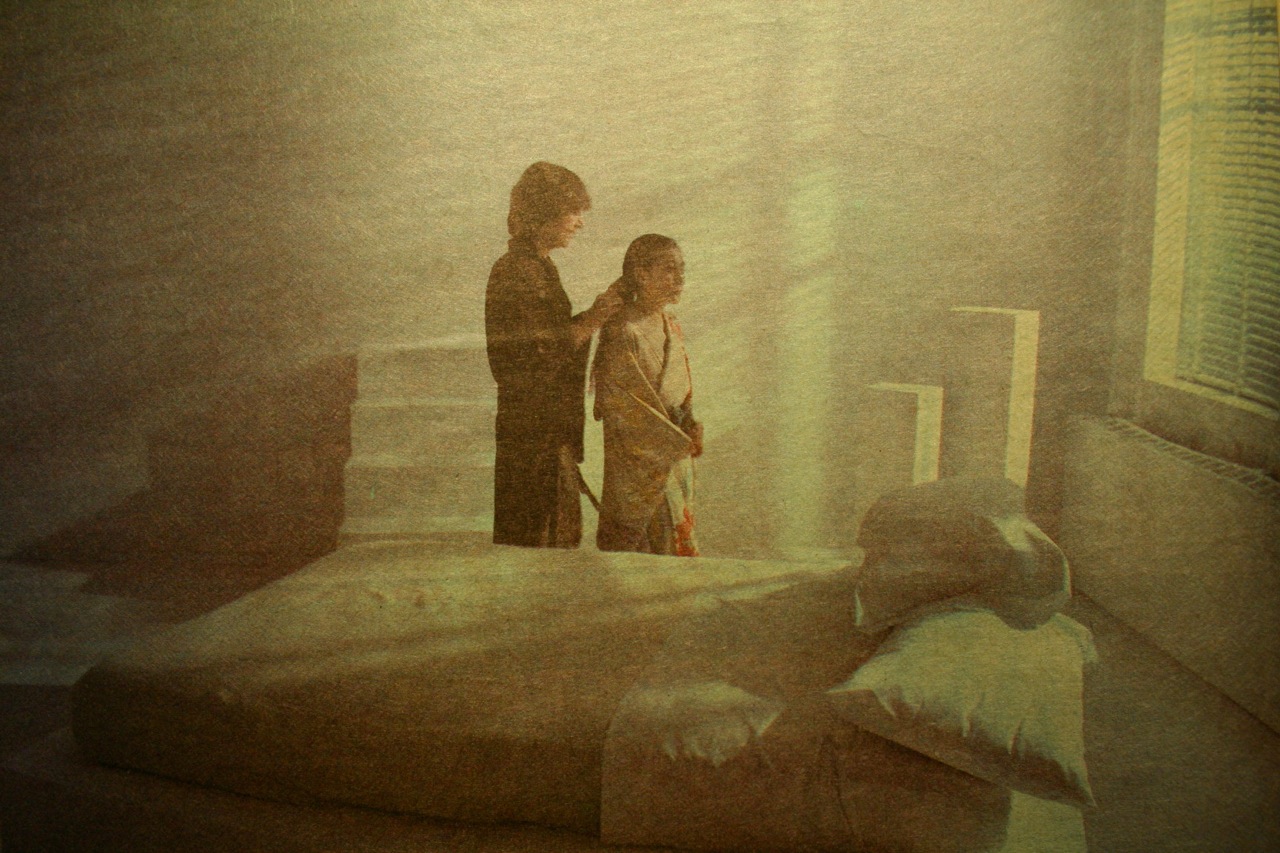
Of course John and Yoko frequently made the cover of Rolling Stone, and there have been some striking images of them published. Who could forget the most famous Annie Leibovitz shot of the pair? But this one comes a close second I reckon. Its by Allan Tannenbaum and it is a beautiful contemplative study that perfectly accompanies an article by Chet Flippo (which was an extract from the book “The Ballad of John and Yoko”, first published by Rolling Stone Press in October, 1982) detailing the years from 1975 to 1980 when John Lennon dropped out of rock & roll, retreating to his white bedroom in the Dakota building in New York. Inside, the article is accompanied by another touchingly composed Tannenbaum photograph:

John and Yoko, New York City, November 1980 (Tannenbaum)

See more Allan Tannenbaum photographs from the same session here.

In November, 1987 Rolling Stone celebrated twenty years on newsstands with a 20th Anniversary Special Edition. In it they re-published a selection of Letters to the Editor from across the 20 years. This one, from 1974, is telling: “John Lennon has given more to America that Nixon and Ford….He fought for peace a long time before it came to the attention of the government that “the people of America” wanted peace. Lennon was concerned about America, and now they’re deporting him. Nixon has admitted he’s a crook; why don’t we deport him?” – Lynn Grubbs, Malvern, Arkansas. And then this, from 1981, sadly again about John Lennon: “We’ve come a long way in seventeen years, from shooting presidents to murdering musicians.” – Jon Grabill, Wayland, Massachusetts…..this was the cover of that special edition:
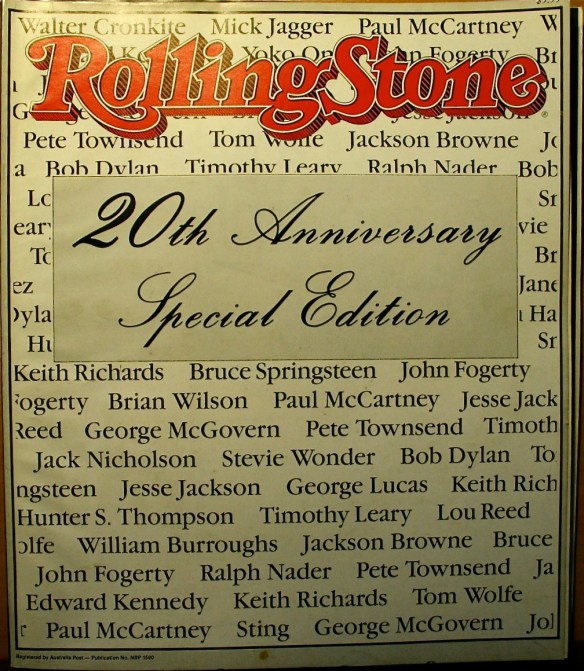
(November 1987) 20th Anniversary Special Edition.

The special edition was comprised of a series of previously-published Rolling Stone articles. There’s one on Paul McCartney by Anthony DeCurtis, and one on Yoko Ono by David Fricke. There are some image galleries as well from across the twenty years, but they only include one photograph of John Lennon.
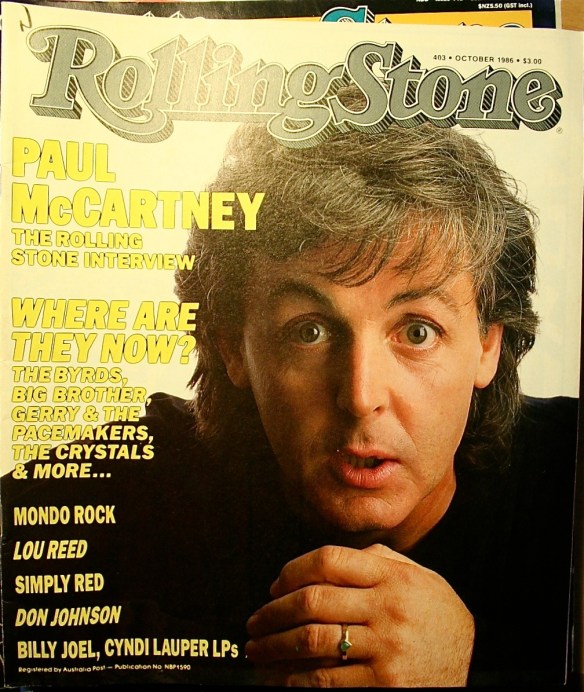
(October 1986) Issue 403 Paul McCartney - The Rolling Stone Interview

October, 1986 saw another Paul McCartney cover shot (above) – with very grey hair and an interesting heart-shaped ring on Paul’s wedding finger…? The Rolling Stone interview was by Kurt Loder, who begins: “It is Monday in London, two days before the royal wedding, and Soho Square is filled with flowers, sunshine and fresh-faced young tourists. Some loll on the grass, sharing joints. Others peer up expectantly at the etched-glass windows of an art-deco-style town house across the street, where, in an airy third floor office, Paul McCartney presides over the bustling affairs of MPL Communications, the company that manages the professional projects of the singer and his wife, Linda.”
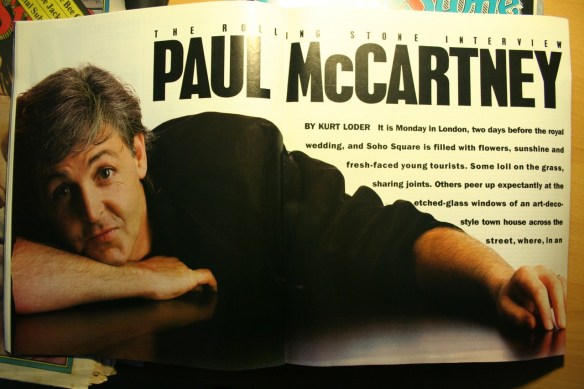
Inside Rolling Stone, Issue 403

The McCartney’s were doing publicity for “Press To Play”, the fifteenth album he’d released since he announced the breakup of the Beatles in 1970…..Loder observed “After eight years of largely lackadaisical releases on Columbia, he is back with Capitol – the Beatles’ old label – and he seems serious about rehabilitating his somewhat tattered artistic reputation.”

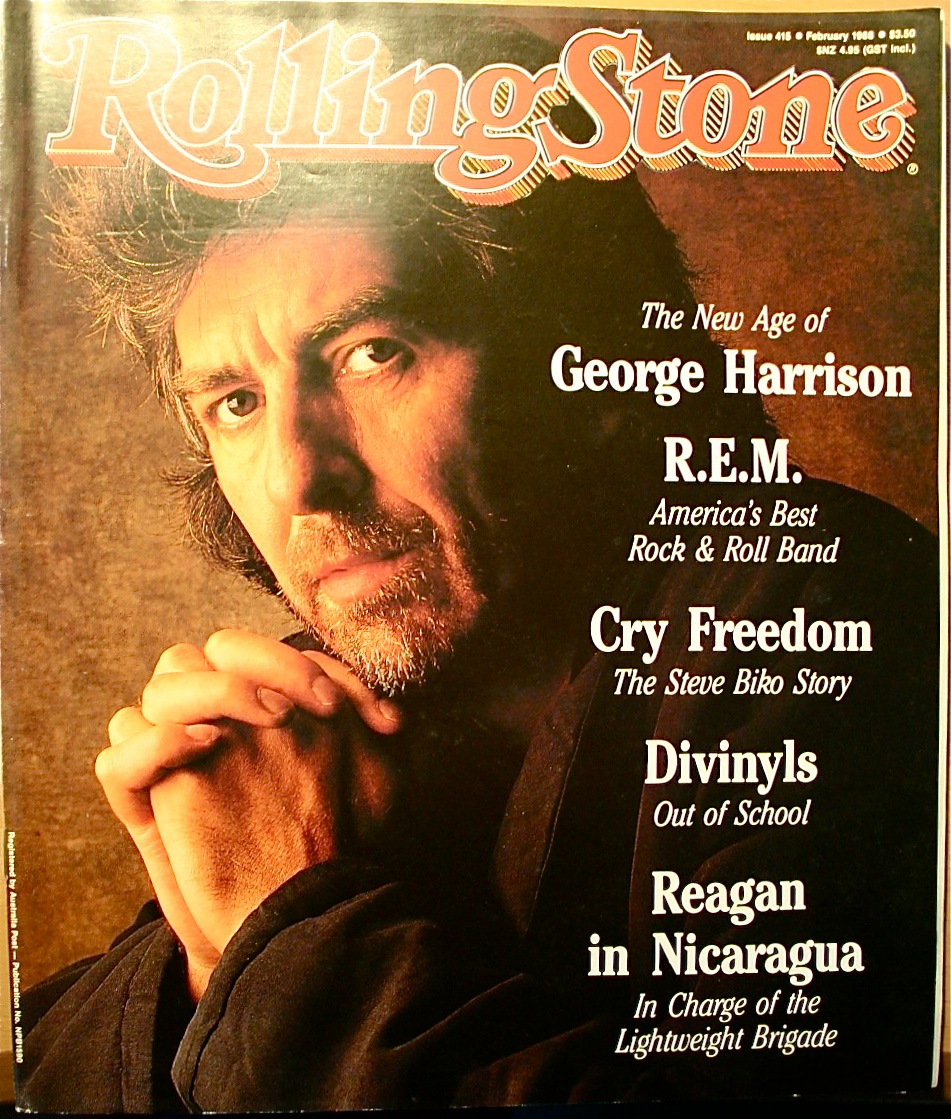
(February 1988) Issue 415 The New Age of George Harrison

In 1988 George had a new record to push. “Cloud Nine”, his first record in five years, had just been delivered to Warner Brothers Records. The article, by Anthony DeCurtis, is a really good read about George, the production of the album (with ELO’s Jeff Lynne), his past, and where he was at in 1988. “After years of tending his garden, his movie company and his son, the elusive ex-Beatle has reemerged with a great album”.

The front page of Issue 424 has an image of John Lennon and the words “Lennon – A Special Photo Album and the inside story on Goldman’s book”:

(November 1988) Issue 424 Lennon - A Special Photo Album and the inside story on Goldman's book

Inside is a revealing article by David Fricke and Jeffrey Ressner called “Imaginary Lennon – The True Story Behind Albert Goldman’s Character Assassination of John Lennon”. That title pretty much says it all… Albert Goldman’s controversial book “The Lives of John Lennon” had just been released, and his publishers claimed it to be “…a startling and revolutionary portrait”. Fricke and Ressner write however that it is not “the definitive biography”. “In fact,” they say, “the book is riddled with factual inaccuracies, embroidered accounts of true events that border on fiction and suspect information provided by tainted sources.” The magazine devotes five and a half pages to taking apart Goldman’s work. The article is worth digging out if you can. As if to balance that, Issue 424 also has six pages of candid Lennon photographs from another book (“Imagine: John Lennon” by Andrew Solt and John Egan). Here’s a terrific, early shot of Lennon, Paul McCartney, drummer Pete Best and George Harrison – taken by Paul’s brother, Mike McCartney:

Early Beatles (Mike McCartney)

Issue 443, in April 1990 also contained a wealth of rare early photographs, though it was the B52’s who made it onto the front cover. You have to look pretty closely for the Beatles reference:
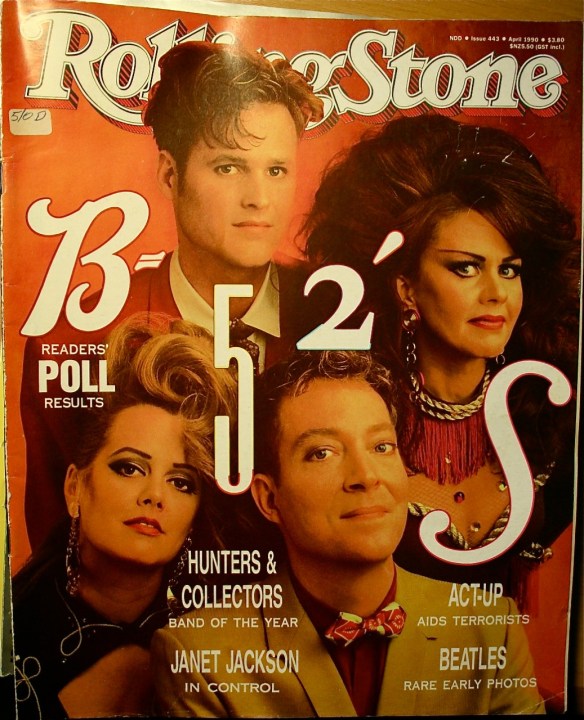
(April 1990) Issue 443 The Beatles Rare Early Photos

This contains never-before-published photographs that chronicle the Fab Four’s first American tour in 1964. They are all taken by Curt Gunther, and I think you’ll agree they are impressive. I’d never seen these before and will certainly be seeking out the book they come from. Here are just a few from the Rolling Stone eight page spread:

Fans from Harrisburg, Pennsylvania at Indianapolis airport (Curt Gunther)
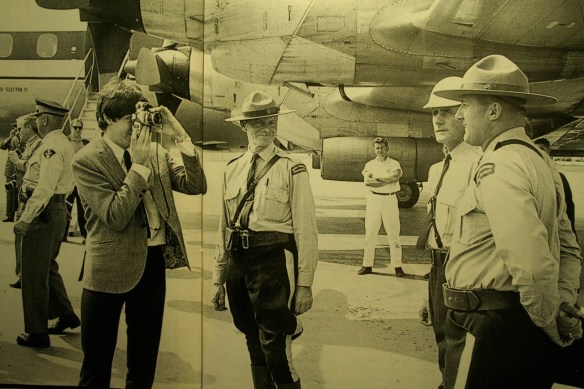
Paul photographs Canadian Mounties at Malton Airfield, Toronto (Curt Gunther)
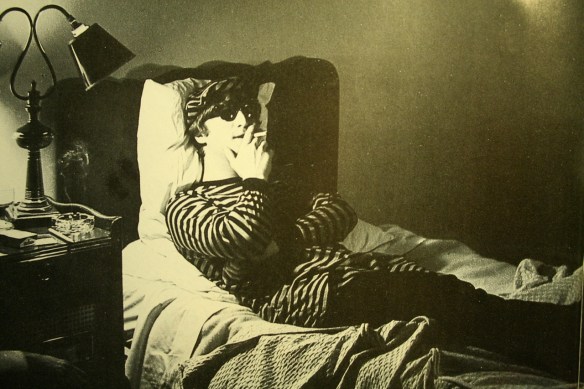
Lennon in bed, King Edward Hotel, Toronto (Curt Gunther)

All the photos above were reproduced in Rolling Stone, but come from the book “Beatles ’64: A Hard Day’s Night in America” released in 1989. Photographs by Curt Gunther, text by A.J.S.Rayl.  There are also some fantastic Gunther images here from the Genesis Books publication “Mania Days: The Beatles 1964 US Tour”

October, 1990 saw Rolling Stone release another special issue. This time it was The Sixties – The Age of the Beatles. And it was an excuse for a psychedelic-look, Beatles-inspired cover:
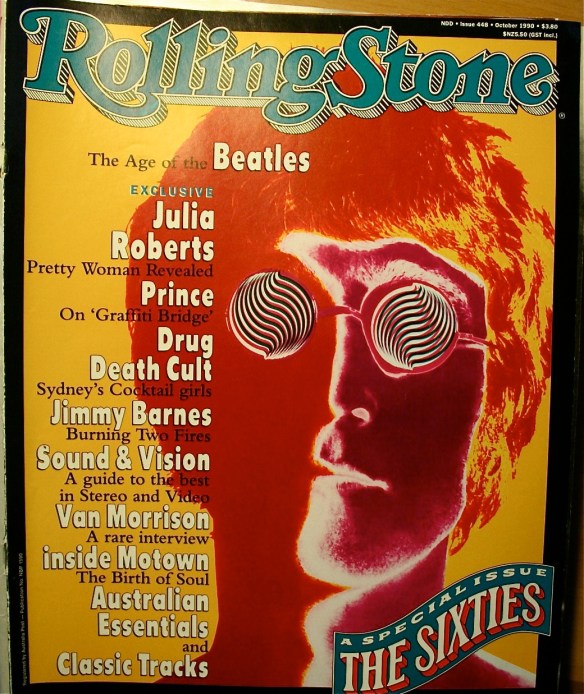
(October 1990) Issue 448 A Special Issue: The Sixties - The Age of the Beatles

Mikal Gilmore in his feature article “The Sixties” spends a lot of time on the Beatles and their impact throughout that turbulent decade: “In short, the Beatles were a rupture – they changed modern history, and no less craftsman than Bob Dylan understood the meaning of their advent. ‘They were doing things nobody else was doing. But I just kept it to myself that I really dug them. Everybody else thought they were just for the teenyboppers, that they were gonna pass right away. But it was obvious that they had staying power. I knew they were pointing the direction that music had to go….'”.

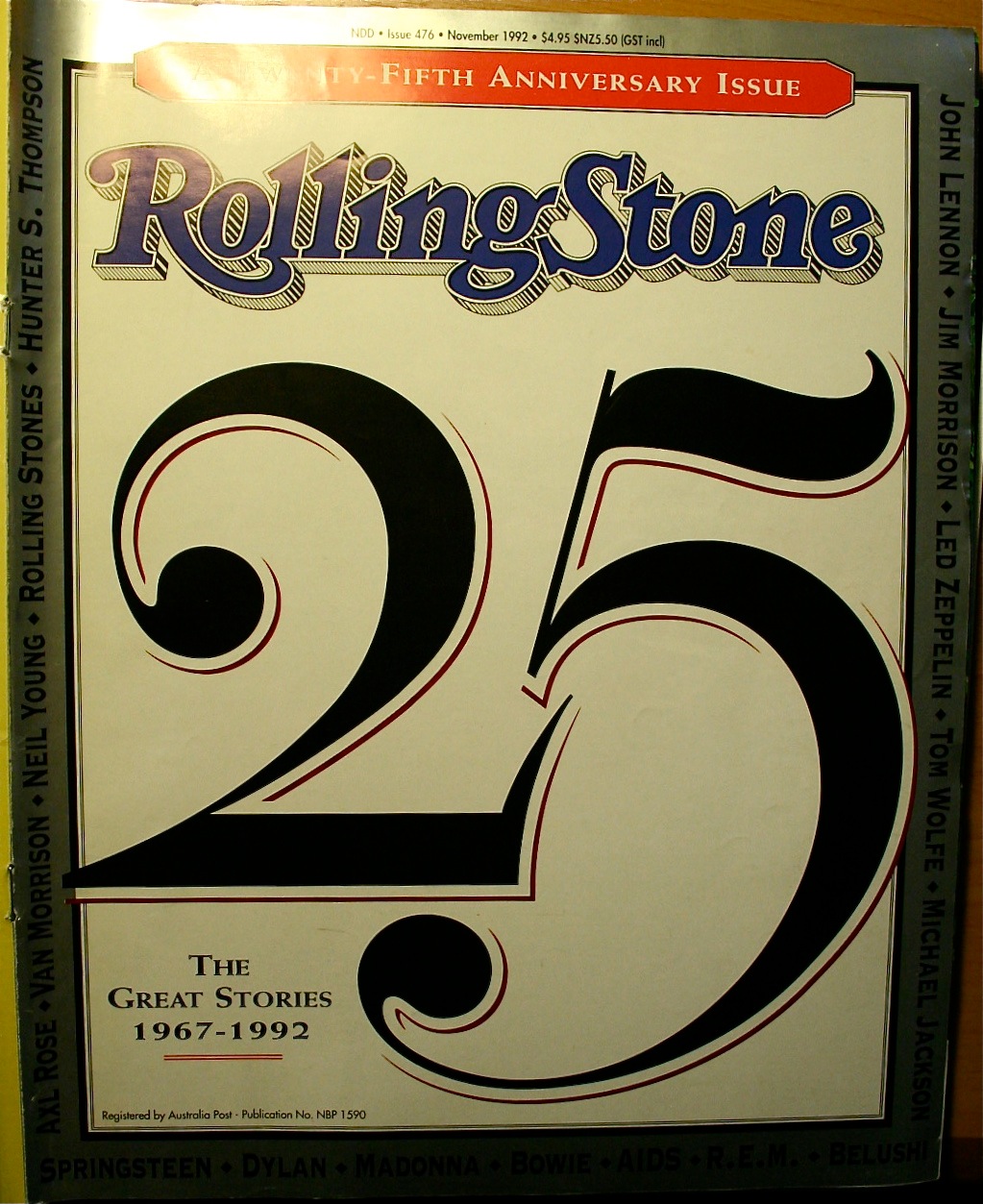
The final magazine to pop out of the large pile was from November, 1992, issue 476, a 25th Anniversary Special Edition, subtitled “The Great Stories 1967-1992”.
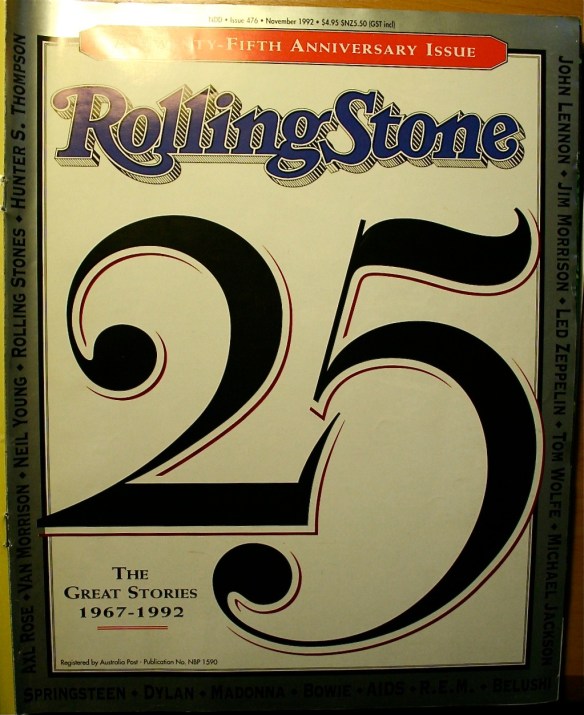
(November 1992) Issue 476 25th Anniversary Special Edition

Like the special Twentieth  Anniversary edition (above) this one contained some of the all-time great articles ever written by Rolling Stone‘s staff writers and contributors over the past quarter of a century. There are pieces on Led Zeppelin, the Rolling Stones, Springsteen, Bowie, Van Morrison, REM, Madonna, Neil Young, Michael Jackson and (of course) Bob Dylan, but probably pride of place was given to the now legendary interviews with John Lennon by Jann S. Wenner – a 30,000 word verbal splurge in which the ex-Beatle spoke openly, fully and truthfully about the Beatles and announced their breakup:

The Jann Wenner interview with John Lennon in Issue 476

Originally from Rolling Stone Issues 74 and 75 in 1971, this was Lennon talking about the demise and aftermath of the Beatles as he saw it – for the first time.  You can listen to extracts and read transcripts at Jann Wenner’s own page.

So, that it. An accidental journey through the past through random editions of Rolling Stone magazine – mags that have been hidden away in a cupboard at home for over 17 years…..

Beatles “Love” – A Further Collectable Variation

Following my post on some of the release variations I have in my collection of the Beatles “Love” CDs and LP, I had a note from Ned in the United States who has a very interesting and unique CD single from the “Love” releases.
He has in his collection this rare Japanese promo CD single:

LOVE rare promo single - front cover

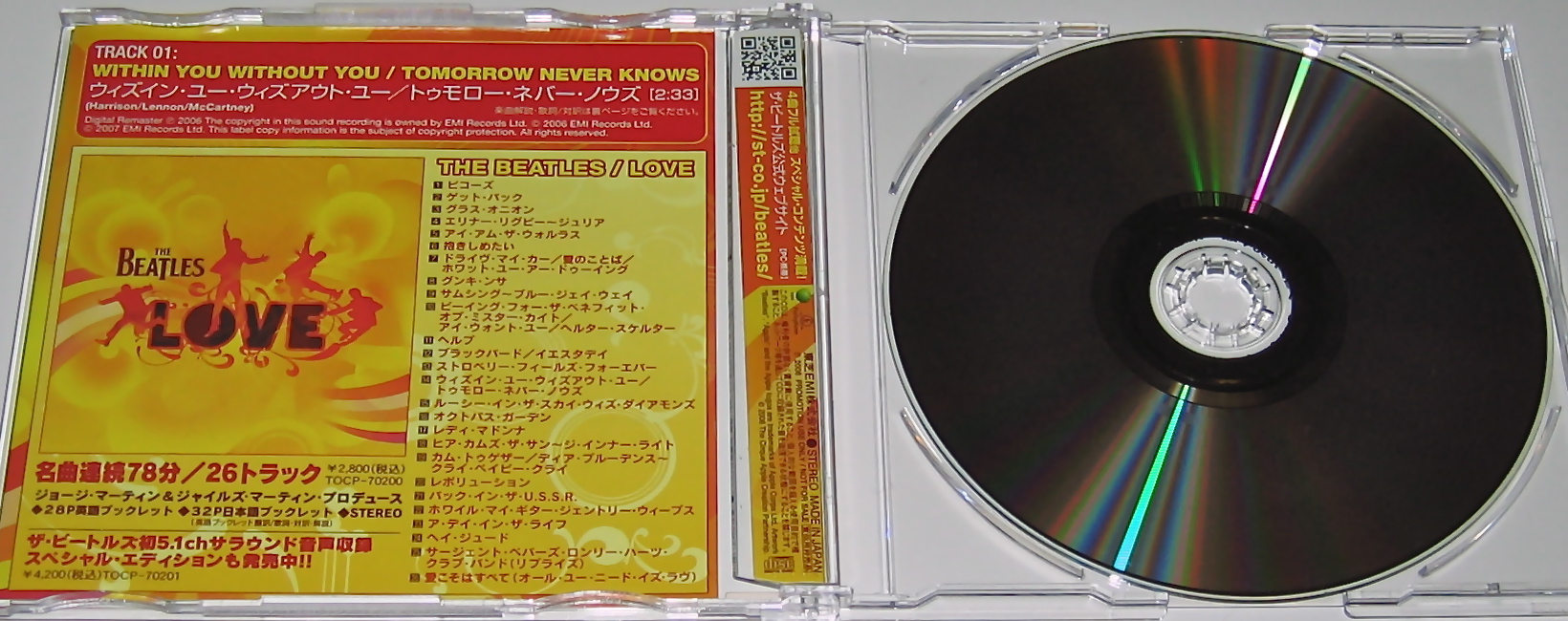
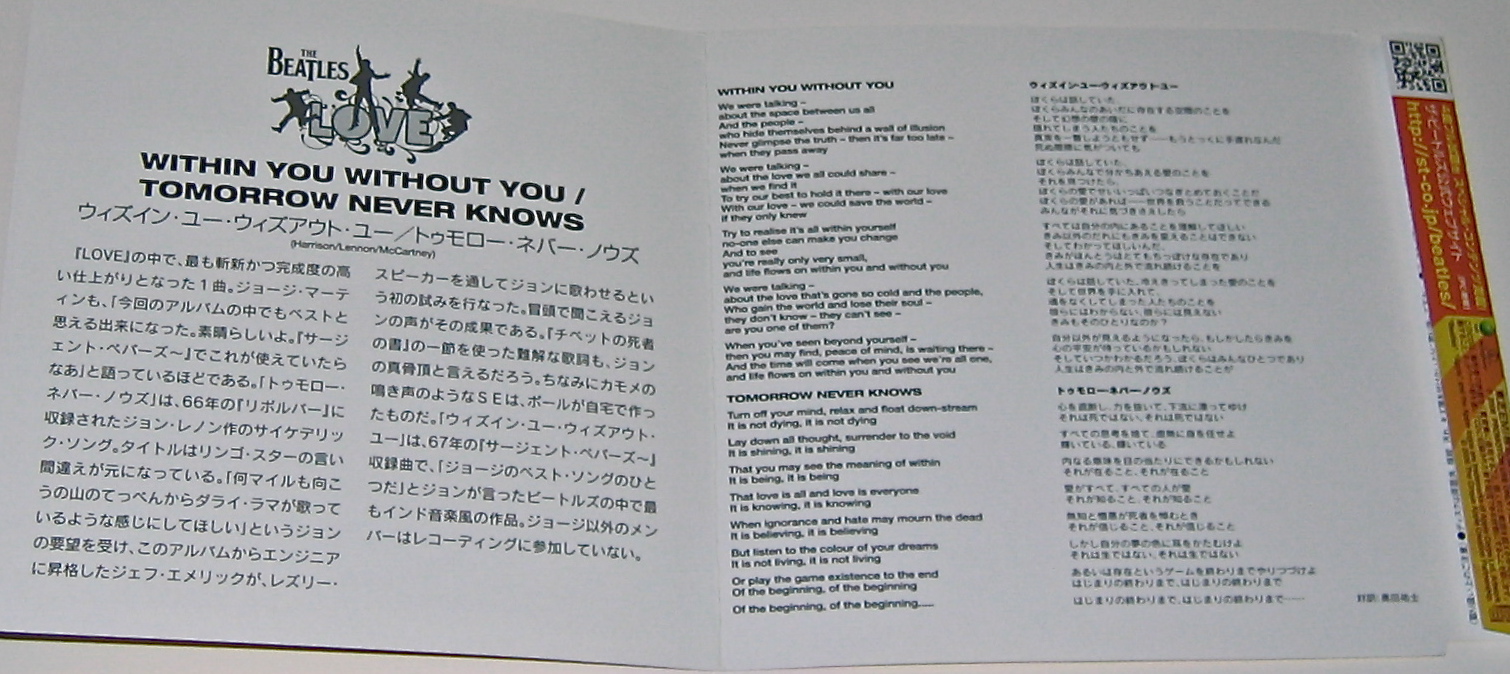
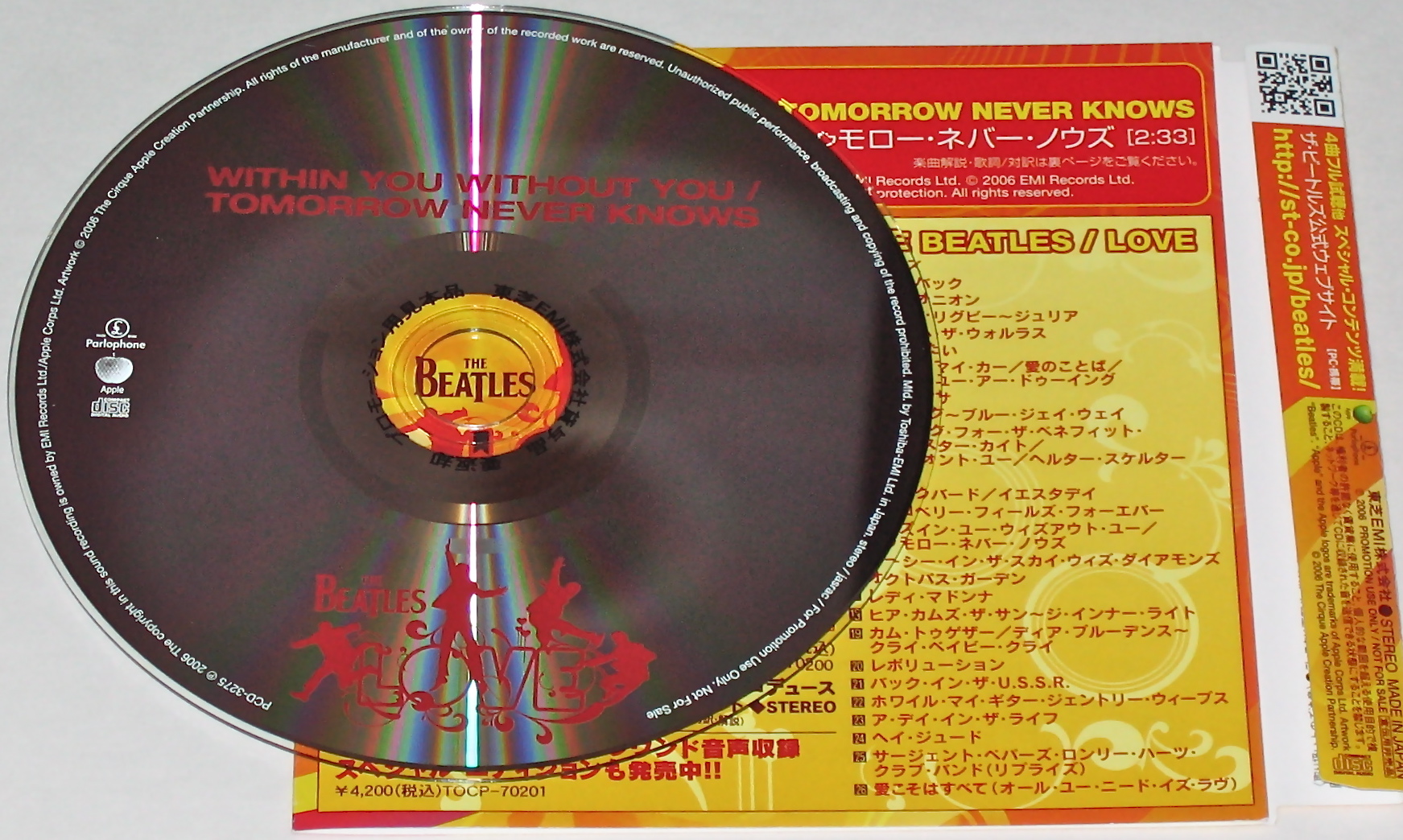
As you can see above, it has the familiar bright yellow “Love” cover art work – but it contains just one track from “Love” called “Within You Without You/Tomorrow Never Knows”, a mash-up mix by George and Giles Martin of the basic track and vocal from “Within You Without You” (originally released on “Sgt Pepper”), and the drum track from “Tomorrow Never Knows” (taken from “Revolver”).  Giles Martin said “This was the first thing we did (for the “Love” project). We played it for them (Paul and Ringo) and they said ‘we want more like that!’  We had to remind them, ‘Fellas, you know that on most songs you did actually change chords!”  George Martin said at the time: “‘Within You’ is not the most memorable song, but it’s much more interesting with that rhythm.”
According to Ned this CD single was created for Japanese radio stations and issued by EMI Japan without the full knowledge of EMI’s London office. When they found out it was withdrawn shortly after release, thus making it a very collectable item. “It is absolutely NOT an unauthorized release but remains the only CD single issued from the “Love” project”, says Ned.

LOVE single - inside

It has a nice insert that lists the other tracks on the full CD release:

LOVE single - booklet

Ned writes: “I mail ordered this from Japan right at the time of the opening of the show in Vegas.  I believe it ran me around US$20 – including shipping.  I have no idea what the value is now as I only collect what I like and not what might be worth something someday.  Apparently, Yoko Ono had (has) the same collecting philosophy and it has served her well.
Ned has two other favorite Beatles-related items. One is a still-sealed, 4 CD Lennon box from 1990 with a blank space on the back cover art where the song “Imagine” should be listed (the song is on the disc, however). “I bought this one from a woman going through a bad divorce.  She only wanted US$15 for it.  Even though I was very much interested I IMPLORED her to ask for more because I knew she could get it.  However, she insisted because, to her, it represented her former husband.  (Years earlier, I had regretfully sold my copy…and I was desperate to get a copy back in my possession).”
The other item is a withdrawn, mid-80’s CD release of Lennon’s Shaved Fish – manufactured in Japan for the U.S. market – that has slightly different artwork on it. “It was withdrawn because EMI either failed to use “No-Noise” on the master tapes or the tapes they did use were from inferior sources.  Either way, the hiss is more apparent than the common one.  But the fact that it was quickly pulled off the market makes it of interest”, says Ned.

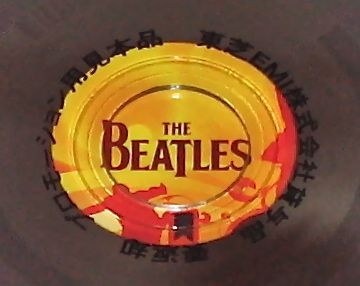
But back to the “Love” promo CD. “Promo Sample” is printed in Japanese around the hub. The catalogue number on the disc is PCD-3275.

LOVE single - the Japanese promo writing around hub

Sincere thanks to collector Ned for all the info and photos. Here’s a clearer picture of the black  promo writing around the center of the CD single’s hub:

LOVE single - promo hub close-up

Beatles “Love” – Lots of Collectable Variations

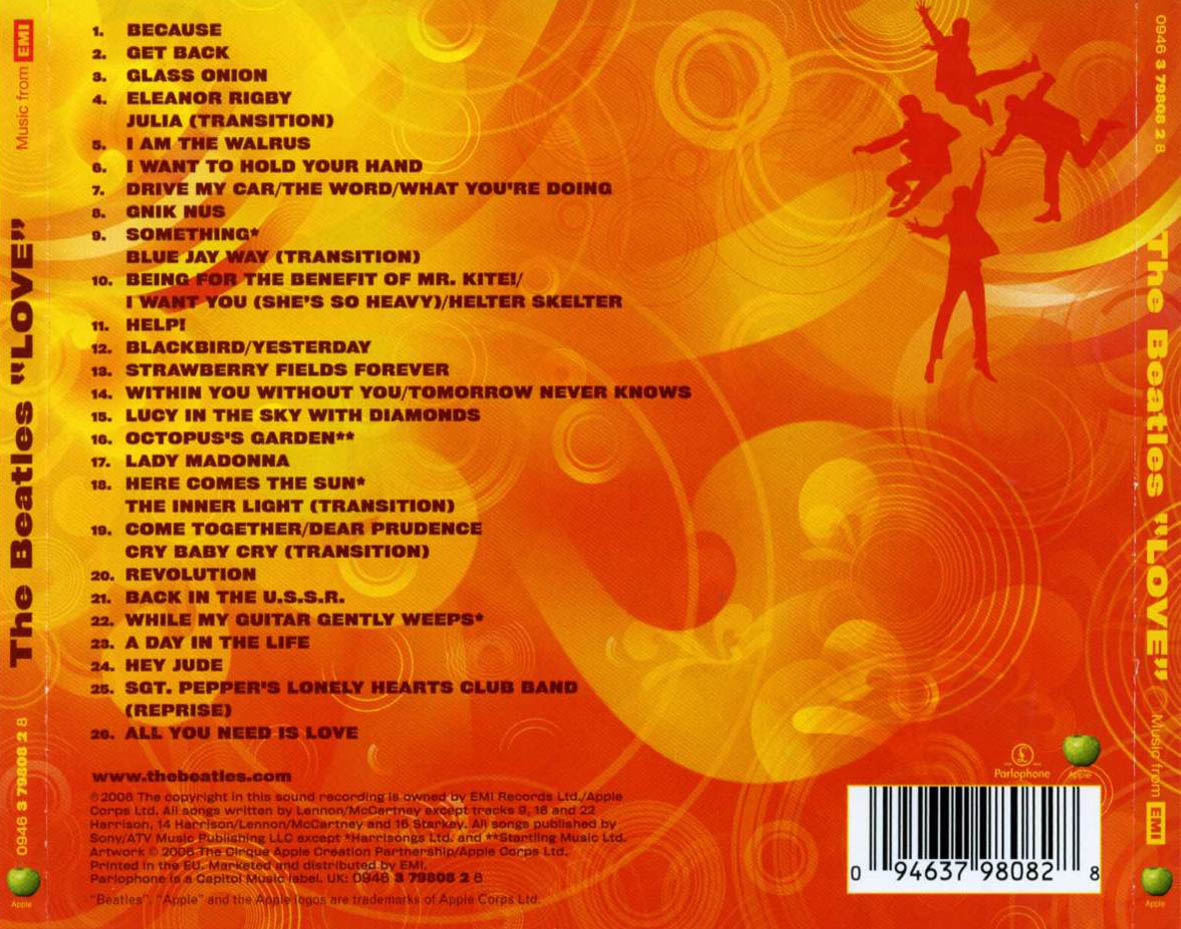
At the Beatles own official website there’s a lot of info about “Love” their 2006 album, which is not only the soundtrack to the Cirque du Soleil performance show celebrating the Beatles music, but also a controversial departure for the Beatles in that its made up of some of their best-known songs remastered and re-mixed with sounds and songs from across their extensive catalogue. “Love” is produced by longtime Beatles producer Sir George Martin and his son Giles, and it won two Grammy Awards in the categories Best Compilation Soundtrack Album for Motion Picture, Television or other Visual Medium, and Best Surround Sound Album.

For dedicated Beatles fans and collectors it proved to be a bit of of a challenge. Firstly, had the Beatles done the unthinkable and started to mess with the canon? Debate still continues as to whether this was a smart move, or a folly. Additionally, there were numerous release variations to buy if you were an avid collector. Two CD versions, promotional CDs, and other bits and pieces to track down for the completists amongst us…

To start with there was a single disc with the standard stereo mix in a standard jewel case:

“Love” single CD – front cover

“Love” single CD – rear

“Love” CD – with the single CD artwork

Then there was a two-disc set that came with more elaborate packaging. It’s a double fold-out Digipac in a thick slipcase. The package contains the single CD with the standard stereo mix (but with a slightly different printed image on the CD to the single version CD shown above). Added to this is a separate DVD disc containing the 5.1 surround sound mix. Same track list and songs – but if you have a 5.1 stereo set-up at home, the songs and sound effects surround you. It has the same booklet as the single CD release.

“Love” two disc edition – front cover

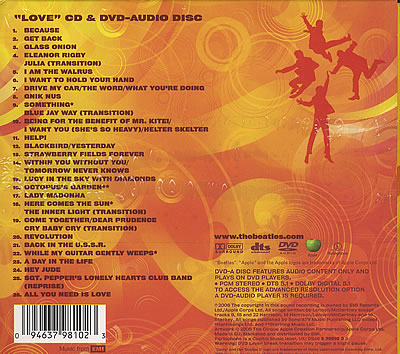
“Love” two disc edition – rear of slipcase

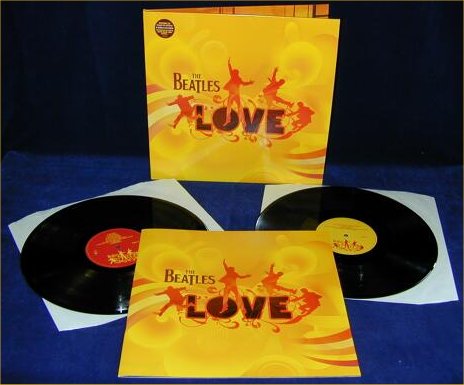
The final official commercial release (which came out a few weeks after the CD’s) was the vinyl LP. It arrived in a deluxe, 2 disc, gate-fold package. Mine is still sealed, so these images I’ve borrowed from the web.

“Love” vinyl LP set

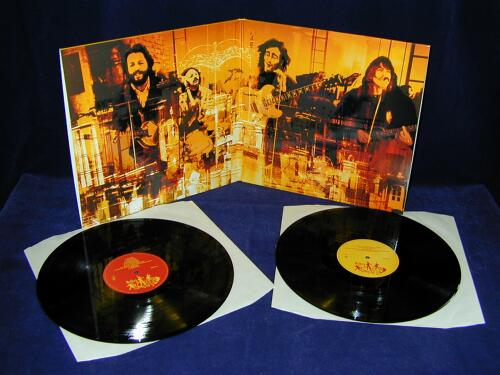
“Love” gatefold open

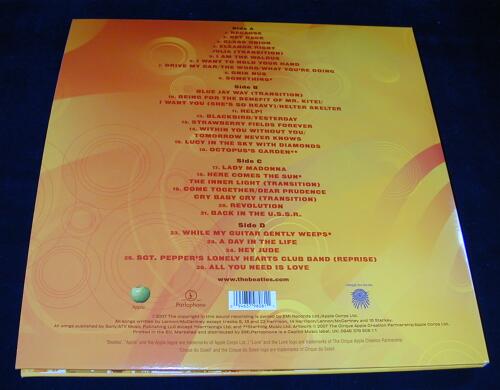
“Love” vinyl LP – rear

As you can see the vinyl edition came with custom labels for each LP, and is contained in a gate-fold cover with a large-format book. Its similar to the CD booklet, but because of the large format – complete with rich colour images from the Cirque du Soleil production – it is way more impressive.

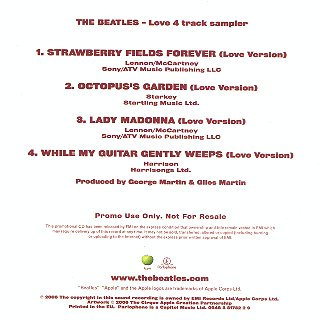
There was also a four-song radio sampler released to stations around the world. This was done in an effort to generate publicity and conversation about the forthcoming new Beatles release for 2006. The songs on it were “Strawberry Fields Forever”, “Octopus’s Garden”, “Lady Madonna” and “While My Guitar Gently Weeps” (which was one of the most anticipated tracks from the whole album as it was George Harrison’s original demo tape of the song accompanied by a completely new string arrangement composed by George Martin for the new “Love” record). This promo CD was sent out with a press release containing quotes from Sir George Martin and his son Giles – who co-produced the album – talking about the four tracks on the promo CD. They describe how those songs were selected and give some of the background to the production techniques employed in mashing together different parts of Beatles songs to pretty much make completely new versions -a radical thought at the time. The cover of the radio sampler promo CD looks like this:

“Love” radio sampler promo CD – front

And the rear:

“Love” radio sampler promo CD – rear

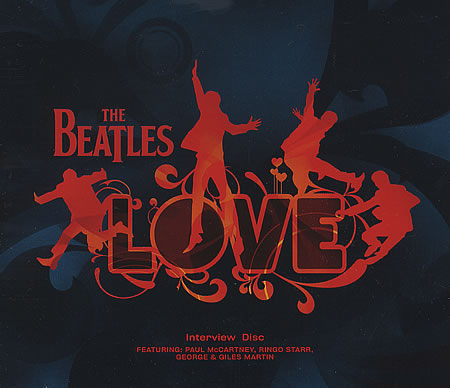
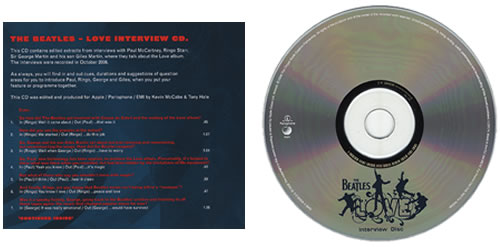
Apple/EMI was obviously determined to give “Love” the full promotional and marketing treatment because they also pressed and distributed (in limited numbers) a special “Interview Disc” featuring Paul McCartney, Ringo Starr and George and Giles Martin in conversation about “Love”. The interviews were recorded in October 2006, and they are all stand-alone statements about dirrent aspects of the work that went into producing “Love”, and the running order works through the release track-by-track. Its an interesting historical artifact to have in the collection. And definitely an authentic, original release. As you can see, again it has a colour variation of the “Love” artwork common to all releases:

“Love” promotional interview disc – front cover

“Love” promotional interview disc – rear cover and CD art

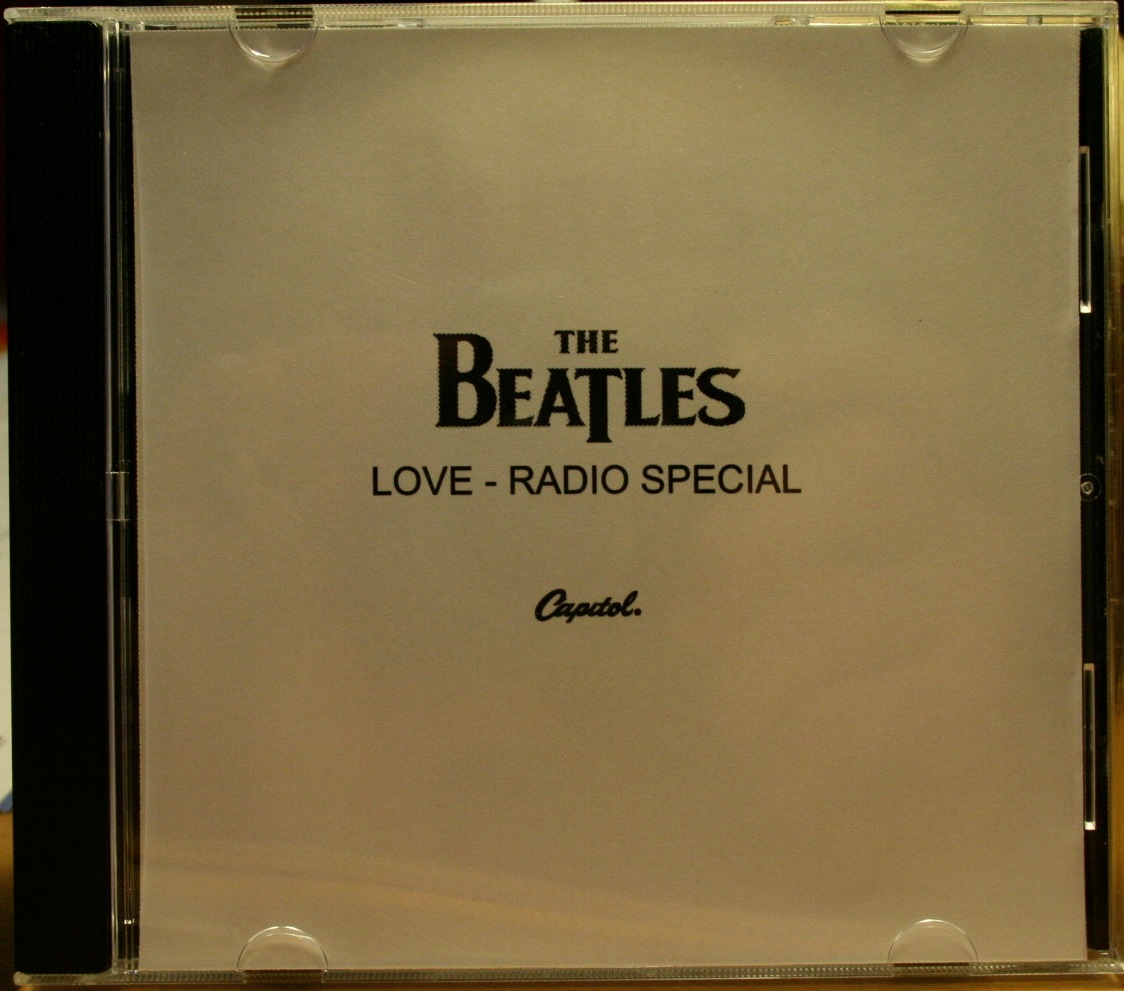
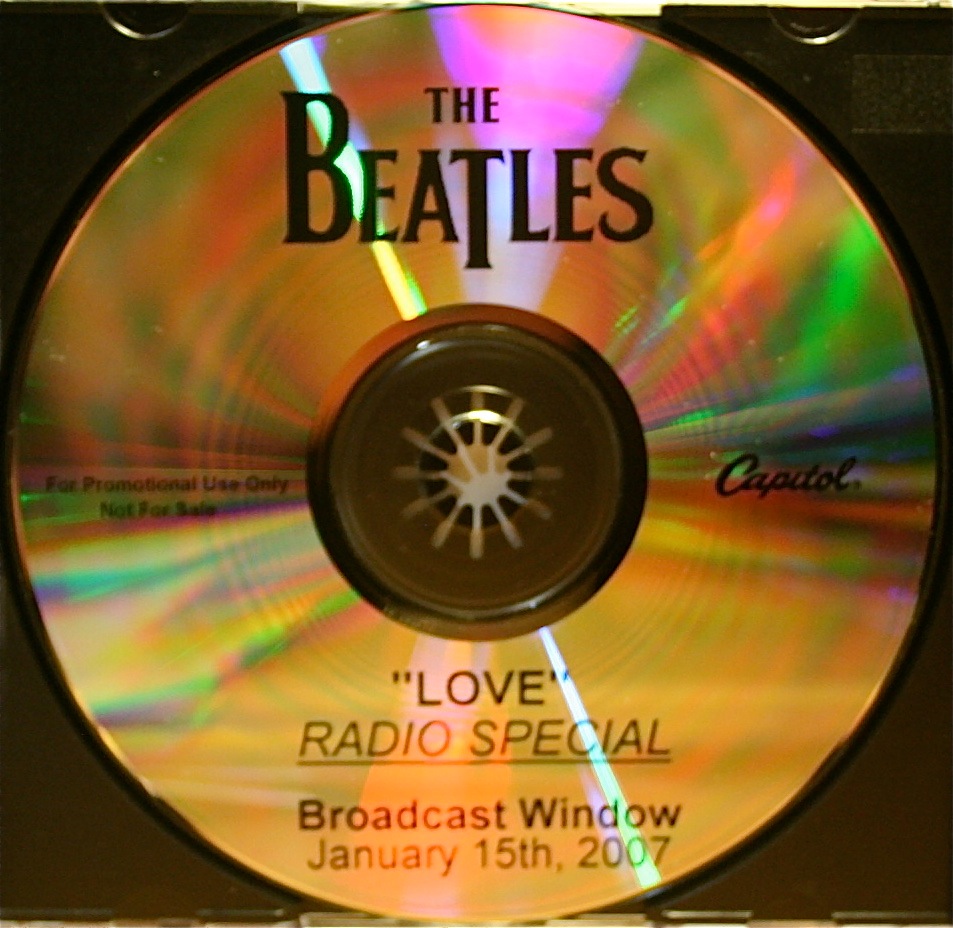
This disc is entirely spoken word and contains edited voices only. No music. The idea was that radio stations would get the songs from the official CD and make their own radio specials. For a time there on the web, via Ebay and the like, there was also a disc called “The Beatles Love – Radio Special”, purportedly distributed by Capitol in the US. I got a copy of this but, while someone has gone to a lot of trouble to make it look authentic, there is something suspicious about this one. The special is hosted by a DJ named Andre Gardner. If you Google him he seems legit, very much associated with covering Beatles news, hosting a show on WMGK in Philadelphia and having a Facebook page dedicated to the Beatles. Now, Capitol may well have commissioned this radio special and hired Andre to host it. It does have additional material to the official “Interview Disc” in that there are comments on “Love” by Olivia Harrison and Yoko Ono in addition to Paul, Ringo, and George and Giles Martin. And it comes with an official-looking running sheet, with track details and outcues. Here’s a short extract from the program:

There are some images of this CD below. If anyone can shed any more detail on this release – drop me a comment and let me know….

“Love” Capitol Records Radio Special – front cover – genuine?

“Love” Capitol Records Radio Special – CD

Meanwhile….at the time of the “Love” release the Beatles official website had not long been launched (it looked quite different to it’s present incarnation), and Apple used the new site to deliver a series of five down-loadable podcasts to further promote “Love”. Each was between six to seven minutes in duration, and like the official “Interview Disc” above, it contained extracts of Paul, Ringo, George Martin and Giles Martin talking about “Love”. Hosted by UK presenter Robert Lindsay, it contains music extracts mixed with the spoken word extracts. Quite nice to have.

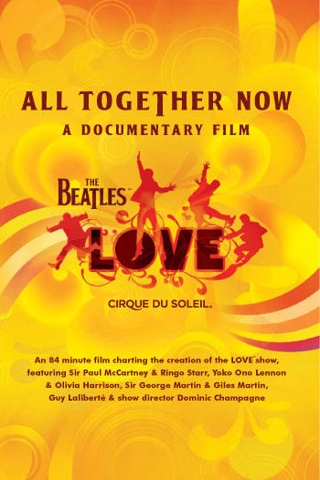
Yet another spin-off for collectors was the DVD “All Together Now”, a documentary film about the creation of the Cirque du Soleil show and the accompanying soundtrack CDs. Earlier this year took out a Grammy Award for Best Long Form Music Video. (I posted about this at the time).

“Love” – the “All Together Now” DVD documentay

You can still see “Love” by Cirque du Soleil at The Mirage Casino in Las Vegas. MTV reviewer Gil Kaufman saw the show just last month (April, 2010) and had this to say. The Beatles own site has some fun facts about the “Love” show.

Finally, an official printed promotional cardboard flyer for the two CD releases came my way. It’s about foolscap size, and is four pages in all – the front looks like this:

“Love” cardboard promotional flyer – front cover

Let It Be at 40

Can you believe it?

Let It Be turned 40 last weekend.

Here’s the Wikipedia extract with a brief detail of the album:

Let It Be  was the twelfth and final studio album released by The Beatles. It was released on 8 May, 1970 by the band’s Apple Records label shortly after the group’s announced breakup.

Most of Let It Be was recorded in January 1969, before the recording and release of the album Abbey Road. For this reason some critics and fans, such as Mark Lewisohn, argue that Abbey Road should be considered the group’s final album and Let It Be the penultimate. Let It Be was originally intended to be released before Abbey Road during mid-1969 as Get Back, but the Beatles were unhappy with this version, which was mixed and compiled by Glyn Johns, and it was temporarily shelved. A new version of the album was created by Phil Spector in 1970 and finally released as Let It Be, serving as the soundtrack album for the 1970 motion picture of the same name.

Let It Be - film lobby card

Let It Be - lobby card - Paul

While three songs from the sessions were released as singles before the album’s release, “Get Back”/”Don’t Let Me Down” and “Let It Be”, the songs were remixed by Spector for the album.

The rehearsals and recording sessions for the album did not run smoothly. The acrimony that began during the recording of the previous year’s White Album resumed soon after the rehearsals began. At one point, George Harrison walked out and quit the group after severely arguing with both Paul McCartney and John Lennon, only to be coaxed back some days later. The film version is famous for showcasing a number of conflicts between the group members and has frequently been referred to as a documentary intended to show the making of an album but instead showing “the break-up of a band”.

Despite a largely negative review from Rolling Stone magazine at the time of its release, the album was ranked number 86 in the magazine’s list of the 500 greatest albums of all time in 2003.

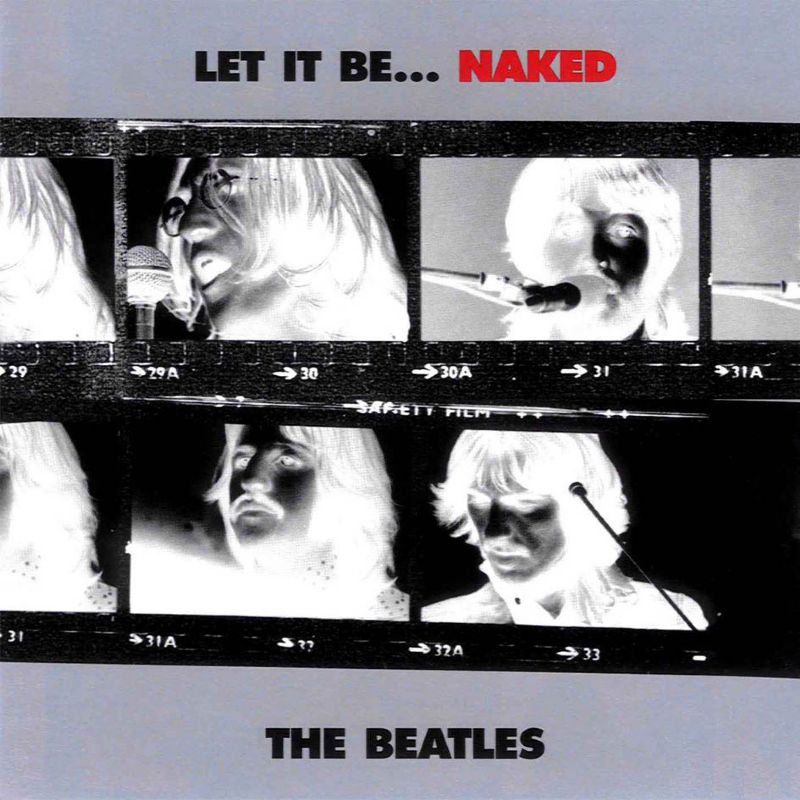
Let It Be… Naked was released in 2003, an alternative version of the album stripping much of Phil Spector’s production work and using some different versions of songs.

Let It Be - Naked (2003)

Here’s an article from Rolling Stone magazine this week:

Forty years ago this weekend, the greatest band of all time gave the world their final album together: On May 8th, 1970, the Beatles released Let It Be, the Phil Spector-produced LP that featured hits like the title track, “The Long and Winding Road” and one of John Lennon’s most famous compositions, “Across the Universe.” While the album was recorded during the band’s caustic final days, Let It Be would go on to become one of their most celebrated records: it ranked Number 86 in Rolling Stone‘s 500 Greatest Albums of All Time.

The story behind Let It Be is almost as mythic as the Beatles themselves. The band originally intended to record it as a live-in-the-studio album and movie in 1969. But the ambitious undertaking left the Beatles so weary, they abandoned the project to make Abbey Road instead. Later, Phil Spector added oversweetened orchestral overdubs to many of the album’s tracks — even though the record features some of the band’s strongest rock songs ever (including “Get Back”). In 1970, the Beatles released the documentary film of the same name, which captured the group’s iconic performance atop the Apple Studios building in January 1969. Perhaps due its controversial and detailed look at the Beatles’ interpersonal problems, the film itself remains unavailable on DVD.

Despite the album’s status in rock history, Paul McCartney was never a fan of Phil Spector’s production flourishes on Let It Be. In Rolling Stone‘s original review of the album, writer John Mendelsohn also criticized Spector’s superfluous additions, saying the famed Wall of Sound producer rendered “The Long and Winding Road” “virtually unlistenable with hideously cloying strings and a ridiculous choir” when compared to the version that appeared on the Get Back bootlegs in May, 1969. After years of dissatisfaction with the released version, McCartney announced plans to put out Let It Be… Naked in November 2003, which stripped the Let It Be songs of Spector’s ornate production.   (Daniel Kreps – Rolling Stone)

Finally, here’s the sound of  “Get Back” in an early incarnation, in rehearsal with John singing lead instead of Paul, and clearly the words to the song are still coming together….

See also: Label Variations – Part Two – Let It Be

Japanese Beatles EP Box Set

It must have been 27 years ago. It was a chance visit to a local record shop in Forestville, a northern suburb of Sydney, Australia.

Back then “record” stores were just that. They sold vinyl records. However, at the time many were in a state of transition. Compact Discs had just come out and the writing was very much on the wall for the humble vinyl record. At the time this record shop was in the process of getting rid of it’s vinyl, settling into the retailing of CD’s, and transitioning to become a video movie hire shop – on the way out of music all together.

I walked in for a look around and saw this small box set on one of the shelves:

Box set – The Beatles E.P.’s Collection

It was sitting alone. Catalogue number: Odeon Mono EAS-30013-26.

You had the definite feeling that it had been on that shelf quite some time….had not sold…and the owners were definitely keen to shift it. I took it down and noticed it didn’t have a price sticker on it. I also noticed that amongst the individual vinyl singles they still had displayed that they’d opened at least one other similar box set to break up the contents and sell the EP records it contained individually.

I walked up to the counter and asked “How much is this one?”, holding up the box set. “You can have it for A$25.00”, said the guy behind the counter. Now, back then it wasn’t dirt cheap, but it was cheap for the quality of this mint, red vinyl Japanese copy of the entire Beatles Extended Play vinyl discs. I bought it.

What you see here is that same box set from all those years ago.

Beatles E.P.’s Collection – box spine

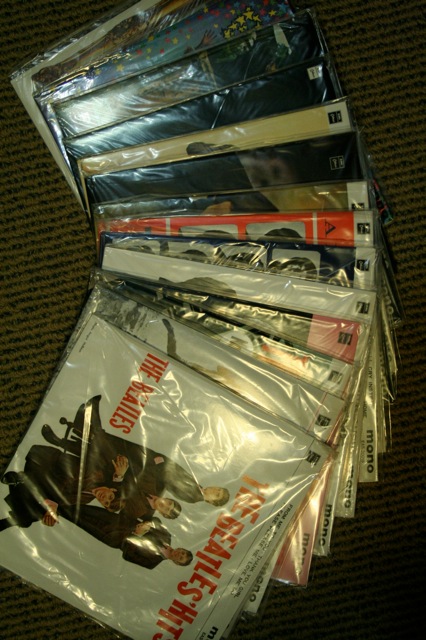
This Japanese release is the same as the U.K. set, except that all fifteen records inside are pressed on red vinyl and the two-record Magical Mystery Tour is in mono instead of stereo. All discs in fact are mono – except The Inner Light, which is in stereo.

The Beatles E.P.’s Collection – lid opening

Each of the fifteen EP records inside come with plastic covers:

All the discs have plastic covers

Another interesting thing is that these discs play at 33 and 1/3 r.p.m, not the usual 45 r.p.m. There’s a paper sheet inside (in Japanese) with some information about the release:

Beatles E.P.’s – paper insert sheet

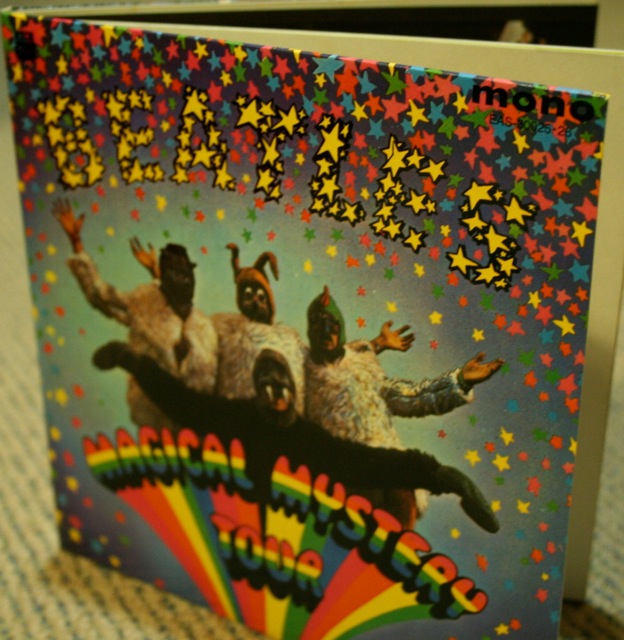
The famed 2-record EP Magical Mystery Tour comes complete with the gatefold and booklet just like the original, and as already mentioned, is in mono:

Mono Japanese Magical Mystery Tour

And all the discs come pressed in a delicious-looking transparent red vinyl, and all with the original cover artwork:

The lovely red vinyl “Nowhere Man” EP

 Note the “33and 1/3 r.p.m.” on the left-hand side of the label.

The red vinyl again – and each disc has plastic inner sleeves

Apparently this Japanese red vinyl edition also came out in a black vinyl edition.