Some Unusual Asian Beatles Items….Part One

OK. I’m going to preface this first post on some unusual CD and DVD items I acquired in a South East Asian country with a statement that I don’t collect Beatles bootlegs and I don’t support or promote piracy in the music business. All my collection to date has been made up of legitimate, officially released discs – that’s CDs, LPs, singles, books, DVDs, magazines and other printed items.

Recently I was able to spend some time on holiday in Vietnam. Like most Asian and developing countries there are many opportunities to buy fakes – everything from Louis Vuitton luggage and Gucci handbags to Ray Ban sunglasses and Tag Heuer watches. Of course there are lots of stores, markets and street vendors selling illegally copied DVD films as well. There are not so many places to buy music – but they’re there if you seek them out. In the central Vietnamese city of Hue I walked into a store selling mostly fake DVDs and a bit of music on the side and saw a copy of Paul McCartney’s latest 2 CD release “Good Evening New York City”. It was easy to tell it was a fake. It came (like all the cheaply copied DVDs do) in a flimsy clear plastic bag (i.e. no hard jewel case or Digipac cardboard). The artwork was all there ready to put it into a CD jewel case, but it looked like a cheap photocopy. The discs had rudimentary labels printed on them but clearly looked fake. No catalogue numbers, copyright info, not even the title of the disc. One disc had the words “Paul 1” printed roughly on it, the other “Paul 2” and that was it. It was selling (in the local currency) for 20,000 Vietnamese Dong – that’s US$1.03, or $1.17 Australian. And that’s even before any bargaining over the price. I decided I really didn’t want to buy a copy – even for the novelty value.
At the other end of the scale are those CDs and DVDs where its obvious that a lot of time and effort has gone into producing what looks to be an absolutely legitimate release. Standing in a shop in Hanoi (which I did last week) it becomes really hard to tell. Is what I’m looking at the version sanctioned by the artist and record company as the official release for China and South East Asia?

Take this example of the Beatles “Anthology” 5 DVD box set. I got it from a shop in Hanoi that was filled with what looked like official releases. All movie stock was in standard DVD packaging with proper labels. It was not one of the shops dealing in fakes.

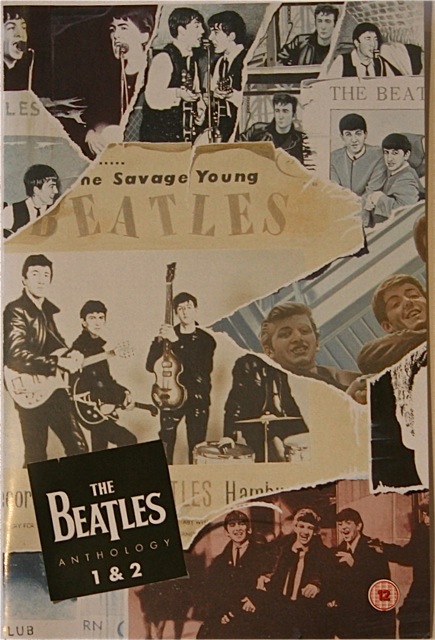
It looked like this. Here’s the front of the box:

Chinese Beatles Anthology - front

This copy still has the shrink-wrap around the sturdy cardboard box, though the opening has been cut by me so that the DVDs can be removed. The sticker is attached to the shrink-wrap.

Compare this to this official release purchased in Australia:

Official Beatles Antholgy DVD - front

Again, the shrink-wrap is still around the box. The sticker is also on the shrink-wrap.

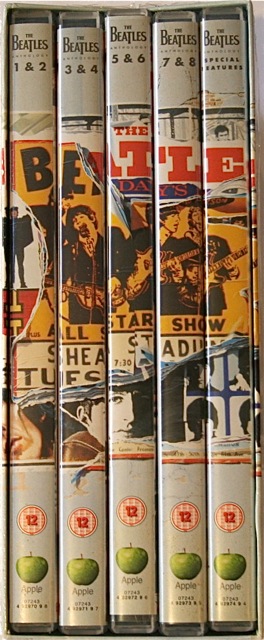
Here are the Chinese DVD spines:

The five Chinese DVDs

Compared to the official release:

The official release

The number “12” in the pink circle on each refers to the censorship rating in Australia. Apart from that, not a lot of difference….Here is the sticker on the base of the Chinese version:

Sticker on base of Anthology DVD box - Chinese

As you can see, the Apple word is written but the Apple logo itself is missing. Also, apparently common with cheap copies, there are small spelling mistakes. Notice in the centre box of the sticker the words “Doldy Digital 5.1 surround sound”. It should be Dolby Digital 5.1 sound. This sticker appears to be stuck over the printed label actually on the box. You can faintly see the bar code, etc. underneath. Otherwise the Capital, Abbey Road, DVD Video, Dolby Digital and DTS logos on the right-hand side all look legit. Compare it to the Australian official release, where the label is printed onto the box:
Official Anthology DVD box - sticker on box base

Notice the official release has a Parlophone logo instead of Capitol which is just a territory thing (Parlophone seems to get half the world, and Capitol the other half!). There’s also a Region 1 DVD symbol, and a bar code.

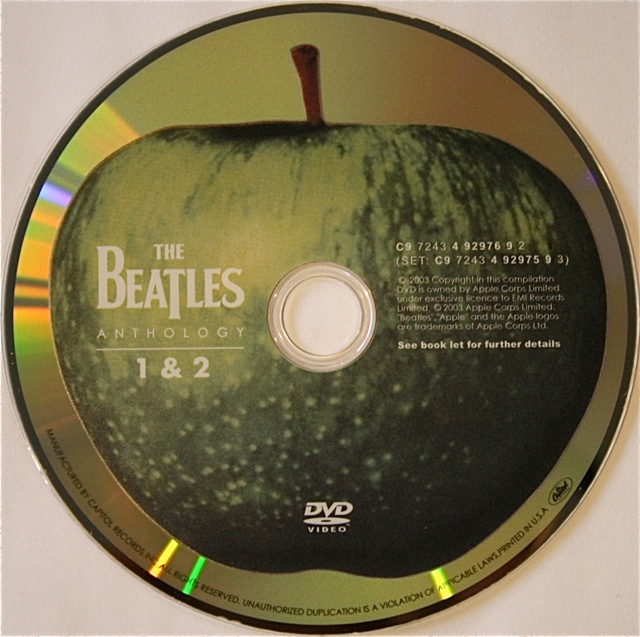
Inside the individual DVD containers the story is similar. The actual discs in the Chinese version are very well-printed and look very official:

Chinese DVD disc

They even say “Printed in the USA”. Compare this to the official release:

Anthology DVD - official release

However, the Chinese stuff up the sequencing of labels on the DVD discs.

Disc One, as you can see above, has Episodes 1 & 2 on it and correctly contains those episodes. Sadly, Disc Two is also labeled Episodes 1 & 2, but actually has Episodes 3 & 4.

Disc Three is incorrectly labeled Episodes 3 & 4, but contains Episodes 5 & 6. And Disc Four is incorrectly labeled Episodes 3 & 4, but correctly contains Episodes 7 & 8.  The “Special Features” 5th disc is incorrectly labeled Episodes 5 & 6 but contains the correct Special Features material…….so, all the contents is there across the five discs. Just a severe lack of attention to detail on the part of the counterfeiters. However, they all play well and the quality of the video looks perfect.

The other noticeable difference to the official release is that the Chinese versions don’t have the small booklets inside each DVD box outlining the contents of each episode. These are in official release and look like this:

DVD Booklet - front - from episodes 1 & 2 in official release

Anthology booklet (rear) - inside each DVD box of the official release

So, you can see that standing in a shop in Hanoi, deciding if this is official or not (especially while it’s still sealed up in its shrink-wrap) is very tricky. The price might have been a give-away: this 5 DVD box set cost 250,000 Vietnamese Dong. That’s around US$12.80 or AUS$14.80. Very cheap. It also doesn’t help if you don’t read Chinese. Here’s a close-up of the sticker on the front:

Sticker on the front of the Anthology DVD box set

Vietnam is actively cracking down on pirate or illegal copies of DVDs, CDs, clothing and watches. While there I read an article in one of the national papers that police are actively trying to break up the flow of counterfeit goods from across the border in China. When departing the country via Ho Chi Minh City airport all travelers bags are X-Rayed separately to the usual security check specifically to identify and confiscate goods, or to fine travelers for having fake DVDs. A New Zealand family in front of us were caught. They had in their bags over 60 copied DVDs they’d bought on the street. They were given the option of handing them over, or keeping them and paying a fine of US$50.00 (at first they were asked to pay a US$100.00 fine, but talked the official down…interesting). They decided the pay the fine and keep their DVDs. All the CDs I had purchased, plus the Beatles “Anthology” 5 DVD box above were in our suitcases and were also X-Rayed. We were not stopped by the airport officials. I’ll detail some of the Beatles compact discs I purchased in the next posts. Again it was confusing and difficult to pick the real from the fake.

See also Some Unusual Asian Beatles Items – Part Two and Some Unusual Asian Beatles Items – Part Three

Nine Copies of Rolling Stone Magazine

Up on the very top shelf of a closet in my study there’s a large pile of old music magazines – mostly Rolling Stone magazine. They’ve been there, oh, for at least 16 or 17 years. Sitting quietly, gathering dust.

About a week ago it suddenly occurred to me that there could probably be some Beatles-related treasure hidden away in there.

Really don’t know why I’d never thought of this before. And so I got them down from the shelf this weekend and had a browse. This post, in chronological order, is about what I found.

(July 1979) Issue 295 Paul McCartney by Paul Gambacini

These are all the Australian editions of Rolling Stone, and back in 1979 it was still very much like a newspaper in appearance. No staples to hold it together and printed on flat, newsprint style paper. The cover story about Paul (above) is by veteran DJ, writer and rock historian Paul Gambacini. The cover portrait of Paul McCartney is by Julian Allen, June, 1979. Gambacini’s  byline says: “The leader of Wings looks back at yesterday”, and he writes: “I have known Paul McCartney for over five years, since just before the release of ‘Band on the Run’…Not surprisingly, McCartney at that time was desperate to avoid talking about the Beatles, especially about the never-ending reunion rumors…In the years since, Paul has let down his defenses. Anecdotes about the Beatles now flow, in addition to reminiscences of the pre-Beatles days. He seems pleased with his past. This is a product of being happy with his present.” The article coincided with the release of Wings “Back to the Egg”.

(October 1982) Issue 358 Exclusive: The Private Years

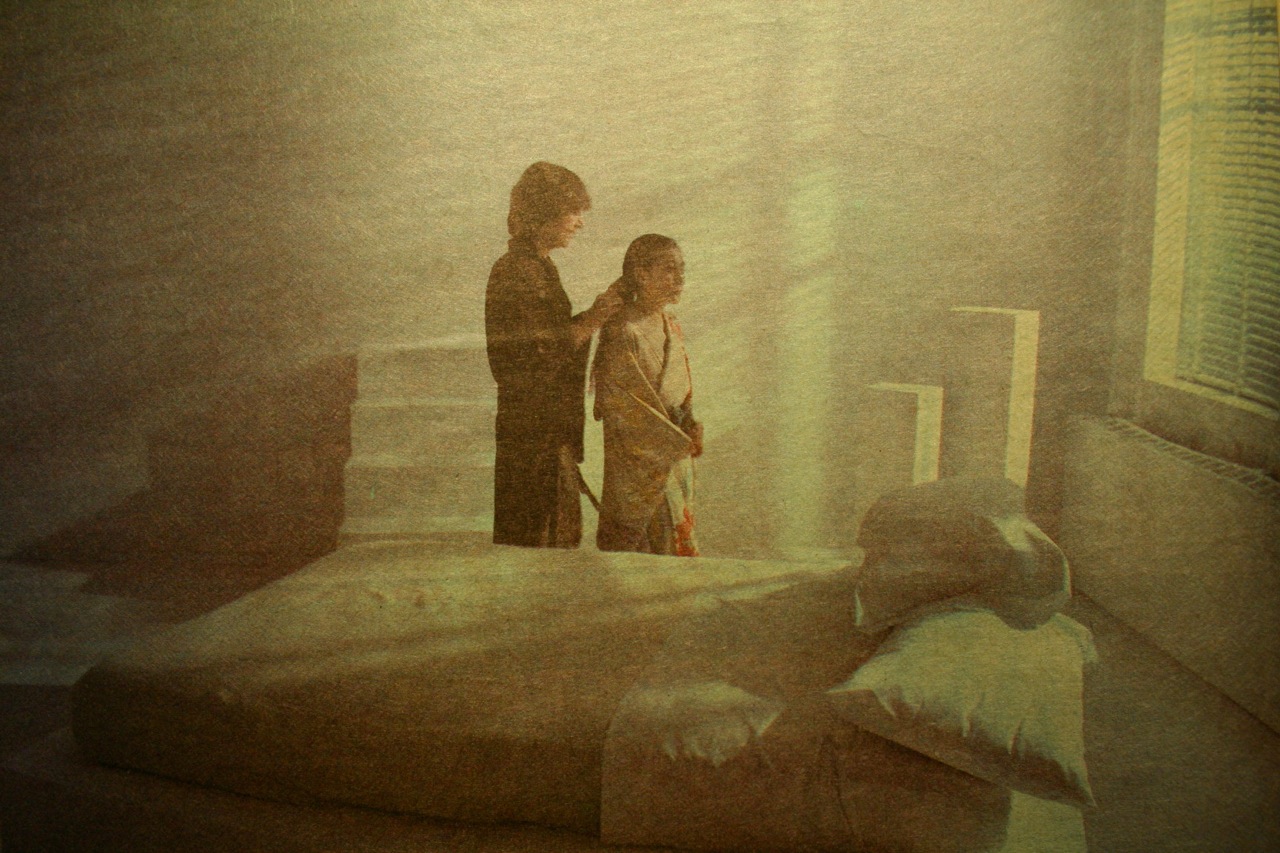
Of course John and Yoko frequently made the cover of Rolling Stone, and there have been some striking images of them published. Who could forget the most famous Annie Leibovitz shot of the pair? But this one comes a close second I reckon. Its by Allan Tannenbaum and it is a beautiful contemplative study that perfectly accompanies an article by Chet Flippo (which was an extract from the book “The Ballad of John and Yoko”, first published by Rolling Stone Press in October, 1982) detailing the years from 1975 to 1980 when John Lennon dropped out of rock & roll, retreating to his white bedroom in the Dakota building in New York. Inside, the article is accompanied by another touchingly composed Tannenbaum photograph:

John and Yoko, New York City, November 1980 (Tannenbaum)

See more Allan Tannenbaum photographs from the same session here.

In November, 1987 Rolling Stone celebrated twenty years on newsstands with a 20th Anniversary Special Edition. In it they re-published a selection of Letters to the Editor from across the 20 years. This one, from 1974, is telling: “John Lennon has given more to America that Nixon and Ford….He fought for peace a long time before it came to the attention of the government that “the people of America” wanted peace. Lennon was concerned about America, and now they’re deporting him. Nixon has admitted he’s a crook; why don’t we deport him?” – Lynn Grubbs, Malvern, Arkansas. And then this, from 1981, sadly again about John Lennon: “We’ve come a long way in seventeen years, from shooting presidents to murdering musicians.” – Jon Grabill, Wayland, Massachusetts…..this was the cover of that special edition:

(November 1987) 20th Anniversary Special Edition.

The special edition was comprised of a series of previously-published Rolling Stone articles. There’s one on Paul McCartney by Anthony DeCurtis, and one on Yoko Ono by David Fricke. There are some image galleries as well from across the twenty years, but they only include one photograph of John Lennon.

(October 1986) Issue 403 Paul McCartney - The Rolling Stone Interview

October, 1986 saw another Paul McCartney cover shot (above) – with very grey hair and an interesting heart-shaped ring on Paul’s wedding finger…? The Rolling Stone interview was by Kurt Loder, who begins: “It is Monday in London, two days before the royal wedding, and Soho Square is filled with flowers, sunshine and fresh-faced young tourists. Some loll on the grass, sharing joints. Others peer up expectantly at the etched-glass windows of an art-deco-style town house across the street, where, in an airy third floor office, Paul McCartney presides over the bustling affairs of MPL Communications, the company that manages the professional projects of the singer and his wife, Linda.”

Inside Rolling Stone, Issue 403

The McCartney’s were doing publicity for “Press To Play”, the fifteenth album he’d released since he announced the breakup of the Beatles in 1970…..Loder observed “After eight years of largely lackadaisical releases on Columbia, he is back with Capitol – the Beatles’ old label – and he seems serious about rehabilitating his somewhat tattered artistic reputation.”

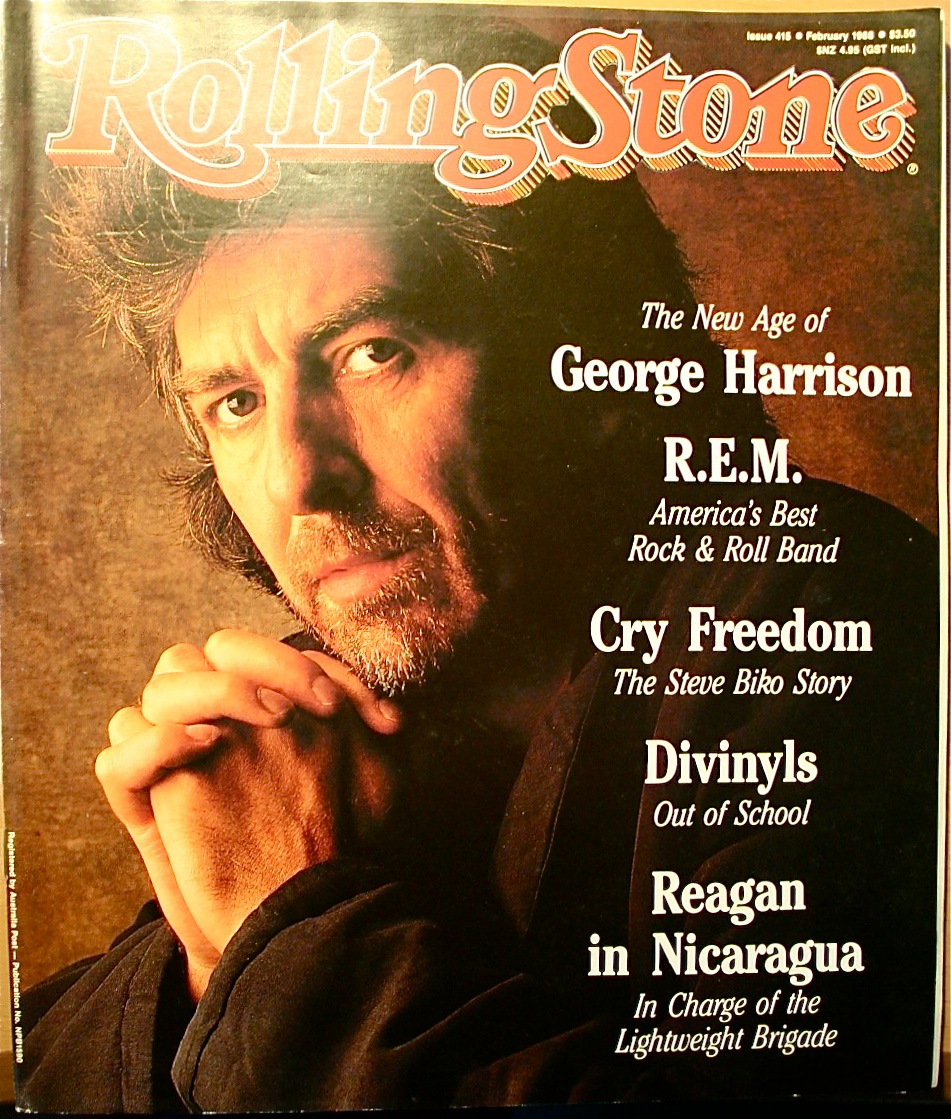
(February 1988) Issue 415 The New Age of George Harrison

In 1988 George had a new record to push. “Cloud Nine”, his first record in five years, had just been delivered to Warner Brothers Records. The article, by Anthony DeCurtis, is a really good read about George, the production of the album (with ELO’s Jeff Lynne), his past, and where he was at in 1988. “After years of tending his garden, his movie company and his son, the elusive ex-Beatle has reemerged with a great album”.

The front page of Issue 424 has an image of John Lennon and the words “Lennon – A Special Photo Album and the inside story on Goldman’s book”:

(November 1988) Issue 424 Lennon - A Special Photo Album and the inside story on Goldman's book

Inside is a revealing article by David Fricke and Jeffrey Ressner called “Imaginary Lennon – The True Story Behind Albert Goldman’s Character Assassination of John Lennon”. That title pretty much says it all… Albert Goldman’s controversial book “The Lives of John Lennon” had just been released, and his publishers claimed it to be “…a startling and revolutionary portrait”. Fricke and Ressner write however that it is not “the definitive biography”. “In fact,” they say, “the book is riddled with factual inaccuracies, embroidered accounts of true events that border on fiction and suspect information provided by tainted sources.” The magazine devotes five and a half pages to taking apart Goldman’s work. The article is worth digging out if you can. As if to balance that, Issue 424 also has six pages of candid Lennon photographs from another book (“Imagine: John Lennon” by Andrew Solt and John Egan). Here’s a terrific, early shot of Lennon, Paul McCartney, drummer Pete Best and George Harrison – taken by Paul’s brother, Mike McCartney:

Early Beatles (Mike McCartney)

Issue 443, in April 1990 also contained a wealth of rare early photographs, though it was the B52’s who made it onto the front cover. You have to look pretty closely for the Beatles reference:

(April 1990) Issue 443 The Beatles Rare Early Photos

This contains never-before-published photographs that chronicle the Fab Four’s first American tour in 1964. They are all taken by Curt Gunther, and I think you’ll agree they are impressive. I’d never seen these before and will certainly be seeking out the book they come from. Here are just a few from the Rolling Stone eight page spread:

Fans from Harrisburg, Pennsylvania at Indianapolis airport (Curt Gunther)

Paul photographs Canadian Mounties at Malton Airfield, Toronto (Curt Gunther)

Lennon in bed, King Edward Hotel, Toronto (Curt Gunther)

All the photos above were reproduced in Rolling Stone, but come from the book “Beatles ’64: A Hard Day’s Night in America” released in 1989. Photographs by Curt Gunther, text by A.J.S.Rayl.  There are also some fantastic Gunther images here from the Genesis Books publication “Mania Days: The Beatles 1964 US Tour”

October, 1990 saw Rolling Stone release another special issue. This time it was The Sixties – The Age of the Beatles. And it was an excuse for a psychedelic-look, Beatles-inspired cover:

(October 1990) Issue 448 A Special Issue: The Sixties - The Age of the Beatles

Mikal Gilmore in his feature article “The Sixties” spends a lot of time on the Beatles and their impact throughout that turbulent decade: “In short, the Beatles were a rupture – they changed modern history, and no less craftsman than Bob Dylan understood the meaning of their advent. ‘They were doing things nobody else was doing. But I just kept it to myself that I really dug them. Everybody else thought they were just for the teenyboppers, that they were gonna pass right away. But it was obvious that they had staying power. I knew they were pointing the direction that music had to go….'”.

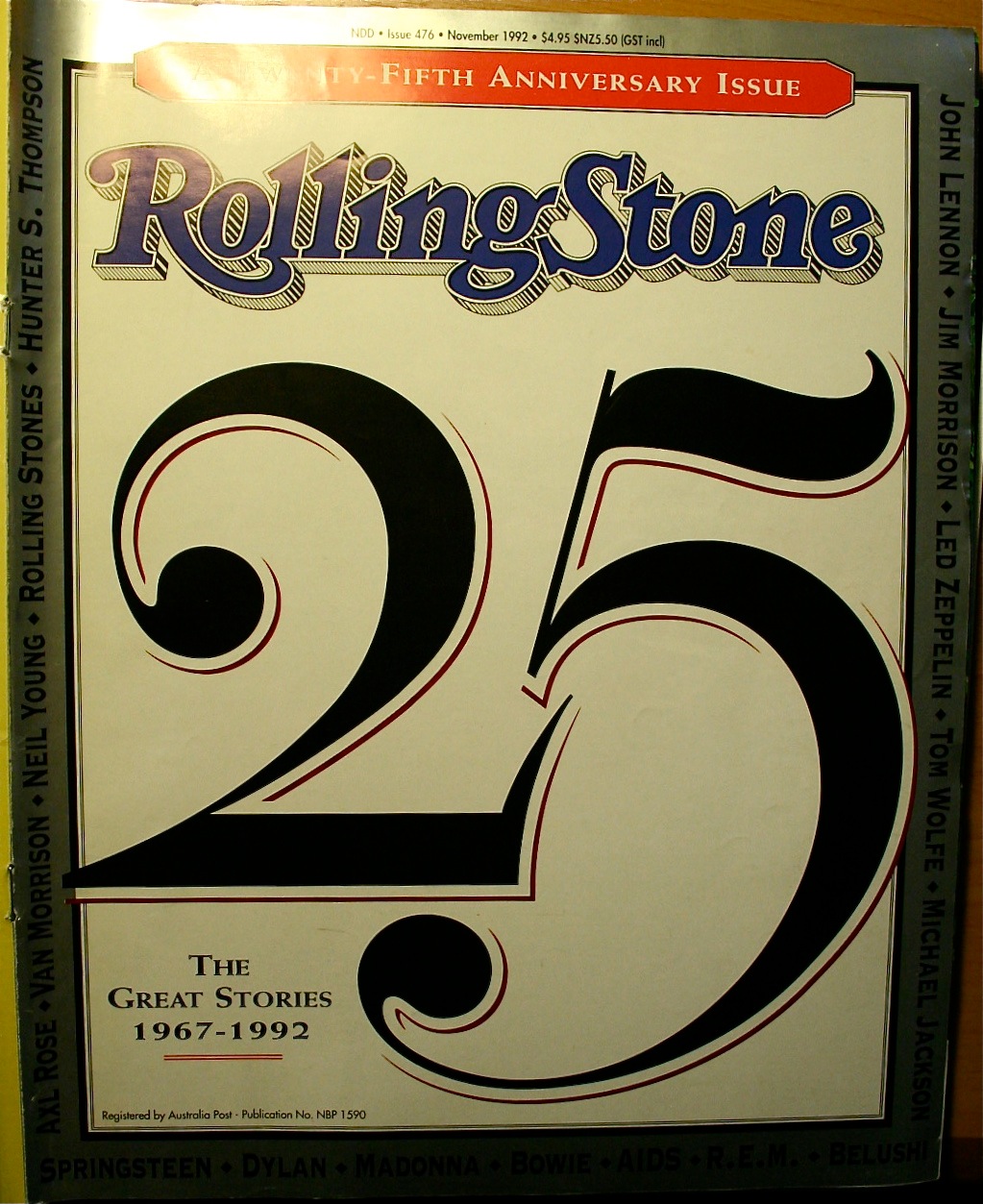
The final magazine to pop out of the large pile was from November, 1992, issue 476, a 25th Anniversary Special Edition, subtitled “The Great Stories 1967-1992”.

(November 1992) Issue 476 25th Anniversary Special Edition

Like the special Twentieth  Anniversary edition (above) this one contained some of the all-time great articles ever written by Rolling Stone‘s staff writers and contributors over the past quarter of a century. There are pieces on Led Zeppelin, the Rolling Stones, Springsteen, Bowie, Van Morrison, REM, Madonna, Neil Young, Michael Jackson and (of course) Bob Dylan, but probably pride of place was given to the now legendary interviews with John Lennon by Jann S. Wenner – a 30,000 word verbal splurge in which the ex-Beatle spoke openly, fully and truthfully about the Beatles and announced their breakup:

The Jann Wenner interview with John Lennon in Issue 476

Originally from Rolling Stone Issues 74 and 75 in 1971, this was Lennon talking about the demise and aftermath of the Beatles as he saw it – for the first time.  You can listen to extracts and read transcripts at Jann Wenner’s own page.

So, that it. An accidental journey through the past through random editions of Rolling Stone magazine – mags that have been hidden away in a cupboard at home for over 17 years…..

Dezo Hoffmann – The Beatles Conquer America

I was in Lismore in New South Wales last week (it’s a small-ish Australian country town in the north of the state). Once I’d completed my work business there I had about 40 minutes to spare before my plane home, so I went for a walk around the town’s CBD. You can probably guess that I can’t resist a second hand/old wares shop when I find one. Especially the one I did find, which was advertising “All Books Half Price”.

Inside this store was a treasure trove. Not only are most walls lined chock-full with old books of all sorts, but there’s antique furniture, old toys, art works, advertising signs, glassware, ornaments and all sorts of collectables.

They had a crate of old records and, while there were some interesting things there from other artists, no Beatles or Beatles-related sadly. “Do you have a music section in the books?”, I asked. “Well, we haven’t got much, but its over there.”, said the sales assistant, pointing to my right.

They actually had four Beatles books.  1. A hardback copy (in pretty good condition) of Peter Brown’s book “The Love You Make – An Insider’s Story of the Beatles” (1983);  2. An original paperback of a book based on the film “Help!” (1965) written by Al Hine (in just reasonable condition);  3. An original paperback called “Love Me Do – The Beatles Progress” (1964) by Michael Braun, similar in vintage and condition to the “Help!” book; and 4. “The Beatles Conquer America”, a book of photographs taken by Dezo Hoffmann.

I already have Peter Brown’s book and, while tempting as they are collectable items, the two old paperbacks were not in the greatest condition. Also, even at half price were reasonably expensive. So, I went for the Dezo Hoffmann book:

Front Cover - The Beatles Conquer America

For a book that came out in 1984 it was in almost mint condition. It contains some absolutely fantastic and rare photographs, and at the half-price cost of just A$7.50, it was a bargain addition to the collection. The black and white photographs were all taken between January 14 and February 22, 1964 when Dezo Hoffmann accompanied the Beatles from London to New York, Washington, Miami, and then back to London. It was their first American tour, and the Beatles as a pop phenomenon was really kicking into gear…

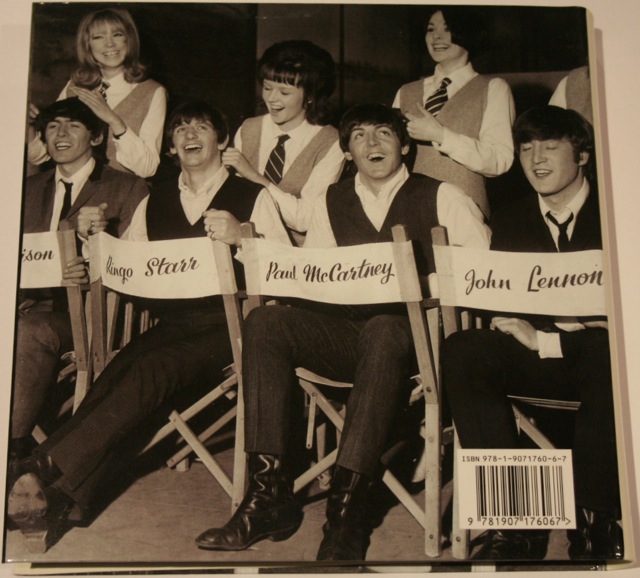
Rear cover - The Beatles Conquer America

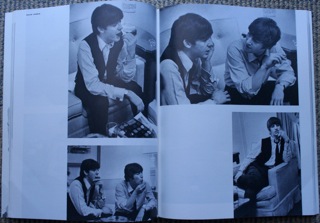
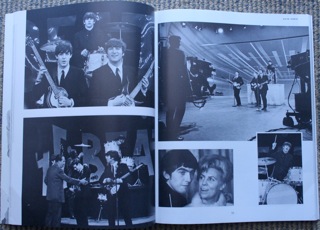
The book also contains photos from a short tour to Paris prior to the US visit. Dezo Hoffmann was a Beatles insider – having taken an interest in photographing the band from well before their meteoric rise to fame. As such he got unique access – as seen throughout this book. Dezo also writes a short description of the background to each photograph. Here’s a quick flip through just a couple of the pages:

There is very much a “fly on the wall” feel to these photographs. They capture the Beatles at ease and enjoying themselves away from the fans, enjoying performing, and just soaking up the success that was coming their way.

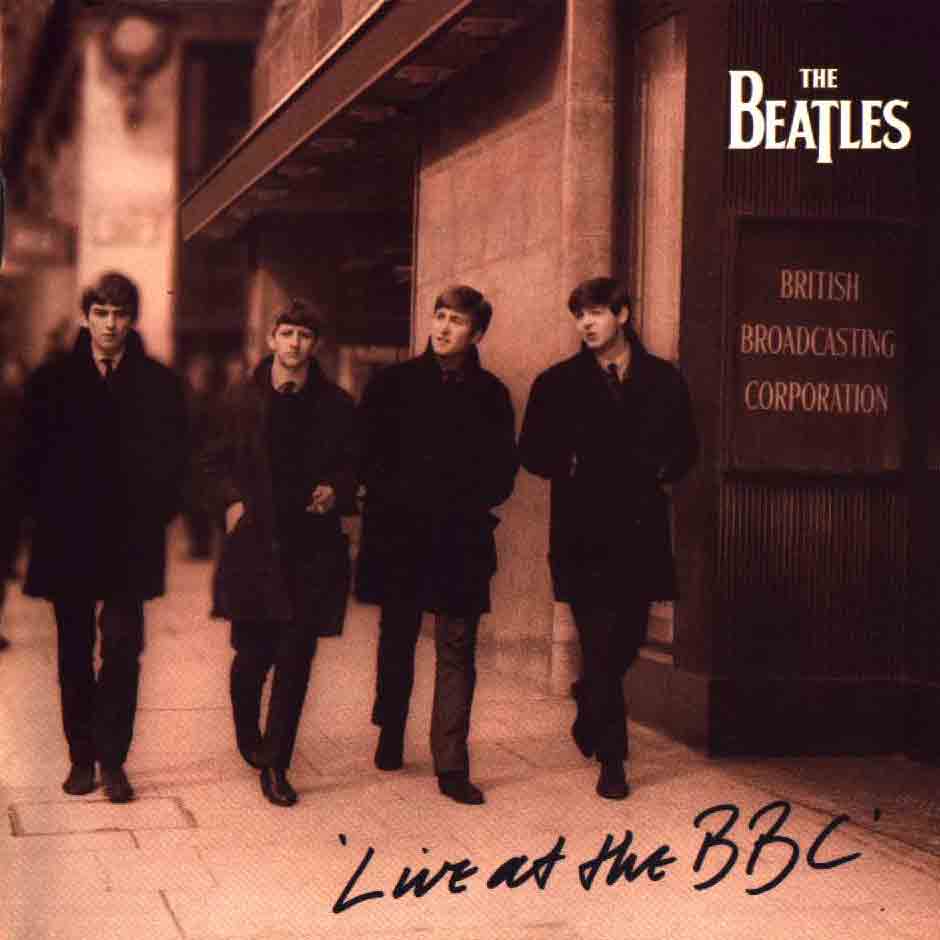
If you don’t think you’ve ever seen a Dezo Hoffman image of the Beatles before, you might know this one:

Click here for a larger image and some official info on this release. In looking around for additional information on Dezo Hoffmann I found an interesting page about how his original shot outside the BBC was manipulated for this now famous cover.

As well as historic photographs, Dezo Hoffmann also took many informal home movies on location with the Beatles:

Time Magazine – The Beatles Final Year

Time Magazine online is currently running an interesting photo-essay detailing the events surrounding the demise of the world’s greatest band. Click here to see and read their tribute, in this the 40th anniversary since the Beatles split. They say: “The band’s internal feuds boiled over into public view on April 10, 1970, when Paul McCartney announced his intention to leave the group”.

Time also has a special on the Top Ten Band Breakups, of which the Beatles (of course) are number one on the list.

40th Anniversary of Beatles Breakup – Special Programs are Under Way

The ABC Radio weekend of special programming in Australia to mark the 40th Anniversary of the breakup of the Beatles is now under way. To listen:

Windows Audio

Real Audio

Here’s the schedule of documentary programs – most of which are from the BBC, many of which have never been heard in Australia before and are rarely heard overseas.

You’ll hear tracks and rare moments from the Beatles along with the following full docos (all times Australian Eastern Standard Time):

Saturday April 10
8:00am Nothing’s Gonna Change My World
9:20am The Beatles Story
2:53pm The White Album at 40
3:50pm Songwriters – Lennon and McCartney
4:04pm Nothing’s Gonna Change My World
5:26pm The Beatles At The Beeb Take 2
6:23pm The Beatles Story

Sunday April 11
0:08am Songwriters – Lennon and McCartney
0.22am The Making of Sgt Pepper
1:18am The Beeb’s Lost Beatles Tapes
8:02am Nothing’s Gonna Change My World
9:23am The White Album at 40
10:21am The Beeb’s Lost Beatles Tapes
5:04pm Nothing’s Gonna Change My World
6:29pm The Beatles Story
Midnight ABC Beatles ends

Further info here.

Enjoy!

40th Anniversary of Beatles Break Up – Special Broadcasts This Weekend

Here’s some news for Beatles fans.

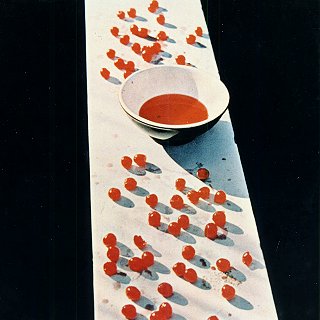
This coming weekend (10 & 11 April) marks the 40th anniversary of Paul McCartney formally announcing the break-up of the Beatles. He was about to release this album:

"McCartney" April, 1970

McCartney issued a press release in the form of a self-interview that was inserted into early promo copies of his first-ever solo album. It went something like this (I’ve highlighted the most telling question that signaled the Lennon/McCartney partnership was over – forever):

FOR IMMEDIATE RELEASE
FROM: Paul McCartney
DATE: April 9, 1970

Q: “Why did you decide to make a solo album?”

PAUL: “Because I got a Studer four-track recording machine at home, practiced on it (playing all the instruments)- liked the results, and decided to make it into an album.”

Q: “Were you influenced by John’s adventures with the Plastic Ono Band and Ringo’s solo LP?”

PAUL: “Sort of, but not really.”

Q: “Are all songs by Paul McCartney alone?”

PAUL: “Yes, sir.”

Q: “Will they be so credited: McCartney?”

PAUL: “It’s a bit daft for them to be Lennon/McCartney-credited, so ‘McCartney’ it is.”

Q: “Did you enjoy working as a solo?”

PAUL: “Very much. I only had me to ask for a decision, and I generally agreed with me. Remember, Linda’s on it too, so it’s really a double act.”

Q: “What is Linda’s contribution?”

PAUL: “Strictly speaking, she harmonizes, but of course it’s more than that, because she’s a shoulder to lean on, a second opinion, and a photographer of renown. More than all this, she believes in me- constantly.”

Q: “Where was the album recorded?”

PAUL: “At home, at EMI (no. 2 studio), and at Morgan Studios. (Willesden!)”

Q: “What is your home equipment– in some detail?”

PAUL: “Studer four-track machine. I only had, however, one mike, and as Mr. Pender, Mr. Sweathenham and others only managed to take six months or so (slight delay) I worked without VU meters or a mixer, which meant that everything had to be listened to first for distortion, etc, then recorded. So the answer– Studer, one mike, and nerve.”

Q: “Why did you choose to work in the studios you chose?”

PAUL: “They were available. EMI is technically very good and Morgan is cozy.”

Q: “The album was not known about until it was nearly completed. Was this deliberate?”

PAUL: “Yes, because normally an album is old before it even comes out. (aside) Witness GET BACK.”

Q: “Why?”

PAUL: “I’ve always wanted to buy a Beatles album like people do and be as surprised as they must be. So this was the next best thing. Linda and I are the only two who will be sick of it by the release date. But we love it really.”

Q: “Are you able to describe the texture or feel of the album?”

PAUL: “Home, family, love.”

Q: “How long did it take to complete- from when to when?”

PAUL: “From just before Christmas, until now. ‘The Lovely Linda’ was the first thing I recorded at home and was originally to test the equipment. That was around Christmas.”

Q: “Assuming all the songs are new to the public, how new are they to you? Are they recent?”

PAUL: “One was from 1959– ‘Hot As Sun.’ Two are from India– ‘Junk’ and ‘Teddy Boy.’ And the rest are pretty recent. ‘Valentine Day,’ ‘Momma Miss America’ and ‘Oo You’ were ad-libbed on the spot.”

Q: “Which instruments have you played on the album?”

PAUL: “Bass, drums, acoustic guitar, lead guitar, piano, organ, mellotron, toy xylophone, bow and arrow.”

Q: “Why did you play all the instruments yourself?”

PAUL: “I think I’m pretty good.”

Q: “Will Linda be heard on all future records?”

PAUL: “Could be. We love singing together and have plenty of opportunity for practice.”

Q: “Will Paul and Linda become a John and Yoko?”

PAUL: “No, they will become a Paul and Linda.”

Q: “Were you influenced by their work?

PAUL: “No.”

Q: “Will they or who will receive the first copies?

PAUL: “The press.”

Q: “What has recording alone taught you?”

PAUL: “That to make your own decisions about what you do is easy, and playing with yourself is very difficult but satisfying.”

Q: “Who did the cover?”

PAUL: “Linda came up with and took the photos, and she and I designed tha album cover.

[The following question was not part of the original press release, but appears in some sources on the web.]

Q: “Is it true that neither Allen Klein nor ABKCO have been nor will be in any way involved with the production, manufacturing, or promotion of this new album?”

PAUL: “Not if I can help it.”

Q: “Did you miss the other Beatles and George Martin? Was there a moment when you thought, ‘I wish Ringo were here for this break?'”

PAUL: “No!”

Q: “Assuming this is a very big hit album, will you do another?”

PAUL: “Even if it isn’t, I will continue to do what I want, when I want.”

Q: “Are you planning a new album or single with the Beatles?”

PAUL: “No.”

Q: “Is this album a rest away from the Beatles or the start of a solo career?”

PAUL: “Time will tell. Being a solo means it’s ‘the start of a solo career…’ and not being done with the Beatles means it’s just a rest. So it’s both really.”

Q: “Is your break with the Beatles temporary or permanent, due to personal differences or musical ones?”

PAUL: “Personal differences, business differences, musical differences, but most of all because I have a better time with my family. Temporary or permanent? I don’t know.”

Q: “Do you foresee a time when Lennon/McCartney becomes an active songwriting partnership again?”

PAUL: “No.”

Q: “What do you feel about John’s peace effort? The Plastic Ono Band? Giving back his MBE? Yoko?

PAUL: “I love John and respect what he does, but it doesn’t really give me any pleasure.”

Q: “Were any of the songs on the album originally written with the Beatles in mind?”

PAUL: “The older ones were. ‘Junk’ was intended for ‘Abbey Road,’ but something happened. ‘Teddy Boy’ was for ‘Get Back,’ but something happened.”

Q: “Were you pleased with ‘Abbey Road’? Was it musically restricting?”

PAUL: “It was a good album. (No. 1 for a long time.).”

Q: “What is your relationship with Klein?”

PAUL: “It isn’t. I am not in contact with him, and he does not represent me any way.”

Q: “What is your relationship with Apple?”

PAUL: “It is the office of a company which I partly own with the other three Beatles. I don’t go there because I don’t like offices or business, especially when I am on holiday.”

Q: “Have you any plans to set up an independent production company?”

PAUL: “Yes, McCartney Productions.”

Q: “What are your plans now? A holiday? A musical? A movie? Retirement?”

PAUL: “My only plan is to grow up!”

Well, all this coming weekend ABC Digital Radio in Australia will be marking the anniversary with a continuous stream of special programs and documentaries (many sourced from the BBC and never before heard in this country) celebrating the music and the history of the band. If you have a digital radio and you live in Brisbane, Sydney, Melbourne, Adelaide or Perth you can hear the special programs on your radio. If you don’t have digital, or don’t live in any of those places you can still hear them streamed on the internet.

This is from the ABC Radio press release:

ABC Beatles: Saturday 10 – Sunday 11 April

On the 40th anniversary of Paul McCartney’s announcement that his songwriting partnership with John Lennon was over, the Australian Broadcasting Corporation is presenting a weekend of very special digital radio broadcasts to celebrate the band from Liverpool that changed the course of popular music.

On ABC Digital Radio (and online), beginning at 8am (Eastern Australian Time), Saturday 10th April and continuing until midnight Sunday 11th April, ABC Beatles will give listeners the opportunity to hear rare and exclusive material drawn from the depths of the BBC Radio archives. The broadcast will include an in-depth history of the band, interviews and recordings from their visits to BBC studios and documentaries never broadcast in Australia.

There will be online streaming links (Windows Media & Real Audio) via this page.

New Beatles Book Released This Month – Looks Interesting

Pop culture historian Robert Rodriguez has a new Beatles book just out.

It’s the sequel to a previous title, “Fab Four FAQ: Everything Left to Know About the Beatles, and More!” This was released in 2007 and co-authored with Stuart Shea. It tells the story of the Beatles years in a new way – chronicling many previously unknown facts about the famous four and their recording career, friends, songs and lots of other stuff. It has its own dedicated web page.

Rodriguez newest is called “Fab Four FAQ 2.0: The Beatles’ Solo Years 1970-1980”.

As the title suggests this one looks at the group’s solo output over a ten-year period, and like the first book you can dip into it to discover facts and info that either you forgot or never knew about the recordings and lives of the Beatles as four individual artists. As with the first book, Rodriquez has created a stand-alone web page to accompany the book release. It is really worth a visit because it has some exclusive content not published in the book – including a free chapter you can download called “You Think You’re A Groove: Album Packaging”. In it Rodriguez takes a walk through some of the album art for many solo Beatles releases. Quite an interesting read for collectors of vinyl records and the often fascinating cover artwork they contained.

(The website for the first book is worth a visit too – it has an additional four free chapters to download and read). Rodriguez is nothing if not prolific.

Check out the latest book at Amazon. And there’s a review here.

Klaus Voormann – A Sidesman’s Journey

One of the great artists and session men and part of the inner-circle of the Beatles for many years is Klaus Voormann.

He’s been a long-time friend and sometime collaborator and he has an album out looking back and celebrating that association with the group. I stumbled across this video which pretty much tells the back story to the making of the record, which is called “A Sidesman’s Journey”:

As you can see “A Sideman’s Journey” features guest appearances by Paul McCartney and Ringo Starr, as well as Beatle-related songs like George Harrison’s “All Things Must Pass” – here sung by Yusef Islam (Cat Stevens).

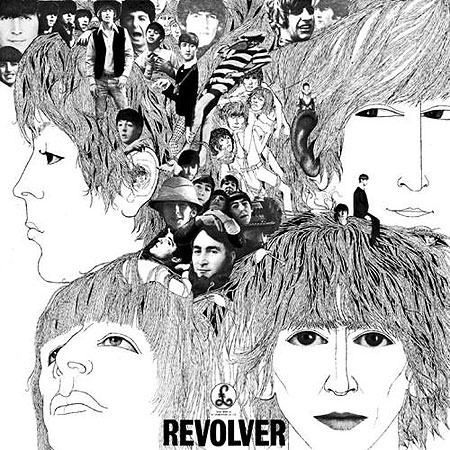
Voormann has known the Beatles since the Hamburg days and is an artist and bass player. For example, he drew the legendary cover for “Revolver”:

The Beatles - Revolver (1966)

Later Voormann also played bass on numerous Beatles solo projects including, amongst many others,  Lennon’s “Walls and Bridges” and “Imagine”, Harrison’s “All Things Must Pass” and “Concert for Bangladesh”, and on the Ringo solo outings “Ringo” and “Goodnight Vienna”.  He was a founding member of the Plastic Ono Band.  See his biog entry in Wikipedia here.

Voormann’s new CD is made up of newly-recorded covers of some of the songs he helped make famous with the former Beatles plus many other artists over the years.

Well worth a listen.

Goodbye, Abbey Road

I just got home and opened my emails to find this post by Brandonblog, a guy who writes with great wit and authority on music matters. Couldn’t really say it better myself, so here are Brandon’s words as-is:

Just heard news of the ultimate bit of Beatles memorabilia, although, you can bet it isn’t about to be offered on ebay.

If Michael Jackson were still around, he’d probably be vying for it but, most likely, it will go to some cashed-up entrepreneur who will want to open it up for tours. Let’s hope it isn’t turned into a restaurant: “Would sir like the Savoy Truffle? Or, the Yellow Matter Custard, perhaps?”

Anyhoo, for better or worse – and I fear it may be the latter – EMI is about to sell the historic Abbey Road Studios where the Fabs recorded the greater bulk of their astonishing legacy.

But it wasn’t just The Beatles who recorded there. Abbey Road also played host to the likes of Pink Floyd who delivered their landmark opus, ‘Dark Side Of The Moon’ in those hallowed studios.

How cool would it be if the British Government chipped-in for it and registered Abbey Road with The National Trust? Former Kinks frontman, Ray Davies recently lamented the gradual disappearance of his city’s iconic landmarks in the song he recorded with Chrissie Hynde, “Postcard From London”.  Imagine what he must think of this.

In it’s current financial predicament, I can’t blame EMI one bit but if Abbey Road is allowed to disappear, or to be so transformed as to become virtually unrecognizable, then England will lose something of significant cultural value.

Let’s hope not. 

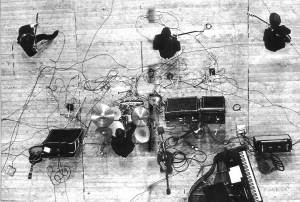
Brandon accompanied his post with this groovy photograph – an angle of the boys in concert that I’d certainly never seen before…

“All Together Now” nominated for a Grammy

From the Beatles official news site:

“All Together Now”, the documentary about the making of  the Beatles and Cirque du Soleil’s “The Beatles: LOVE”, has been nominated for a Grammy Award in the Long Form Music Video category (Adrian Wills, video director; Martin Bolduc & Jonathan Clyde, video producers).

“All Together Now” details the story behind the unique partnership between The Beatles and Cirque du Soleil that resulted in the creation and 2006 launch of “LOVE”, the stage production still playing to packed houses at The Mirage in Las Vegas. The film also documents the creation of the show’s music, the experimental Beatles soundscape album of the same name which garnered two Grammy Awards for producers Sir George Martin and Giles Martin in the categories of Compilation Soundtrack Album for Motion Picture, Television or other Visual Medium and Surround Sound Album.

You can see two short trailers from “All Together Now” here.

The 52nd Annual Grammies will be presented Sunday, January 31, 2010 in Los Angeles.

The Film
“All Together Now” is a feature-Length documentary chronicles the making of “The Beatles’ LOVE” by Cirque du Soleil. The film details the story behind the unique partnership between The Beatles and Cirque du Soleil that resulted in the creation and launch of “LOVE” and the double Grammy-winning album of the same name. The film is dedicated to the memory of Neil Aspinall, an Executive Producer.

“All Together Now” faithfully recounts how the “LOVE” project came into being, borne from the personal friendship between George Harrison and Cirque du Soleil founder Guy Laliberte. George saw how the twin talents of Cirque’s artistry and The Beatles’ music could be fused into something new and totally original.

The director, Adrian Wills, records early meetings between the Cirque & Apple Corps Ltd. creative teams, as well as contributions from Sir Paul McCartney, Ringo Starr, Yoko Ono Lennon and Olivia Harrison discussing how The Beatles’ music can be used in a different way. We hear about the decision to utilize the combined talents of Sir George Martin and his son Giles Martin to produce what became a 90-minute soundscape created from The Beatles’ multi-track recordings and how this new audio adventure was being quietly worked on in the famous Abbey Road Studios in London, England whilst the first creative ideas for the show were being formulated in Montreal, Canada.

These early stages of the project were all filmed, as were the first rehearsals at the Mirage Hotel theatre in Las Vegas, which was completely rebuilt with a one-of-a-kind sound system and complex round staging to house the “LOVE” show. George and Giles Martin, the show’s Musical Directors, were involved every step of the way with the remarkable Cirque du Soleil creative team, performers and backroom staff.

It wasn’t all “plain-sailing” and there has been no attempt to disguise some of the disagreements that took place along the way regarding how some of the songs would be portrayed visually. These creative differences, a necessary part of the overall process of bringing “LOVE” to its most vibrant life, illustrate the participants’ love and respect for the music and vision of The Beatles.

The “All Together Now” documentary provides fascinating insight into the creative skills and passion that went into making this project a groundbreaking critical and commercial success.

UPDATE: It won!