Three George Martin LPs Due for Re-Issue

Rhino/Parlophone have announced the re-issue of three long-out-of-print George Martin & His Orchestra titles.
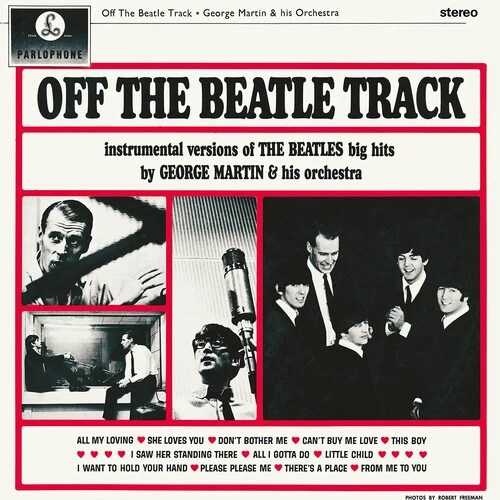
Off The Beatle Track was the first in a series of orchestral releases by George Martin and the first ever release under his own name. Originally released in 1964 at the height of Beatlemania, it was supported by the band and has liner notes written by John Lennon. Original copies of this vinyl are now in high demand due to its relatively limited release originally. Overseen by Martin’s son Giles, Off The Beatle Track has been faithfully remastered from the original master tapes, replicating the original release.
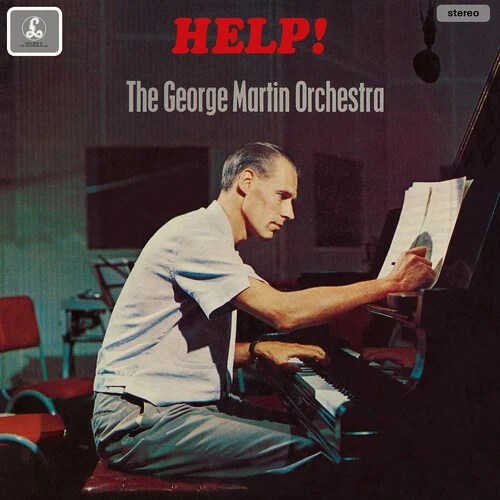
Help! was released the following year in 1965 and was the second release in the series. Featuring instrumental arrangements of Beatles songs, this reissue is true to the original UK release. (The original US release tracklisting omitted “Bahama Sound” and used some of the track working titles like ‘Auntie Gin’s Theme’ (I’ve Just Seen a Face), ‘That’s A Nice Hat’ (It’s Only Love) and ‘Scrambled Egg’ (Yesterday). The record came at a time when orchestral music had begun to embrace the sound of beat music – something it had initially dismissed as a ‘noisy’ genre, dismissing its integrity entirely. As Beatlemania grabbed hold of the world in the early 60s, and with respected ‘high-brow’ newspapers such as The Times of London giving serious analysis of Lennon and McCartney’s song writing, attitudes began to shift. This 2026 re-issue is also overseen by Giles Martin.
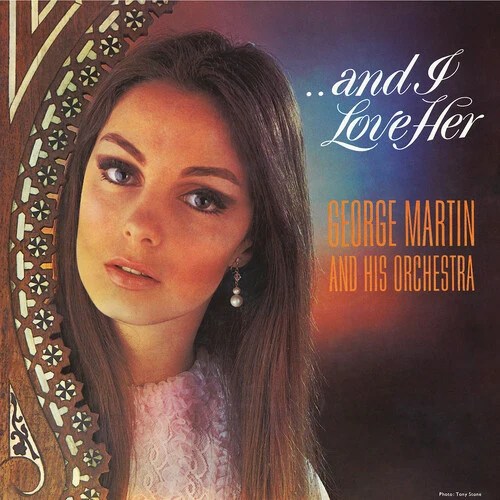
…And I Love Her dates from 1966 and is regarded by some as George Martin’s best instrumental project. Featuring his signature “Studio 2 Stereo” sound, which brought a lush, easy-listening sophistication to several popular hits of the mid-60s. Unlike the other two re-issues, this album not only has orchestral Beatles interpretations but Petula Clark’s ‘Downtown’, The Righteous Brothers’ ‘You’ve Lost That Lovin’ Feeling’, as well as the original Martin composition ‘All Quiet On The Mersey Front’, a track he wrote for the Ferry Cross The Mersey soundtrack.

These three interesting re-issues are out on CD or 140g vinyl on November 6. They’ll also be available on streaming platforms globally for the first time.

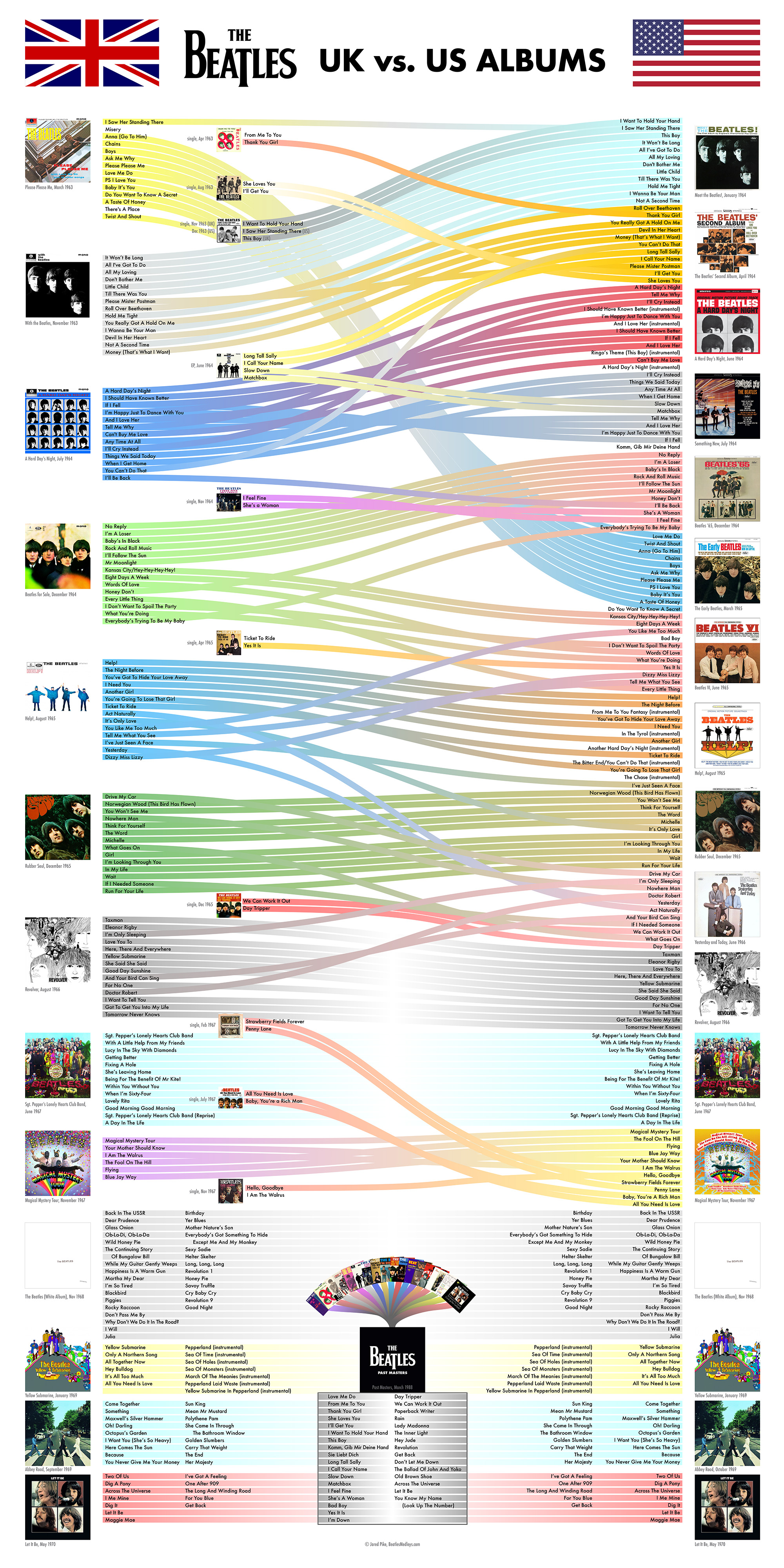
Beatles – The UK vs. The US Albums Chart

Been looking for information on just how the six newly-reissued Beatles 1964 U.S. Albums in Mono LPs were originally compiled back in the day by Capitol Records?

For those who like a visual to help take in complex information, this chart is a fantastic resource showing exactly which songs from the original UK albums were used to create the records that Capitol produced for US audiences. It’s like a Beatles Parlophone/Capitol family tree!

(click on image to see a larger version, or download below)

The chart was created by a fan named Jared Pike who runs a site called Beatles Medleys + Mashups

Thanks to Jared, you can download the complete chart for yourself:

The Beatles UK vs. US Albums (PDF)

The Beatles UK vs. US Albums (JPG, 7200×14400)

The Beatles UK vs. US Albums (JPG, 2000×4000)

Sgt. Pepper Label Anomaly

The subtitle of this blog is “Adventures in Collecting Beatles Music” and so we often get people inquiring about rare (or not-so-rare) pressings that they’ve come across out in the wild.

Like this one earlier this week from a reader named D-Wizz who is based in Brisbane, Australia:

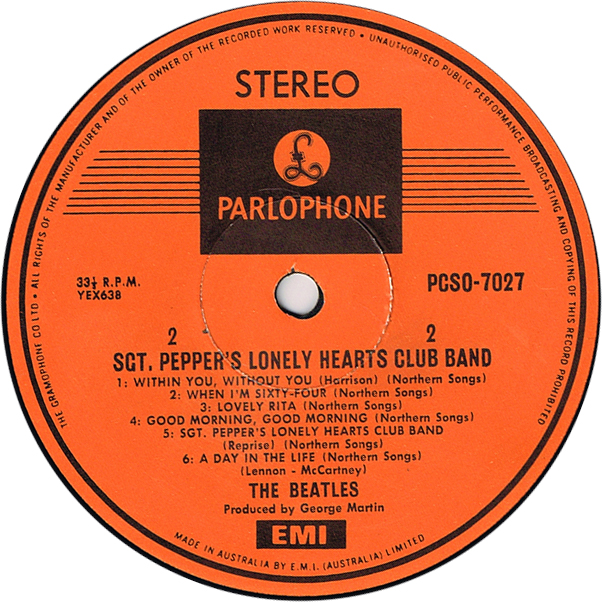
I refer to the attached photos which are both sides of the same record. I note that the font used for each label is different. Side 2 looks like a 1960s style while Side 1 has an early 70s font. I cannot find an example of this on any Beatles related site, so I wonder is it a rarity, a mis-pressing, or something else? Does it make this copy any more valuable?

Thanks for your attention and assistance.

Regards, etc.

We love a challenge like this and delved into doing a little research. This is right at the heart of the adventures in collecting Beatles music! Here’s what we wrote back with:

Thanks for your email, and for sending through actual photos of the labels. This makes identification so much easier!

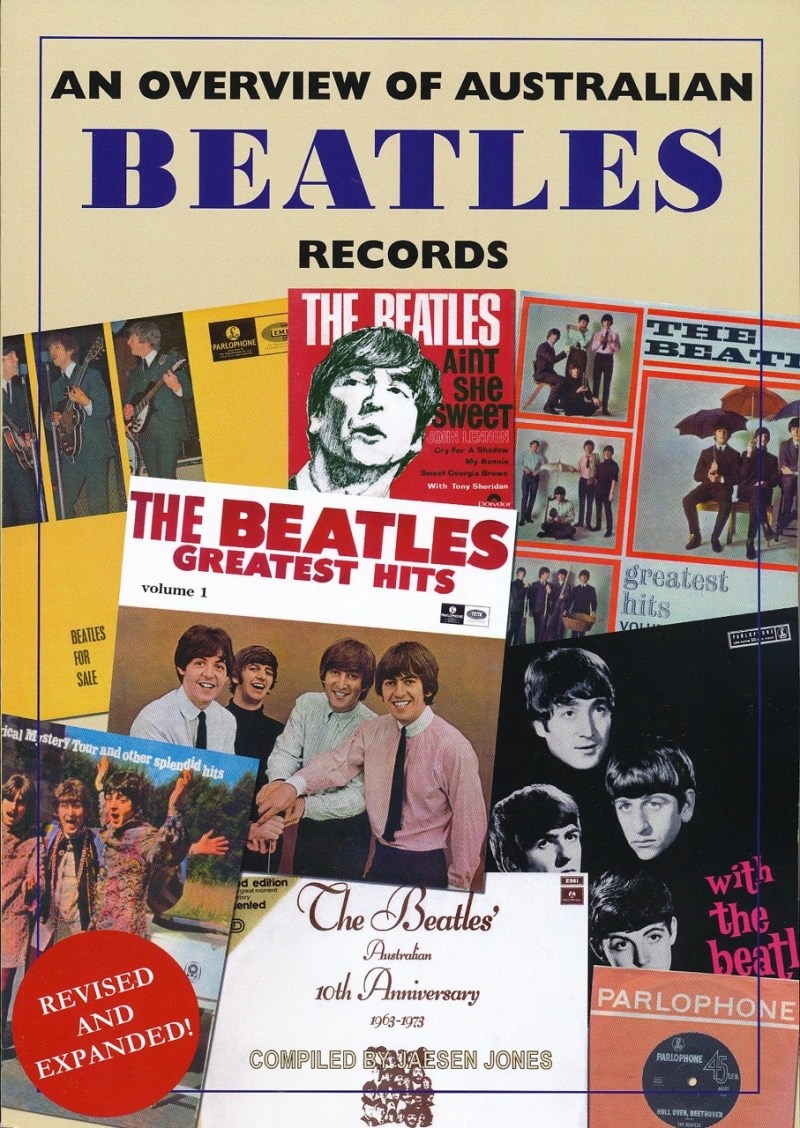
We’ve consulted the book An Overview of Australian Beatles Records by Jaesen Jones, which is a fantastic resource, plus his comprehensive website I Am The Platypus – The Beatles Australian Records Labelography – also very helpful in identifying Aussie Beatle pressings and variations. For what you need to know you should look at this page for the Sgt. Pepper’s label variations, and this page for further info on Australian label variations generally (click on the “Orange 1-Box” tab at the top).

What you have here is obviously a pressing of Sgt. Pepper’s that came out around October 1978 when EMI Australia was right in the middle of transitioning from one label design to another.

You’ve correctly identified that your Side 2 label is older – and in fact it is. It was the orange Parlophone label in use on Australian pressings of Sgt. Pepper’s from 1969-1978. It is known as the Orange 1-Box Style A, and has the word STEREO written large at the top. 

Then, in October 1978, EMI changed that label to what is called the Orange 1-Box Style B. This still has the word STEREO, but now in a much smaller font and set to the right of the spindle hole above the catalogue number. This is your Side 1 label.

We’d guess that when they were pressing your copy it must have been right on the change-over date between the two variations in October 1978. They obviously had some of the older style Side 2 labels left over (Orange 1-Box Style A) and where just using them up. However, for Side 1 they’d obviously started using the new-look Orange 1-Box Style B labels. 

(FYI there was a further orange label variation that was introduced from early 1979 called Orange 1-Box Style C that was used up to 1981. This had no mention of the word “Stereo” on it at all).

So, is your copy rare and more valuable? Well, it is interesting! 

Jaeson Jones includes in his book a ‘Guide to Rarity’ and, on a scale of 1-10 (where 1 is very common, and 10 is very rare), he lists the Sgt. Pepper’s Orange 1-Box Style A as a 5, and the Orange 1-Box Style B as a 3. Both therefore are reasonably common I’m afraid – but at least yours is different and it has a bit of a story behind it! I dunno, maybe we’d rate it as a 6?

Hope this helps,

beatlesblogger.com

At Last – A Blue Box for The Beatles Singles Collection

For quite a few years now we’ve had in the collection a complete set of all the Beatles UK singles that go inside the 1982 box set, The Beatles Singles Collection.

Only thing is, we didn’t have the lovey blue box with gold embossed writing to hold them.

Until now.

We’ve been searching on eBay and other places for quite some time to find an empty box in excellent condition. Have even bid on a couple over the years, but have never been successful.

Then, a few weeks back, a very nice example came up for sale, and here it is:

This box has the catalogue number BSCP1:

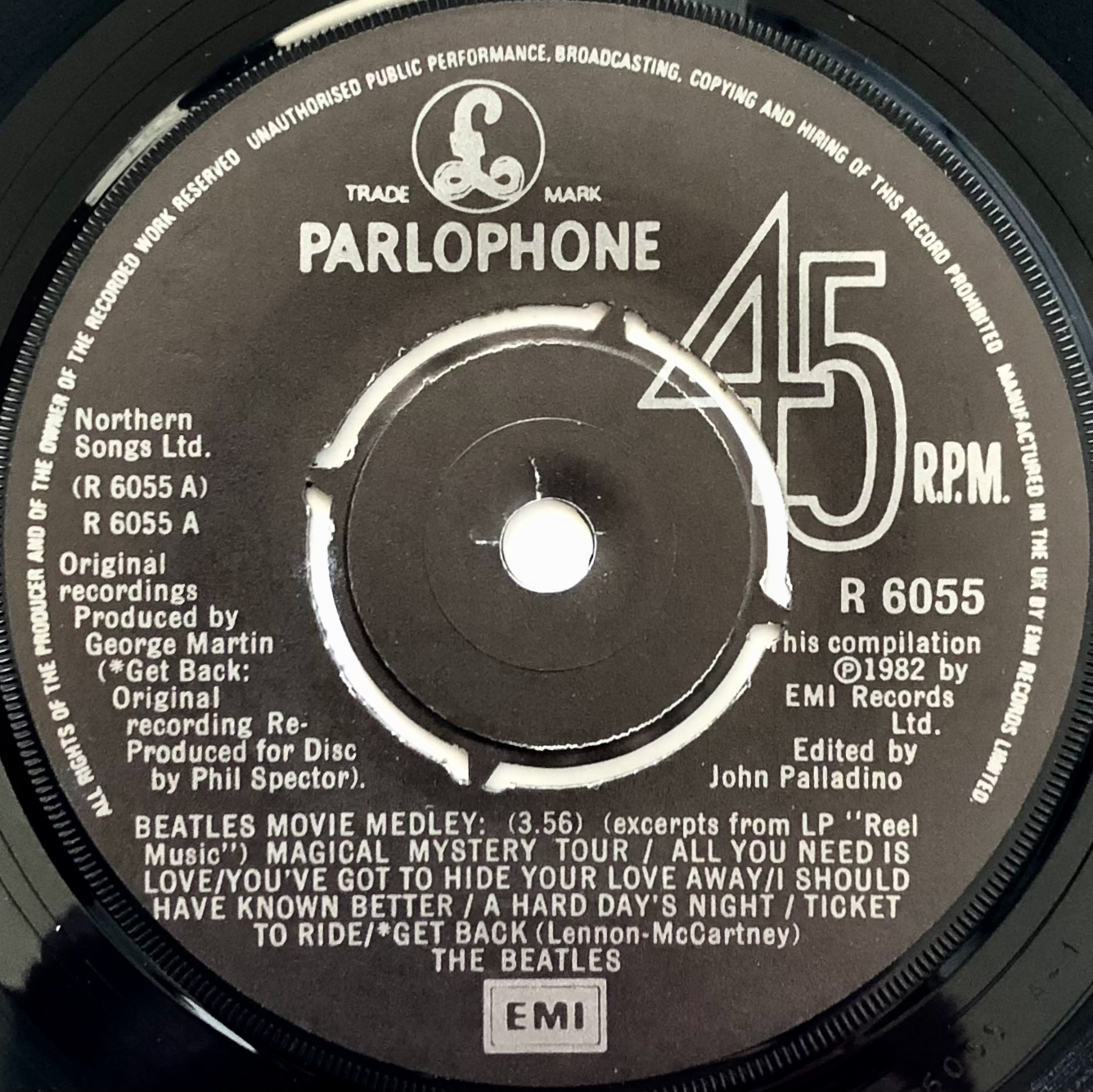
That BSCP1 marking means that the box should contain all 22 singles The Beatles released between 1962-1970, plus 4 singles that were issued following the break-up (‘Yesterday’ from March, 1976; ‘Back In The USSR’ from June, 1976; ‘Sgt. Pepper’s Lonely Hearts Club Band/With a Little Help From My Friends’ from September, 1978; and ‘The Beatles Movie Medley’ from May, 1982). Each should also be housed in unique paper picture sleeves, plus (and this is what delineates this release from the earlier BSC1 Singles box), a picture disc of ‘Love Me Do’ should also be included.

So, that’s 27 discs in all.

It should also have a blue paper insert detailing the complete list of singles with recording dates, release dates and chart positions.

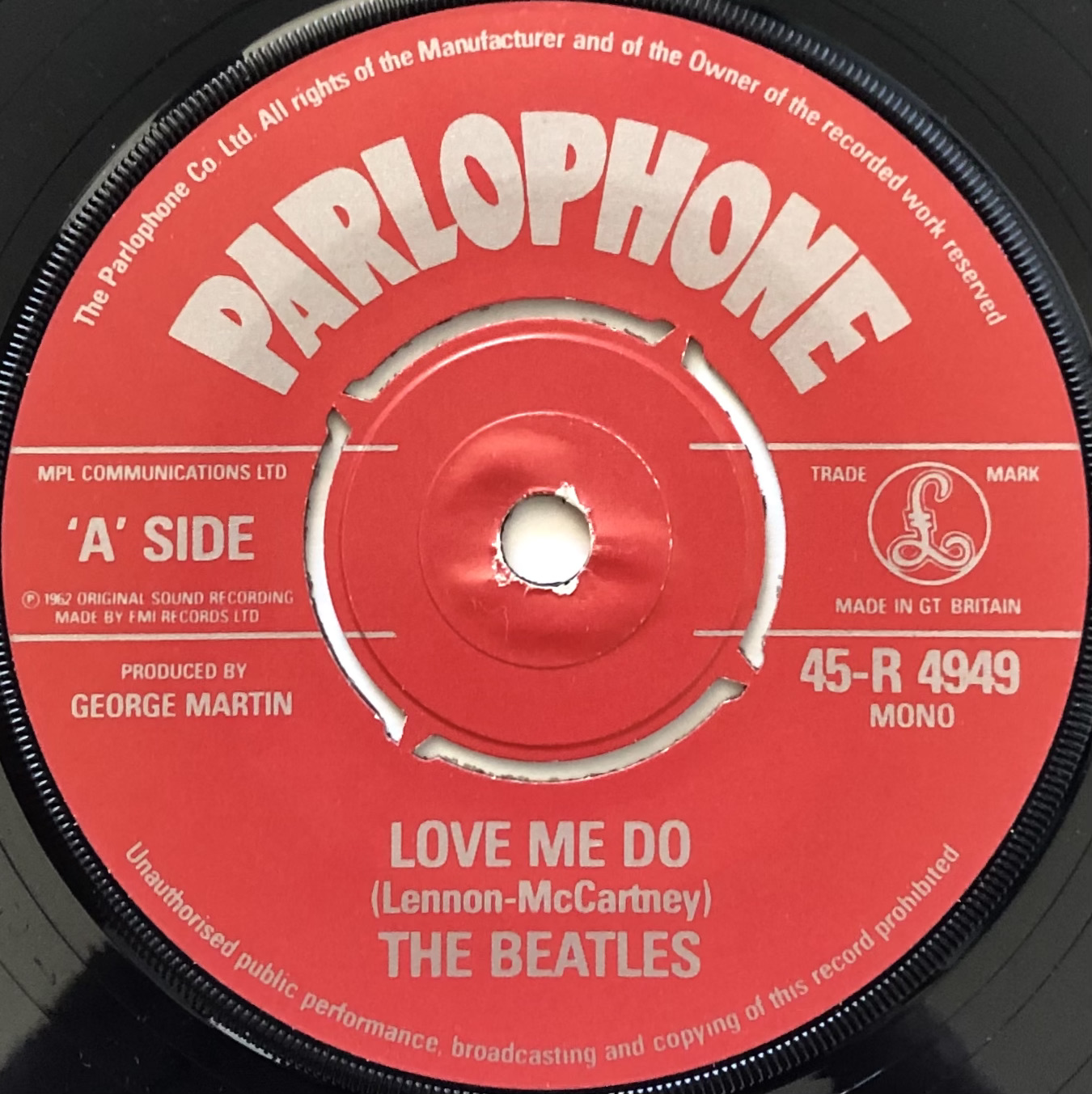
Each single has labels reproduced just as they would have been in the UK at the time of original release too. That means the first two singles, ‘Love Me Do’ and ‘Please Please Me’, are on the red Parlophone label:

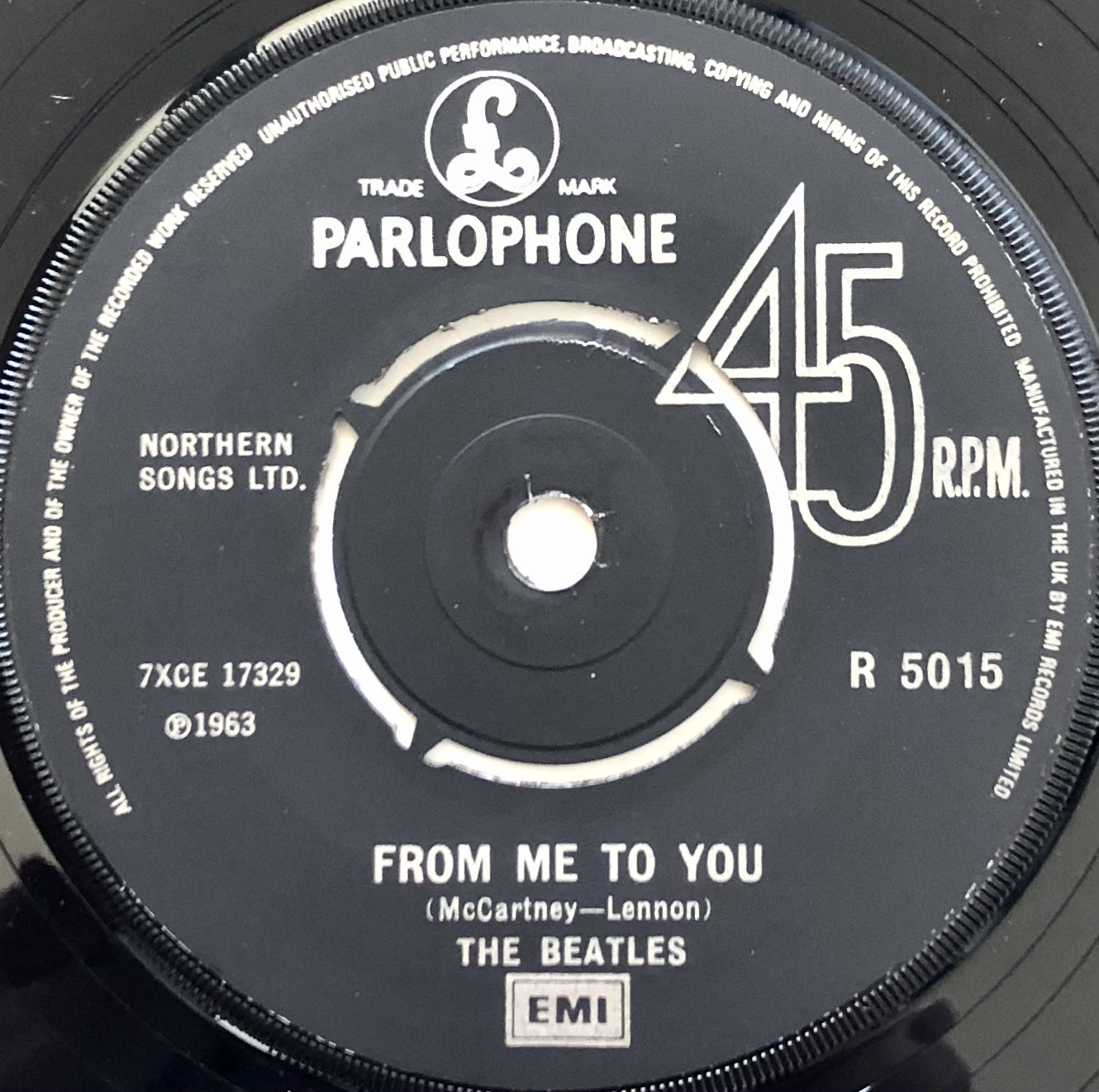
From the singles ‘From Me To You’ through to ‘Lady Madonna’, the labels are the black and silver Parlophone/EMI:

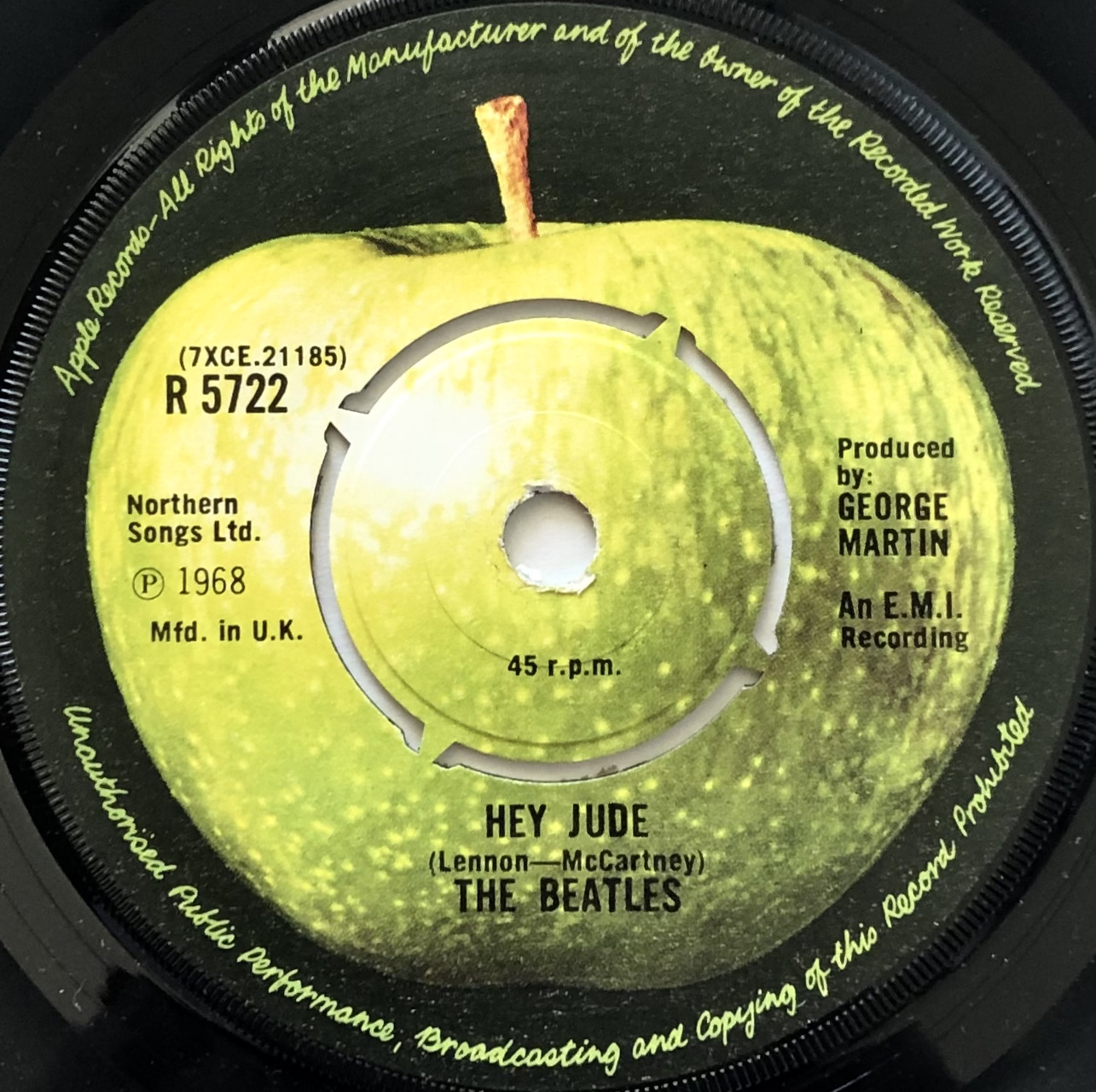
Then, from ‘Hey Jude’ through to ‘Let It Be’, we get the green Apple label:

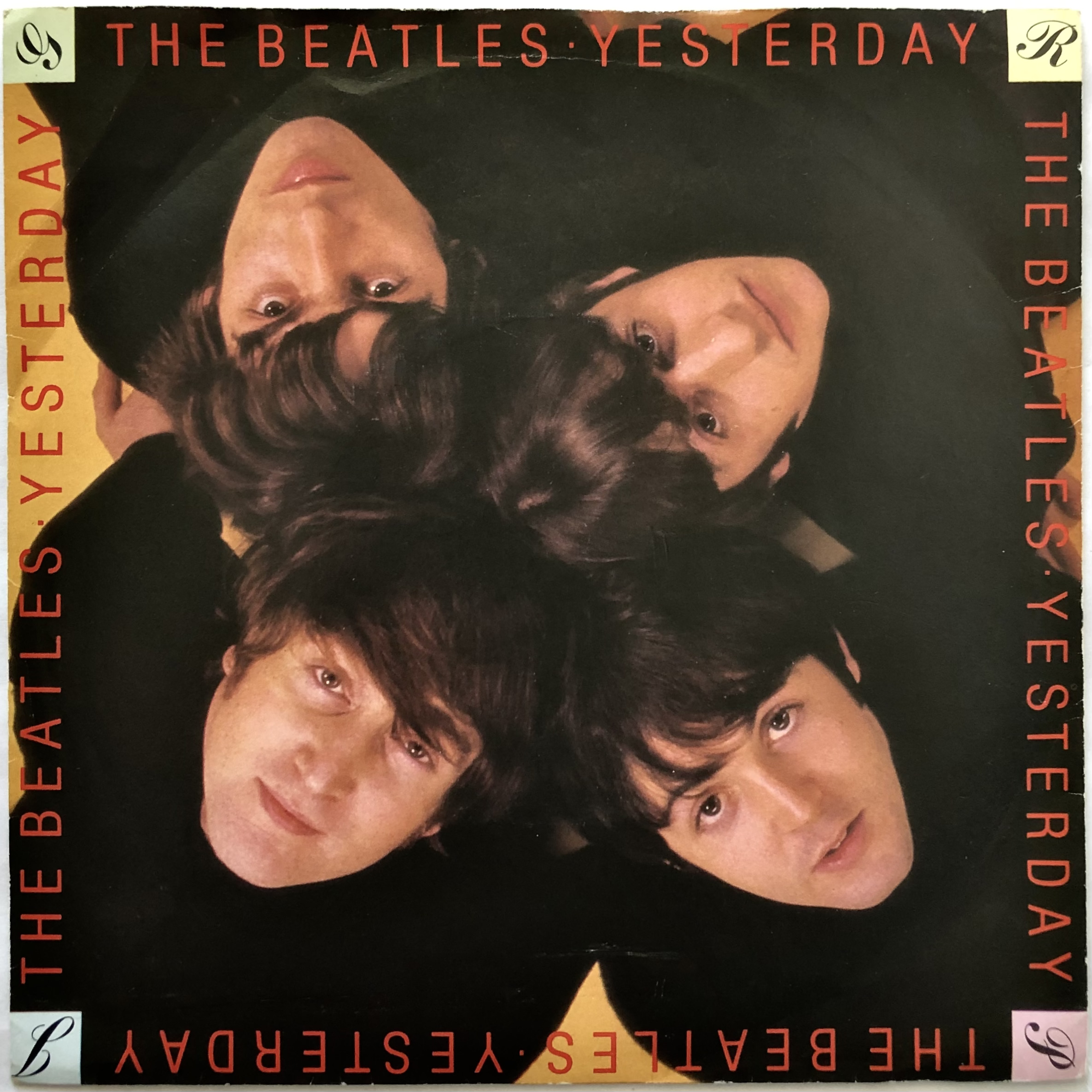
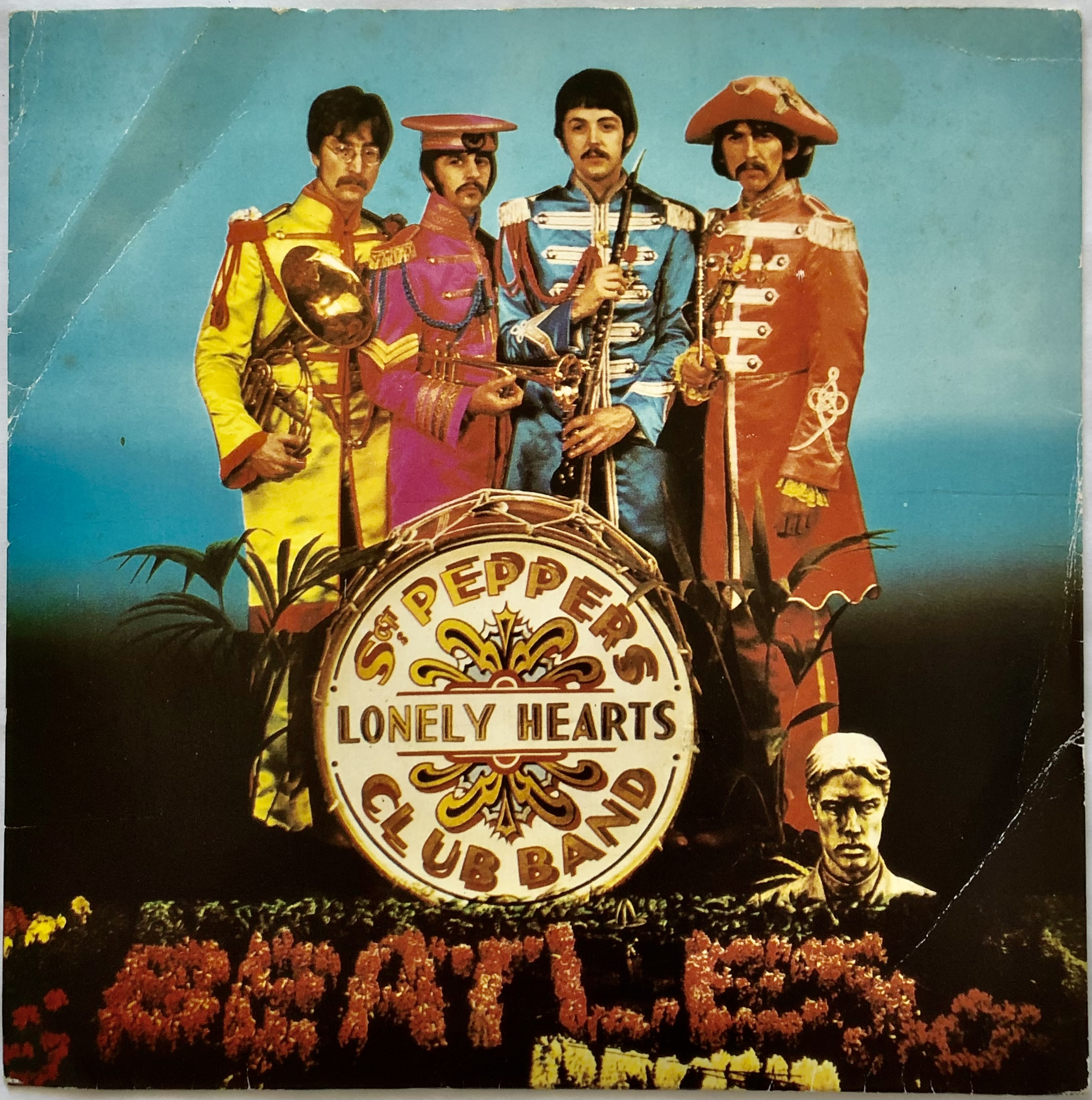
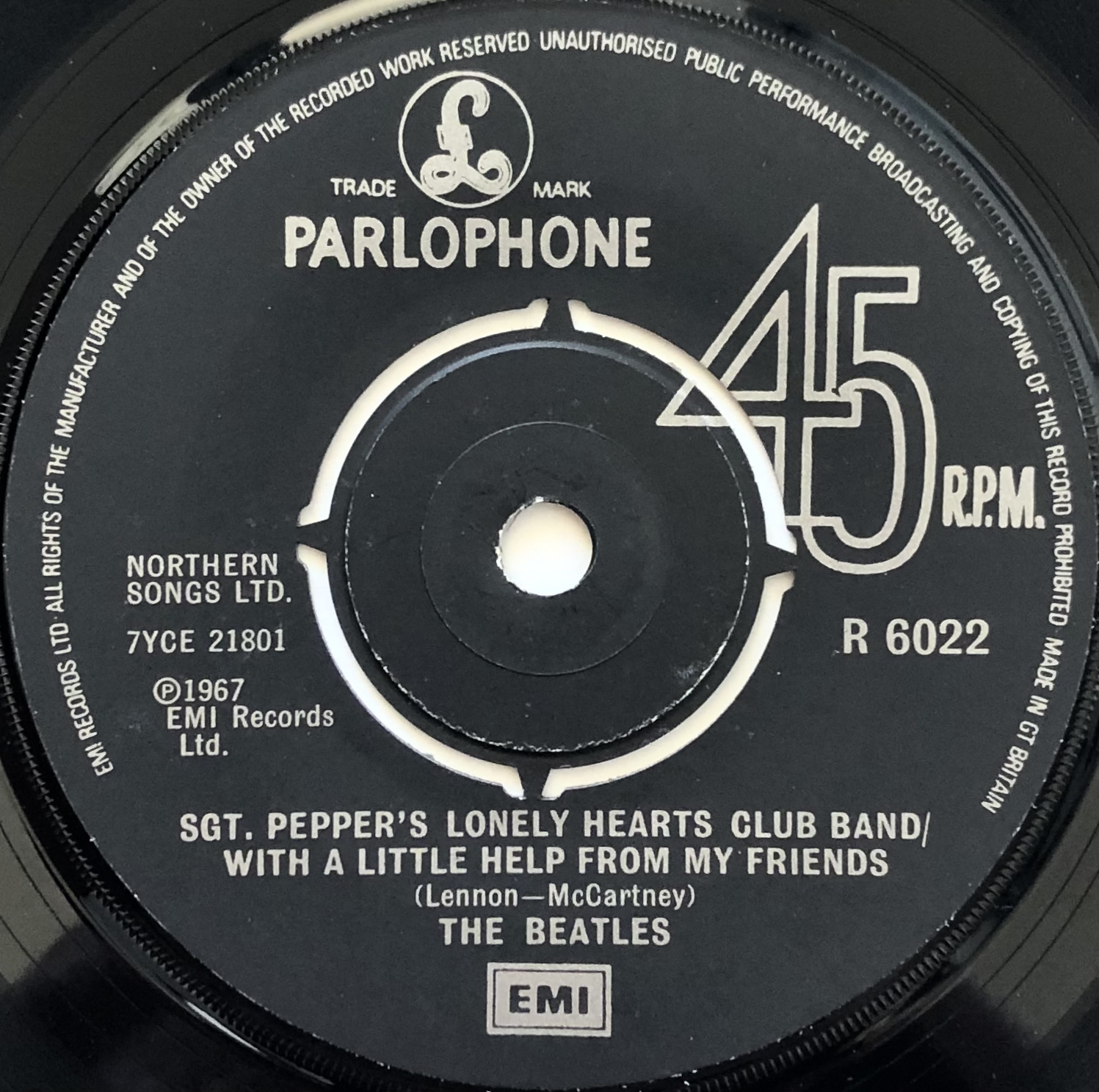
Here are the covers and labels for the four additional singles, ‘Yesterday’, ‘Back In The USSR’, ‘Sgt. Pepper’s Lonely Hearts Club Band/With a Little Help From My Friends’, and ‘The Beatles Movie Medley’:

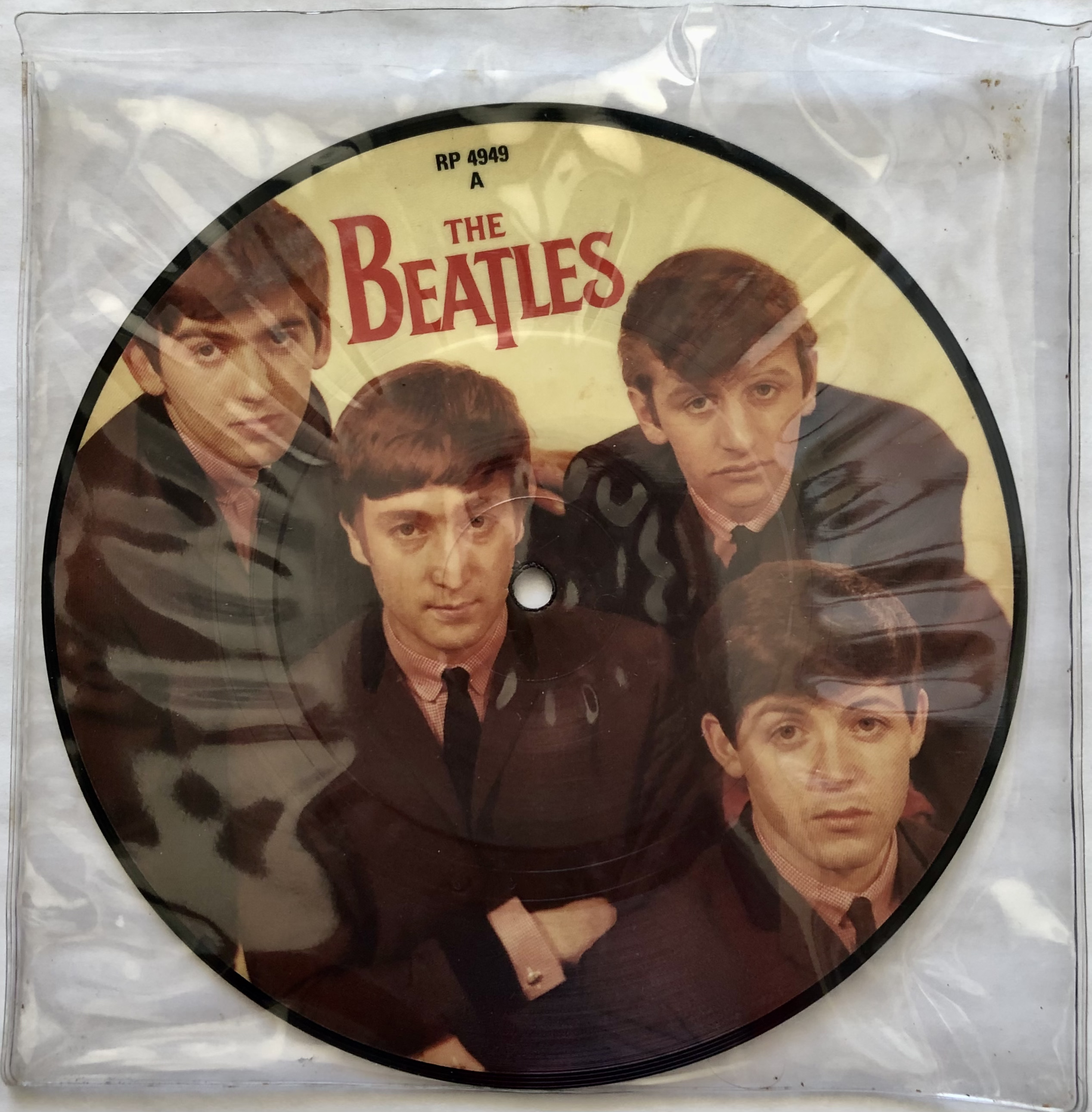
The final single in this set is a ‘Love Me Do’ picture disc, housed in its original clear plastic sleeve:

Here’s the picture disc image on the flipside:

So, at last a blue box for The Beatles Singles Collection (BSCP1). See also our posts on the 1978 edition of 25 singles called The Beatles Collection; the Australian edition blue box containing all the LPs – also called The Beatles Collection. And the CD Singles Collection (two versions), and The Compact Disc EP Collection.

As usual, click on the images above to see larger versions.

Strange/Unusual Find of the Month

It’s not every day that you walk into your local second-hand record store and find an almost mint copy of The Beatles’ 1967 EP Magical Mystery Tour, but that’s what happened last week.

Dropped into Audiomania in the Sydney suburb of Manly Vale and as we were quietly browsing the LP section we looked up to a shelf just near the “New Arrivals” bin, and this is what we spied:

This is a UK pressing, and we’re pretty sure it is an original from 1967, making it just over 50 years old. For it’s age this example is in exceptionally good condition, both the laminated gatefold sleeve, and the two EP records it contains.

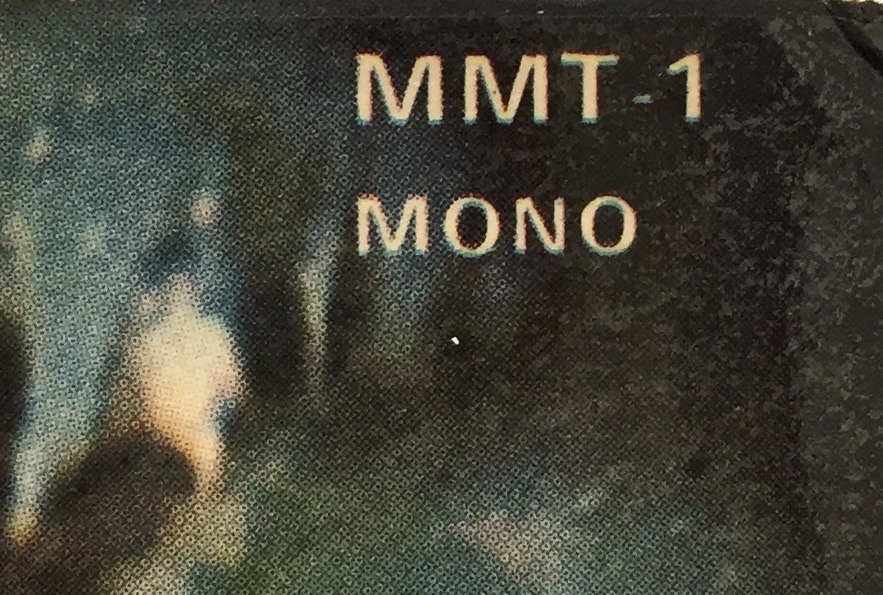
This is the mono UK pressing. You can tell that from the catalogue number MMT-1 which is printed on the upper right of rear cover (and of course the word MONO is also there!). Stereo pressings have an SMMT catalogue number:

The labels also carry the MMT catalogue number. As you can see below this pressing came with a solid centre. There are also examples with a push-out centre. The labels have the “Sold in the U.K. subject to resale price conditions…” text:

Don’t know if you can see it, but the Side 1 label (on either side of the spindle hole) has two raised letters, a K and a T. Not sure if this is significant, or helps identify the pressing date. We think it has something to do with a tax code for the record.

The inner 24-page booklet is also in excellent condition:

It also comes with the 4-page blue lyric sheet pages still intact in the centre. This also helps identify it as being an original pressing. The paper sleeves holding the records are white though, and have a wave-cut top. I think originally the discs may have come in black paper sleeves? If anyone knows please contact us, or leave a comment.

(As usual, click on the images to see larger versions)

So, this was too good an item to pass over. We have Australian mono and stereo pressings of the Magical Mystery Tour double EP, plus a nice French pressing (with a story attached), but a UK pressing in almost pristine condition was our find of the month.

The really sad news is that the Audiomania store will soon be no more. The owner let us know that they will be closing their doors because the site in which they operate has been purchased and its buildings demolished. All the tenants have to get out. They hope to continue online, but it’s just not the same as being there to flip through record bins of used LPs and singles in person…..

Strange/Unusual Finds of the Month – Nowhere Man and Double Fantasy

Every couple of months the Lifeline organisation (which offers a free phone crisis and suicide prevention counselling service in Australia) holds a huge fundraising book fair. They always have, as a side note, lots of second-hand CDs, and usually a few records too. These are usually placed in one corner and any Beatle titles would be scattered in amongst hundreds of other artists.

However, the Lifeline book fair last month had its very own Beatles section!

Obviously someone had donated a large collection and the volunteers had hived off a dedicated section of the tables just for Beatle stuff. There were books, a small selection of LPs and CDs, plus a very large stack of 45 singles. By the time we got through the door though another collector was well into sifting through the 45’s and so we had to wait patiently by for him to finish. Sadly (for us) he took just about all of them, and we were left to pick over the remains.

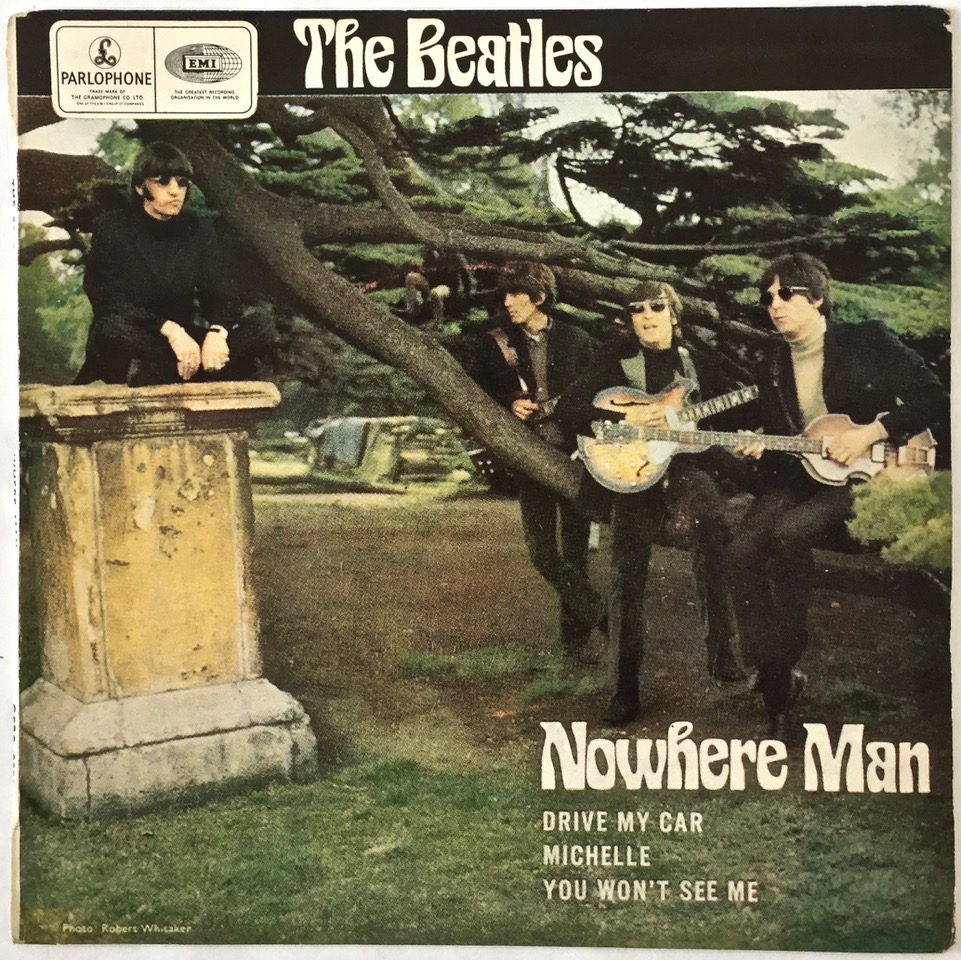
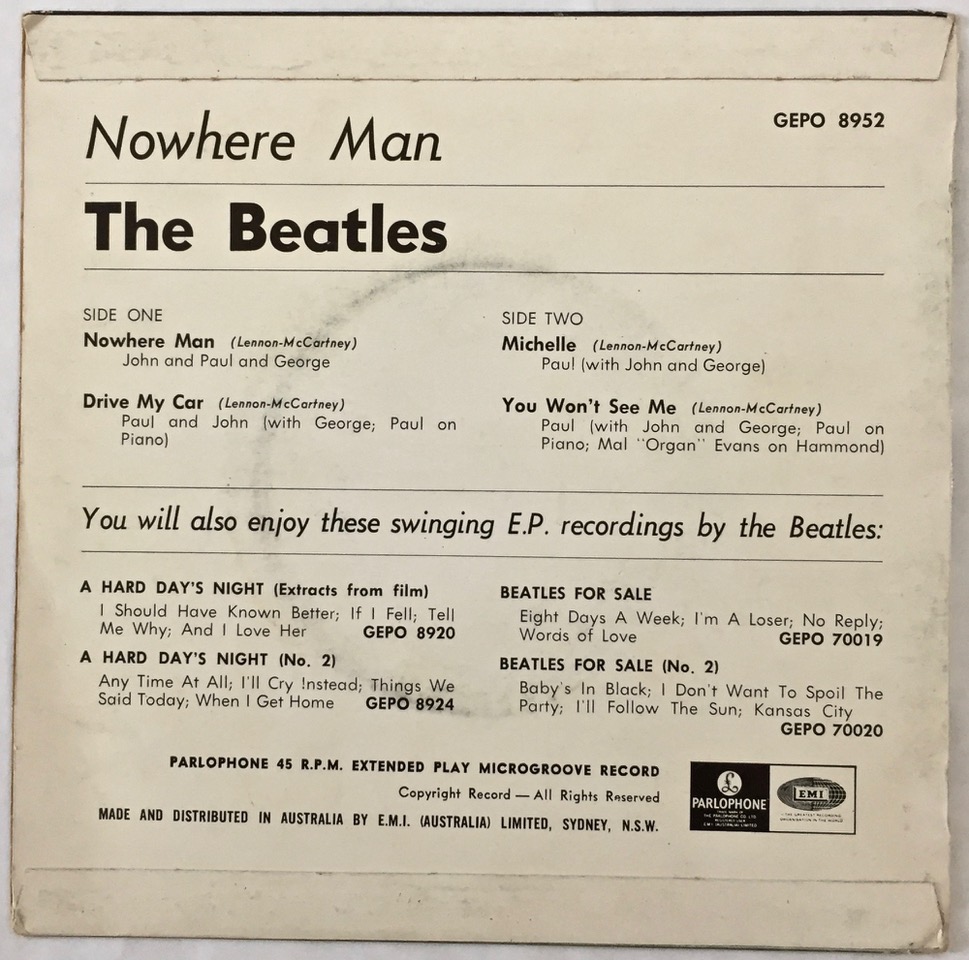
Much to our delight though we discovered a very clean copy of a Beatle EP that had been missing from the collection – one that is now considered rare and fetches hefty prices on eBay. It’s the Australian pressing of the band’s Nowhere Man EP, released on November 3, 1966:This one has the flipback tabs on the rear cover, and the early black and yellow Parlophone label with the Northern Songs royalty stamps included:We’d been looking for a copy of this EP for ages, so to find a copy in good condition was a real bonus. It completes a full set of all the Beatles’ Australian EP releases.

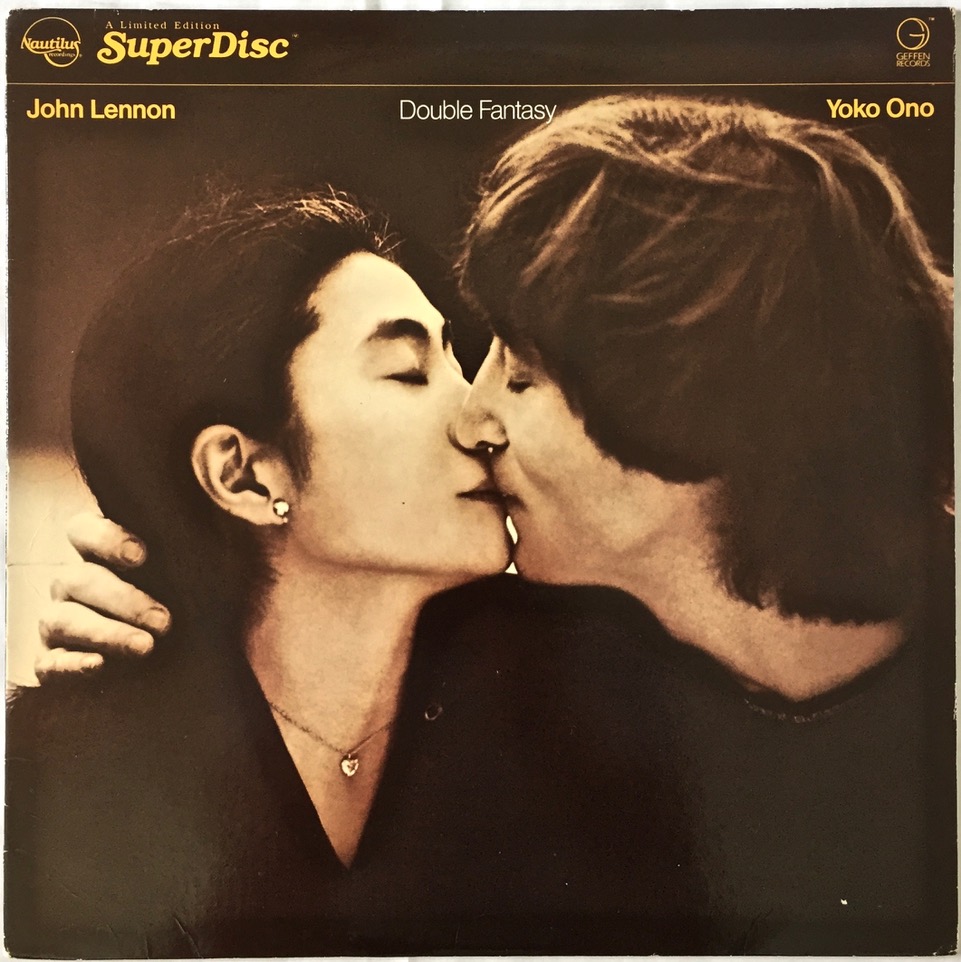
While biding time waiting for the other collector to sift through the stack of 45’s we checked out the books and the small number of Beatle albums on offer. Amongst these was this LP: This is the rarer Half-Speed mastered pressing of the John Lennon/Yoko Ono disc Double Fantasy. It is on the Geffen/Nautilus Superdisc label and dates from 1982. This limited edition release should come with a poster and a lyric sheet insert. Both these are missing, but it does have the original Nautilus ‘blue disc’ poly inner “Super Sleeve”:So, another strange/unusual find on what turned out to be a pretty good day.

McCartney’s ‘Pipes of Peace’ – Original Labels

Looking at the recently released Capitol Records coloured (and black) vinyl reissue of the Paul McCartney Pipes of Peace LP, we got thinking about the labels used for the original release back in 1983.

This is the label style used on both sides of the 2017 version:

As you can see, the custom designed labels are similar thematically (but not exactly the same) as those used for Side 2 of the 1983 vinyl release:

The chrome-plated chair image is larger and positioned differently, plus it has a different musical instrument on it.

But it’s the labels used for Side 1 in 1983 that fascinate.

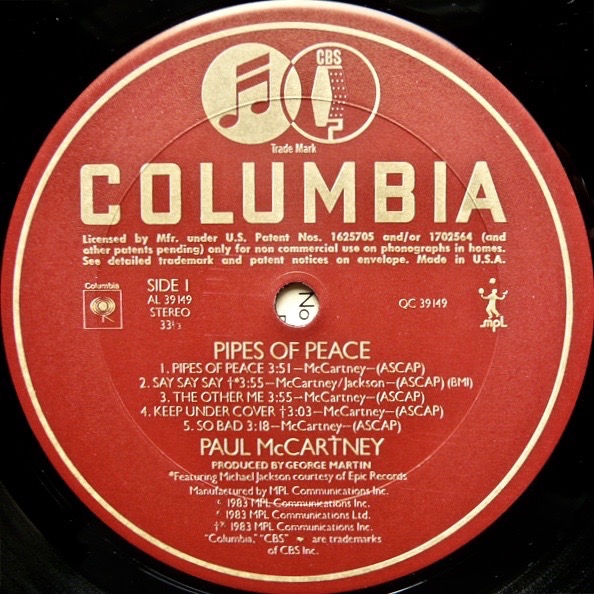
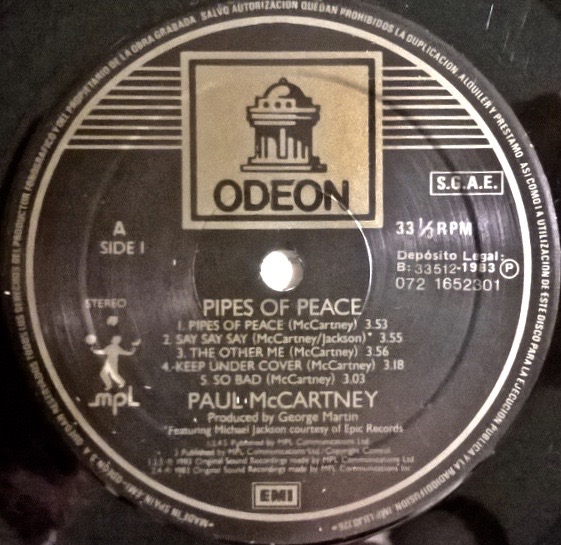
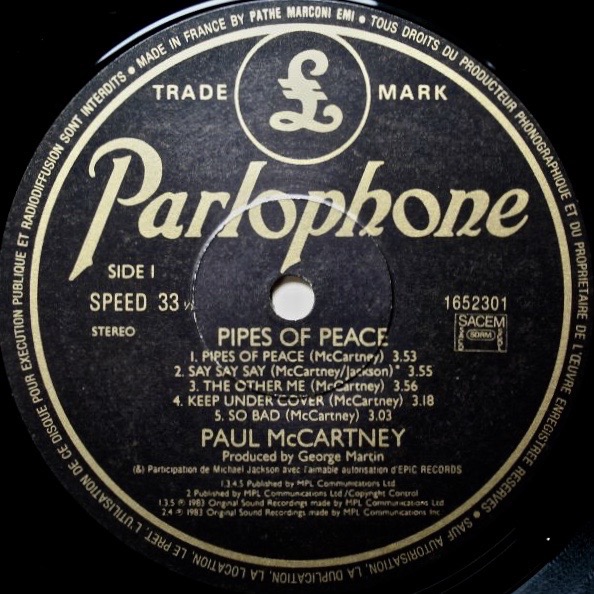
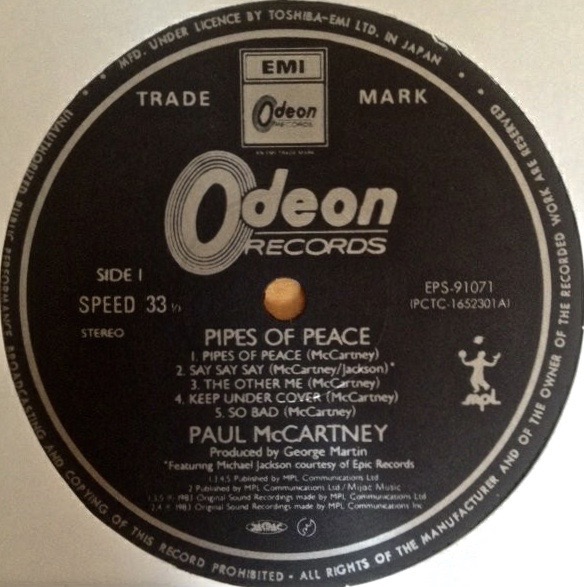
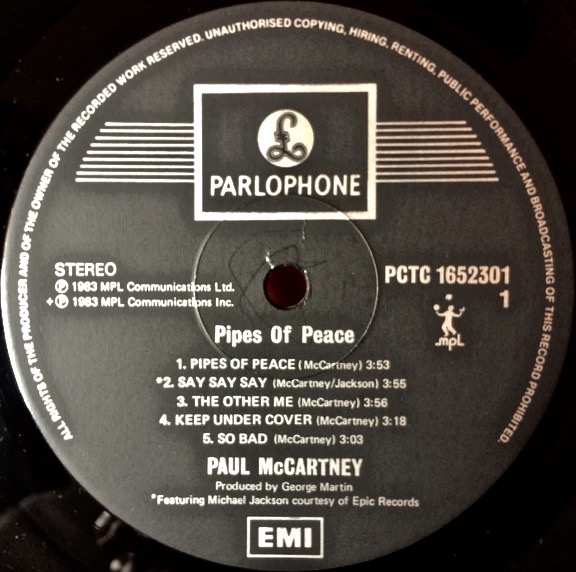
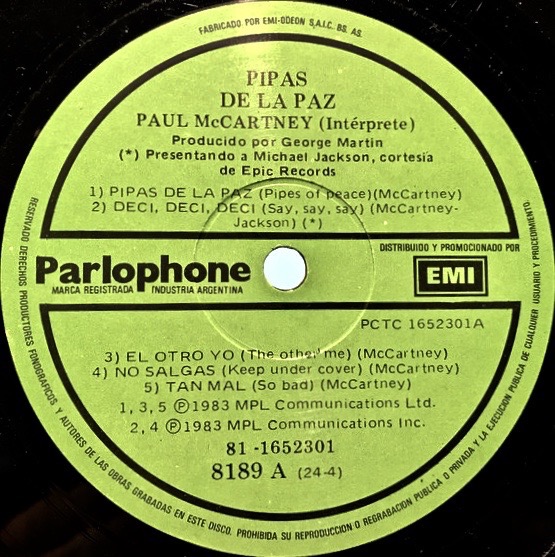
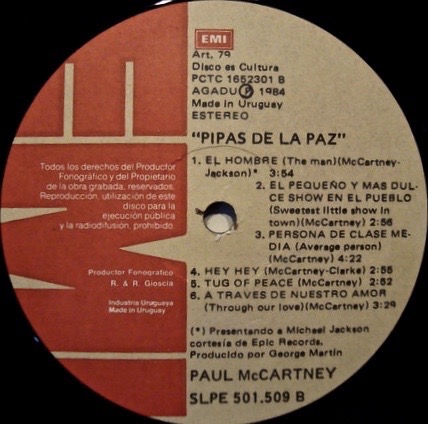
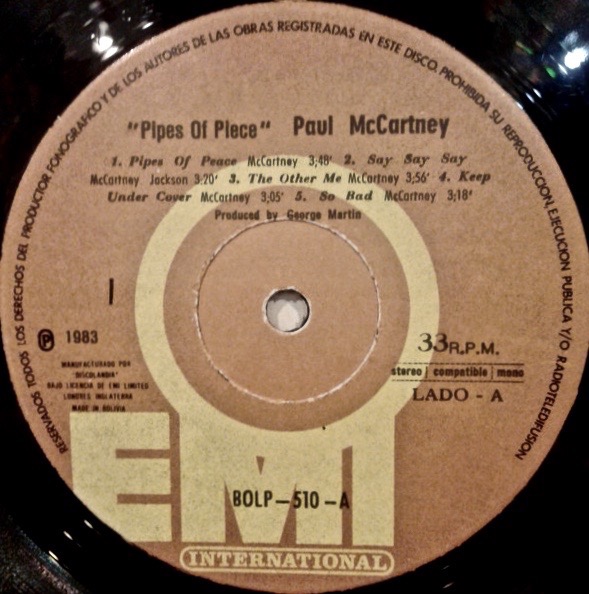
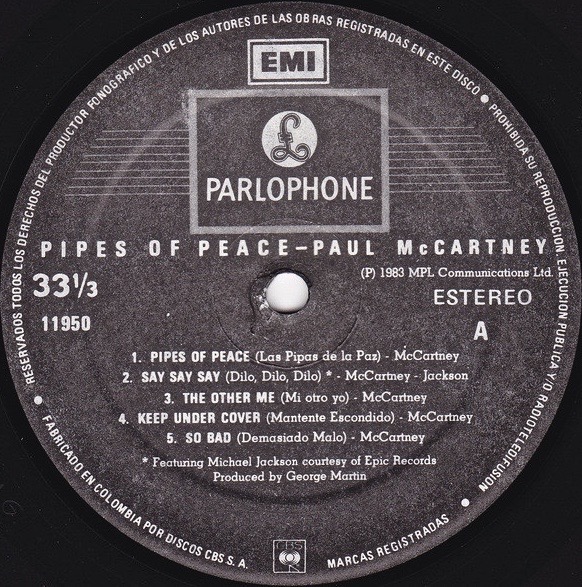
For some reason Side 1 in each of the major markets around the world featured vintage depictions of either Parlophone or Odeon record labels (for those territories outside the US), or Columbia Records for the United States (because that was the label McCartney was signed to there at the time).

Here, for example, is the Side 1 label used in the UK – a vintage Parlophone in deep maroon:

And here’s the label used in the US, which was done in the style of an old-fashioned Columbia release:

In Australia it was a vintage Parlophone – done in a dark brown and gold:

For Europe, where the Odeon label was used to release EMI titles, they used a vintage version too. Here’s the one for Germany:

And Spain of course:And here’s the label used in France for Side 1. Unusually, it’s a vintage Parlophone – which is strange because you’d think it would more likely be on Odeon too:

It was definitely vintage Odeon for Japan: And in New Zealand it was a Parlophone: 

These next few are from smaller territories where we’re pretty sure that on both sides of the disc the  labels used were both the same. If you happen to have any further info on these please get in touch using the “Leave a Reply” section below. First up, India:

We can confirm that The Philippines definitely used a vintage black and yellow Parlophone for both sides of the disc:

Malaysia:

And to some South American countries now – Argentina:

Uruguay:

Bolivia:

And lastly, Columbia, which interestingly seems to be serviced by both Parlophone and Columbia/CBS records:

If you’d like to see these labels in more detail, click on the images to bring up larger versions.

And if anyone knows just why Paul McCartney wanted to use vintage labels for Side 1 only of Pipes of Peace, please let us know by commenting below.

The Beatles DeAgostini Vinyl Collection Has Been Extended

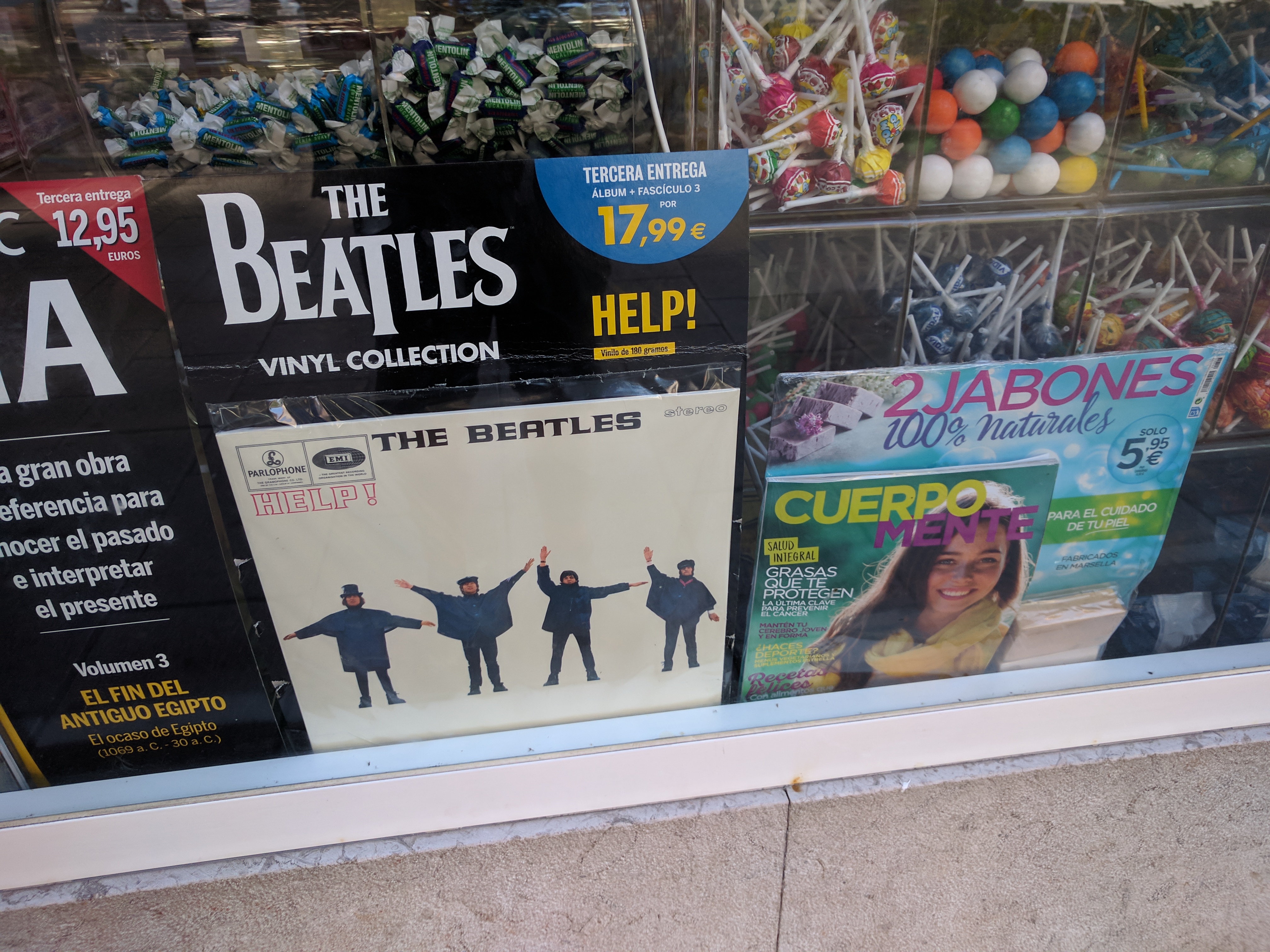
Looks like the newsagent and mail order Beatles Vinyl Collection series from DeAgostini has recently been extended to five more countries: Germany, Austria, Luxembourg, Spain and Japan.

These re-issues (all beautifully pressed on 180gram vinyl at the French MPO plant) are still going strong in Italy (where they are now up to On Air – LIve at the BBC Vol.2, which is issue 18 in the 23-issue series), and in the United Kingdom (where they are up to issue 15 –Anthology 2).

A friend just sent us this photo – a news agency window in Spain:

John Lennon – ‘Jealous Guy’ 12-inch Single

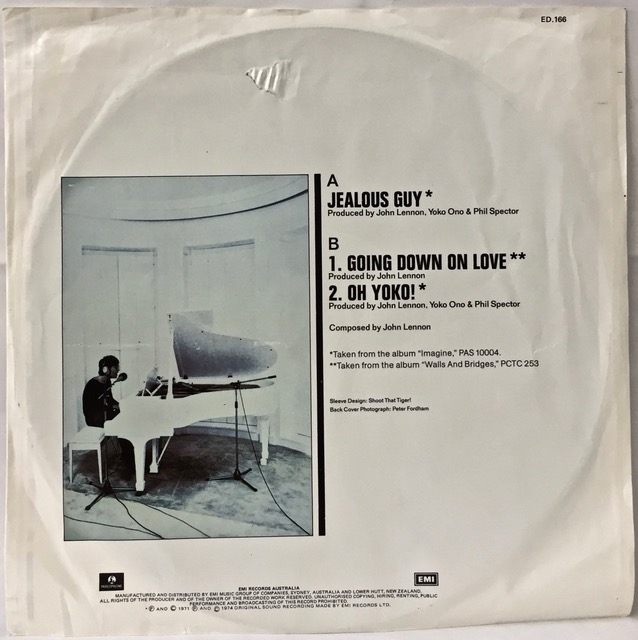
My daughter was at a big market in Melbourne a couple of weeks back. There was a guy selling records and so she bought this for me:lennon-jealous-1

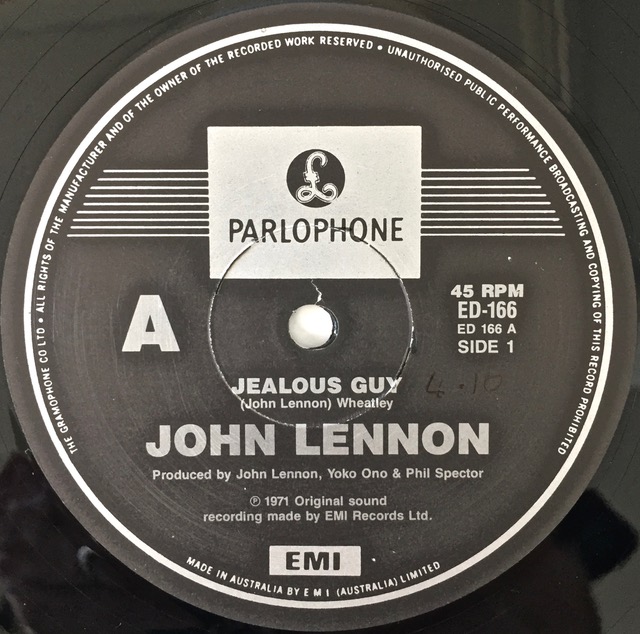
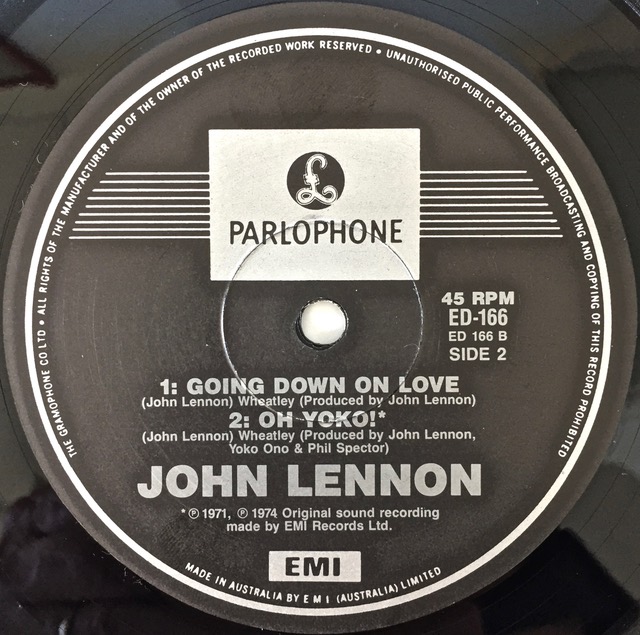
It’s the 12″ single release of John Lennon’s ‘Jealous Guy’, taken from his Imagine album. As far as I can tell the single was released in 1985. Discogs doesn’t have this particular release listed, but it does have entries for the UK and Europe which look to be the same.

This is the Australian release and as you can see it’s backed with ‘Going Down On Love’ (from Walls and Bridges), and ‘Oh Yoko!’ (also from Imagine).lennon-jealous-3lennon-jealous-4

(click on the labels for a larger version)

The cover is a bit worn and creased and there’s a slight tear on the back, but the vinyl inside is in absolute mint condition. lennon-jealous-2It’s nice when your kids buy you presents!

“Great Record Labels” Book

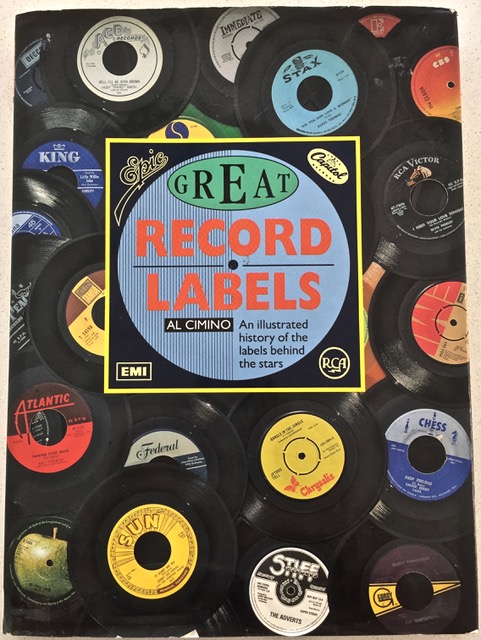
Chanced upon a small local garage sale (or yard sale) this morning and found this book:great-labels-cover

Great Record Labels, written by Al Cimino and published by Chartwell Books in 1992, is quite an interesting overview of some of the most famous record companies, admittedly with a strong US bias. It has some really good images liberally scattered throughout, not only of the various record company labels themselves, but also many of the artists signed to the labels too.

Cimino has split his book into five broad categories covering music from the 1950’s through to the 1990’s. He starts with Sun Records in the Fifties, and ends with Def Jam in the Nineties, and works his way through most of the big labels in between – like Atlantic, Stax, Motown, Decca, A&M, CBS, Warner Brothers, Island, and Virgin – to name but a few.

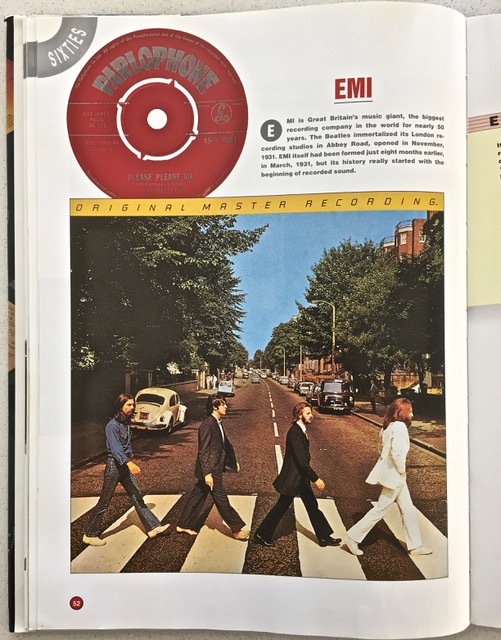
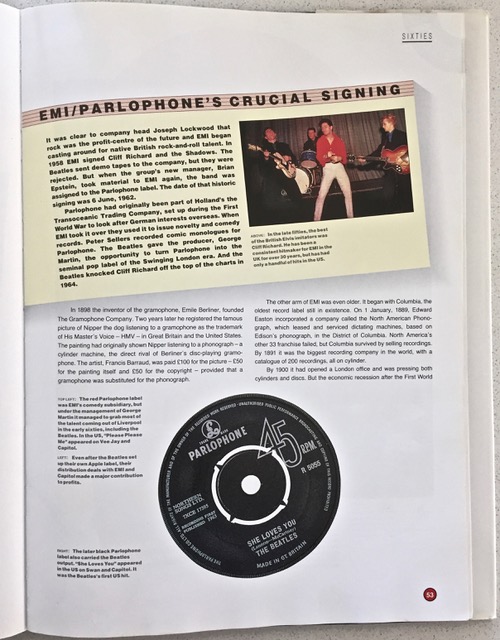
There are two main segments of the book where The Beatles pop up. First is the chapter on the British EMI/Parlophone label:great-labels3great-labels4

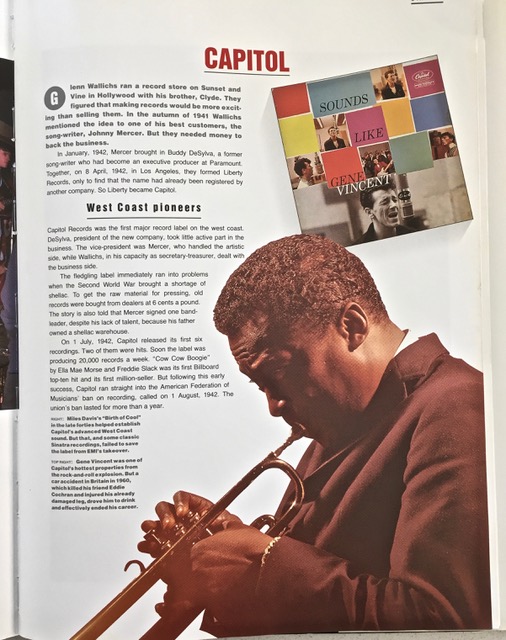
In the section on EMI’s US subsidiary Capitol Records there is only fleeting reference to The Beatles, despite the huge amounts of money they made for the company:great-labels9

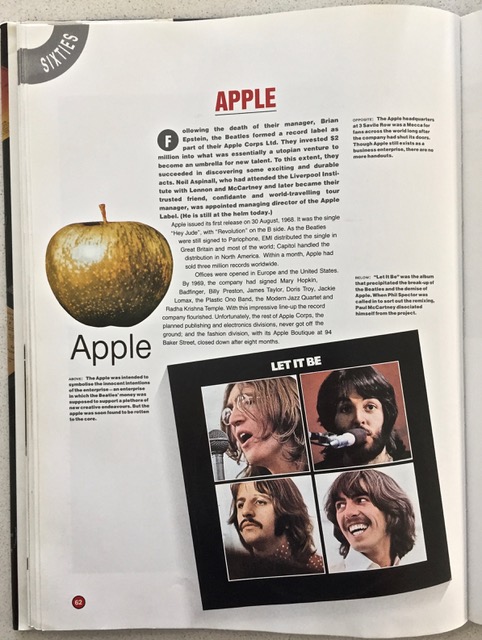
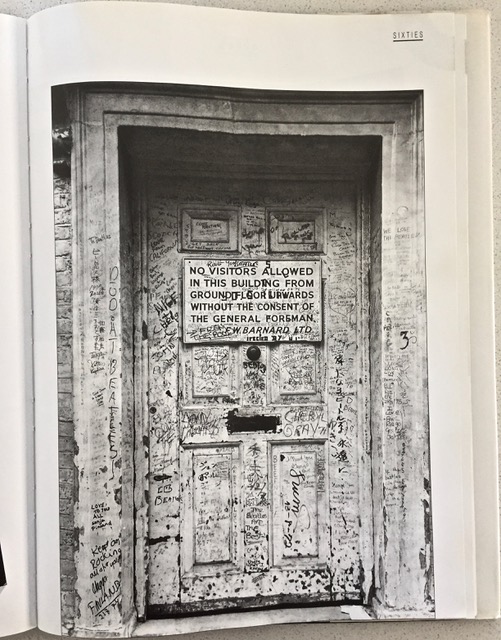
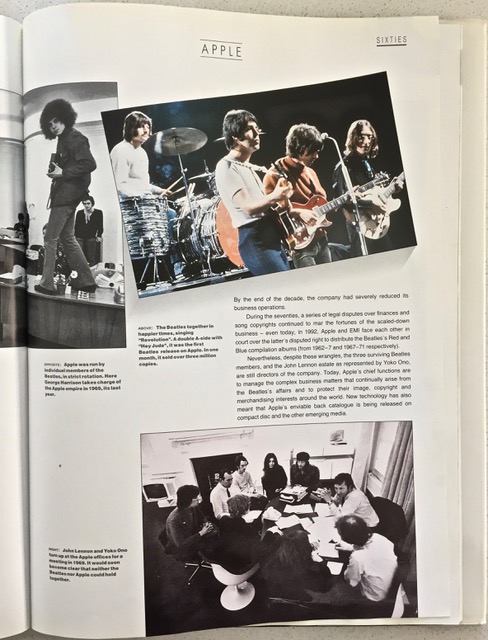
But to make up for that there’s no less than four pages dedicated to The Beatles’ own Apple Records:great-labels5great-labels6great-labels7great-labels8

Here’s the rear cover of Great Record Labels (the dust cover has seen better days…):great-labels-rearDespite being a little beat up, this is a nice little find and a good book to have in the collection.