Three Copies of “Q” Magazine

I needed to visit Australia’s national capital Canberra for work the other day and ended up staying overnight. That meant driving back to Sydney on a Saturday morning and so I had time to call into the large-ish New South Wales country town of Goulburn, which is just off the freeway on the way home.

Goulburn, I had discovered on a previous trip, has a very large second-hand book and record shop just off the main street called The Argyle Book Emporium. When I say big I’m talking an extensive old rambling period building with room after room literally filled floor-to-ceiling with books. One room at the rear is devoted to music. There’s a small selection of music-related books and magazines, and boxes and boxes of records and CDs. Its a bit frustrating as these boxes are just randomly grouped together. They’re not split out into Male Vocal, Female Vocal or Groups for example. Not even 50s, 60s ,70s and 80’s. Just everything mixed in together – making finding anything of interest a needle-in-a-haystack affair….

I didn’t have a lot of time and so I gave the LPs just a cursory flip through. I looked at a couple of boxes at the front which were easy to get to and didn’t find anything. What was more interesting was a very large pile of “Q” and “Rolling Stone” magazines. A collector had obviously off-loaded a lot of past editions that were no longer wanted. The “Rolling Stone” magazines had been pretty well picked over. Nothing really of interest to the avid Beatles collector. However, in the “Q” magazine pile I found these three editions: 

This slideshow requires JavaScript.

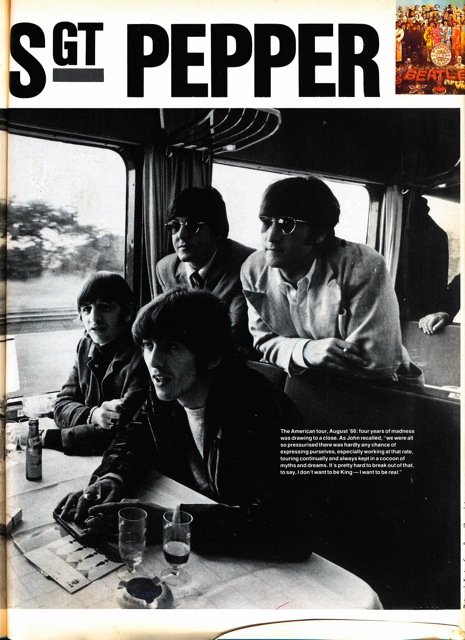
The first dates way back to June 1987 – a time when we were all celebrating the 20th Anniversary of “Sgt Peppers”. Inside there are ten pages of photos and text:

Sadly, there was a “Sgt Pepper Part II” article that was due to be published in the following month’s magazine. It wasn’t on the pile of mags I found in Goulburn….oh well.

The next “Q” magazine I found featured an extensive article about Paul McCartney from July 1989. The headline on the front cover screams: He sings! He plays! He writes his own songs! For  PAUL McCARTNEY OPPORTUNITY KNOCKS! * Now available for live work! *.  Inside there’s a nine-page article about Paul. It begins: “He never expected to be doing this when he was 46 – “We thought 25 was the end of the line” – but Paul McCartney has stoutly refused to give up his day job. Engaged in rustic rehearsals for his first British tour in 10 years, and with a fresh solo album on offer [“Flowers In The Dirt”], he’s preparing once again to be public property. With mixed feelings…”. In the article there’s reference to the number of times McCartney makes reference to his father, Jim McCartney….”a Liverpool cotton broker and part-time musician who brought Paul up after his mother’s death (when McCartney was 14), and who died himself in 1976. One song on McCartney’s new album “Flowers In The Dirt”, is called “Put It There”, after a favourite phrase of his Dad’s”.

Finally, the “Q” magazine with that awesome David Bailey portrait of Paul and John on the cover. It comes from August 1999. Its a pretty simple premise on the part of “Q”. As the century draws to a close why not run a reader poll asking who are the 100 greatest stars of the 20th Century. According to “Q” readers back then the top ten are (were):

10. Michael Stipe; 9. Liam Gallagher; 8. Noel Gallagher; 7.Madonna; 6. David Bowie; 5. Elvis Presley; 4. Bob Dylan; 3. Kurt Cobain; 2. Paul McCartney; and and number one the runaway winner (according to “Q” by a long way)…..John Lennon.

It is kind of fitting to look back and read a magazine like this (from 1999) in this year (2010) when Lennon would have turned 70, don’t you think? Kind of cements the fact that his presence could in fact be enduring. That now, a further eleven years down the track, his music is still around and he’s still held in very high regard by many. There’s an additional article right at the end of the poll headed: “John Would Have Been Proud”. It says: “Yoko Ono, the keeper of the Lennon flame and the Lennon vat of money, telephoned Q as soon as she heard about the readers’ tsunami-sixed endorsement of her late husband’s transcendental magic and generation-straddling stature….”. That article is illustrated with this beautiful photograph:

Enough said.

(see also “Nine Copies of Rolling Stone”)

1001 Songs You Must Hear Before You Die

I was sent a new book the other day. Its called “1001 Songs You Must Hear Before You Die”. Great title.

Its edited by Robert Dimery and is a compendium of entries about the greatest popular songs ever recorded. The book is a companion to his previous work “1001 Albums You Must Hear Before You Die”.  (Click here if you are wondering about what’s on that album list).

The front cover of "1001 Songs You Must Hear Before You Die"

Of course the first place I went was to the index to find where the Beatles appeared.

They have no less than six full entries:  “A Day in the Life”; “Eleanor Rigby”; “Hey Jude”; “Strawberry Fields Forever”; “Ticket to Ride”; and “Tomorrow Never Knows”.

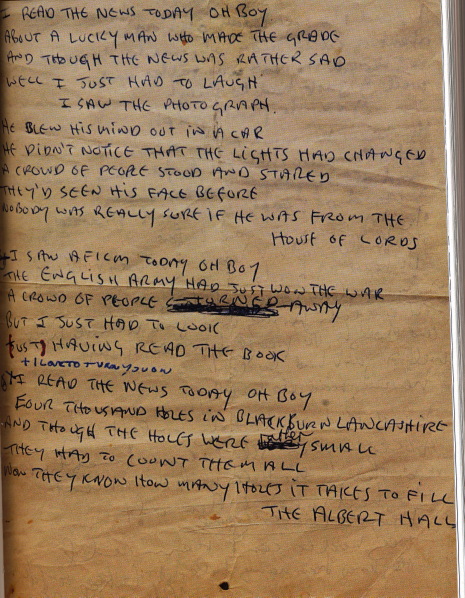
The entry for "A Day in the Life" uses an image of John Lennon's hand-written lyrics for the song

Interesting that “A Day In The Life” features so prominently as it was also recently nominated as the number one Beatles song in Rolling Stone’s Beatles special edition “Top 100” list.

The Beatles are matched in the book only by Elvis – who also featured with six entries. Bob Dylan, by way of comparison, has four entries…..

John Lennon as a solo artist gets one (a little predictably its “Imagine”); Paul McCartney gets one (perhaps surprisingly its “Maybe I’m Amazed”); George Harrison gets one (“Awaiting On You All”); and Ringo…well, Ringo doesn’t get any solo mentions.

Rolling Stone Magazine Names Its Top 100 Beatles Songs

I’m a bit late catching up on this one as news first came out about it at the end of August, but it’s probably only just hitting news stands near you now – depending on where you live…

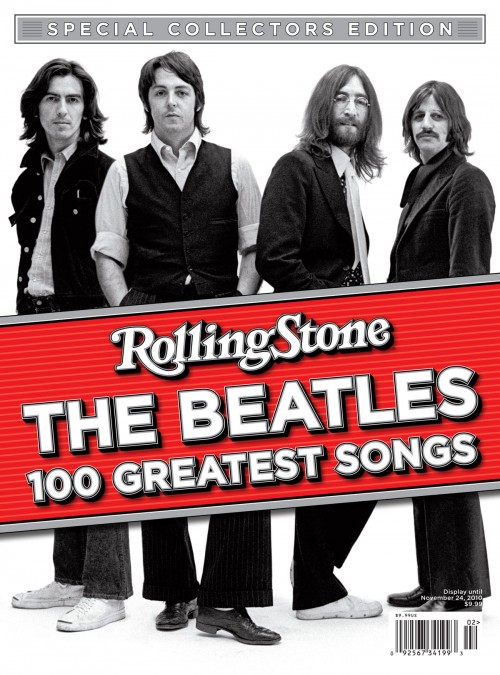
In a special Collectors Edition, Rolling Stone magazine has named its Top 100 Beatles songs of all time. (Apparently its the first time they’ve done this). News of the the special edition came out in the US on August 26.

The press release reads:

ROLLING STONE RELEASES “THE BEATLES 100 GREATEST SONGS”

“New York, NY – August 26, 2010 – Rolling Stone released its first-ever list of the 100 greatest Beatles songs as part of a special interest publication that coincides with the 40th anniversary of the Beatle’s final album, Let It Be, and the 30th anniversary of John Lennon’s death. Topping the list, as ranked by the editors of Rolling Stone, is “A Day in the Life,” followed by “I Want to Hold Your Hand” and “Strawberry Fields Forever.”

Following an introduction by Elvis Costello, the book features the stories behind each song, dozens of photos, an index of the complete list, and a breakdown of the numbers, including the years with the most songs (1965 and 1966 each had 17), the shortest song (“Her Majesty,” 23 seconds) and the song that spent the longest time at number one on the charts (“Hey Jude,” 9 weeks).

The book also includes special sections with lists of Lennon and Paul McCartney’s five favorite songs, the top guitar and drumming moments of George Harrison and Ringo Starr, respectively, and the best Beatles cover songs.” (ends)

The magazine has created a really nice page detailing their Top Ten songs – including some great photographs too.

See also the different Australian cover.

All Things Must Pass – Variations and Collectors Items

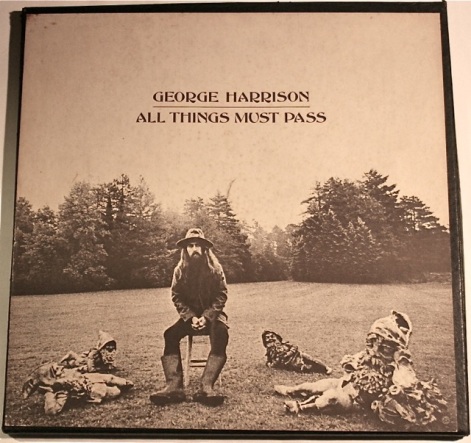
In November it will be 40 years since George Harrison released his masterpiece, “All Things Must Pass”.

It was the first triple LP ever released by a solo artist. Harrison had so many songs – many of them stored up from his Beatles days – that they sprawled across 2 LPs, plus a third disc called “Apple Jam” which was just that: George and his mates jamming in the studio.

In both the US and the UK the album came out in a black box with a matte, monochrome shot of Harrison on the front, sitting like an elf (complete with accompanying garden gnomes) in the garden of his Friar Park mansion:

atmp-us-cover1

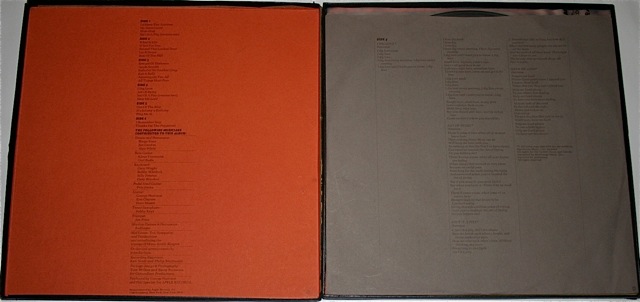
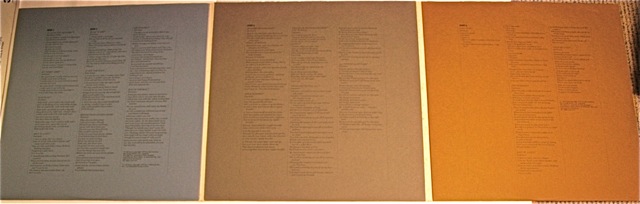
The box came with a huge poster of George (36″ x 24″), and each inner sleeve was in a different colour, complete with the printed lyrics to the songs it contained. Record one is in a light blue sleeve, record two is grey, and record three (“Apple Jam”) is mustard coloured.

The US box open with orange inner and light blue sleeve for record one

The US box open with the lyric sleeve for record two

The US box open with the mustard coloured “Apple Jam” sleeve

The US and UK labels were Apple – but in this time in bright orange:

On the first two discs there was the full Apple on one side, and a cut Apple on the other:

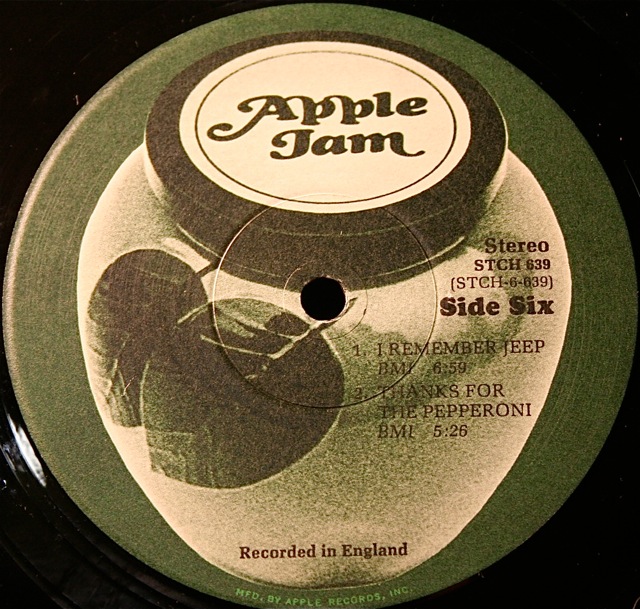
The “Apple Jam” disc (sides 5 & 6) had its own custom labels:

In Australia the packaging for the 3 x LP set was quite different. It was a specially designed triple fold-out cover (not a box set), with a shiny laminated finish on the outside:

The Australian release – front cover

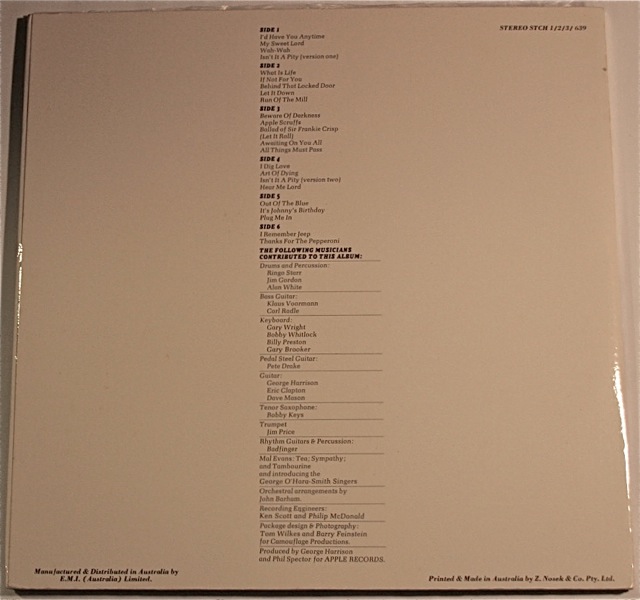
The original release was a top-load cover (there was a later Parlophone label release which was side-load – see below). Here’s the rear cover for the Australian release:

The Australian release – rear cover with song list and artist details

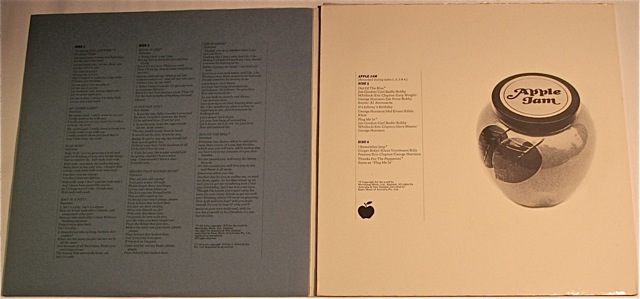
The triple gate-fold opened up like this, and the inserts in which the records are held were made of high quality textured paper in the same colours as the US and UK box-set inner sleeves:

The Australian triple gatefold open on one side

The Australian triple gatefold open both sides

The original Australian issues also came with the giant George poster, and had the bright orange Apple labels – however this time in full on all four sides of each LP (in other words no “cut” Apples on sides 2 and 4):

Plus it also had the special Apple Jam labels for sides 5 & 6:

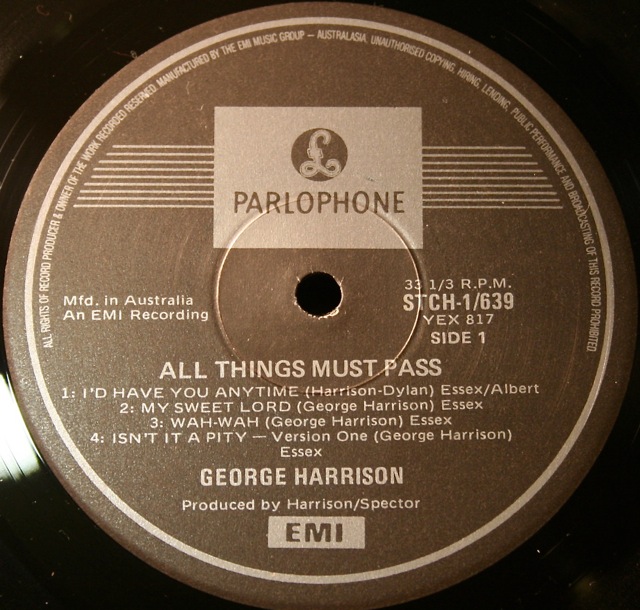
In the 1990’s in Australia came a vinyl re-issue of the set. It came in the same triple gatefold cover, but this time at a lower quality of paper. And it wasn’t on Apple Records, but the Parlophone label:

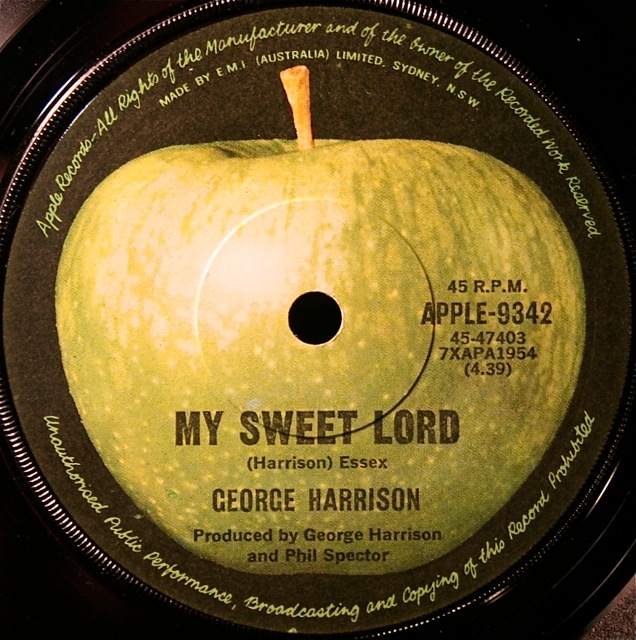
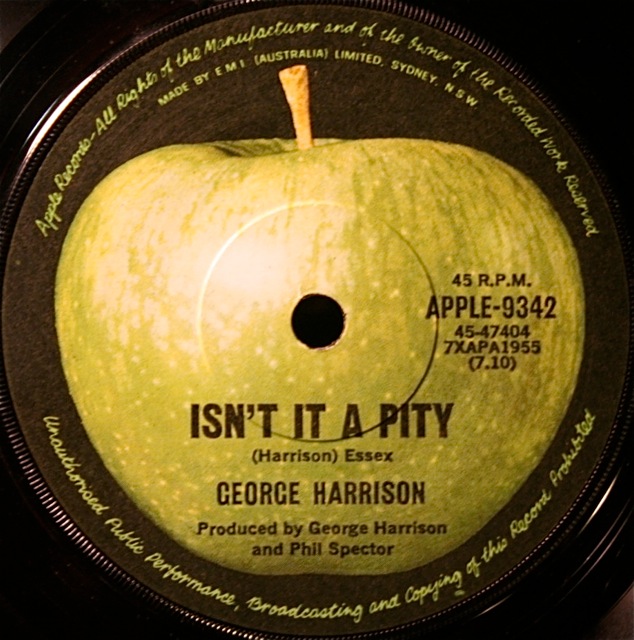
There were two 45 rpm singles released from the album at the time. These were “My Sweet Lord” and “What Is Life”.  In Australia “My Sweet Lord” was backed with “Isn’t It A Pity” and a little bit unusually, the labels on each side had a full green Apple – kind of like a double “A” side:

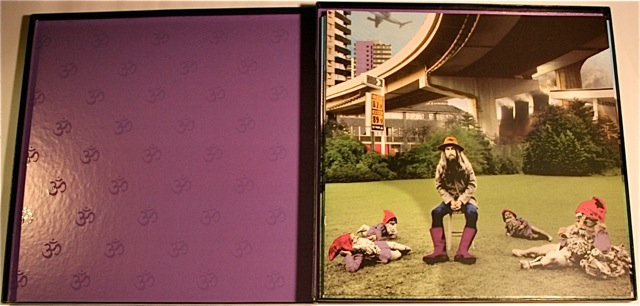
In 2001 came an LP and a CD re-issue, both of which came as box sets. Here’s the deluxe vinyl box:

The EU 2001 re-issue vinyl box cover

Both the CD box and the LP box were expanded and remastered – containing five previously un-released bonus tracks:  “I Live For You” (out-take); “Beware Of Darkness” (demo); “Let It Down” (alternate version); “What Is Life” (backing track); and “My Sweet Lord (2000)” (alternate version). Both box sets featured a colourised version of the original front cover image. Unlike the original 1970 LP box set, this one had a song list on the rear:

The vinyl was again three LP records – including the “Apple Jam” disc:

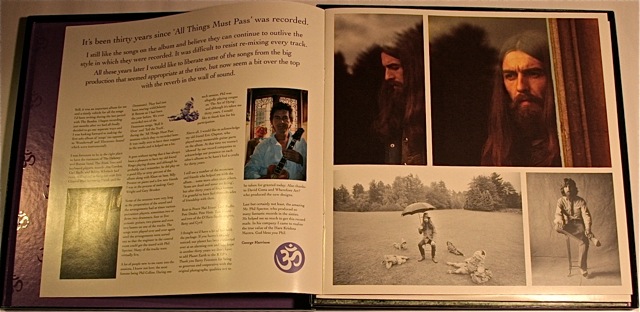
The vinyl box open – notice the booklet cover’s statement on environmental degradation

The internal packaging was quite different to the original in a lot of ways. The inner lining (now purple) and the inner sleeves for example:

The vinyl 2001 reissue with the inner sleeve for Disc 1

A booklet replaced the giant poster, but still had some shots from the same photo shoot:

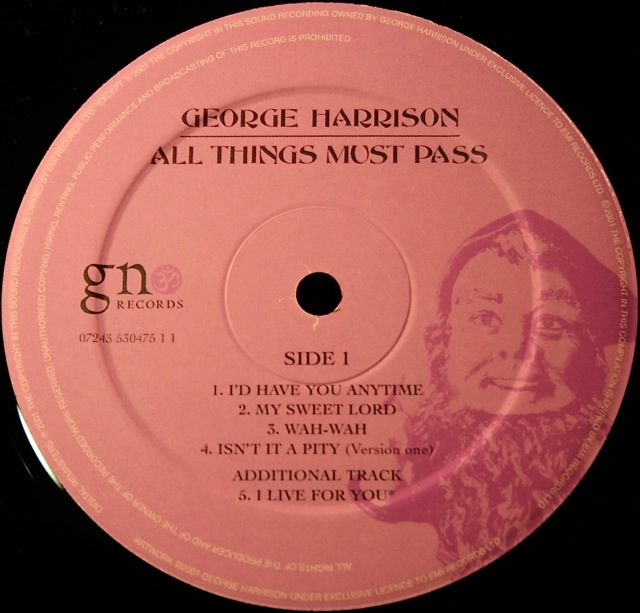
And the LP labels (the record was released on George’s own GN Records label) were different too:

The CD box set contained all the content of the triple LPs – but on two CDs:

The 2001 CD reissue cover – still in shrink wrap with original sticker

All the tracks on “All Things Must Pass” (2001) were remastered and/or remixed by George. He says in the booklet that on some tracks he wanted to “….liberate some of the songs from the big production that seemed appropriate at the time, but now seem a bit over the top with the reverb in the wall of sound”. I guess he means Phil Spector’s production work on the original. There are no hard feelings though as in the booklet George pays tribute to “….the amazing Phil Spector, who produced so many fantastic records in the sixties. He helped me so much to get this record made….God bless you Phil”.  For more information on the complete story of the 2001 reissue see wikipedia

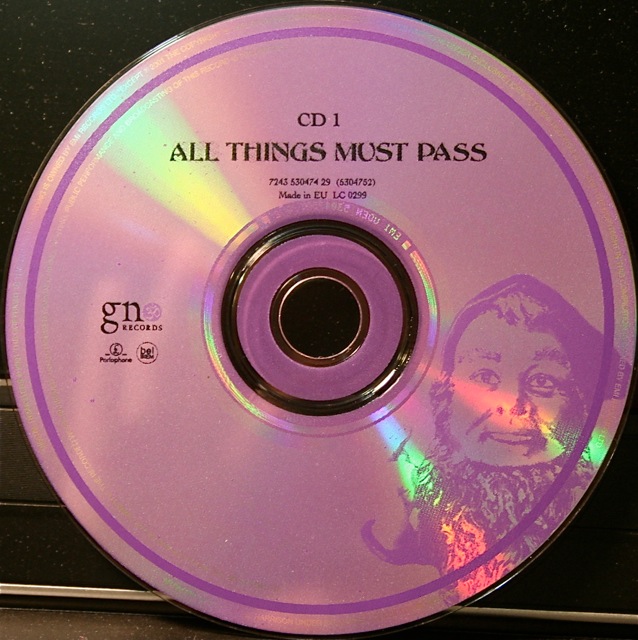
The CD box also had the coloured cover. Urbanisation and degradation of the environment gets worse from the front image, through to changes in each image on the inner sleeves, until the final scene on the booklet where George is literally overshadowed by a motorway and factories belching smog. Here’s the CD label:

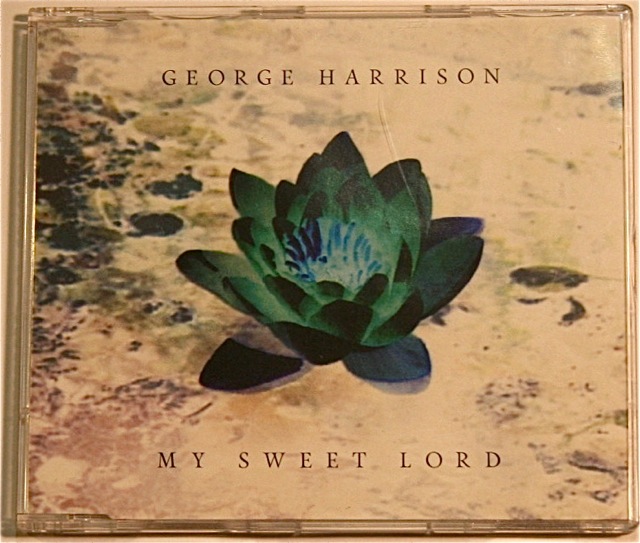
Also from 2001 comes a 3 track CD single re-issue of “My Sweet Lord”:

The 2001 “My Sweet Lord” CD single cover

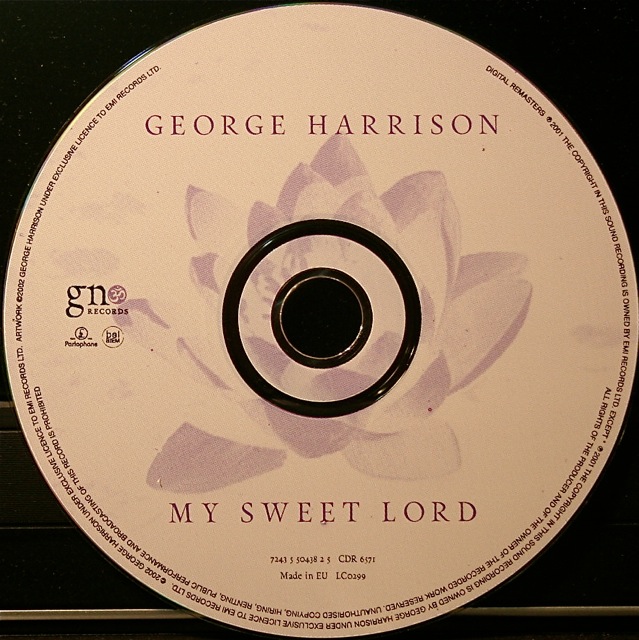
The disc contained “My Sweet Lord”, “Let It Down” and “My Sweet Lord (2000)”:

For further information see also the official All Things Must Pass website, and the excellent Beatles Recorded Sound Index entry.

Don’t forget to check out this weird version of this album.

Also this update on another US label variation in the collection.

And click here for the Record Store Day 2010 limited edition of “All Things Must Pass”.

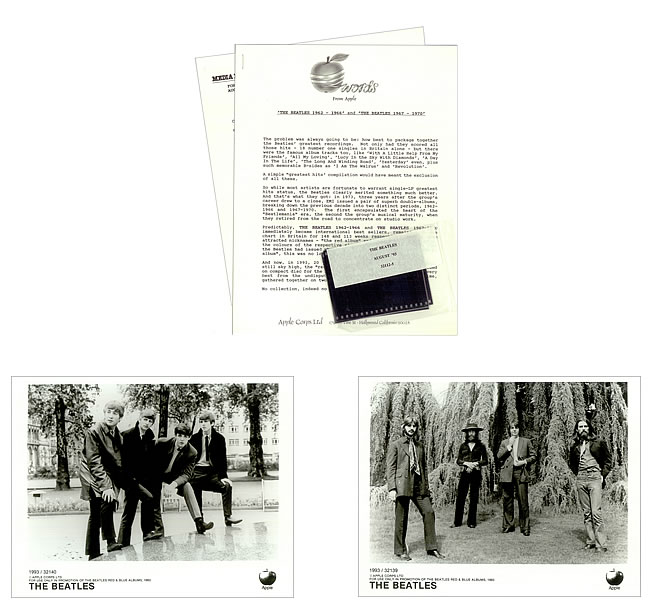
Beatles “Red” and “Blue” to be Remastered and Re-Issued

Apple Corps Ltd. and EMI Music have announced that The Beatles original 1973 compilations, “1962-1966” (‘Red’) and “1967-1970” (‘Blue’) have been digitally remastered for worldwide CD release on October 18 (October 19 in the USA).

Both will be 2CD packages and each will include expanded booklets with original liner notes, newly written essays by Bill Flanagan, and rare photos. However, in typical EMI/Apple fashion they will not have contain any bonus material, nor any bonus DVD discs 😦

Its the same team at Abbey Road Studios responsible for remastering The Beatles original studio albums remasters in stereo and mono last year who have carefully maintained the authenticity and integrity of the original analogue recordings of the “Red” and “Blue” albums. The result will be the highest fidelity versions the catalogue has seen since its original 1973 release.

See the official Beatles news site (now with cover art) here, and the EMI Music press release here.


Beatles Books Abound

I came into the possession of two more Beatles books this week.

I wasn’t actually looking for them – they came looking for me. As I’ve posted earlier, we’ve recently visited Vietnam. It was my wife’s birthday this week and so I thought a Vietnamese cookbook might be popular. I went along to my local discount bookshop – but no Vietnamese cooking books were to be seen. However, in the Music section (a frequent haunt) I found these two Beatles “picture” books, both by the same publisher, both in the same format, and both only AUS$7.95 (US$7.28) each. Who could resist?

The first is “The Beatles – The Illustrated Biography”. It’s a small-format book – about 17.5 cm (7 inches) by 17.5 cm square. Here’s the front cover:

The Beatles - The Illustrated Biography - front cover

The sub-title reads: “A Unique Collection of 200 Classic, Rare and Unseen Photographs”, and that’s pretty much what this book is. It’s a photographic step through the career in photographs. Part One is called “Four Lads From Liverpool”. Part Two is called “The Long and Winding Road”. Text is provided by Tim Hill, Alison Gauntlett, Gareth Thomas and Jane Benn. It’s published by Transatlantic Press in Britain in 2009.

The Beatles - The Illustrated Biography - rear cover

These sorts of books abound – with many of them published in a variety of formats and all using the Daily Mail library of Beatles photographs. This book is no exception. The photographs are all credited to Getty Images, but I suspect they are all pretty much from the Daily Mail archive – just re-packaged. I must say though that this one is nicely presented in black-and-white and in colour, and worth having in the collection.

Here is a random open page from the book:

The Beatles - The Illustrated Biography - open page

What you can see is a series of two colour shots taken on location in May, 1965 during the filming of the movie “Help”. Clearly the group are in downtime, waiting no doubt for a scene to be lit or some technical problem to be sorted out at Cliveden House in Buckinghamshire. The text talks about the Beatles the previous evening having attended Royal Albert Hall in London to watch a performance by Bob Dylan, whose song-writing was proving to be a big influence on John Lennon at this time.

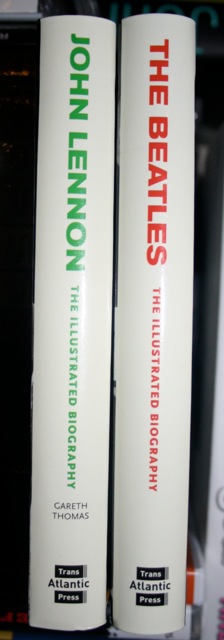
This little Beatles book is accompanied by what is clearly a companion publication by the same publisher (Transatlantic Press) –  a book called “John Lennon – The Illustrated Biography”:

John Lennon - The Illustrated Biography - front cover

This is in the same format (about 17.5 cm (7 inches) square) as the Beatles book above, and was also published in 2009.

It’s sub-title is “200 Classic, Rare and Unseen Photographs by the Daily Mail” – so clearly it is a re-packaging of many previous books along the same lines. Here’s the rear cover image:

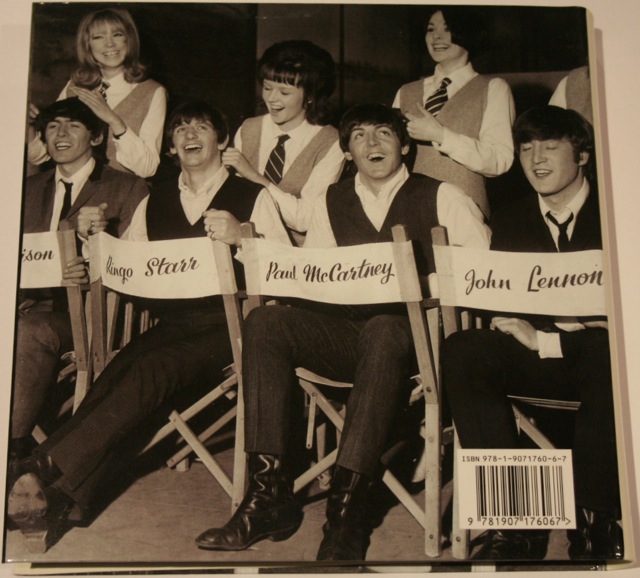
John Lennon - The Illustrated Biography - rear cover

A happy moment (albeit public) between John and his then wife Cynthia Lennon.

The text for this book is by Gareth Thomas, and all photographs are copyrighted to the Associated Newspapers Archive (read: “Daily Mail”), and to Getty Images. Unlike the Beatles book, all the images in this one are black-and-white. Here’s a random open page from the book:

John Lennon - The Illustrated Biography - open page

The photographs here were taken in August 1966, and the text says: “Before leaving for Chicago, John and the boys were taken on a relaxed tour around London airport, including a visit to the new police facilities….However, by the time they had reached their destination [they’d learned about] the seriousness of the “more popular than Jesus” debacle they were facing. John’s anxiety levels were at an all-time high…as he prepared to apologize for his supposedly anti-Christian remarks at a televised press conference….”

Two nice little books to have in the collection

UPDATE:  Another Beatles related book (released in August 2010) is Howard Sounes’ “FAB: An Intimate Biography of Paul McCartney”.

“Come and Get It” – Best of Apple

Apple and EMI have just officially announced a special “Best Of” disc and digital downloads associated with their extensive reissue program planned for October this year.

The full press release details a 21-track compilation CD called “Come and Get It: The Best of Apple Records”. It will contain a selection of songs from the planned full-album re-mastered reissues I first wrote about here, PLUS a significant number of additional tracks – hard-to-get singles by a wide range of additional Apple artists.

Along with the announcement of “Come and Get It”, Apple has also announced that most of the full album reissues will come with bonus tracks.

As well, Apple has added another CD to the full album release schedule: 1971’s “Radha Krishna Temple”

The press release reads (in part):

“Come and Get It: the Best of Apple Records” – first commercial multi-artist compilation in Apple’s history set for release on October 25, 2010

“Radha Krishna Temple” added

CD bonus tracks and Digital download extras now announced

The dazzling range of music originally issued by Apple Records between 1968 and 1973, which is now the subject of an unprecedented multi-album worldwide campaign starting October 25th – including remastered CDs (with bonus material revealed for the first time) and Apple’s first digital downloads – will now be augmented by two additional titles: “Come and Get It: The Best Of Apple Records”, the first commercially issued multi-artist compilation in the label’s history; and “The Radha Krishna Temple”, the self-titled album of devotional music produced by George Harrison.

“Come and Get It” displays Apple’s vibrant years of musical experimentation in full flower, from bona fide hit singles to the cult classics of the catalogue, as represented by brass band The Black Dyke Mills Band, Cajun collective The Sundown Playboys, and more. Hot Chocolate makes an appearance, as does Ronnie Spector, Bill Elliot & The Elastic Oz Band, Chris Hodge, Brute Force, and others.

As Apple Corps Ltd. and EMI Music prepare for the upcoming 17 album CD and digital download release, it is a reminder that the introduction of an artist on The Beatles’ record label was avidly followed by fans across the universe – then and now. Each of the albums has been digitally remastered at EMI’s Abbey Road Studios in London by the same dedicated team of engineers behind The Beatles’ recent remastered catalogue releases of 2009.

Details of “Come And Get It” is as follows:

1 Those Were The Days / Mary Hopkin

2 Carolina In My Mind / James Taylor

3 Maybe Tomorrow / The Iveys

4 Thingumybob / The Black Dyke Mills Band (Paul McCartney’s theme tune for a 1968 British TV comedy drama series)

5 King Of Fuh / Brute Force (originally banned back in 1969, Brute Force is a New York songwriter championed by John Lennon and George Harrison)

6 Sour Milk Sea / Jackie Lomax

7 Goodbye / Mary Hopkin

8 That’s The Way God Planned It / Billy Preston

9 New Day / Jackie Lomax (an original non-album Lomax 45 that was co-produced with Mal Evans)

10 Golden Slumbers-Carry That Weight / Trash (a heavy Scottish group that came to Apple via their producer, former Shadows drummer Tony Meehan)

11 Give Peace A Chance / Hot Chocolate Band (a reggae version by the band that became hugely popular in the Seventies)

12 Come And Get It / Badfinger

13 Ain’t That Cute / Doris Troy

14 My Sweet Lord / Billy Preston

15 Try Some Buy Some / Ronnie Spector (one-time Ronette and former wife of legendary producer Phil Spector)

16 Govinda / Radha Krishna Temple (a UK Top 30 hit for the Radha Krishna Temple in 1970 produced by George Harrison)

17 We’re On Our Way / Chris Hodge (a young British pop singer who caught the attention of Ringo Starr)

18 Saturday Nite Special / The Sundown Playboys (a Cajun French collective from Louisiana, USA)

19 God Save Us / Bill Elliot & The Elastic Oz Band (John and Yoko wrote this fundraiser for the defence in the famous Oz Obscenity Trial of 1971)

20 Sweet Music / Lon & Derrek van Eaton

21 Day After Day / Badfinger

I must admit that the incredible Wog Blog had this information and posted on it way back on 16 July……I don’t know where he gets his information from, but he was right.

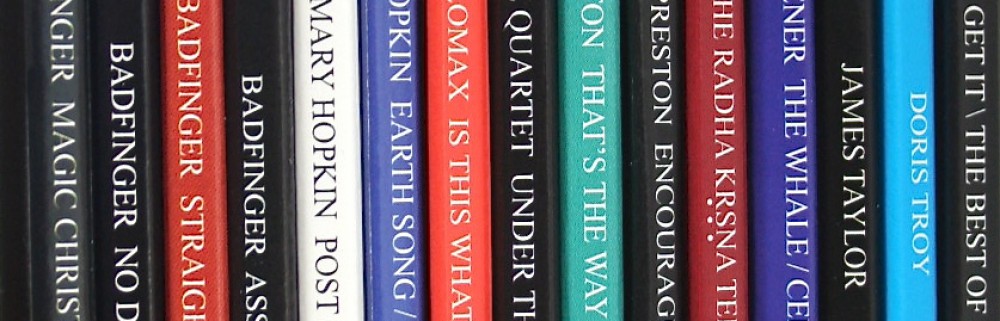
On the Apple Records site there are also full details of the many interesting bonus tracks that will added to the full-album releases, including the studio solo acoustic demo of James Taylor’s “Carolina In My Mind”; a mono studio demo of Badfinger’s “Without You”; Mary Hopkins’ “Those Were the Days” sung in French, German, Spanish and Italian; and The Modern Jazz Quartet interpreting the Beatles’ “Yesterday”, to name just a few.

In addition to the CD bonus tracks there are many other tracks that will only be available as digital downloads….

Some Unusual Asian Beatles Items….Part One

OK. I’m going to preface this first post on some unusual CD and DVD items I acquired in a South East Asian country with a statement that I don’t collect Beatles bootlegs and I don’t support or promote piracy in the music business. All my collection to date has been made up of legitimate, officially released discs – that’s CDs, LPs, singles, books, DVDs, magazines and other printed items.

Recently I was able to spend some time on holiday in Vietnam. Like most Asian and developing countries there are many opportunities to buy fakes – everything from Louis Vuitton luggage and Gucci handbags to Ray Ban sunglasses and Tag Heuer watches. Of course there are lots of stores, markets and street vendors selling illegally copied DVD films as well. There are not so many places to buy music – but they’re there if you seek them out. In the central Vietnamese city of Hue I walked into a store selling mostly fake DVDs and a bit of music on the side and saw a copy of Paul McCartney’s latest 2 CD release “Good Evening New York City”. It was easy to tell it was a fake. It came (like all the cheaply copied DVDs do) in a flimsy clear plastic bag (i.e. no hard jewel case or Digipac cardboard). The artwork was all there ready to put it into a CD jewel case, but it looked like a cheap photocopy. The discs had rudimentary labels printed on them but clearly looked fake. No catalogue numbers, copyright info, not even the title of the disc. One disc had the words “Paul 1” printed roughly on it, the other “Paul 2” and that was it. It was selling (in the local currency) for 20,000 Vietnamese Dong – that’s US$1.03, or $1.17 Australian. And that’s even before any bargaining over the price. I decided I really didn’t want to buy a copy – even for the novelty value.

At the other end of the scale are those CDs and DVDs where its obvious that a lot of time and effort has gone into producing what looks to be an absolutely legitimate release. Standing in a shop in Hanoi (which I did last week) it becomes really hard to tell. Is what I’m looking at the version sanctioned by the artist and record company as the official release for China and South East Asia?

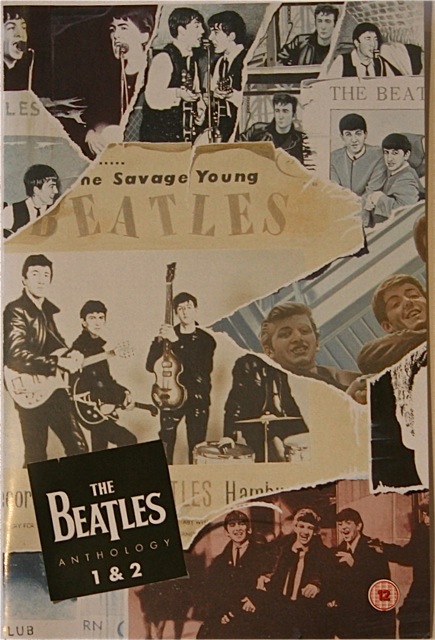
Take this example of the Beatles “Anthology” 5 DVD box set. I got it from a shop in Hanoi that was filled with what looked like official releases. All movie stock was in standard DVD packaging with proper labels. It was not one of the shops dealing in fakes.

It looked like this. Here’s the front of the box:

Chinese Beatles Anthology - front

This copy still has the shrink-wrap around the sturdy cardboard box, though the opening has been cut by me so that the DVDs can be removed. The sticker is attached to the shrink-wrap.

Compare this to this official release purchased in Australia:

Official Beatles Antholgy DVD - front

Again, the shrink-wrap is still around the box. The sticker is also on the shrink-wrap.

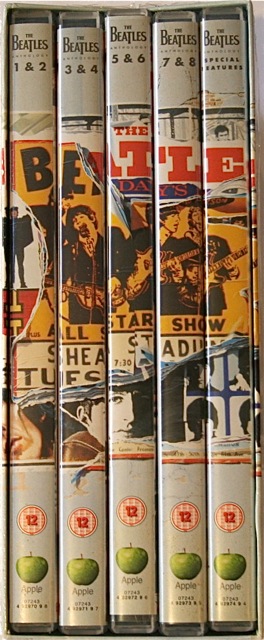
Here are the Chinese DVD spines:

The five Chinese DVDs

Compared to the official release:

The official release

The number “12” in the pink circle on each refers to the censorship rating in Australia. Apart from that, not a lot of difference….Here is the sticker on the base of the Chinese version:

Sticker on base of Anthology DVD box - Chinese

As you can see, the Apple word is written but the Apple logo itself is missing. Also, apparently common with cheap copies, there are small spelling mistakes. Notice in the centre box of the sticker the words “Doldy Digital 5.1 surround sound”. It should be Dolby Digital 5.1 sound. This sticker appears to be stuck over the printed label actually on the box. You can faintly see the bar code, etc. underneath. Otherwise the Capital, Abbey Road, DVD Video, Dolby Digital and DTS logos on the right-hand side all look legit. Compare it to the Australian official release, where the label is printed onto the box:

Official Anthology DVD box - sticker on box base

Notice the official release has a Parlophone logo instead of Capitol which is just a territory thing (Parlophone seems to get half the world, and Capitol the other half!). There’s also a Region 1 DVD symbol, and a bar code.

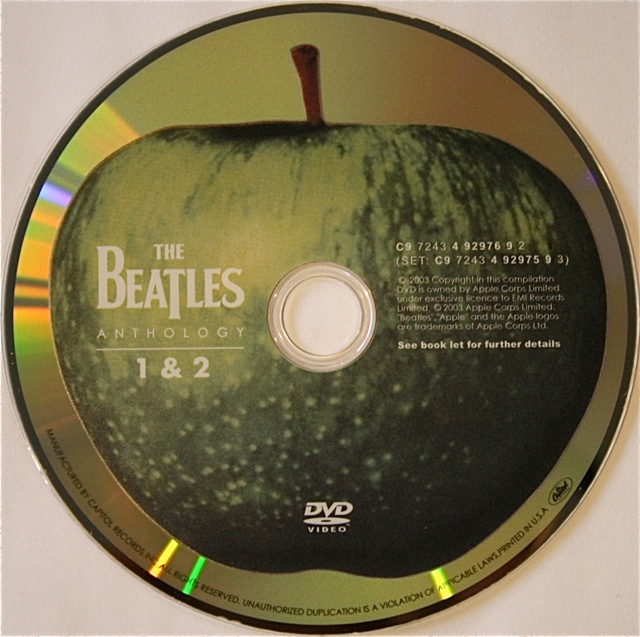
Inside the individual DVD containers the story is similar. The actual discs in the Chinese version are very well-printed and look very official:

Chinese DVD disc

They even say “Printed in the USA”. Compare this to the official release:

Anthology DVD - official release

However, the Chinese stuff up the sequencing of labels on the DVD discs.

Disc One, as you can see above, has Episodes 1 & 2 on it and correctly contains those episodes. Sadly, Disc Two is also labeled Episodes 1 & 2, but actually has Episodes 3 & 4.

Disc Three is incorrectly labeled Episodes 3 & 4, but contains Episodes 5 & 6. And Disc Four is incorrectly labeled Episodes 3 & 4, but correctly contains Episodes 7 & 8.  The “Special Features” 5th disc is incorrectly labeled Episodes 5 & 6 but contains the correct Special Features material…….so, all the contents is there across the five discs. Just a severe lack of attention to detail on the part of the counterfeiters. However, they all play well and the quality of the video looks perfect.

The other noticeable difference to the official release is that the Chinese versions don’t have the small booklets inside each DVD box outlining the contents of each episode. These are in official release and look like this:

DVD Booklet - front - from episodes 1 & 2 in official release

Anthology booklet (rear) - inside each DVD box of the official release

So, you can see that standing in a shop in Hanoi, deciding if this is official or not (especially while it’s still sealed up in its shrink-wrap) is very tricky. The price might have been a give-away: this 5 DVD box set cost 250,000 Vietnamese Dong. That’s around US$12.80 or AUS$14.80. Very cheap. It also doesn’t help if you don’t read Chinese. Here’s a close-up of the sticker on the front:
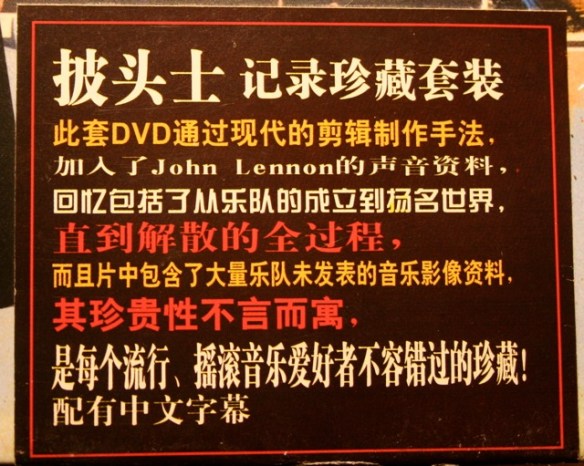
Sticker on the front of the Anthology DVD box set

Vietnam is actively cracking down on pirate or illegal copies of DVDs, CDs, clothing and watches. While there I read an article in one of the national papers that police are actively trying to break up the flow of counterfeit goods from across the border in China. When departing the country via Ho Chi Minh City airport all travelers bags are X-Rayed separately to the usual security check specifically to identify and confiscate goods, or to fine travelers for having fake DVDs. A New Zealand family in front of us were caught. They had in their bags over 60 copied DVDs they’d bought on the street. They were given the option of handing them over, or keeping them and paying a fine of US$50.00 (at first they were asked to pay a US$100.00 fine, but talked the official down…interesting). They decided the pay the fine and keep their DVDs. All the CDs I had purchased, plus the Beatles “Anthology” 5 DVD box above were in our suitcases and were also X-Rayed. We were not stopped by the airport officials. I’ll detail some of the Beatles compact discs I purchased in the next posts. Again it was confusing and difficult to pick the real from the fake.

See also Some Unusual Asian Beatles Items – Part Two and Some Unusual Asian Beatles Items – Part Three
Beatles “Love” – Lots of Collectable Variations

At the Beatles own official website there’s a lot of info about “Love” their 2006 album, which is not only the soundtrack to the Cirque du Soleil performance show celebrating the Beatles music, but also a controversial departure for the Beatles in that its made up of some of their best-known songs remastered and re-mixed with sounds and songs from across their extensive catalogue. “Love” is produced by longtime Beatles producer Sir George Martin and his son Giles, and it won two Grammy Awards in the categories Best Compilation Soundtrack Album for Motion Picture, Television or other Visual Medium, and Best Surround Sound Album.

For dedicated Beatles fans and collectors it proved to be a bit of of a challenge. Firstly, had the Beatles done the unthinkable and started to mess with the canon? Debate still continues as to whether this was a smart move, or a folly. Additionally, there were numerous release variations to buy if you were an avid collector. Two CD versions, promotional CDs, and other bits and pieces to track down for the completists amongst us…

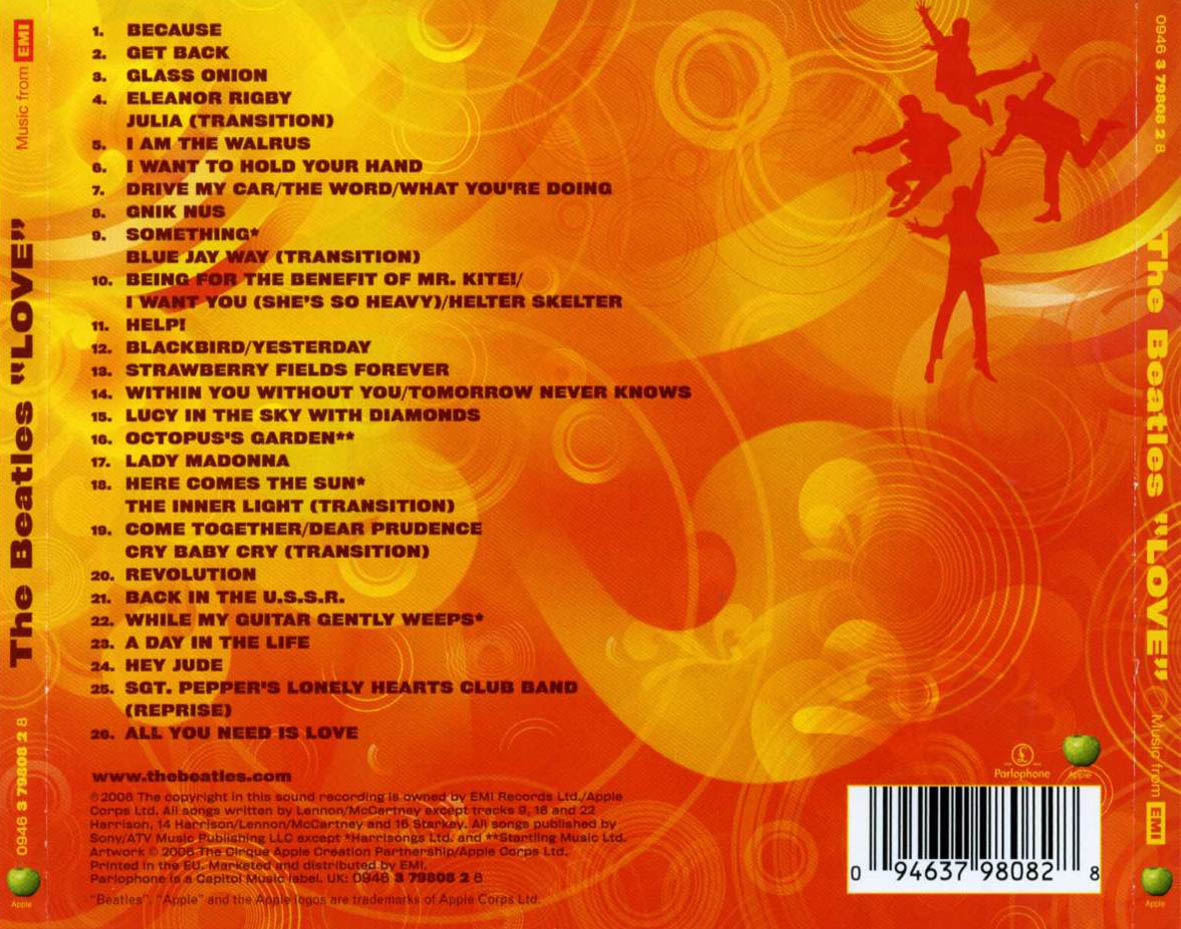
To start with there was a single disc with the standard stereo mix in a standard jewel case:

“Love” single CD – front cover

“Love” single CD – rear

“Love” CD – with the single CD artwork

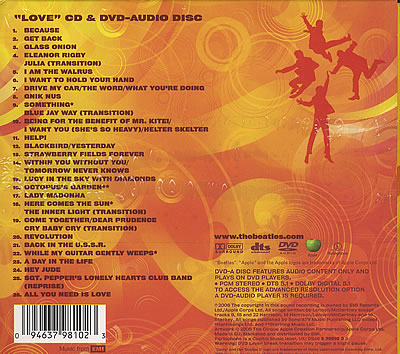
Then there was a two-disc set that came with more elaborate packaging. It’s a double fold-out Digipac in a thick slipcase. The package contains the single CD with the standard stereo mix (but with a slightly different printed image on the CD to the single version CD shown above). Added to this is a separate DVD disc containing the 5.1 surround sound mix. Same track list and songs – but if you have a 5.1 stereo set-up at home, the songs and sound effects surround you. It has the same booklet as the single CD release.

“Love” two disc edition – front cover

“Love” two disc edition – rear of slipcase

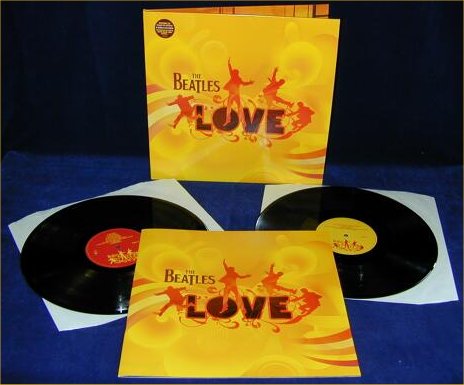
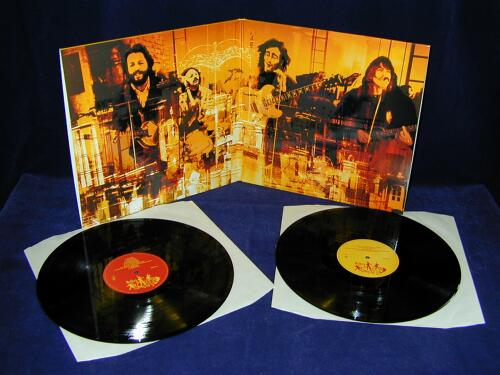
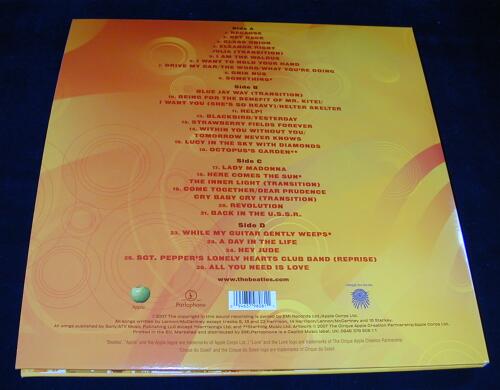
The final official commercial release (which came out a few weeks after the CD’s) was the vinyl LP. It arrived in a deluxe, 2 disc, gate-fold package. Mine is still sealed, so these images I’ve borrowed from the web.

“Love” vinyl LP set

“Love” gatefold open

“Love” vinyl LP – rear

As you can see the vinyl edition came with custom labels for each LP, and is contained in a gate-fold cover with a large-format book. Its similar to the CD booklet, but because of the large format – complete with rich colour images from the Cirque du Soleil production – it is way more impressive.

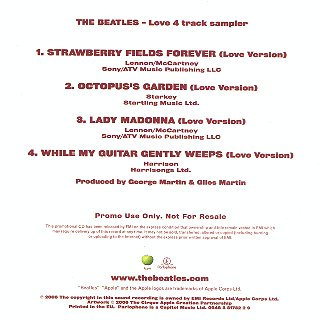
There was also a four-song radio sampler released to stations around the world. This was done in an effort to generate publicity and conversation about the forthcoming new Beatles release for 2006. The songs on it were “Strawberry Fields Forever”, “Octopus’s Garden”, “Lady Madonna” and “While My Guitar Gently Weeps” (which was one of the most anticipated tracks from the whole album as it was George Harrison’s original demo tape of the song accompanied by a completely new string arrangement composed by George Martin for the new “Love” record). This promo CD was sent out with a press release containing quotes from Sir George Martin and his son Giles – who co-produced the album – talking about the four tracks on the promo CD. They describe how those songs were selected and give some of the background to the production techniques employed in mashing together different parts of Beatles songs to pretty much make completely new versions -a radical thought at the time. The cover of the radio sampler promo CD looks like this:

“Love” radio sampler promo CD – front

And the rear:

“Love” radio sampler promo CD – rear

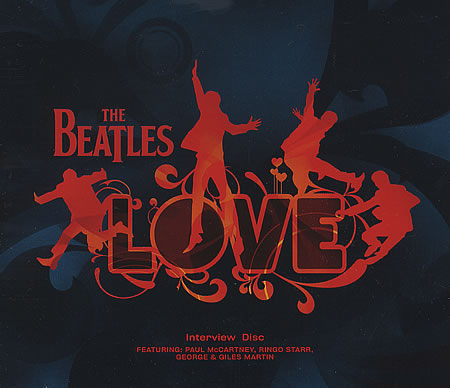
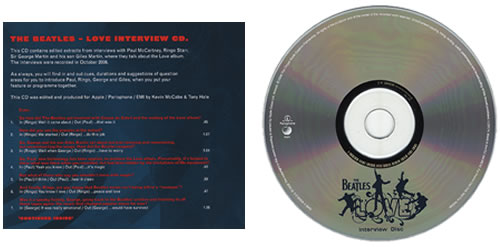
Apple/EMI was obviously determined to give “Love” the full promotional and marketing treatment because they also pressed and distributed (in limited numbers) a special “Interview Disc” featuring Paul McCartney, Ringo Starr and George and Giles Martin in conversation about “Love”. The interviews were recorded in October 2006, and they are all stand-alone statements about dirrent aspects of the work that went into producing “Love”, and the running order works through the release track-by-track. Its an interesting historical artifact to have in the collection. And definitely an authentic, original release. As you can see, again it has a colour variation of the “Love” artwork common to all releases:

“Love” promotional interview disc – front cover

“Love” promotional interview disc – rear cover and CD art

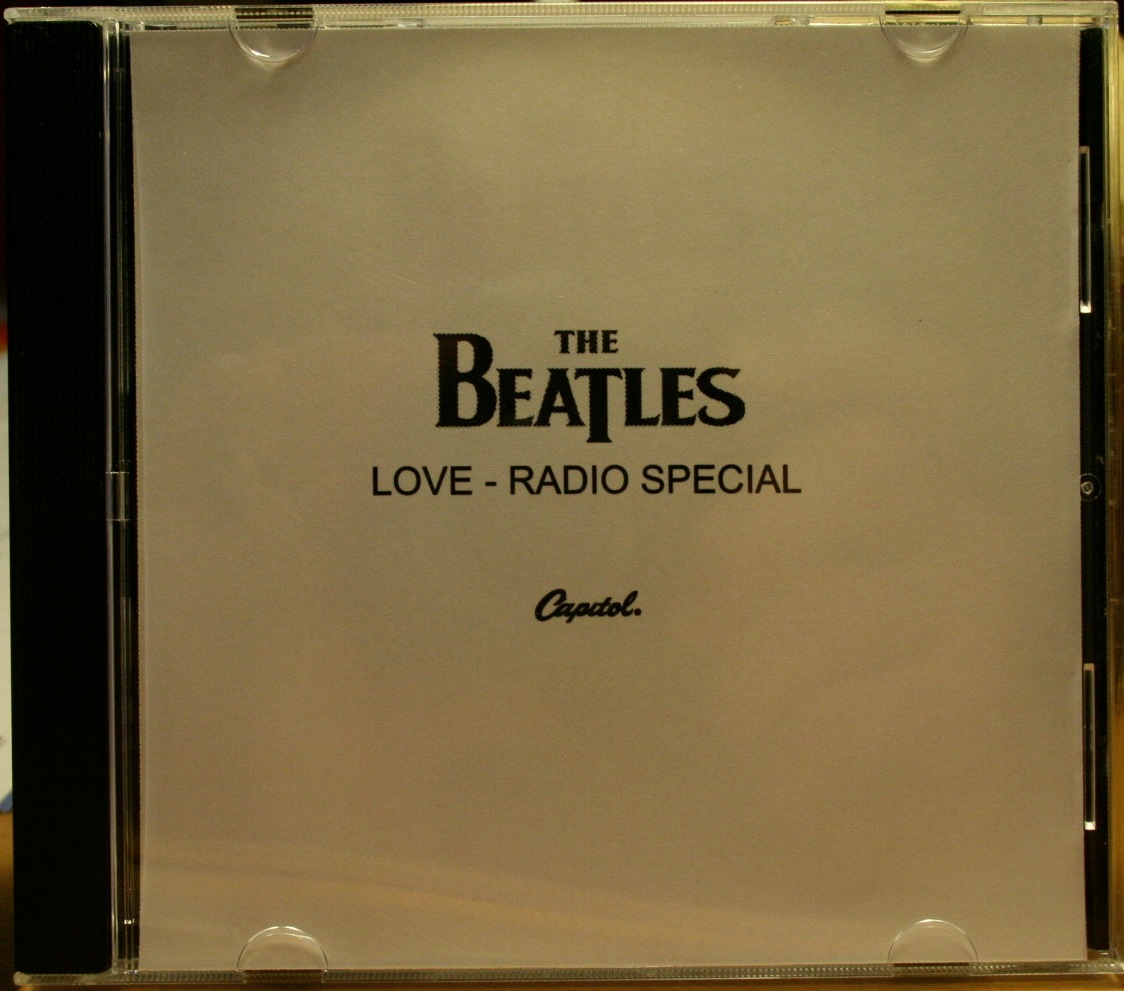
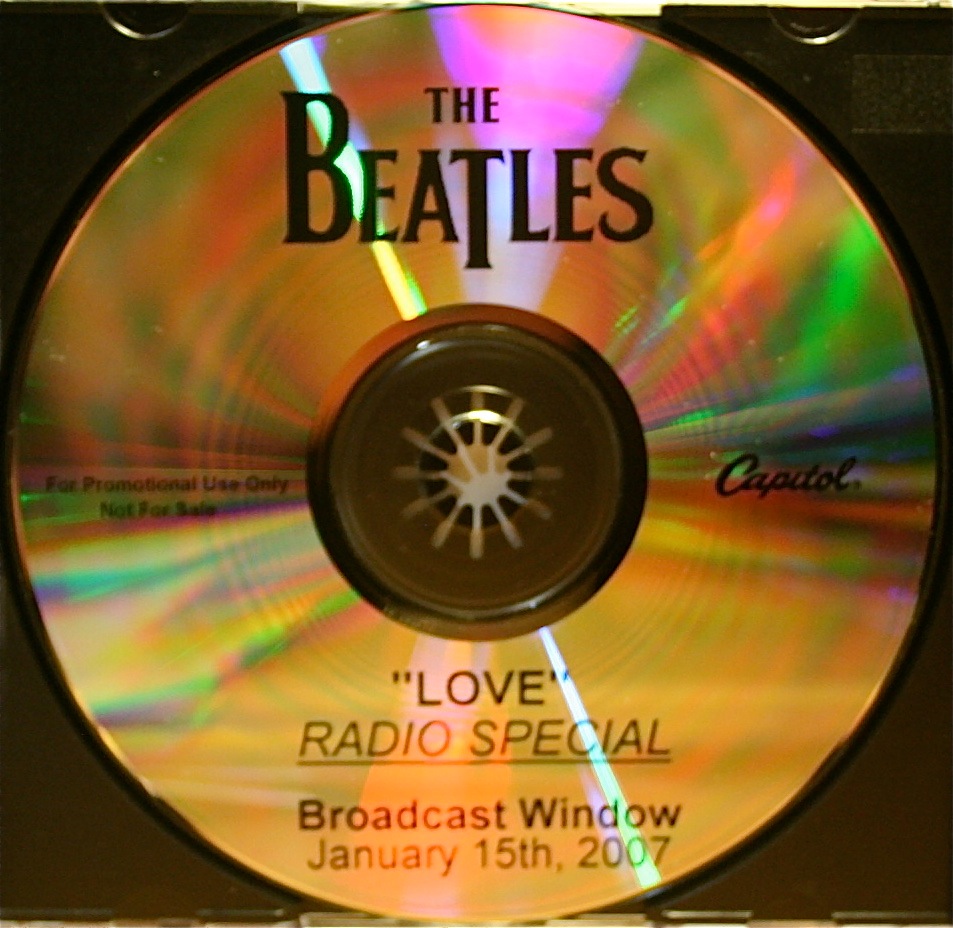
This disc is entirely spoken word and contains edited voices only. No music. The idea was that radio stations would get the songs from the official CD and make their own radio specials. For a time there on the web, via Ebay and the like, there was also a disc called “The Beatles Love – Radio Special”, purportedly distributed by Capitol in the US. I got a copy of this but, while someone has gone to a lot of trouble to make it look authentic, there is something suspicious about this one. The special is hosted by a DJ named Andre Gardner. If you Google him he seems legit, very much associated with covering Beatles news, hosting a show on WMGK in Philadelphia and having a Facebook page dedicated to the Beatles. Now, Capitol may well have commissioned this radio special and hired Andre to host it. It does have additional material to the official “Interview Disc” in that there are comments on “Love” by Olivia Harrison and Yoko Ono in addition to Paul, Ringo, and George and Giles Martin. And it comes with an official-looking running sheet, with track details and outcues. Here’s a short extract from the program:

There are some images of this CD below. If anyone can shed any more detail on this release – drop me a comment and let me know….

“Love” Capitol Records Radio Special – front cover – genuine?

“Love” Capitol Records Radio Special – CD

Meanwhile….at the time of the “Love” release the Beatles official website had not long been launched (it looked quite different to it’s present incarnation), and Apple used the new site to deliver a series of five down-loadable podcasts to further promote “Love”. Each was between six to seven minutes in duration, and like the official “Interview Disc” above, it contained extracts of Paul, Ringo, George Martin and Giles Martin talking about “Love”. Hosted by UK presenter Robert Lindsay, it contains music extracts mixed with the spoken word extracts. Quite nice to have.

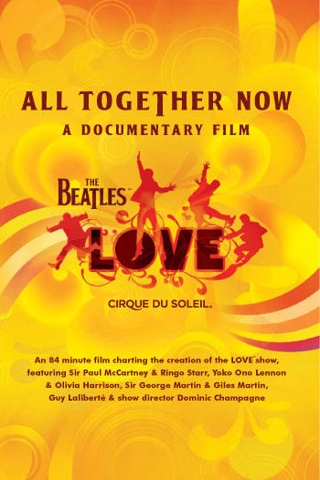
Yet another spin-off for collectors was the DVD “All Together Now”, a documentary film about the creation of the Cirque du Soleil show and the accompanying soundtrack CDs. Earlier this year took out a Grammy Award for Best Long Form Music Video. (I posted about this at the time).

“Love” – the “All Together Now” DVD documentay

You can still see “Love” by Cirque du Soleil at The Mirage Casino in Las Vegas. MTV reviewer Gil Kaufman saw the show just last month (April, 2010) and had this to say. The Beatles own site has some fun facts about the “Love” show.

Finally, an official printed promotional cardboard flyer for the two CD releases came my way. It’s about foolscap size, and is four pages in all – the front looks like this:

“Love” cardboard promotional flyer – front cover

Let It Be at 40

Can you believe it?

Let It Be turned 40 last weekend.

Here’s the Wikipedia extract with a brief detail of the album:

Let It Be  was the twelfth and final studio album released by The Beatles. It was released on 8 May, 1970 by the band’s Apple Records label shortly after the group’s announced breakup.

Most of Let It Be was recorded in January 1969, before the recording and release of the album Abbey Road. For this reason some critics and fans, such as Mark Lewisohn, argue that Abbey Road should be considered the group’s final album and Let It Be the penultimate. Let It Be was originally intended to be released before Abbey Road during mid-1969 as Get Back, but the Beatles were unhappy with this version, which was mixed and compiled by Glyn Johns, and it was temporarily shelved. A new version of the album was created by Phil Spector in 1970 and finally released as Let It Be, serving as the soundtrack album for the 1970 motion picture of the same name.

Let It Be - film lobby card

Let It Be - lobby card - Paul

While three songs from the sessions were released as singles before the album’s release, “Get Back”/”Don’t Let Me Down” and “Let It Be”, the songs were remixed by Spector for the album.

The rehearsals and recording sessions for the album did not run smoothly. The acrimony that began during the recording of the previous year’s White Album resumed soon after the rehearsals began. At one point, George Harrison walked out and quit the group after severely arguing with both Paul McCartney and John Lennon, only to be coaxed back some days later. The film version is famous for showcasing a number of conflicts between the group members and has frequently been referred to as a documentary intended to show the making of an album but instead showing “the break-up of a band”.

Despite a largely negative review from Rolling Stone magazine at the time of its release, the album was ranked number 86 in the magazine’s list of the 500 greatest albums of all time in 2003.

Let It Be… Naked was released in 2003, an alternative version of the album stripping much of Phil Spector’s production work and using some different versions of songs.

Let It Be - Naked (2003)

Here’s an article from Rolling Stone magazine this week:

Forty years ago this weekend, the greatest band of all time gave the world their final album together: On May 8th, 1970, the Beatles released Let It Be, the Phil Spector-produced LP that featured hits like the title track, “The Long and Winding Road” and one of John Lennon’s most famous compositions, “Across the Universe.” While the album was recorded during the band’s caustic final days, Let It Be would go on to become one of their most celebrated records: it ranked Number 86 in Rolling Stone‘s 500 Greatest Albums of All Time.

The story behind Let It Be is almost as mythic as the Beatles themselves. The band originally intended to record it as a live-in-the-studio album and movie in 1969. But the ambitious undertaking left the Beatles so weary, they abandoned the project to make Abbey Road instead. Later, Phil Spector added oversweetened orchestral overdubs to many of the album’s tracks — even though the record features some of the band’s strongest rock songs ever (including “Get Back”). In 1970, the Beatles released the documentary film of the same name, which captured the group’s iconic performance atop the Apple Studios building in January 1969. Perhaps due its controversial and detailed look at the Beatles’ interpersonal problems, the film itself remains unavailable on DVD.

Despite the album’s status in rock history, Paul McCartney was never a fan of Phil Spector’s production flourishes on Let It Be. In Rolling Stone‘s original review of the album, writer John Mendelsohn also criticized Spector’s superfluous additions, saying the famed Wall of Sound producer rendered “The Long and Winding Road” “virtually unlistenable with hideously cloying strings and a ridiculous choir” when compared to the version that appeared on the Get Back bootlegs in May, 1969. After years of dissatisfaction with the released version, McCartney announced plans to put out Let It Be… Naked in November 2003, which stripped the Let It Be songs of Spector’s ornate production.   (Daniel Kreps – Rolling Stone)

Finally, here’s the sound of  “Get Back” in an early incarnation, in rehearsal with John singing lead instead of Paul, and clearly the words to the song are still coming together….

See also: Label Variations – Part Two – Let It Be