To celebrate the 20th anniversary of the Concert for George event at London’s Royal Albert Hall on November 29 2002, the Harrison Estate, film distribution company Abramorama, and Craft Recordings have announced a global theatrical screening of the film of the same name.
The Concert for George is to be shown – for one night only – in select theatres around the world on November 29, 2022:
First released in 2003, the GRAMMY®-winning concert film captures the concert event which celebrated in spectacular style the life and music of George Harrison. It features performances by Eric Clapton, Paul McCartney, Tom Petty, Ravi Shankar, Ringo Starr, Billy Preston and many others.
You now have the opportunity to experience the concert on the big screen in immersive Dolby Atmos sound for the first time – newly remastered by GRAMMY-winning engineer Paul Hicks. The anniversary screenings will also feature a brand-new introduction by Olivia and Dhani Harrison.
Paul Hicks has also produced a new Dolby Atmos mix for the film’s accompanying Concert for George soundtrack album – available now on digital platforms. Listen here.
Certified 8 x Platinum by the RIAA, the acclaimed 27-track album is also still available in a variety of existing physical formats including a 180-gram 4-LP box set; 2-CD/2-DVD and 2-CD/2-Blu-Ray box set; and a 2-CD package. Order here.
This is a really special film of what was an amazing, star-studded tribute to George filled with top performances of his songs. It would be well worth seeing again on the big screen, and with great sound.
The 80 singles (containing 159 songs) are to be released December 2 and represent half a century of Paul’s musical life with releases dating from 1971 (‘Another Day’), right up to 2022 (‘Women and Wives’).
The box set features recreations of 65 singles – complete with their original B-sides (using restored artwork from 11 different countries) as well as 15 singles which have never before been released on 7”. These 15 singles are made up from tracks previously released on 12”, picture discs, CD singles & promos, digital downloads, music videos, two previously unheard demos, and a previously unheard 7” single edit (click here for the complete track listing).
As you can see in the video and images, the singles are housed in a custom wooden art crate designed and built in Derbyshire in the United Kingdom. It includes a 148-page book with a foreword by Paul McCartney, an essay by music journalist Rob Sheffield, plus extensive chart information, liner notes, and single artwork.
Each box will include a randomly selected exclusive test pressing of one of the singles, so in theory if you get a set only 37 other people in the world are likely to have the exact same box set.
The set will be available to download (or stream), and two songs have already been made available. Both have only previously been available as a rare US promo 7″ single: ‘Uncle Albert/Admiral Halsey’ (2022 Remaster – in Mono):
And ‘Too Many People’ (2022 Remaster – in Mono):
To summarise, the numbered, limited-edition box set collection of 80 x 7” singles contains:
Recreations of 65 singles/promos using restored original artwork from 11 different countries (including 2 from Australia!)
15 singles never-before-released on 7” including singles previously released on 12”, picture discs, CD singles/promos, digital downloads, and music videos
2 x previously unheard demos
1 x previously unheard 7” single edit
1 x EP
1 exclusive test pressing randomly selected from the manufacturing process
148-page book containing foreword from Paul, essay by Rob Sheffield, recording notes, release dates, and chart information on each of the singles – each single included is shown on the attached insert, which will be packed into each box
Remastered and cut at Abbey Road Studios, London
All housed in a two-piece, four-walled FSC-approved Redwood pine and Birch Ply wooden art crate manufactured in the United Kingdom.
* Tempting that is until you get to the checkout page! Being in Australia we pay a premium for our lousy exchange rate and for shipping. If Australians were foolish enough to shop at the UK Universal Music site we’d be looking at this box costing £614.99, plus shipping £99.99, making a grand total of £714.98. That is a staggering $1265.02 Australian Dollars on today’s exchange rate. The smarter move would be to go to the US Paul McCartney Store. There the box is US$611.98, plus $61.20 in import taxes. Shipping, apparently, is free. That makes a total of $1019.24 Australian Dollars. That’s a big difference…..but still a hell of a lot of money. 😦
Most collectors of Beatles (and solo) records, CDs, books, magazines and the like will have a broad cross-section of albums and items, ranging from the earliest Please Please Me LP in 1963, right up to the latest Paul McCartney coloured vinyl variation.
Sometimes though a collector will get fixated on one particular thing.
That’s what happened to one of our readers named Simon.
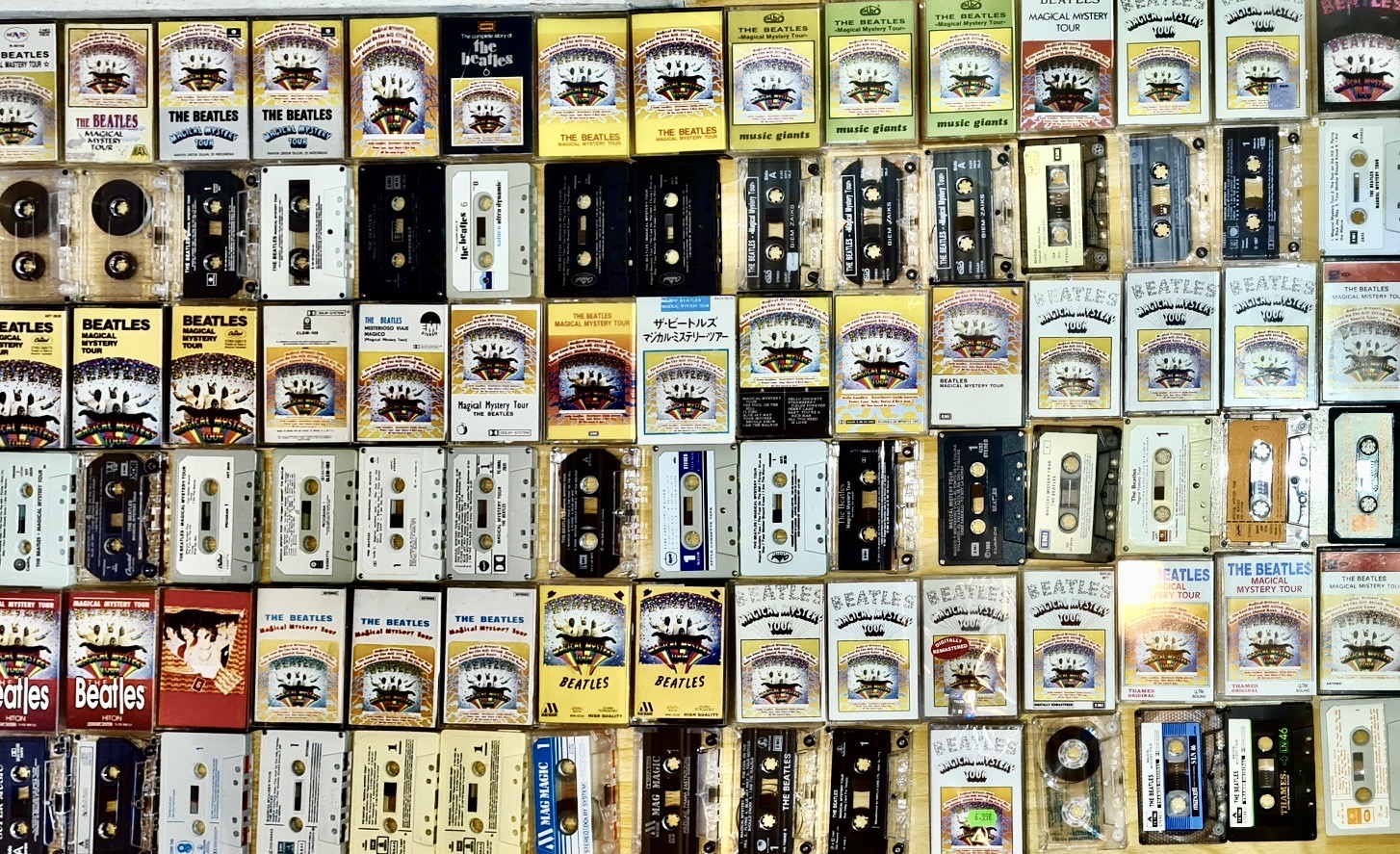
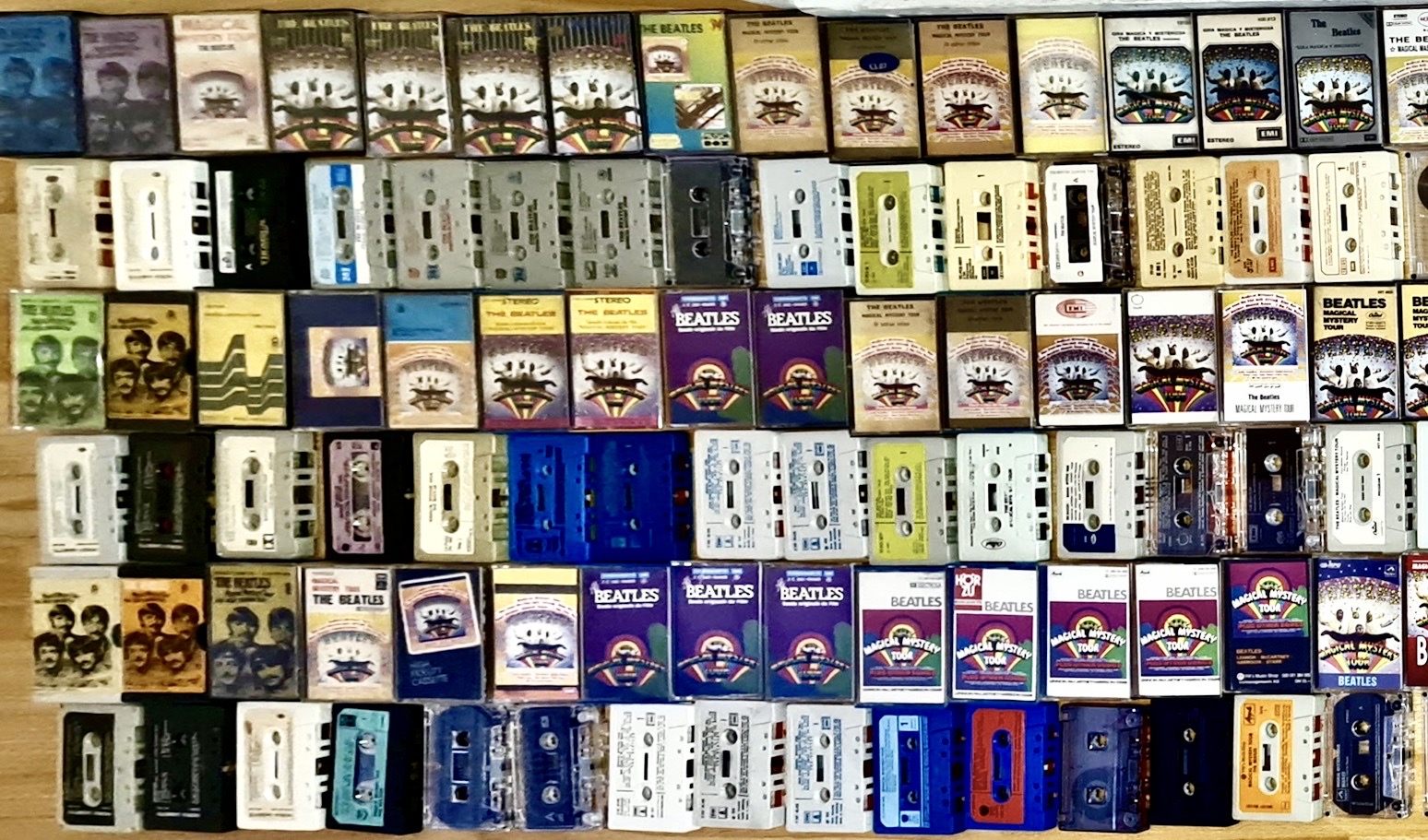
A few weeks ago Simon sent us a photograph of the cassette variations he owns of one particular album – Magical Mystery Tour. They are laid out on the floor and to reproduce them here it is going to take two photographs to show you:
And that is just the cassettes.
Simon has what he believes to be one of the world’s most extensive if not the largest collections of Magical Mystery Tour items (hereafter referred to simply as MMT).
He owns over 60 MMT EP records from different countries around the world, as well as around 150 different versions from the MMT LP. And that’s not to mention the piles of MMT VHS movie tapes, 4-Track and 8-Track recordings, PlayTapes, DVDs, and CDs….He also has Betamax video tapes of the movie, and Reel-to-Reel music rarities.
So, we had to ask him two things.
One is why did the Magical Mystery Tour become Simon’s main thing, the one he must have more and more copies of?
Two is could he send some images of a couple of the more interesting EP versions he has of MMT from around the world?
For the first question here is his answer:
The reason for me collecting Magical Mystery Tour items is because as children in 1967 my sister and I took part in the film as extras. We were in the “Tug of War” and “The Marathon” scenes, and also in “Your Mother Should Know” in the hanger at the RAF West Malling Airfield Base, in Kent, England.
However, my story actually took off in 1978. That year I had to have surgery on both knees. Because the ward where I should have been sent for recovery was being repainted I was instead operated on and put in a ward for children who were terminally ill with cancer. Needless to say these children died.
I said to myself if possible I will try to do something in my life to give aid to children with cancer.
I then met my wife in 1982 and she just happened to be a Beatles fan. Of course the subject of me being involved in the MMT film came up and my wife asked if we could see the film on video. So one day we went to a video store and bought a video tape.
This led to buying an LP, then an EP, and a cassette.….
During this time we were also both very much into Volkswagen Beetles and in 1996 I organized what was to become the largest, most well-known vintage VW show of its kind.
The proceeds were donated to a hospital ward in Hanover in Germany to aid children with cancer.
In the meantime my BeatlesMMT collection was growing.
In the early 2000s I left the VW hobby and decided to concentrate entirely on my MMT hobby instead – and to try to put my collection to good use.
I am always looking for items that I don’t have yet from MMT. I do not sell anything from my collection.
Any doubles are swapped for other MMT items that I don’t have yet in my collection.
So, I have been collecting MMT for the past 40 years and nothing else from The Beatles.
I have only ever looked at the entire film once in one go! But I’ve spent hundreds of hours going frame by frame through DVDs and outtakes looking for tiny details on the famous MMT bus as I bought an original Bedford VAL Plaxton Panorama (the exact same model as the MMT bus) from Liverpool. It’s being restored in the UK and hopefully will be used world wide in aid of different cancer charities.Today I also hold not for profit exhibitions of my collection to help charities, such as for children with cancer.
So, as you can see it is quite a story!
What about some of the gems, some of the rarities from just the MMT EP part of his vast collection?
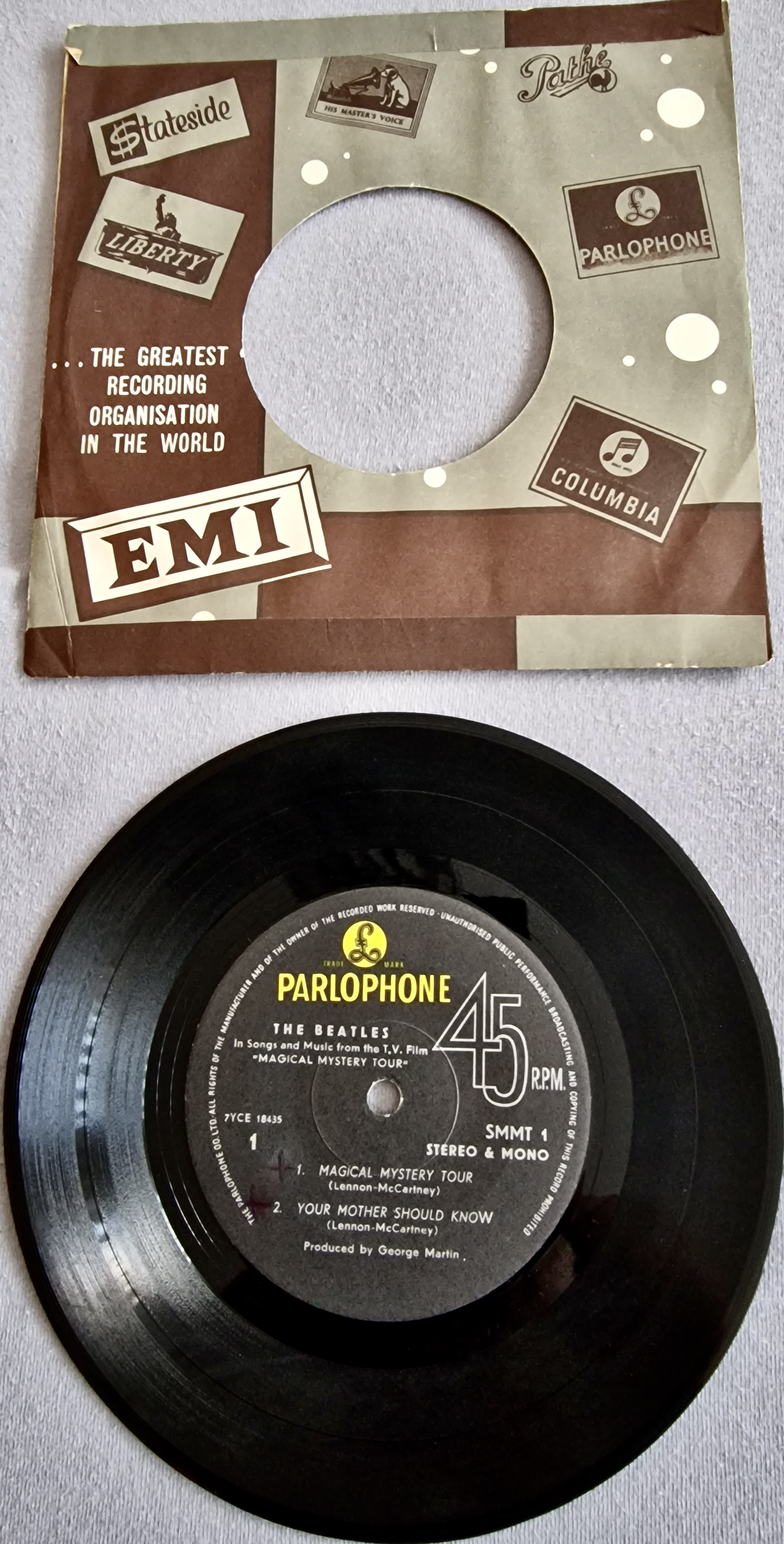
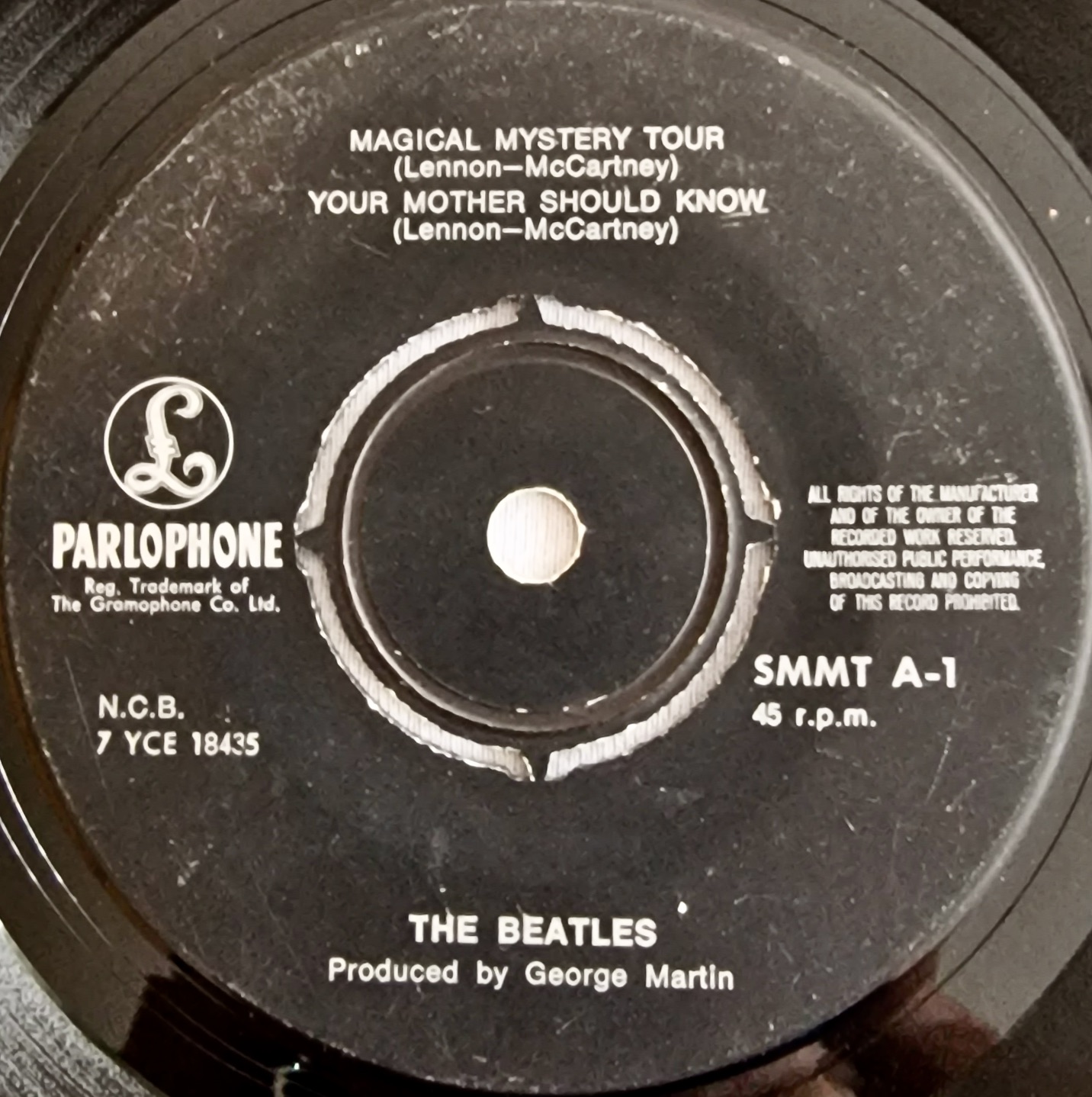
As already mentioned Simon has over 60 copies of this release from different countries. Of course he’s got many of the Made in Great Britain variations (he owns around 15 different versions of these in Mono and in Stereo), but we asked him to show us some of the more unusual examples. You know this one, most often it comes in a gate fold cover with two 45rpm EPs (or extended play) vinyl discs and a booklet with the story and lyrics stapled inside:
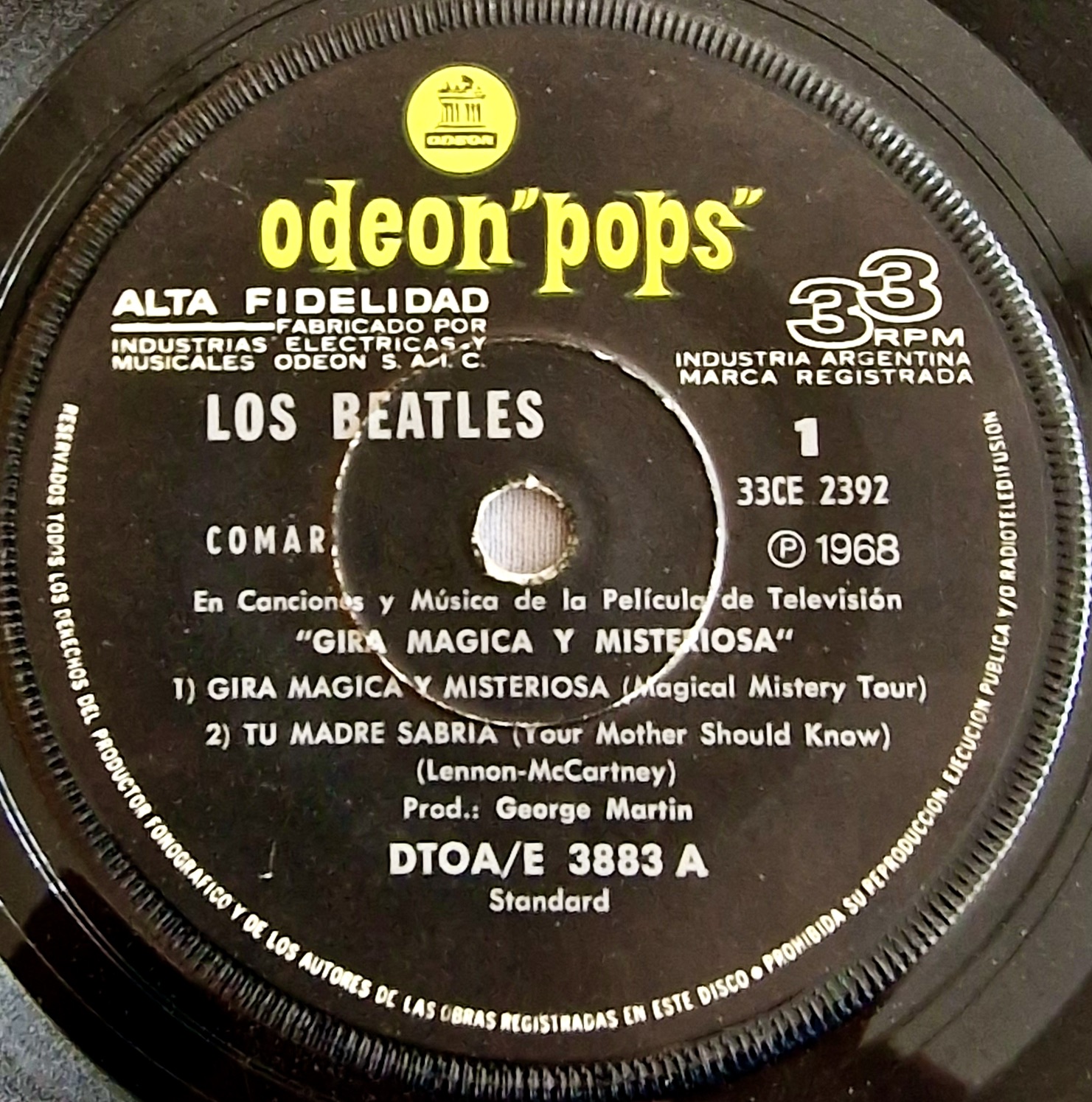
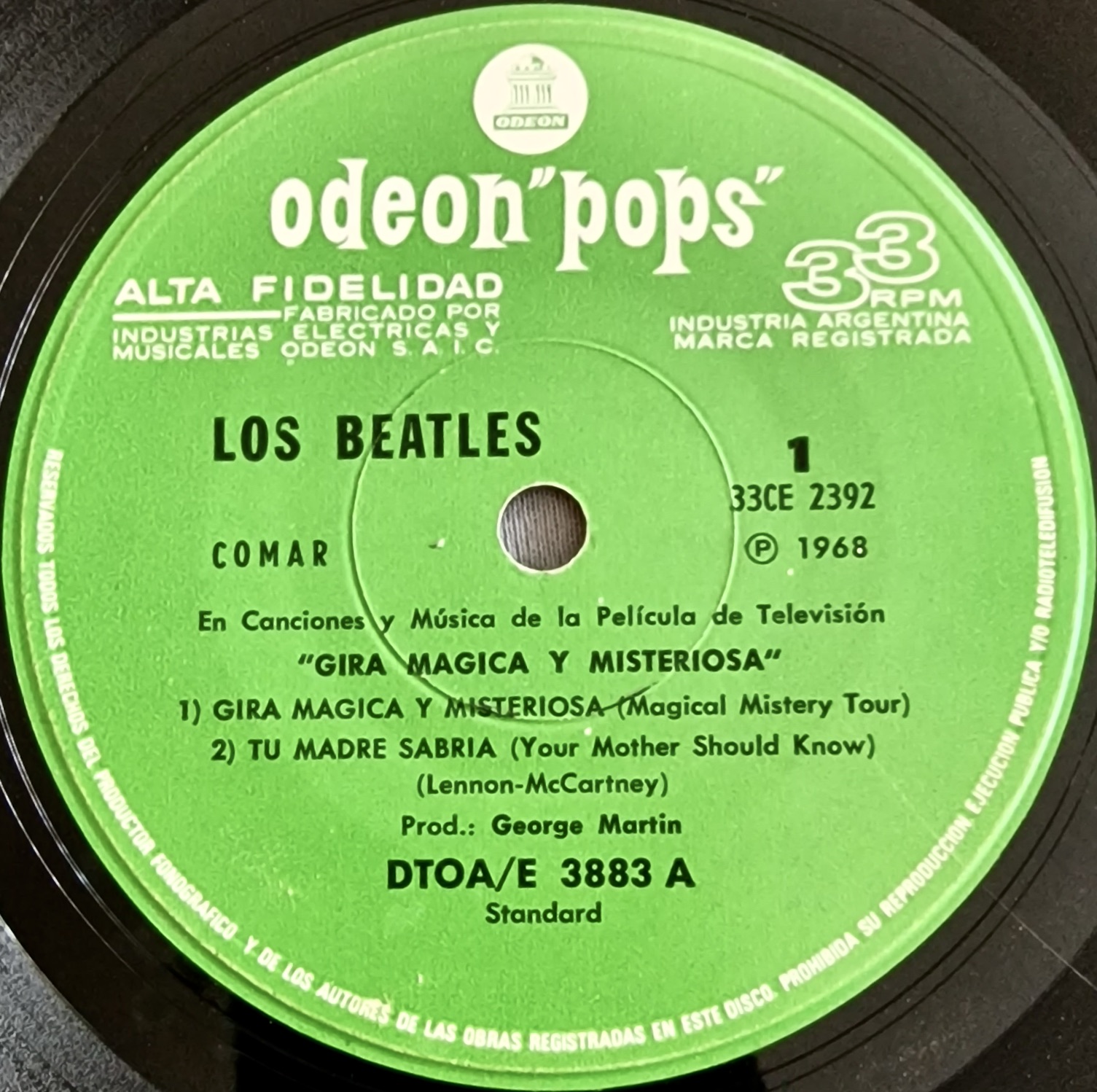
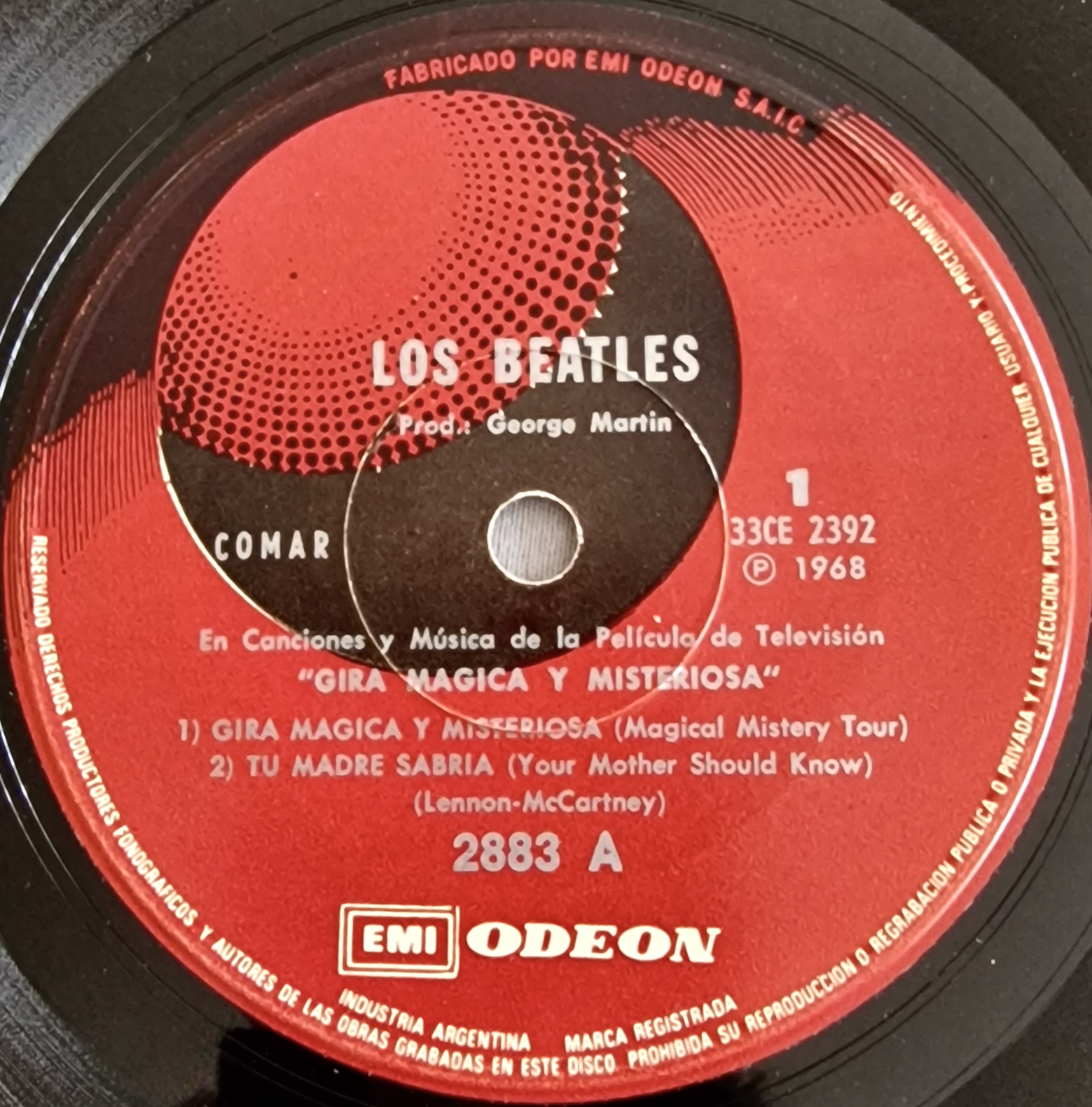
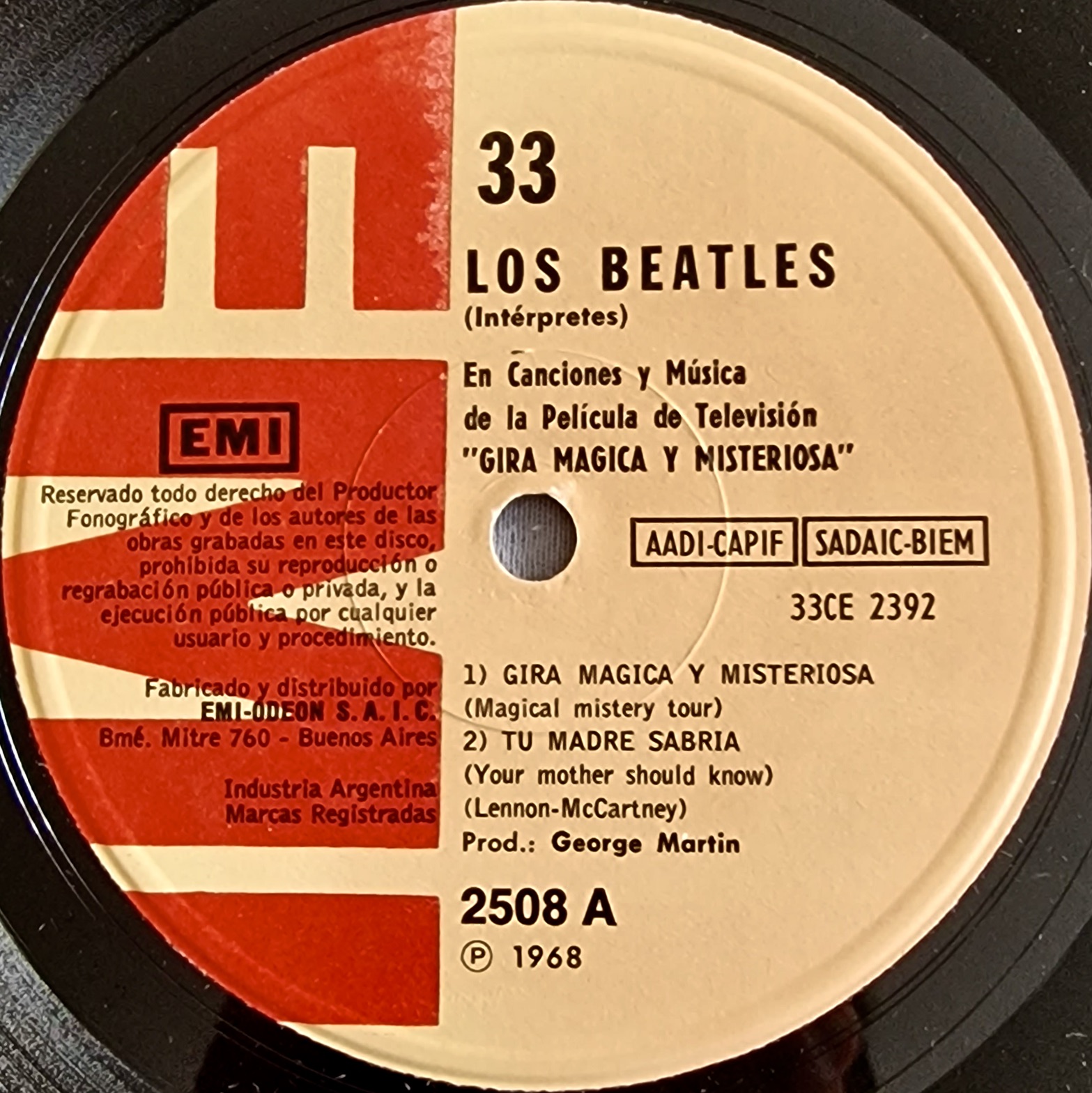
To begin, Simon sent us images of four different examples from Argentina which has a number of different versions of the MMT EP. These below (in order) are from 1968, 1970, 1973, and one of unknown year of release. It’s the one on the red and brown EMI label (it is probably 1975). The song titles are translated from English to Spanish:
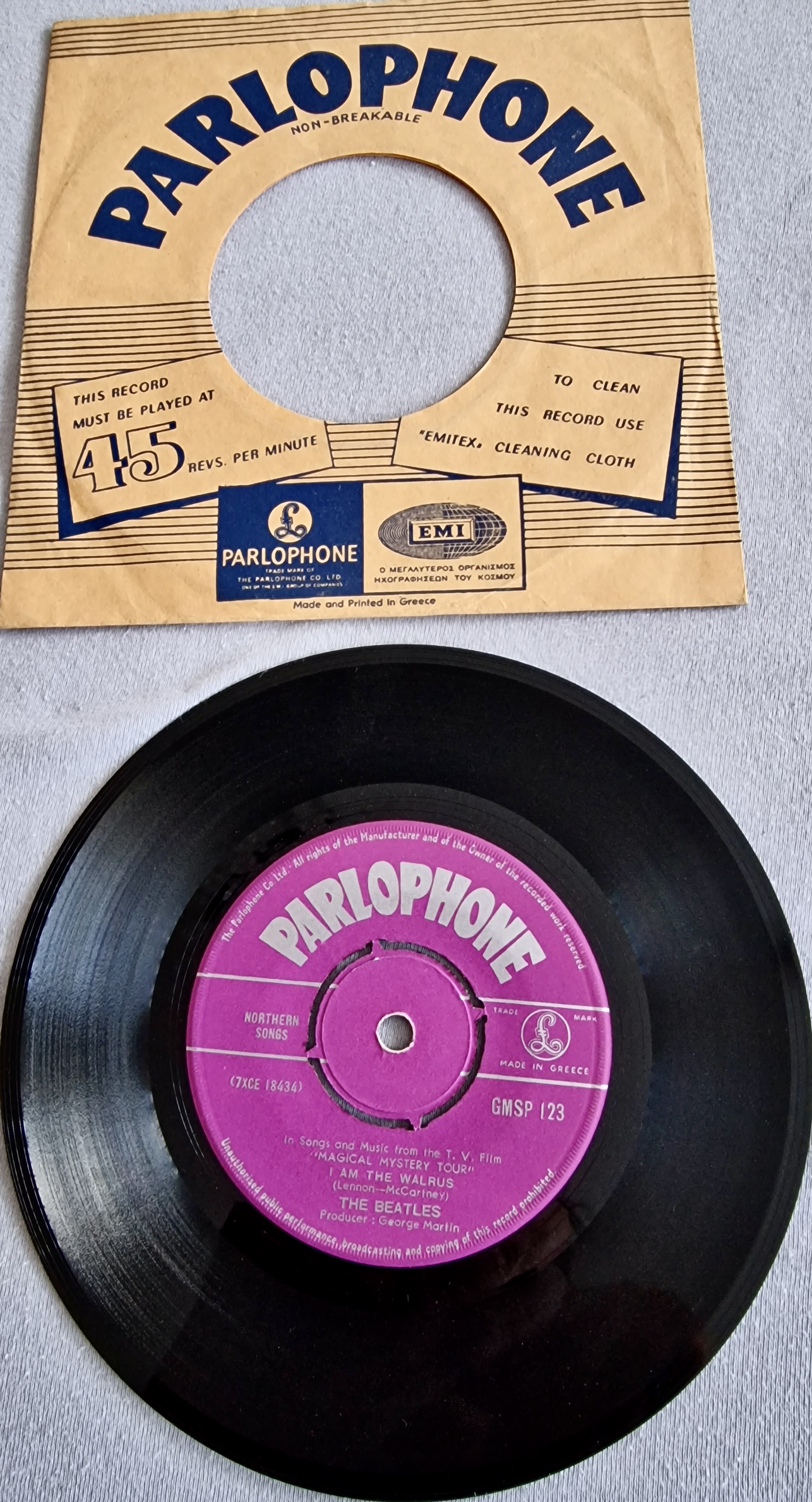
Greece has two different versions – one with a large jukebox center (which Simon doesn’t own yet), and the other with a smaller push-out centre:
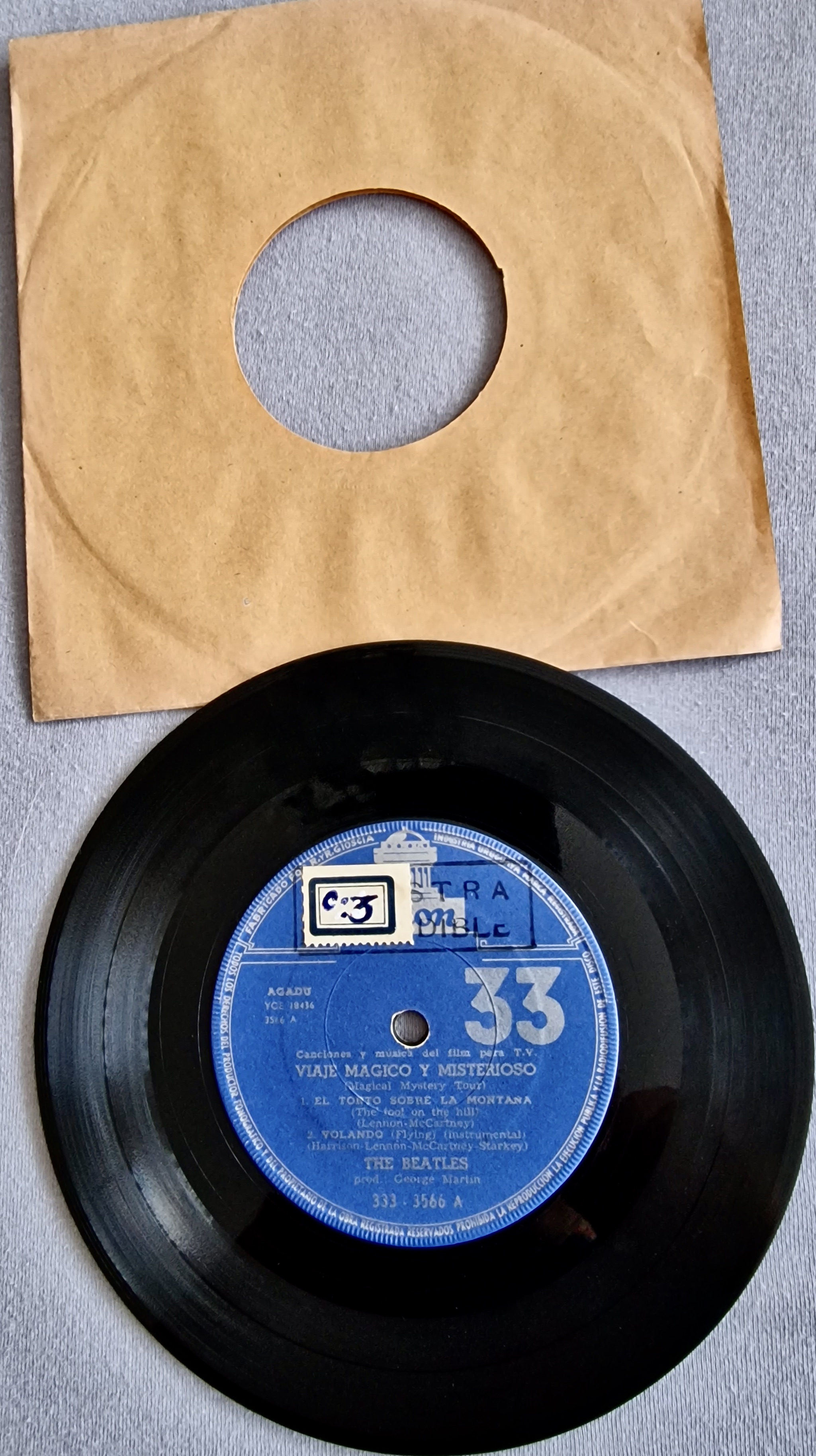
From Uruguay, Simon owns two versions. There’s the regular release, and this rare blue test pressing below that he has never seen for sale again in 40 years:
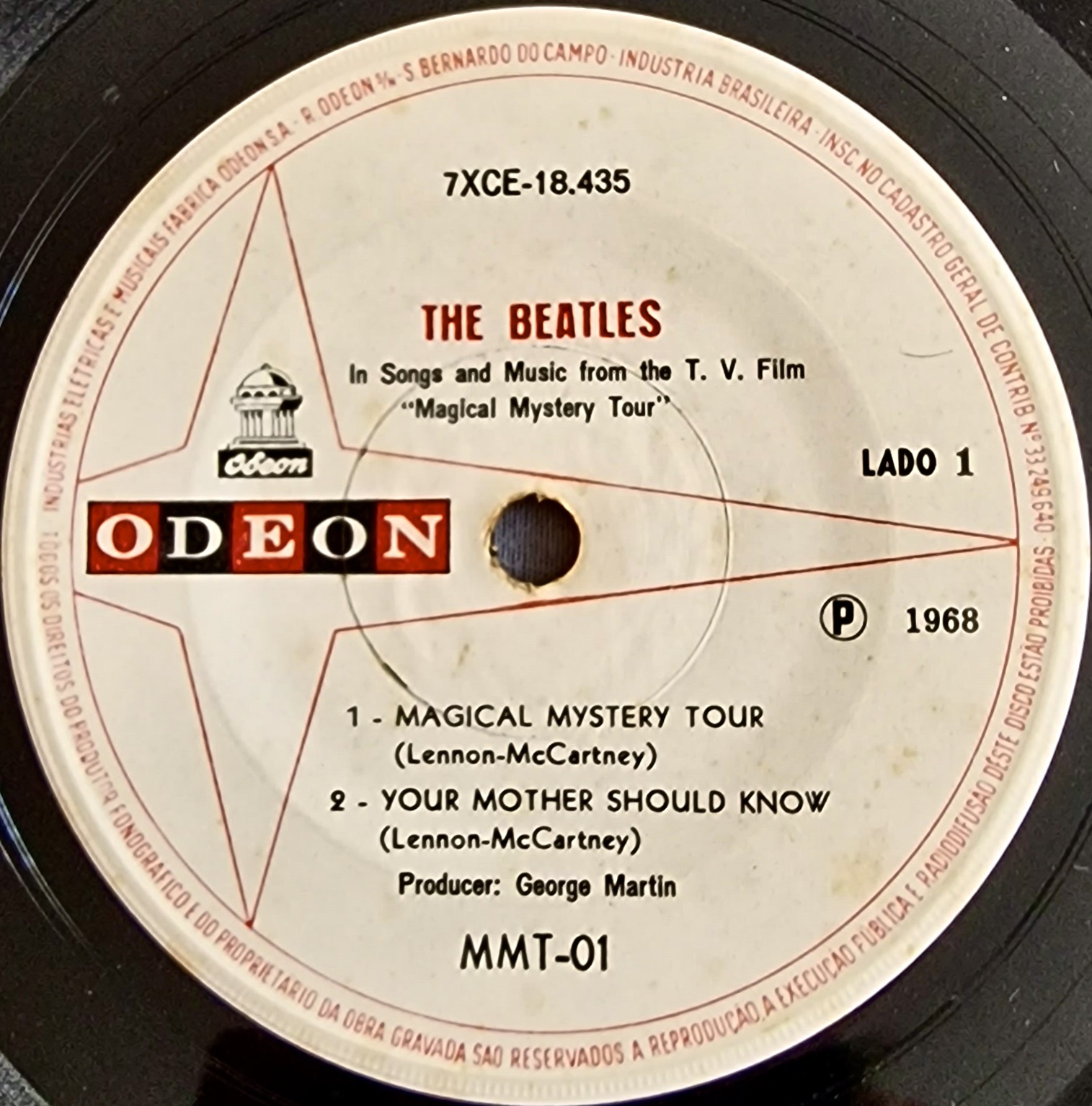
One really cool looking label is this Odeon version from Brazil, released in 1968. It is the Mono version:
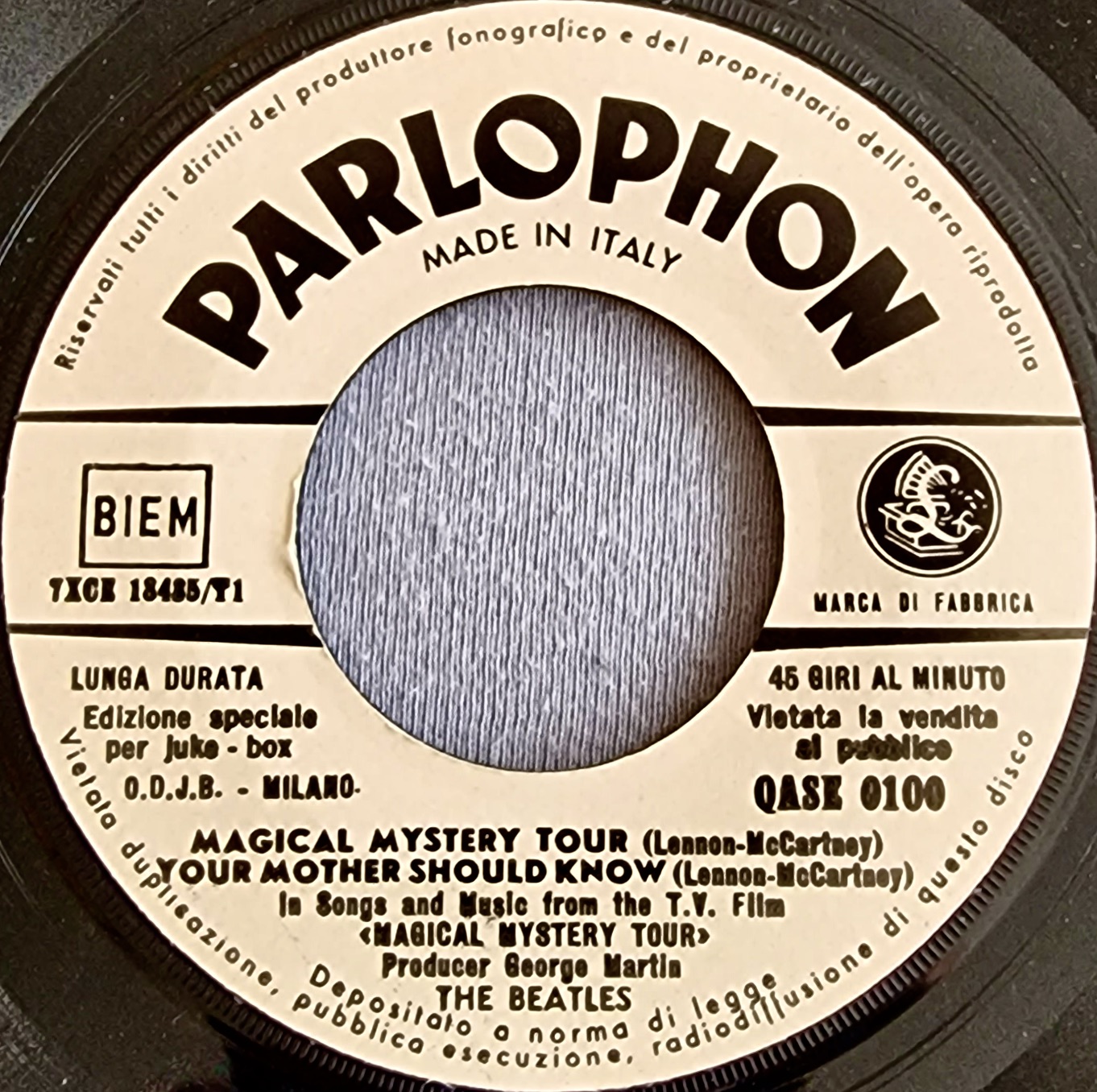
Italy has a number of different pressings on Parlophon in blue, black, and this Juke Box one on a beige label:
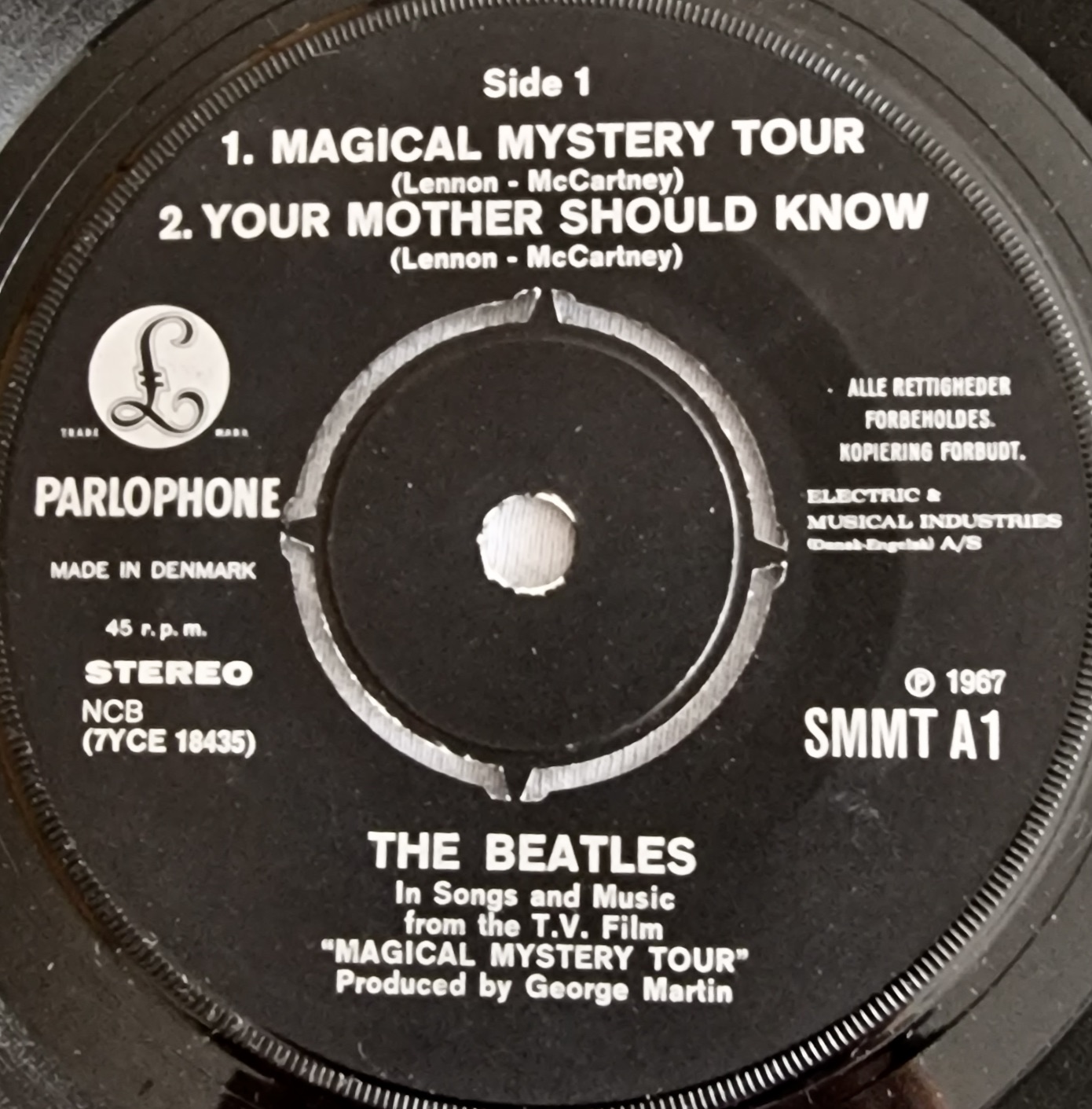
Germany has at least three different versions, as does Denmark. Here’s one of them – a Stereo most probably from 1967:
One of the more unusual and hard to find is this one from Israel. Simon says Israel has two variations. One came as a 2 EP set in a cover much like the rest of the world. The records inside are like the Stereo example below). For the other Israel released the two discs as separate singles in picture sleeves (which Simon doesn’t have yet):
Holland two different editions, France has four versions at least, and Finland has two variations, of which Simon only owns one, this one – a Stereo pressing – is from 1967:
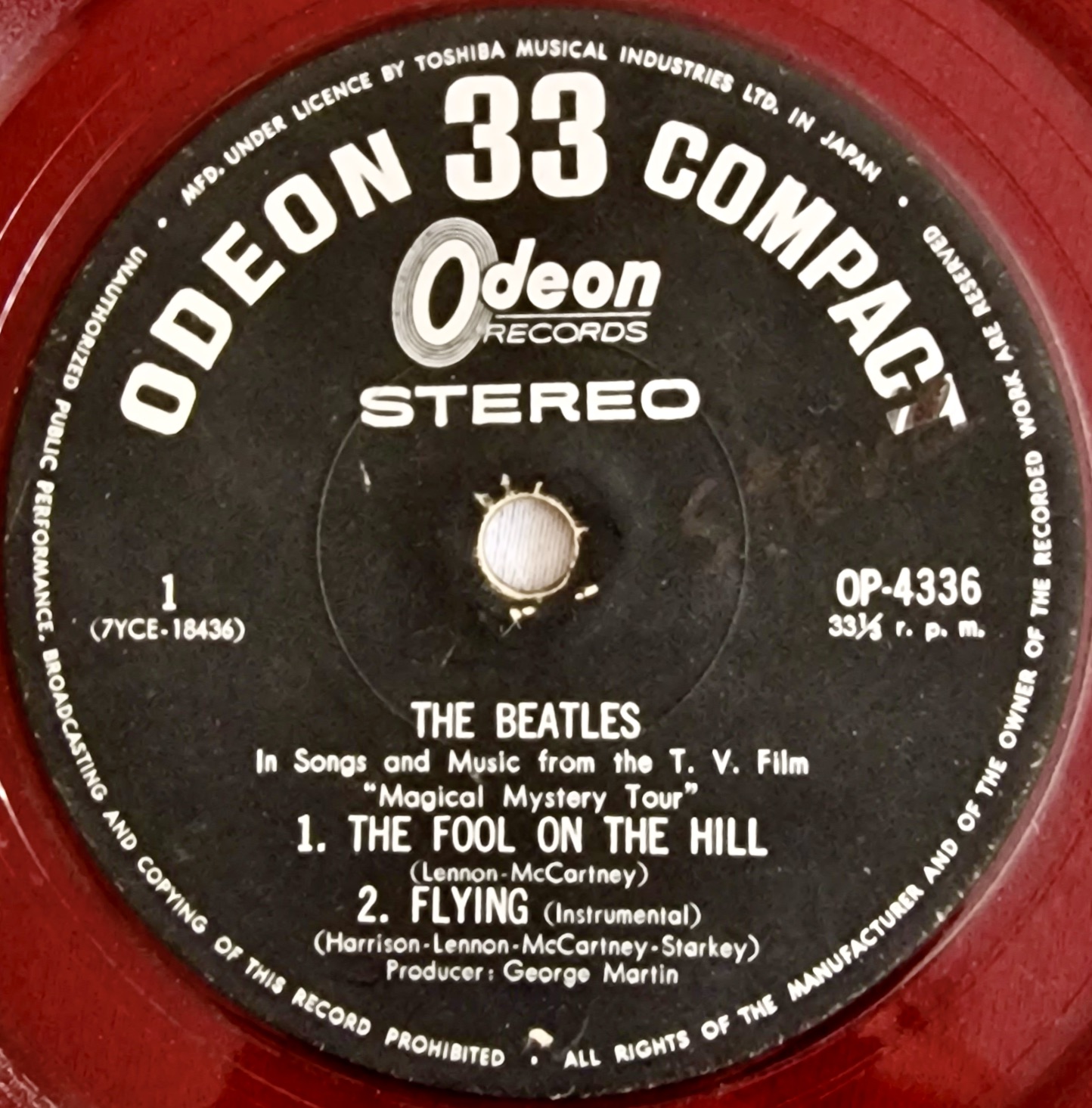
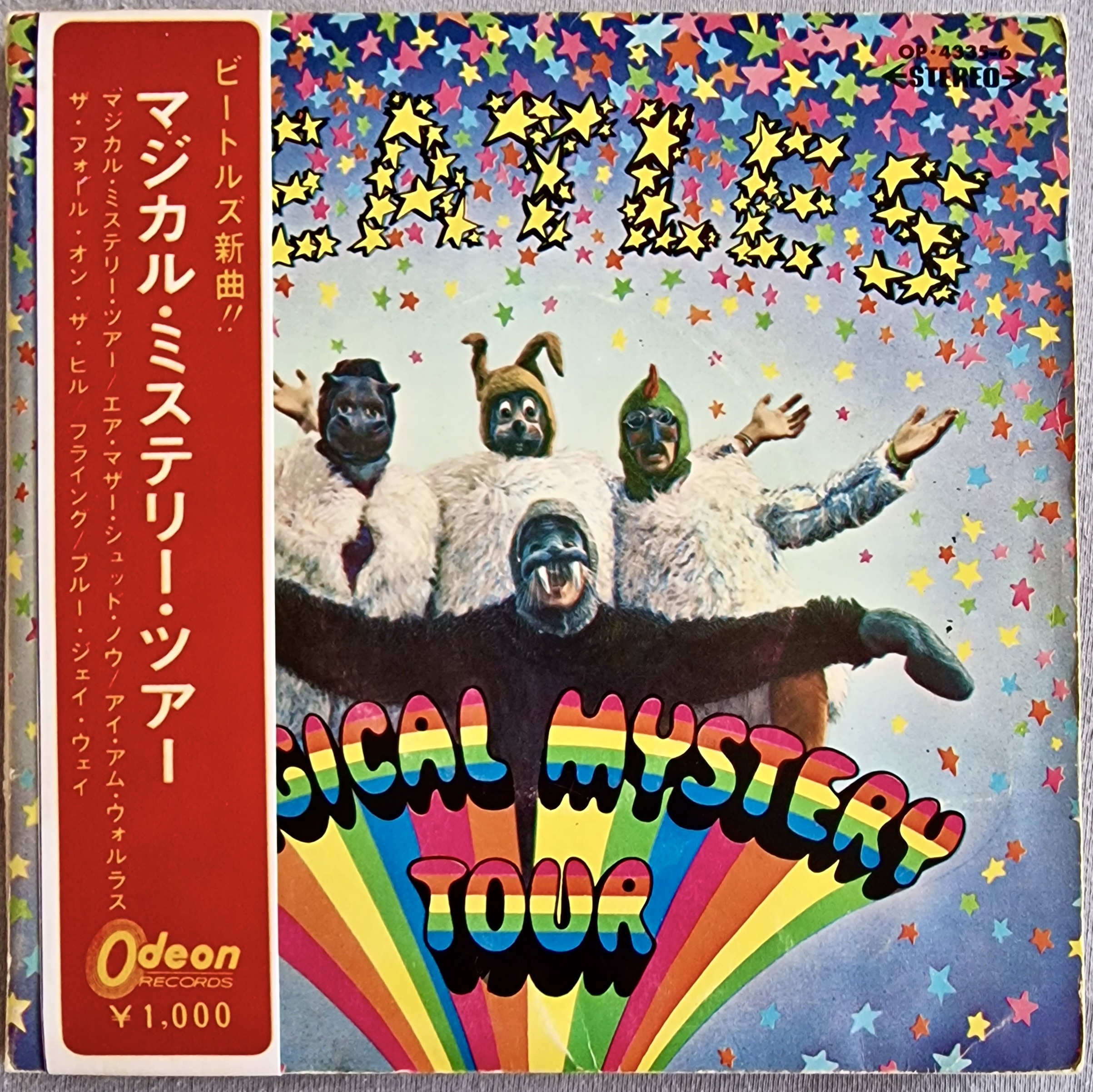
Japan has many different versions on both black vinyl, and this one, from 1968, on red wax:
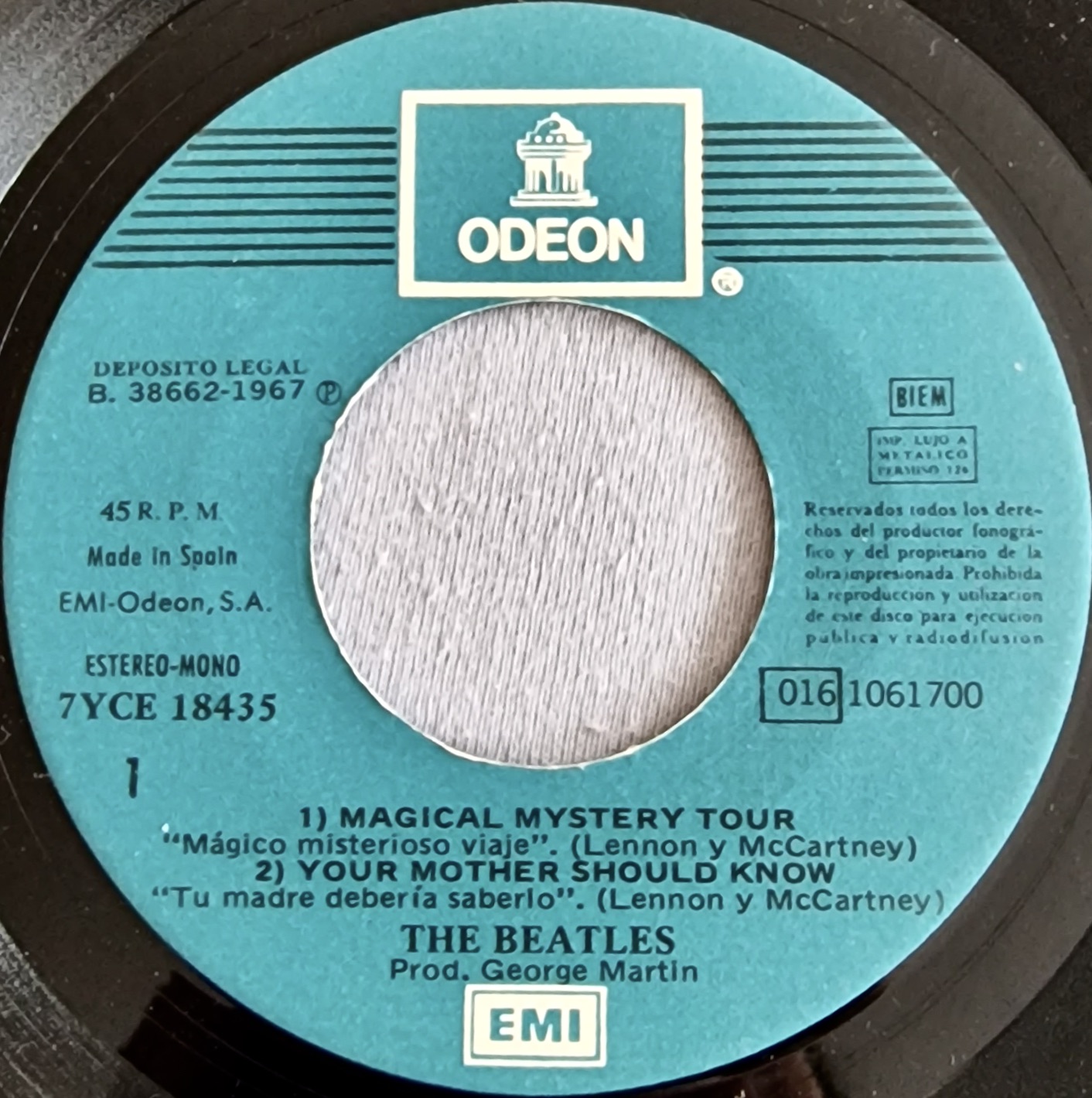
Spain has at least three versions. This is one of the later re-issues on a teal coloured Odeon label. Notice it is the Mono edition:
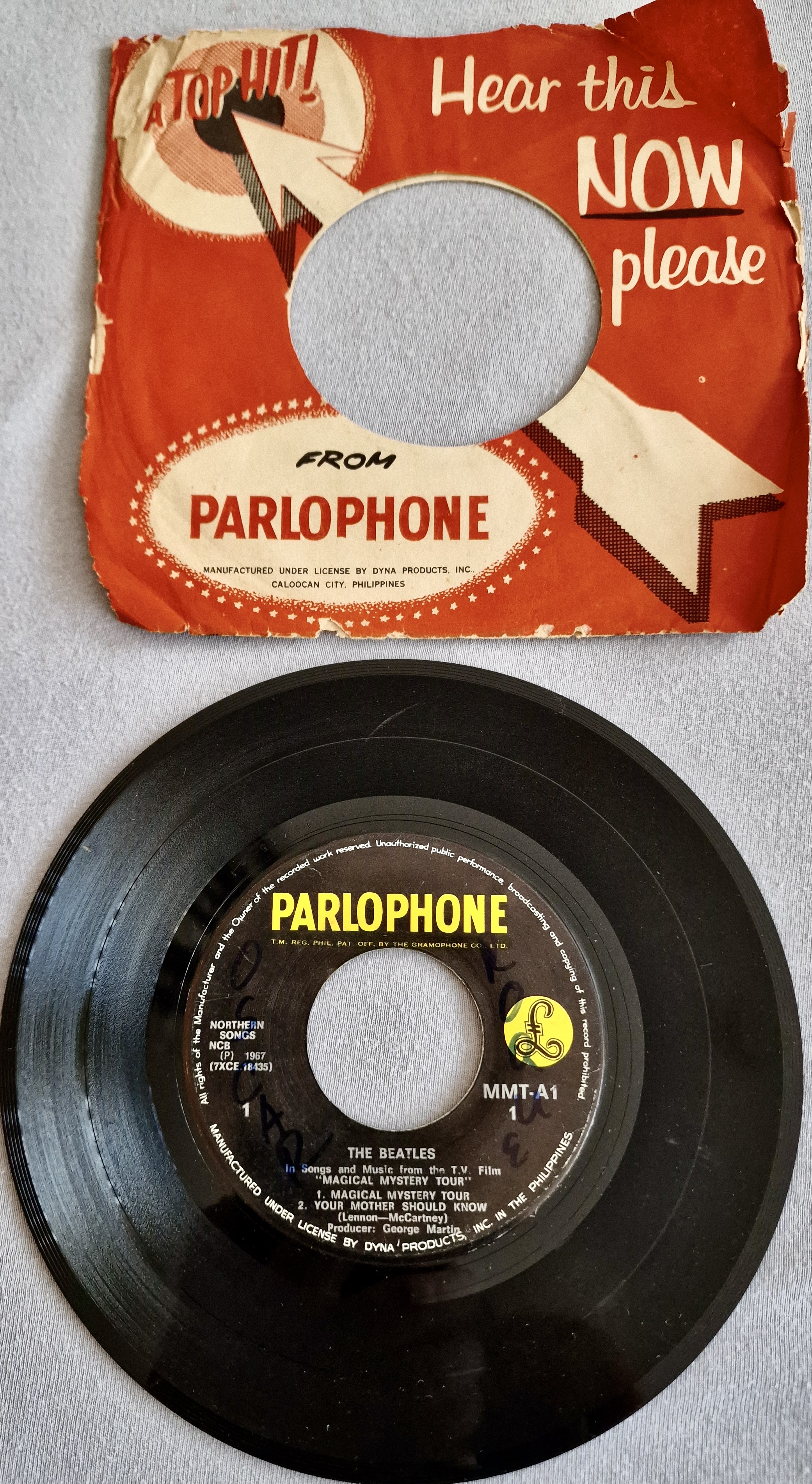
Yugoslavia has at least four versions. Africa has several versions (with round and triangular push-out centres) that Simon still doesn’t own yet. But he does have this example from the Philippines, issued in Mono in 1967:
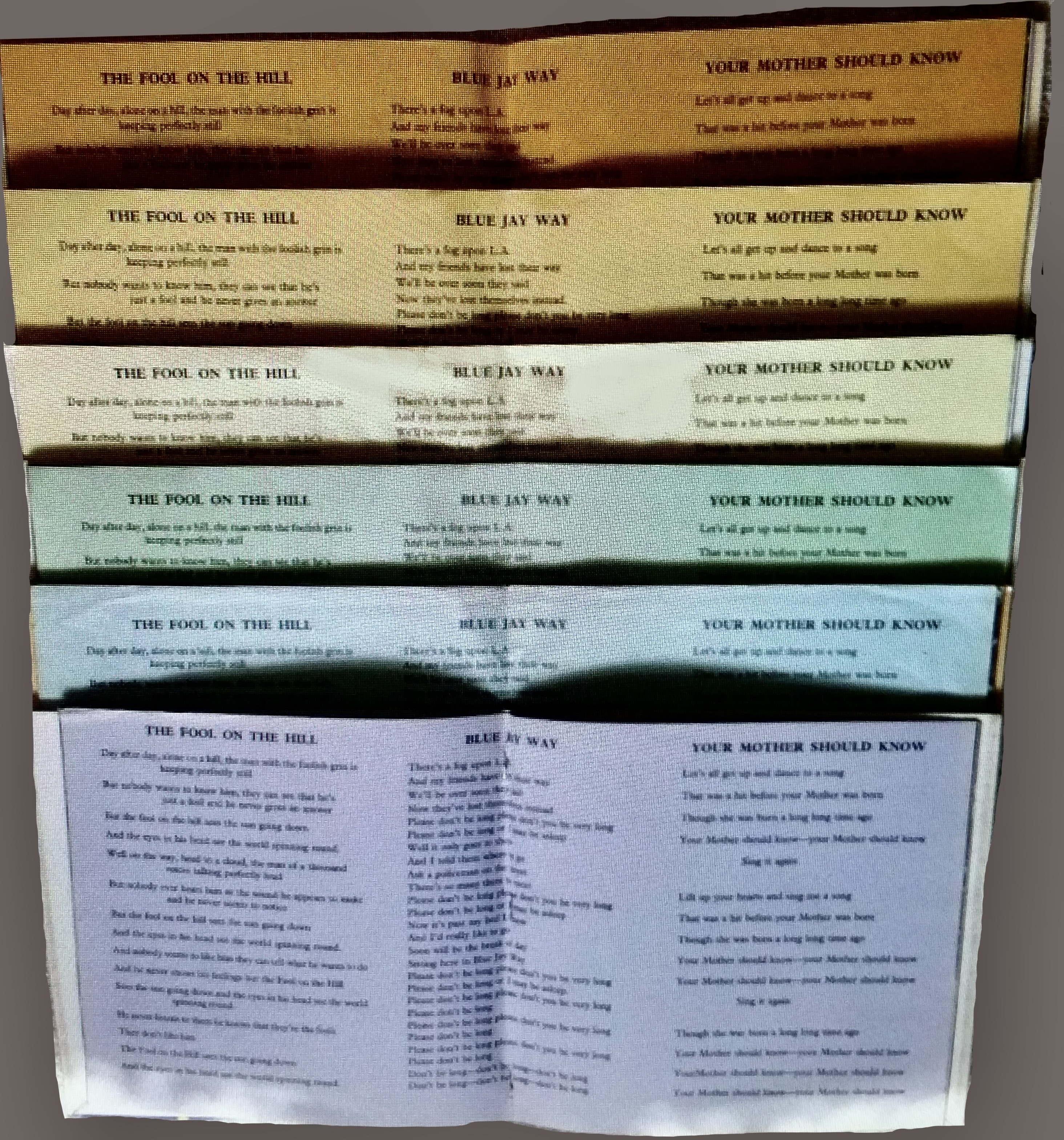
In regards to the lyric sheets stapled inside the MMT EP gatefold cover, these too have their variations from country to country, and across the different re-issue years. Simon sent us an image that illustrates this as well:
In the photo above you can see some of the different colour variations of the lyric pages. There are of course several different shades of each of the colours too.
This is just a taste of Simon’s collection, but he writes that there are still numbers more that he still does not own yet. For example Chile, Greece with larger centre, Rhodesia with the triangle push-out centre, and the very first Japanese version. He’s not sure if Turkey and India ever pressed a set.
Should anyone have an EP or anything else rare from MMT that may help Simon complete his collection he would love to hear from you. They will all be put to good use in aid of others less fortunate in the world. Drop us a line using the Leave a Reply link below and we can put you in touch.
Also, if you or someone you know has a specific area of Beatle collecting – where someone has concentrated on just one particular release – please let us know! We’d love to hear from you and see some of your collection too.
Now that international travel is slowly becoming more feasible for many of us again, a visit to Liverpool – the city where it all began for The Beatles – might just be back on your travel “must do” list.
If so, it’d be nice to have a guide to point you in the right direction when you get there.
Liverpool, on the banks of the River Mersey always looms large in any discussion about the formation of the band and their influences. Many of the physical places they lived or frequented have become key parts of the Beatle story. It is of course the city where John, Paul, Ringo and George were born, grew up in, and knew well.
Now a new guide book The Beatles’ Liverpool – just released – takes you there by gathering more than fifty Liverpudlian localities. The fully illustrated guide then explains why those particular places played such a key role in the band’s development and success.
Of course there are the obligatory entries for the childhood homes (Menlove Avenue for John, Arnold Grove for George, Forthlin Road for Paul, and Admiral Grove for Ringo); there’s the background to Penny Lane and Strawberry Fields; The Cavern Club; and the well-known St Peter’s Church, Woolton where John first met Paul.
But there are many more obscure listings too. Like Hulme Hall in Port Sunlight; the Neston Institute in Wirral; and 4 Rodney Street, birthplace of Beatle manager Brian Epstein.
There’s also a handy two-page guide map pinpointing the location of all the places mentioned in the guide.
If you’re planning a Liverpool visit, this book would be an essential to take with you – and it won’t cost you any excess luggage fees. At just over 44 pages The Beatles’ Liverpool is compact and light enough to easily slip into a travel bag or backpack to have with you as you walk the streets of the historic city.
Even if you’re still a way off physically getting to Liverpool, you can dive into The Beatles’ Liverpool and pay a visit vicariously. It’s the perfect armchair alternative to actually being there.
Author Mike Haskins was himself born and raised in Merseyside – and he still lives there! He’s worked as a scriptwriter and researcher for TV, radio and the stage, and has published over fifty books.
All you need to do is provide your name, email address and have a go at answering two easy Beatle Liverpool-related questions. Just click on the link below to enter:
Good luck!
UPDATE: Thank you to everyone who entered. And congratulations to the two readers who were first in with the correct answers!
They are Fred, from Ontario, Canada; and Diane from New York, USA. They will receive a copy of The Beatles’ Liverpool book, courtesy of Pitkin Publishing and Batsford Books.
The correct answers to our questions were:
In their early career band members purchased many of their instruments from which famous Liverpool music store? Hessy’s Music Centre
Ringo’s family hails from Liverpool’s Dingle area. His Mum worked at pub called The Empress there. In what way did Ringo put that building on the map? It’s on the front cover of his Sentimental Journey LP
Los Angeles – July 29, 2022 – Today, UMe announces the release of EP3 featuring four brand new tracks from Ringo Starr, to be released on September 16. These four new tracks were all recorded at Starr’s Roccabella West studio just as he did for his Change The World and Zoom In eps, featuring longtime collaborators Steve Lukather, Linda Perry, Dave Koz, José Antonio Rodriguez, and Bruce Sugar. Ringo’s instantly recognizable vocals, feel-good lyrics, easy-breezy melodies, and frequent and new collaborators created songs that span the spectrum of pop, country, reggae and rock and roll.
EP3 will be available September 16th digitally and on CD, and on 10” vinyl and as a limited edition translucent royal blue cassette on November 18.
“I am in my studio writing and recording every chance I get. It’s what I have always done and will continue to do, and releasing ep’s more frequently allows me to continue to be creative and give each song a little more love.” – RINGO
The four new tracks are:
World Go Round
Everyone and Everything
Let’s Be Friends
Free Your Soul (feat. Dave Koz and José Antonio Rodriguez)
There’s no doubt there are some very generous souls in the Beatle collecting community and we’ve recently been the recipient of such generosity. In a tidy-up and down-sizing of his collection one beatlesblog reader found he had two copies of the 2009 release Beatles Box of Vision and, very kindly, decided to pass one of them along to us. And a welcome addition it is as we didn’t have this treasure in the collection.
The Beatles Box of Vision was the brainchild of former Capitol Records Executive Vice President/Chief Operating Officer and Beatle fanatic, Jonathan Polk.
Timed to coincide with the 2009 release of the Beatles stereo CD remasters, Box of Vision was a sumptuous way to store all that officially reissued CD catalogue – and more. Its storage section could contain every release from Please Please Me right up to the then-current Love, including Past Masters 1 & 2; the ‘best of’ albums 1962-1966 and 1967-1970; Live at the BBC; Anthology 1, 2 and 3; the Yellow Submarine Songtrack; the 1 compilation; and even Let It Be…Naked.
Box of Vision is large and impressively constructed. It comes shipped in a protective white cardboard outer (that is really worth keeping):
On the rear of this protective box is printed information about the contents:
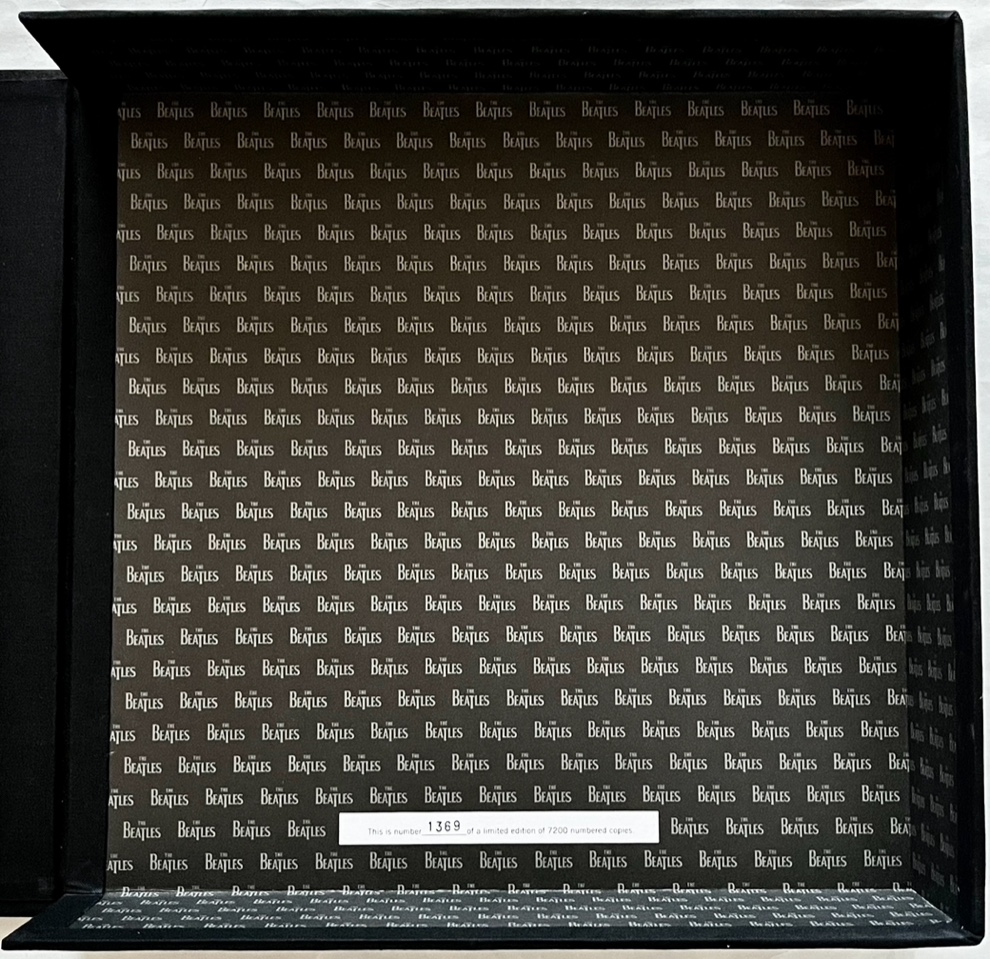
When you open this white outer box the first thing you see inside is the large, well-protected, very good quality Box of Vision box. This initially looks like it might be designed to hold LPs instead of CDs because it is of LP-like proportions:
Taking it out reveals this still striking Robert Freeman image on the front cover of of what is a black linen covered storage box:
The box is deep and has the core collection LP spines printed along its edges :
As mentioned, the box is beautifully made. It is hinged on the left, opens like a large clam shell. It is designed to store, organise and display your Beatle CD collection. It contains two high quality books plus a set of plastic sleeves. The first thing you see when you open it up is a slim, soft cover book called The Beatles Catalography.
Then comes a series of 4 plastic storage sleeves – each of which can hold 8 CDs plus their booklets (4 on the front, 4 on the back of each sleeve). These have black and white images at each slot to show which CD goes where:
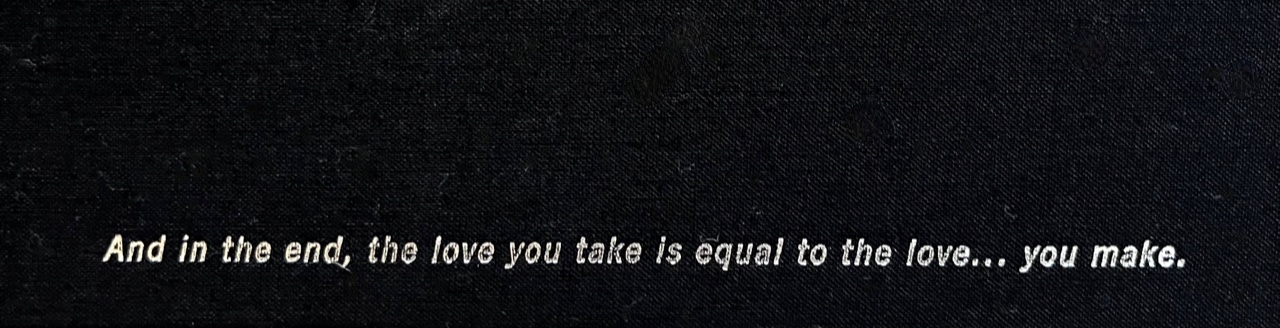
Then at the back of the box is an impressive cloth-bound hard back book containing all the full-sized artwork for every release. This is embossed on the front in shiny black lettering that simply says The Beatles:
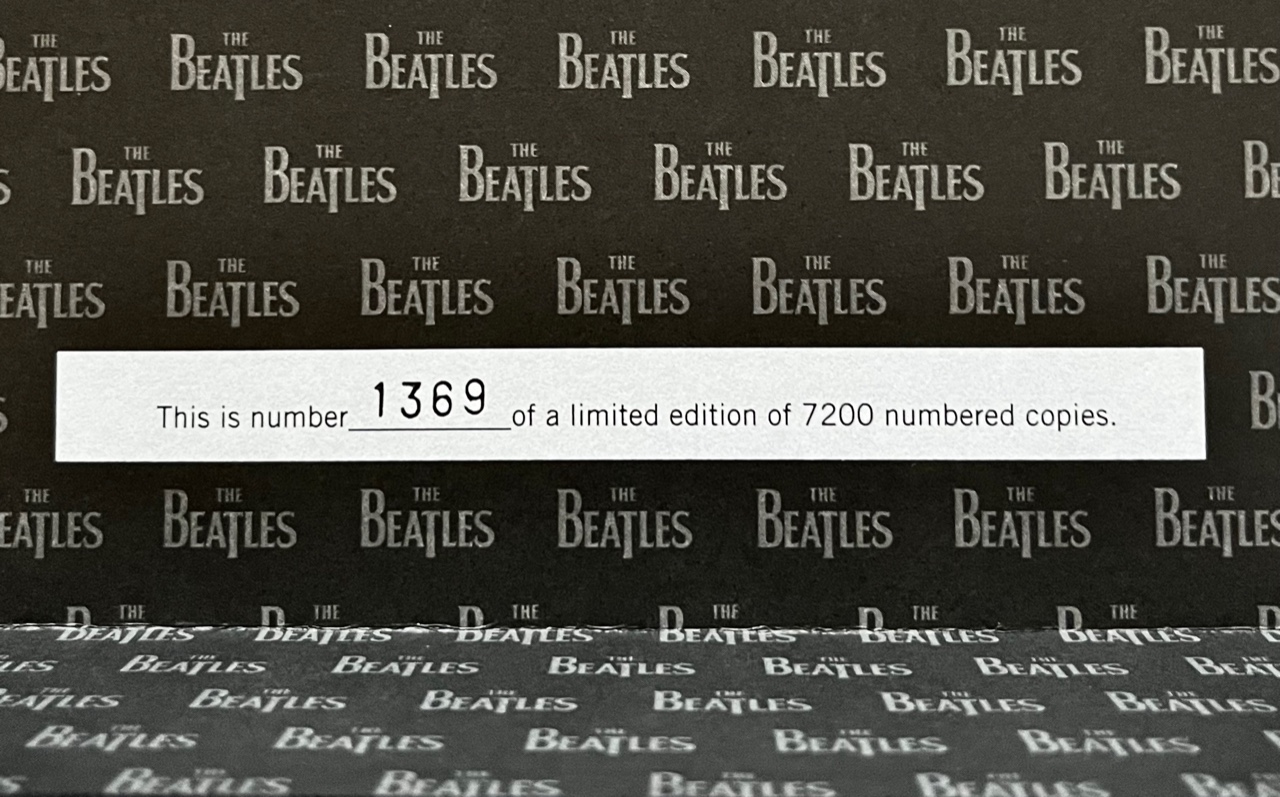
Each box is numbered. This one is #1369:
Even the rear of the box has a nice detail:
Let’s look first at The Beatles Catalography book:
This is a guidebook to the unique history of Beatle releases. It details their UK and US catalogue in a side-by-side presentation so that you can immediately see the differences between the two countries, both in the artwork and the track listings:
Then comes the hefty, cloth-bound book The Beatles with high quality images of all the artwork associated with every official Beatle release in the UK to 2009.
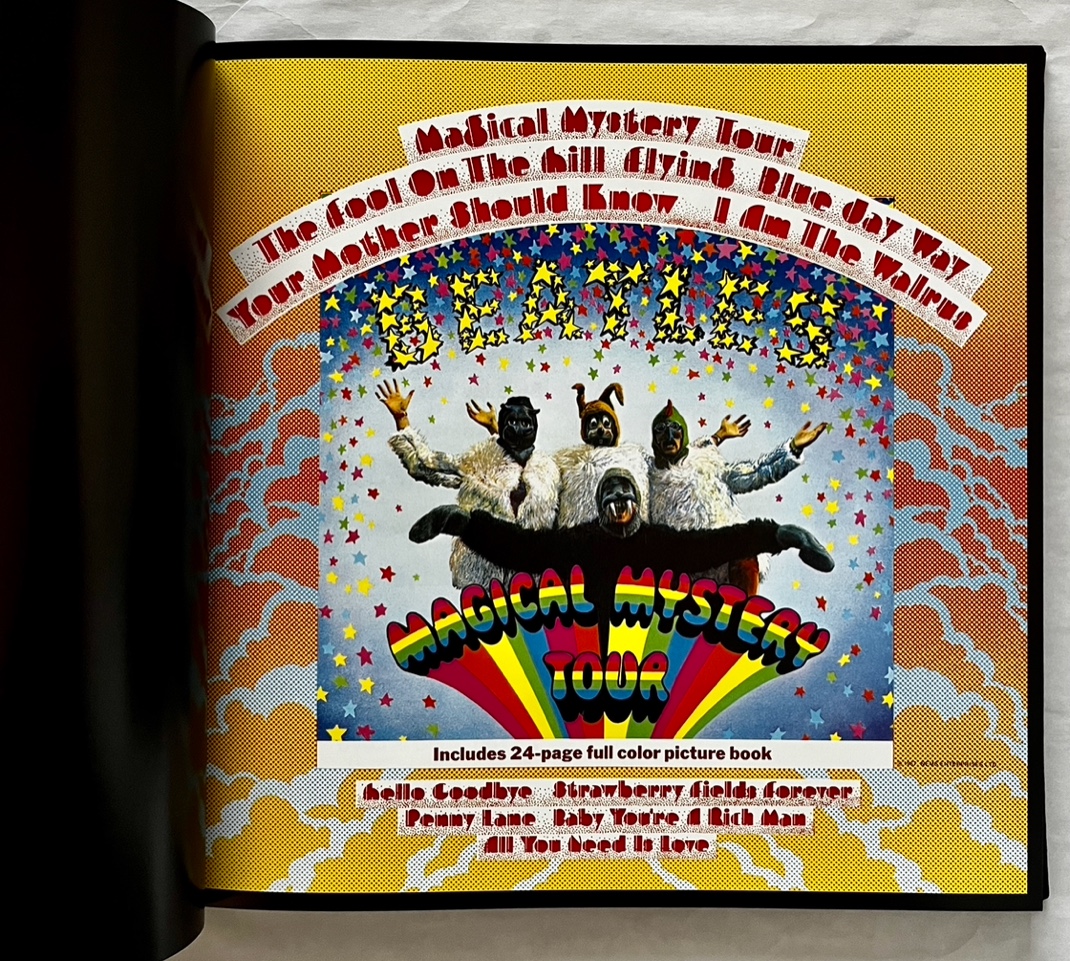
Where that artwork extends to posters, special inserts or booklets these too are reproduced. For example, the story picture book stapled inside the Magical Mystery Tour LP is reproduced in full:
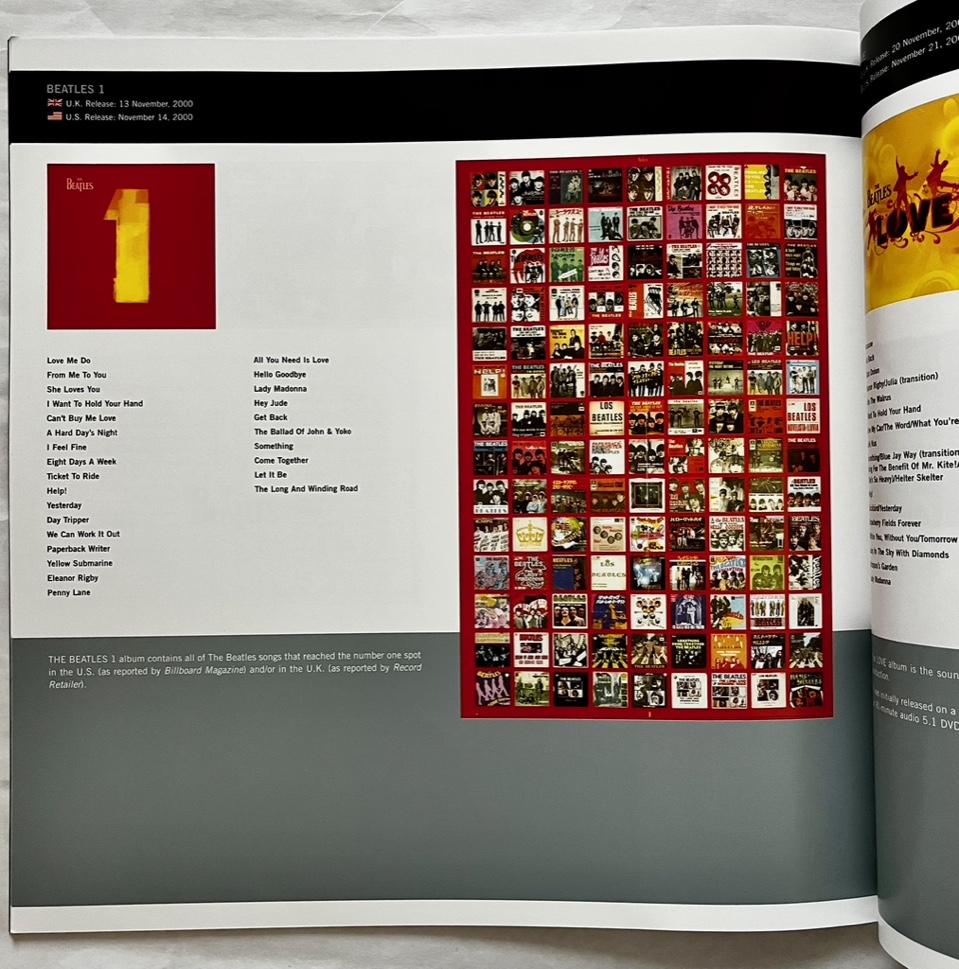
When you get to the 1 album an image of the poster is reproduced:
Likewise the booklet that came with the Let It Be…Naked LP:
The rear covers of each album are also faithfully reproduced:
Where did the name ‘Box of Vision’ come from?
At the time Jonathan Polk told The Houston Chronicle that title is from a song by Tom Russell. “The gist of the song is a father wishing he could give his child a box with all the things he would like her to experience in her life. I thought it was a good fit as I had envisioned this as a way to give a young fan the context to appreciate the history and chronology of the Beatles catalog, and what they were able to accomplish, in a much deeper way than as simply a bunch of hit songs.”
At the time you could order Box of Vision through the official Beatles site, or through a dedicated Box of Vision site – but that sadly is now long gone.
The Beatle/Apple connection – and the incredible quality of the images reproduced in both the books accompanying the storage box – very clearly hints at the close involvement the Beatles camp must have had with this project. They obviously supported the initiative fully, and it shows.
Here’s a YouTube ‘unboxing’ video from the time:
There was also a John Lennon Box of Vision released a year later in 2010, as well as a Bob Dylan Archive in 2011 – both done in a similar style to the The Beatles Box of Vision.
Thank you so much to reader Michael who very generously gifted us the Beatles Box of Vision.
Thanks also to Marc who read our article about The Beatles Box Of Vision and writes: “After it was released the Box Of Vision website had a PDF download containing corrections for three pages in Catalography book: one for the Let It Be/Let It Be…Naked page, and two of the Song/Album Reference pages.” Marc has made that PDF available. He hopes this is useful for others who may have missed it at the time. You can download those pages here:
The photos of George Harrison at home we published in Beatles With Records – Part 30 unleashed something of a flood of further images from readers depicting band members with LPs – especially George.
Additional images from what appears to be that same ‘at home’ photo session show him with even more records:
Specifically a well-stocked, three-tiered record rack seen on the right-hand side here (and thanks to our reader Lammert who sent these images through, plus many more across the whole Beatles With Records series):
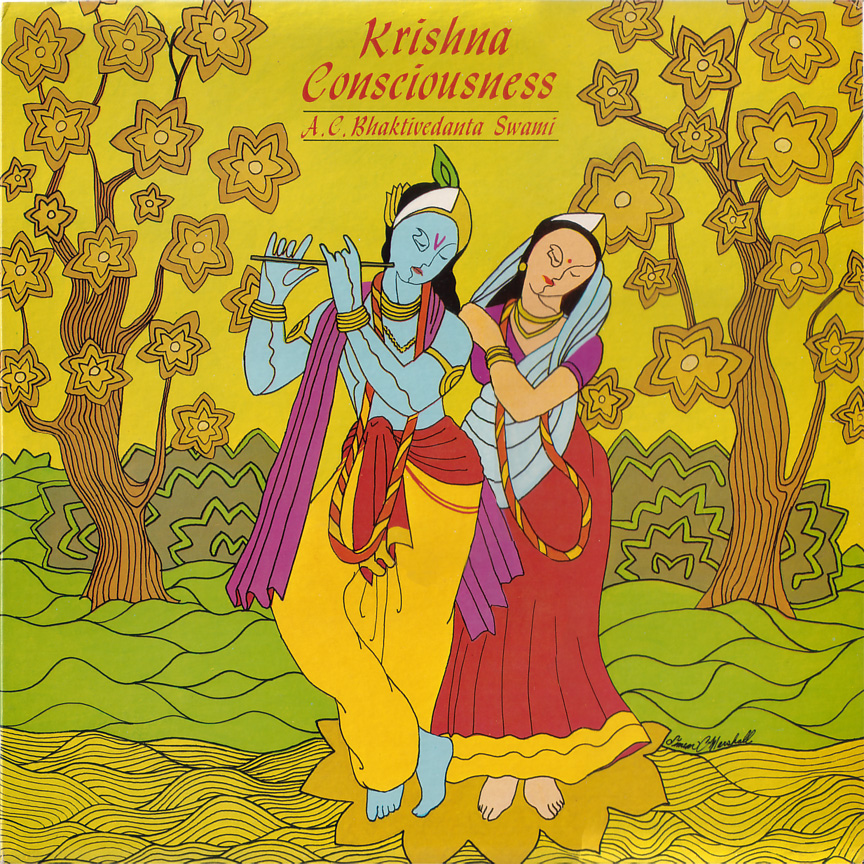
Here, in the top left compartment you can just make out this 1966 album, Krishna Consciousness by A.C.Bhaktivedanta Swami, the Indian spiritual teacher and founder of the International Society for Krishna Consciousness (ISKCON), commonly known as the “Hare Krishna Movement”:
On the top right is Booker T and the M.G.’s Soul Limbo from 1968:
In the middle row, to the left is Woody Guthrie’s classic, Woody Guthrie Sings Folk Songs (with Leadbelly, Cisco Houston, Sonny Terry and Bess Hawes), first released in 1962:
Staying on the middle row – on the right-hand side is one of George’s all-time favourite bands, Smokey Robinson and the Miracles. This time with their Greatest Hits Volume 2 LP first issued in 1967:
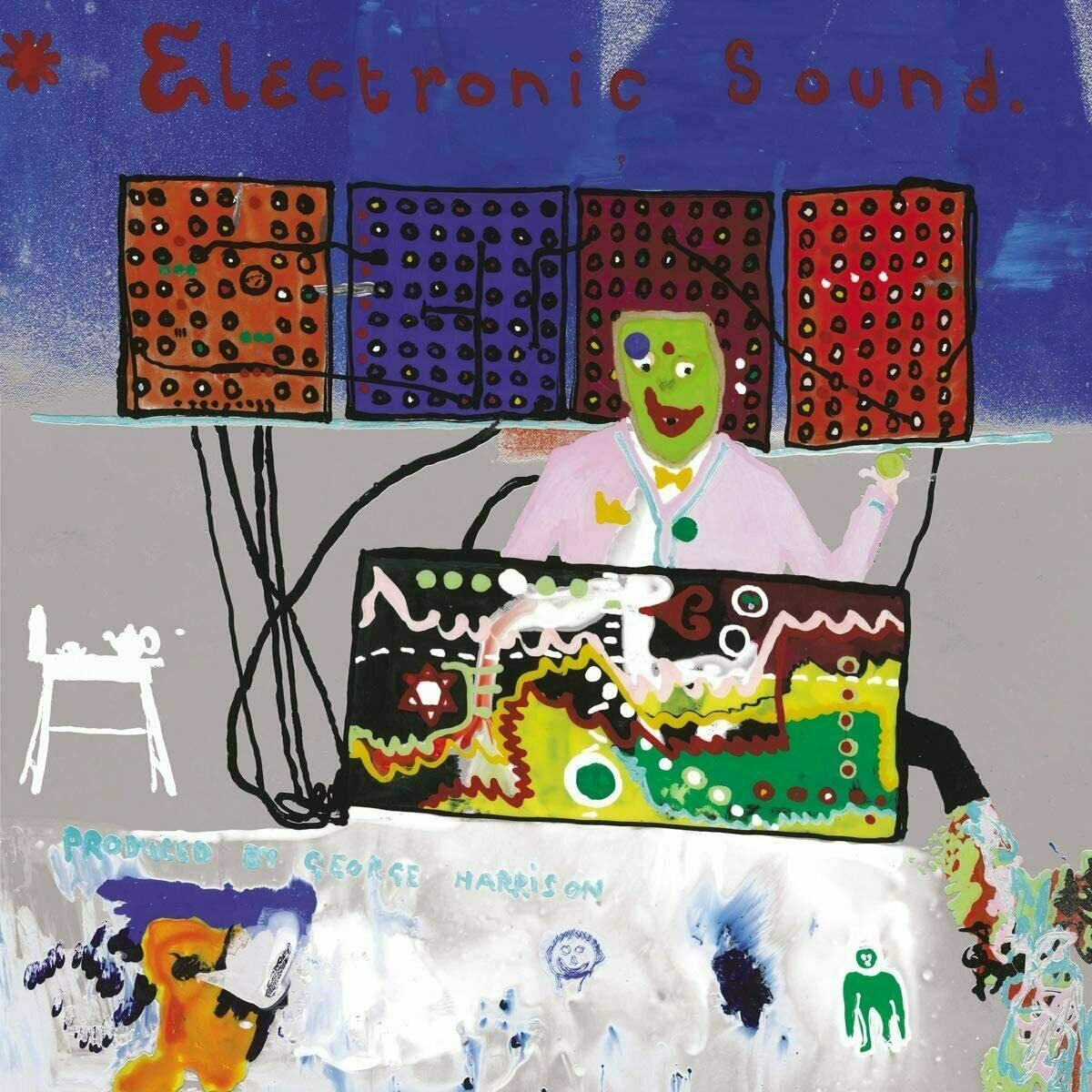
And of course, in the bottom left compartment of his record holder George has his own Electronic Sound, released on the Zapple label in 1969:
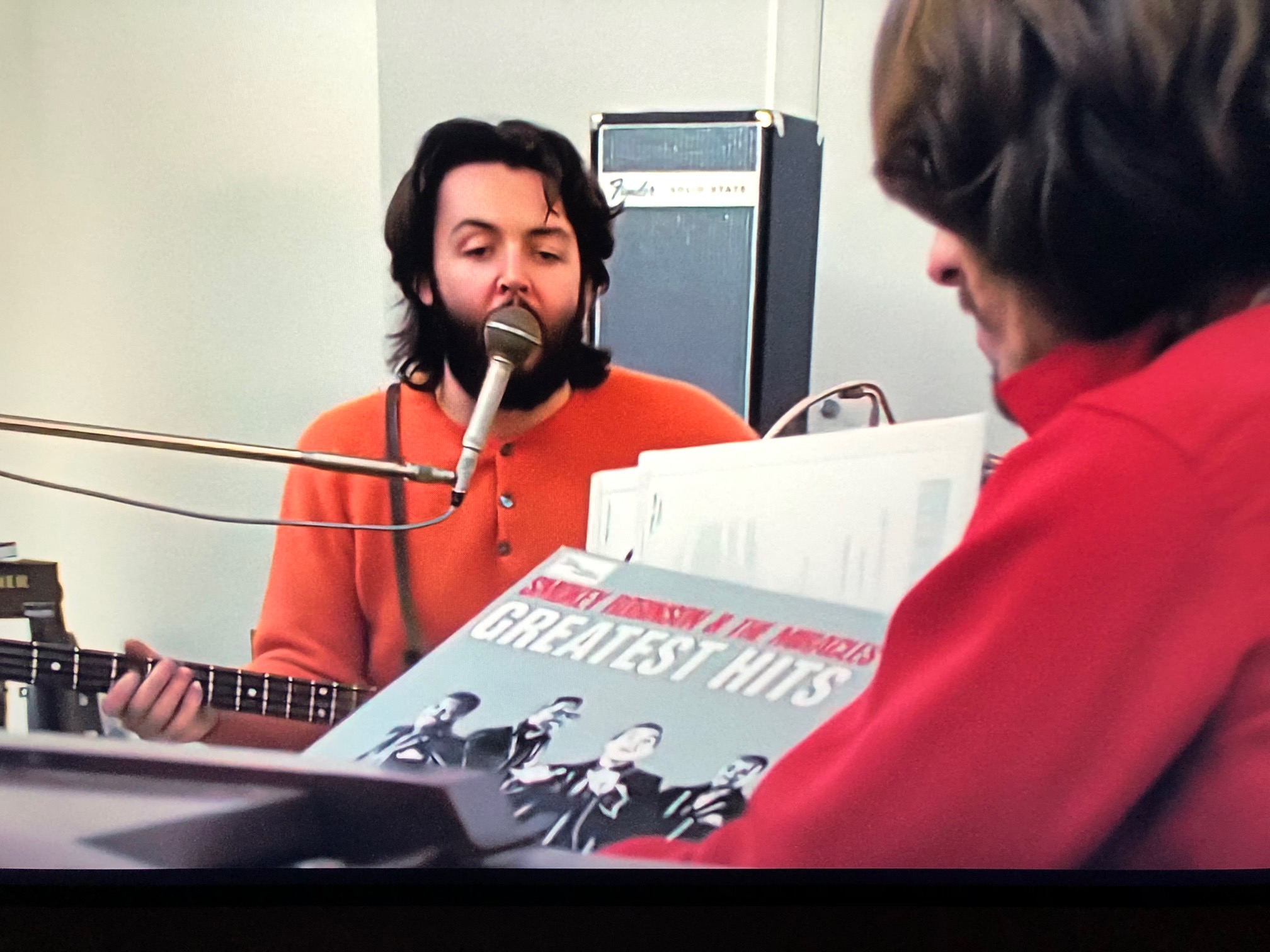
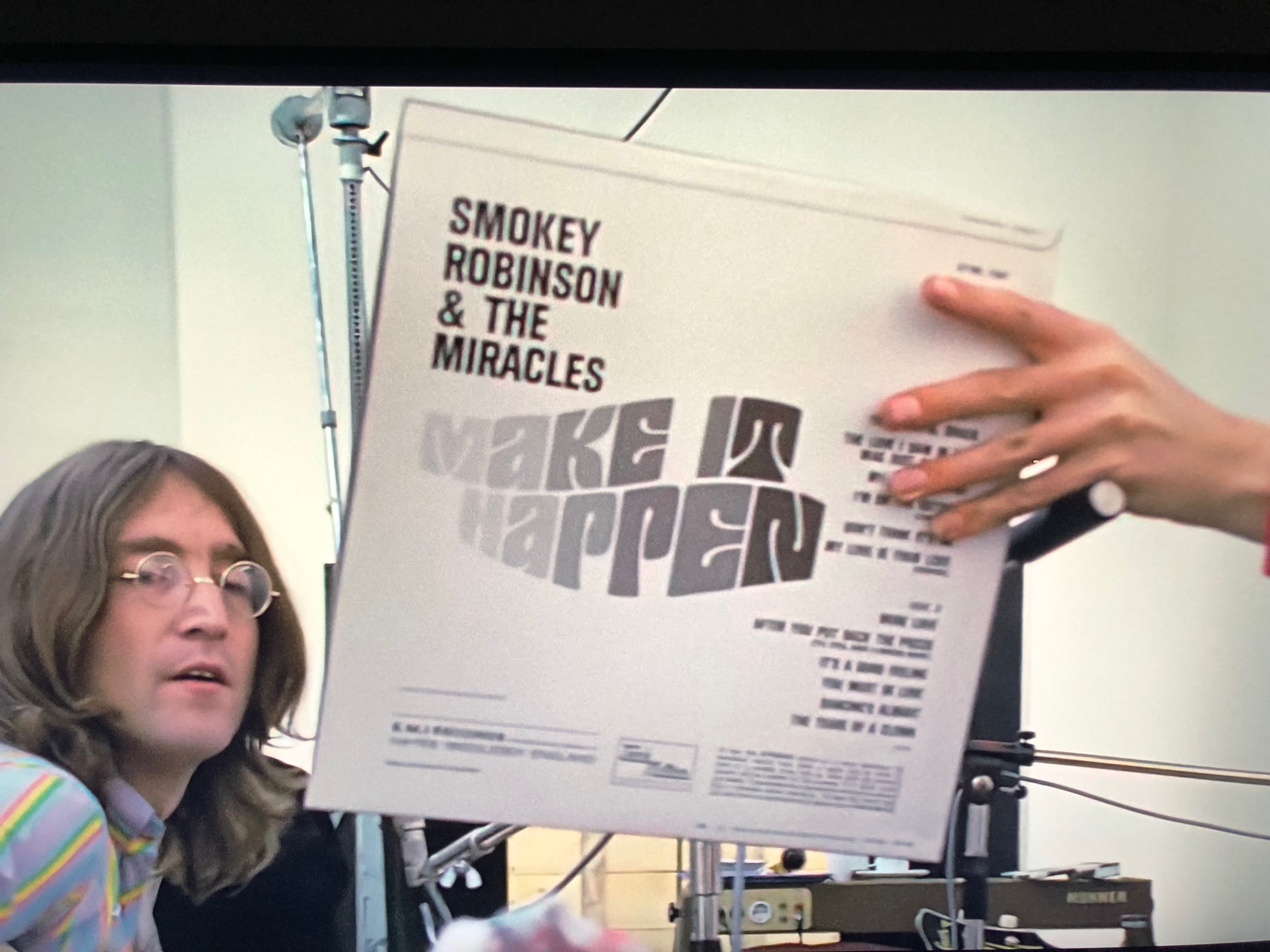
We say Smokey Robinson is one of George’s favourites because when he got a big package of records delivered during the filming of the Let It Be documentary it contained more Smokey Robinson and the Miracles, as these images from the recent Peter Jackson Get Back film clearly show:
These are (in order of appearance) the aforementioned Smokey Robinson and the Miracles Greatest Hits Volume 2, and also the album Make It Happen (from 1967):
Plus there’s copy of Away We A Go Go, from 1966. (You can see the rear cover of this album in the last Get Back photo above):
For another image of George with a different Miracles LP check out Part 18.
Jumping back a few years, we’ve been sent this image by reader and regular contributor Andrey:
The caption reads: ‘EMI House, Manchester Square, London, October 5 1965. According to Beatles Book #28 the group went to the West End headquarters of their record company to collect four Russian-made acoustic guitars and to be photographed playing them for the benefit of the factory where they were made.’
A stack of jazz records just happened to also make it into the image – and we can see a mono pressing of the 1962 Oscar Peterson Trio release The Sound of the Trio clearly in shot:
In this photo the Beatles look a bit tired and jet-lagged. But they’re still carrying records!
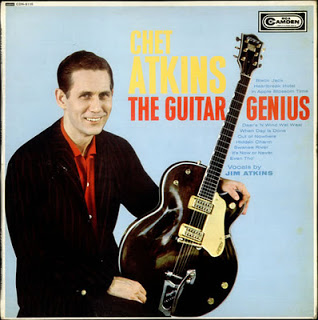
Back to George, and a meeting with the secretaries of the Beatle Fan Club to sort through some of the fan mail. He has some more records on his lap, the top one of which is another of his all-time favourites, Chet Atkins:
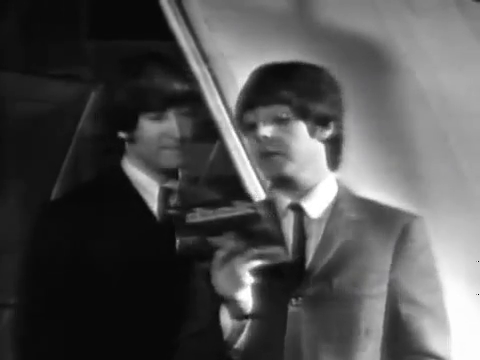
And to end this installment, a photograph of John Lennon and Paul McCartney holding a picture sleeve EP cover:
Why? Because it’s a screen shot from The Music of Lennon & McCartney, a British TV special honoring the Lennon–McCartney songwriting partnership. Produced by Granada Television it first went to air on 16 December, 1965.
During the show The Beatles perform originals, and artists from around the world perform cover versions of their songs. The two are just about to introduce French singer Dick Rivers:
Wikepedia says that Hervé Forneri, known professionally as Dick Rivers, was a French singer and actor who began performing in the early 1960s. He was an important figure in introducing rock and roll music in France. He was an admirer of Elvis Presley, who influenced both his singing and looks.
The judges wrote that The Lyrics was: “A work of art”; “a unique piece of publishing”; and a book that “belongs in a museum, not just our bookshelves.” They praised the two-volume set as a “fantastic visual diary”, singling out the original hand-written lyrics.
The book was supported by a free exhibition at the British Library and McCartney in Conversation at the Southbank Royal Festival Hall.
Publishers Allen Lane coordinated a global launch, simultaneously in 11 languages, attaining extensive broadsheet and radio coverage. Plus the book was released in multiple translations.
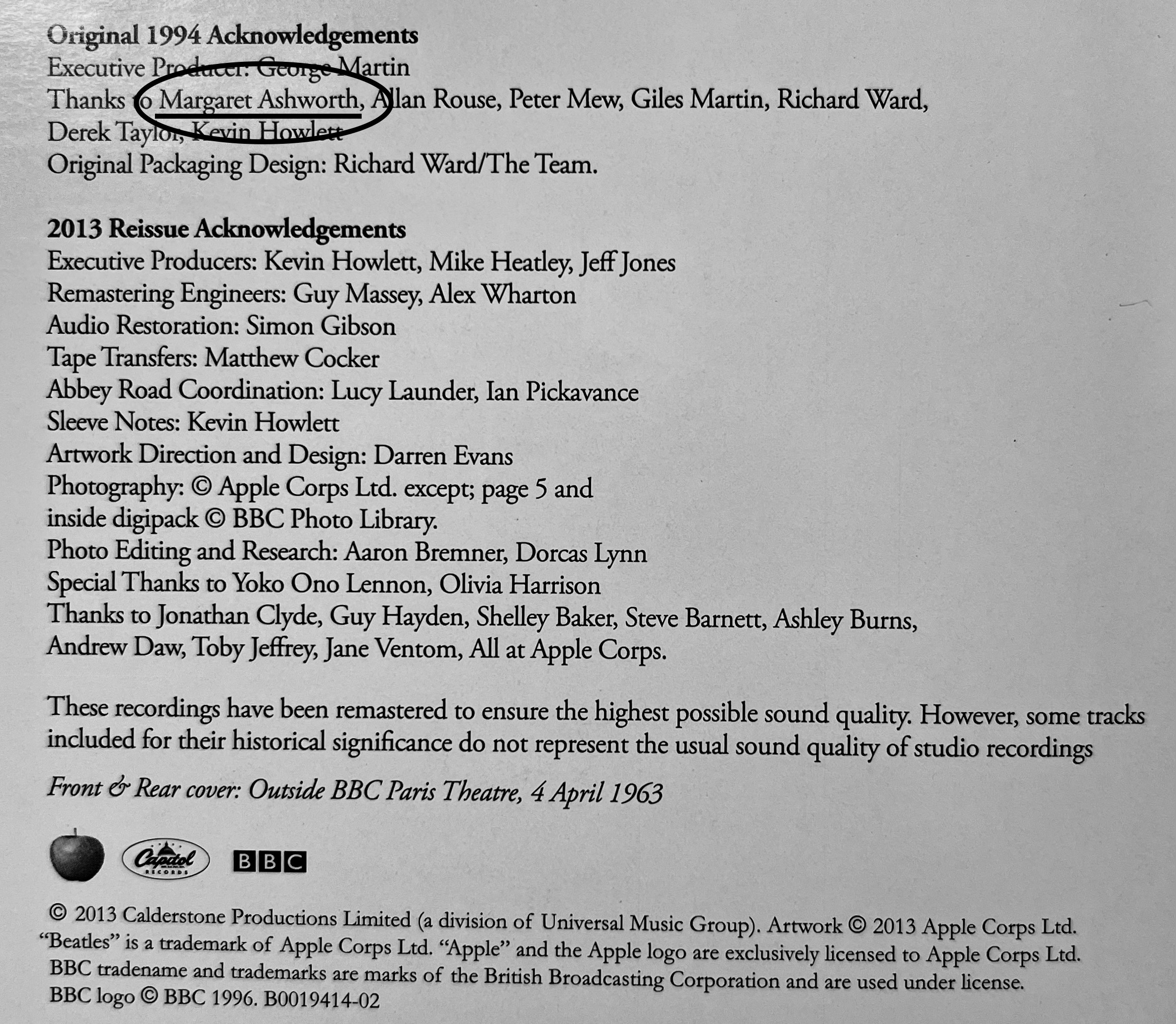
It’s reasonably well known in Beatle circles that when it came to compiling the 1994 album Live at the BBC (later re-issued in remastered form and accompanied by a second volume in 2013), Apple and EMI relied heavily on some previously unknown 1963 recordings made off the radio by a teenage fan named Margaret Ashworth.
Margaret was credited prominently in the liner notes of both. Here’s Volume 1:
And here are the credits for Volume 2:
Her name was there for all to see, and we knew she was the source of many songs and performances previously thought to be completely lost, or only available in very poor quality. But we didn’t really know the whole back story. She’s not even given a single mention in Kevin Howlett’s comprehensive book on the subject, The Beatles: the BBC Archives: 1962-1970.
Now, for the first time, Margaret Ashworth – a veteran journalist (now retired) who worked at the Daily Mail newspaper – has written extensively about just how she was able to come to the rescue of The Beatles and made a new release of their live radio performances possible.
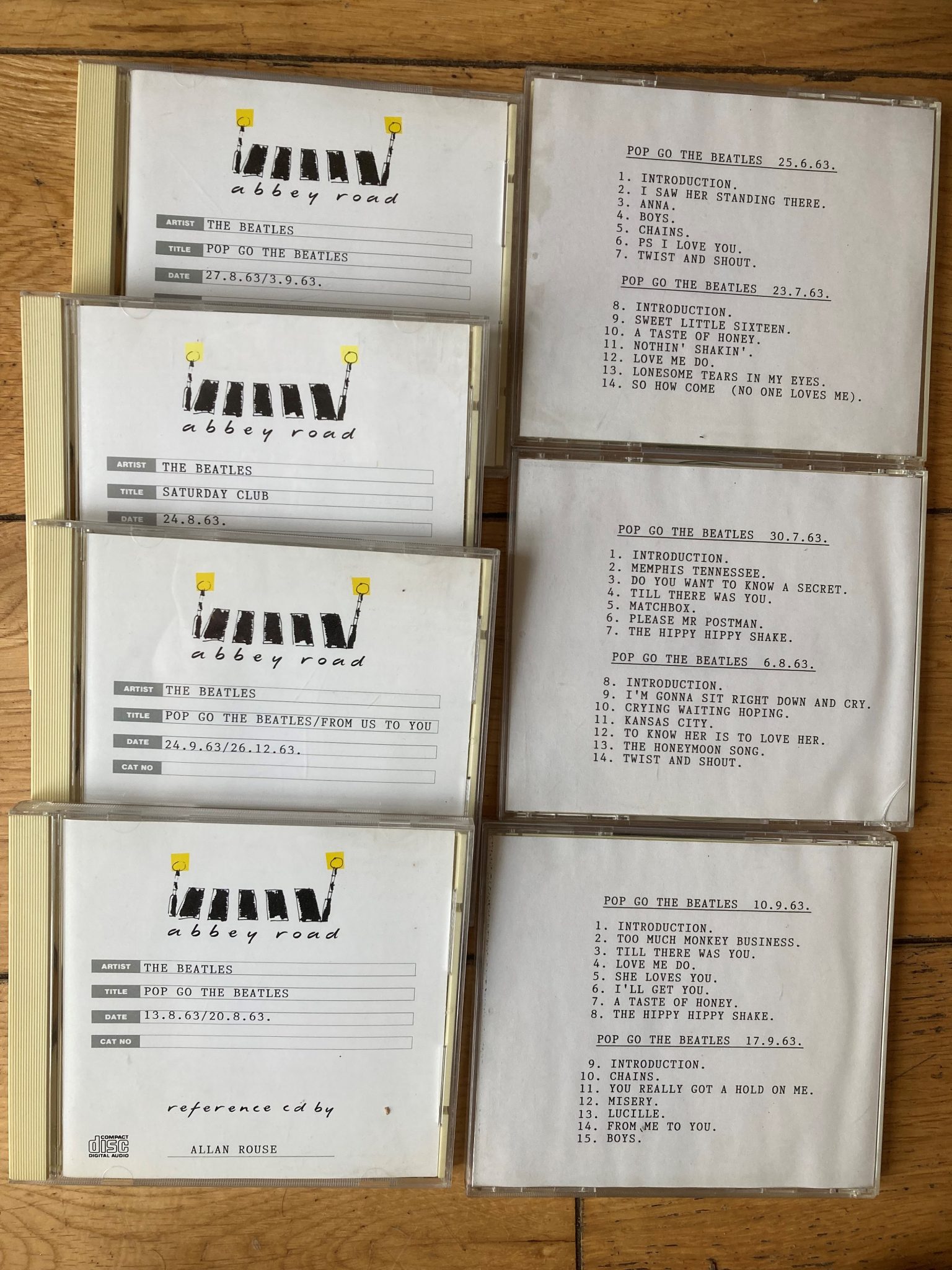
Realising that her homemade tapes were gold, the engineers at EMI immediately made seven sets of CDs of the full Pop Go The Beatles programs. They presented Margaret with one set:
When the album Live at the BBC was originally released in 1994, Margaret Ashworth says she could easily tell which of the tracks came from her tapes. Here’s one of them, ‘Ooh! My Soul’. It is the track the producers and engineers used to test the quality of her recordings when she first took them to the Abbey Road studios:
It’s so good to now have this story told in full, and by the Beatle fan who made it happen.
It has really been quite some time since we’ve done a Beatles With Records post.
Our Beatles With Records series is exactly that: photographs of the band actually holding those things they sold so many of: records and CDs. These can be Beatle discs, or discs by other artists.
The posts prompted quite a few readers to send in additional photographs, and also to do some amazing detective work on the sometimes mysterious records the Beatles are holding in photos. Sometimes the albums are easy to guess. Then there are others where you can only see a fragment of a cover, or the rear image of a sleeve, making it very difficult to identify – especially when the record is by an unrelated artist.
One recent photo to come to light is definitely in that latter camp. It comes from the recently released book by Paul McCartney’s brother, Mike McCartney (a.k.a. Mike McGear).
His book, published by Genesis Publications, is called Mike McCartney’s Early Liverpooland it contains some never-before-seen early photos of The Beatles, including this gorgeous one of John and Paul (and most probably George too, on the left). It is called Mathew Street, 1962 and hey are no doubt standing outside the famous Cavern Club:
This one had us intrigued. Paul is clearly looking at some 45’s, and John has under his arm what at first appears to be an LP of some kind. Further investigation though reveals it not to be a record but a bag containing a record from Liverpool’s NEMS record store. NEMS of course was owned by the family of their manager, Brian Epstein.
Wouldn’t it be great to know which LP John had purchased? What it is will probably never be known….
A couple of other items of interest have surfaced.
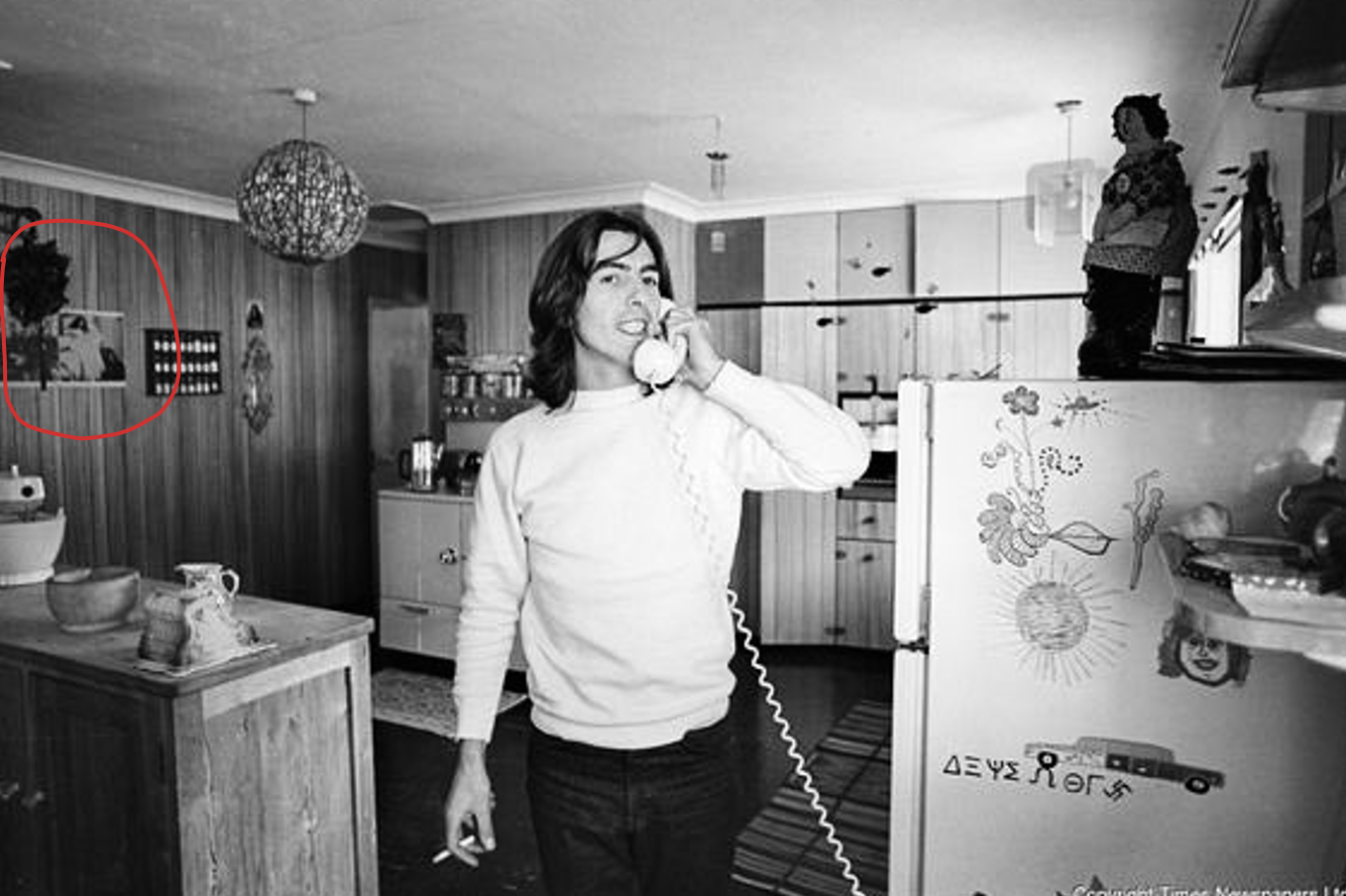
This one shows George Harrison in his kitchen at home at Kinfauns:
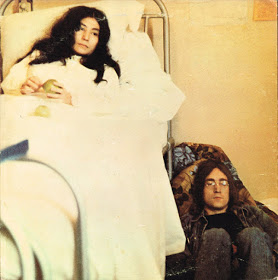
Quite interesting to see pinned up on the wall behind him a John Lennon/Yoko Ono album cover:
Here it is again, a different angle from the same photo shoot (click on image for a larger version):
It appears to be an album slick opened out containing the rear cover image as well:
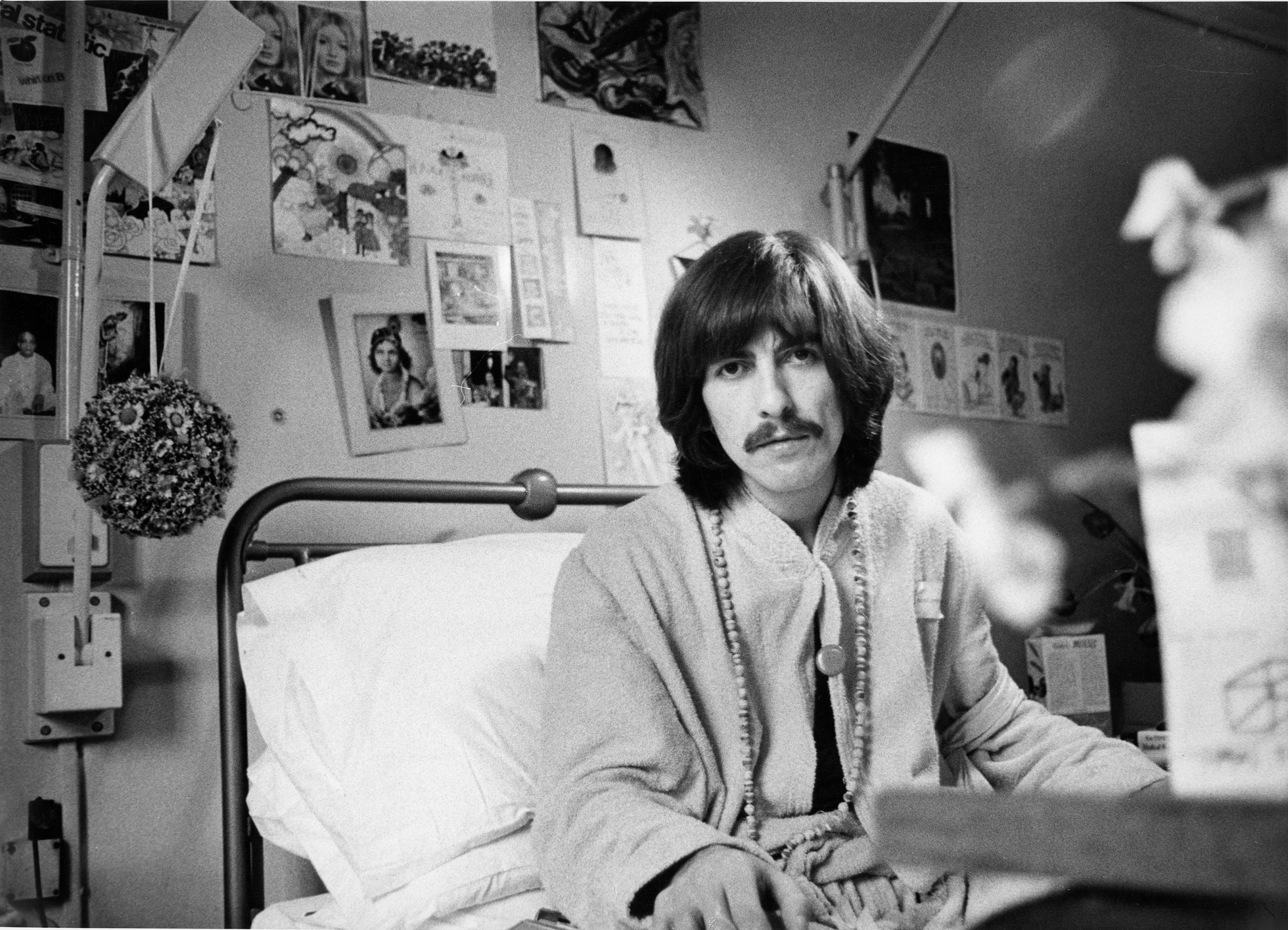
George seemed quite fond of putting up album covers, or elements of album covers, on his walls. If you look at the top left of this photo – taken in what seems to be a hospital ward – you can see two prints of the Linda Eastman photograph of Apple artist Mary Hopkin. That image was used for the front cover of the Hopkin LP Postcard:
(Turns out that George was at London’s University College Hospital, where he got his tonsils removed in February, 1969)
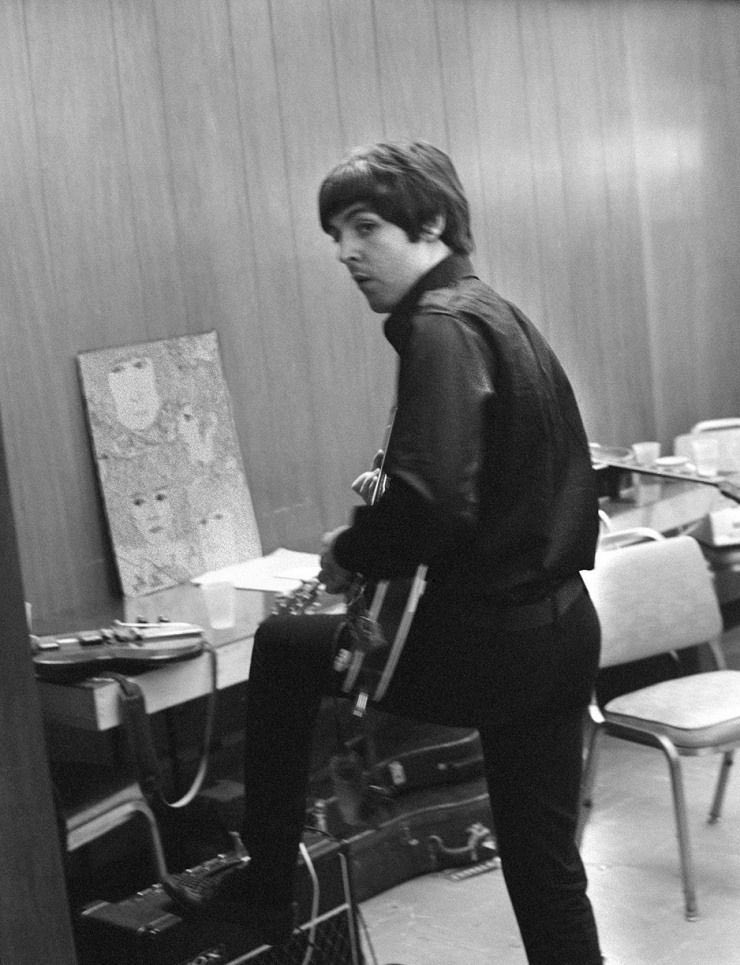
Here’s an image of Paul McCartney with what could be an early rendering of the Klaus Voormann cover for the BeatlesRevolver LP. Either that or an attempt by a fan to replicate Voormann’s amazing artwork:
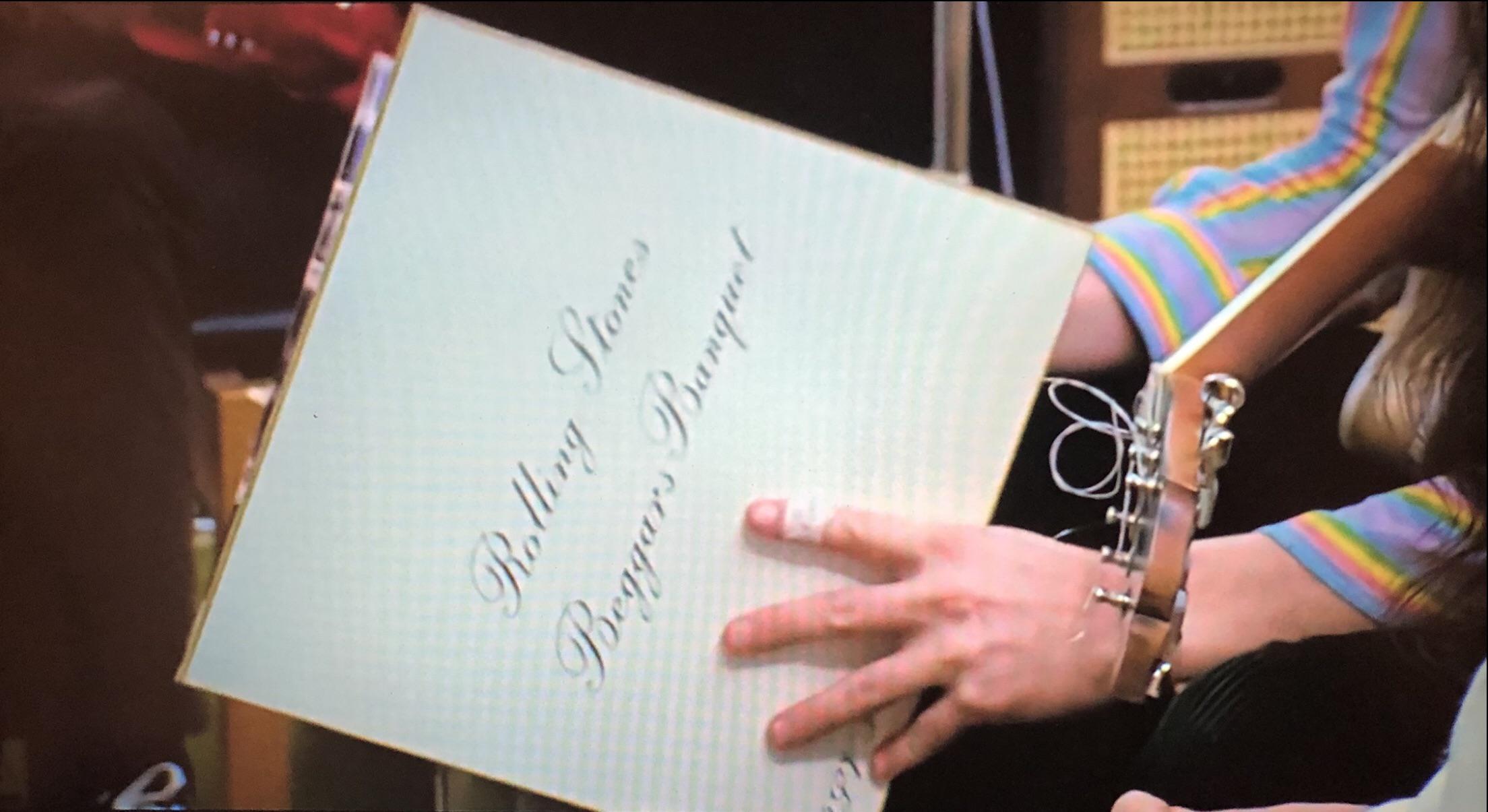
And finally, a still taken from the incredible Peter Jackson/Disney+ 3-part series Get Back on the making of the Let It Be album, this image of John Lennon taking a look at the latest Rolling Stones LP of the day:
See the other instalments of The Beatles With Records here.



























 Beatles Blog