Sometimes tip-offs about Beatle stuff come from the most unexpected places…
Beatlesblog is located in Australia, but it took an email from our friend and avid collector Andrey – based in Russia – to let us know about this magazine, out now in Australian newsagents.
Its the latest edition of Australian Guitar and, following Andrey’s email, we simply walked up to to the corner store and got a copy. Wouldn’t have known it was there otherwise!
As you can see, the mag has a major article (13 pages in all) called ‘The Ultimate Beatles Tone Guide’. In it they unpack how the band crafted their sound from the perspective of the instruments and the electronics used.
To do this writer Chris Gill examines 11 specific songs: ‘Please Please Me’, ‘A Hard Day’s Night’, ‘I Feel Fine’, ‘Ticket To Ride’, ‘Michelle’, ‘Taxman’, ‘Sgt. Pepper’s Lonely Hearts Club Band’, ‘Revolution’, ‘While My Guitar Gently Weeps’, Let It Be’, and ‘The End’.
Obviously, this article has been published previously in the US by parent magazine Guitar World (and you can read it here), but it’s nice to have a physical copy to flip through.
Being a guitar magazine the focus is entirely on the gear – the makes, model and year of manufacture, the amplifiers, studio speakers, etc. In some cases they even get right down to the likely strings used on the guitars to achieve a particular sound quality.
Gill acknowledges a big part of the challenge here is the great amount of sometimes conflicting information out there about these things. The Beatles themselves, their producer George Martin, and even engineers like Geoff Emerick, have offered over the years conflicting accounts. They even contradict themselves in some of their personal recollections.
So, its a tough ask to get this stuff right. Gill says that what the feature contains are his best efforts to determine the guitars, basses, amps and effects actually used. He admits it is not perfect and in many cases highly speculative (for example the amp used by John Lennon to record his solo on ‘The End’), but he reckons it is a good guideline for any guitarist wanting to replicate those magic sounds.
And yes, there’s a whole section on guitar string specifics. To quote: “Many guitar nerds note that perhaps the most important detail of replicating the Beatles’ tones after their guitars and amps is the types of strings that they used. It is generally believed that Harrison and Lennon used flatwound strings in the early years up until late 1965, just after the release of Rubber Soul. After that, from Revolver and beyond, they apparently switched to roundwound strings.” Check out the section on string theory here.
The feature ends with a short article called ‘Beatles Unplugged – A Guide to the Fab Four’s Acoustic Arsenal’. You can read that too online here:
The podcast, which is called McCartney: A Life in Lyrics, starts on September 20. It promises listeners a fly-on-the-wall opportunity to sit in on recordings of conversations made over many years between Paul McCartney and poet Paul Muldoon as they dissected the people, experiences, and art that inspired his songwriting.
The conversations between the two were a central part of their process in compiling the book The Lyrics: 1965 to the Present, released in hardback in 2021, and just about to be re-published in paperback form – with added chapters.
Over two seasons and 24 episodes the podcast will let us in on how that book came together. We’ll be able to hear what is described as “a combination master class, memoir, and an improvised journey with one of the most beloved figures in popular music”.
Each episode will focus on one song from McCartney’s catalog and will span early Beatles through to his solo work.
You can listen to a promo for the new podcast here:
For more background on how it all came about there’s also an interview in The Verge with Justin Richmond, Executive Producer of the podcast. It’s really interesting. “The idea for the podcast came through McCartney’s production team, from the person in charge of special projects. The sort of system that [McCartney and Muldoon] came up with to write [The Lyrics: 1956 to the Present] is that Muldoon turns up to McCartney’s house, turns on his phone, and records a conversation between the two of them. Eventually, the pandemic happened, lockdown, etc., and some stuff was delivered over Zoom.”
“My read on it is that after the stress of getting the book together was relieved, they were sort of realizing that they have hours of Paul McCartney being candid in a really special way. It’s not like this was expertly recorded in the studio. It’s not as if he was sitting down to be Paul McCartney of The Beatles to give an official interview about the band. These [recordings] really have the tenor of someone sitting down with a friend and having a leisurely chat about times past. And McCartney’s “times past” happens to be, for him, The Beatles and Wings and a litany of incredible solo work.”
Season One drops weekly starting September 20. It will feature twelve episodes examining ‘Eleanor Rigby’, ‘Back in the USSR’, ‘Let It Be’, ‘When Winter Comes’, ‘Penny Lane’, ‘Uncle Albert/Admiral Halsey’, ‘Here Today’, ‘Live and Let Die’, ‘Magical Mystery Tour’, ‘Jenny Wren’, ‘Too Many People’ and ‘Helter Skelter’.
Season Two will follow with an additional 12 episodes in February, 2024.
(If you don’t want to wait for each weekly episode and need to binge the whole series all at once you can subscribe to Pushkin+ to get access to all of Season One on September 20).
Whichever way you look at it the announcement overnight by Paul McCartney and Penguin Books that the paperback edition of his book The Lyrics: 1956 to the Present will contain seven additional song commentaries to those in the hardback edition from 2021 is a sneaky marketing ploy to get fans to buy additional copies of content they already own.
Yes, the paperback will have different cover art and will come in one volume (the hardback is split into two separate books), but still, to get McCartney’s thoughts and memories of those seven additional songs we’ll have to fork out yet again…..
The seven new song commentaries will be: ’Bluebird’ ’Day Tripper’ ’English Tea’ ‘Every Night’ ‘Hello, Goodbye’ ’Magical Mystery Tour’ ‘Step Inside Love’
Fans are already reacting to the news – and not in a good way:
“The old bonus track swindle. 😦 I’m sure people who bought the hardback get a free copy.”
“Next up: the expanded hard cover edition with the 7 additions as well as 3 additional additions. This is getting ridiculous.”
“Gotta love marketing. Extra songs for a new book edition, man. I have the hardcover. It’s beautiful. I’m good with what I have…No second bite of the apple from me.”
“I’m waiting for the limited edition cream paper, newspaper, blue paper, green paper, lambskin paper, pink paper, yellow paper, parchment paper, orange paper, purple paper, swirl paper, papyrus paper, 98 bright paper, rolling paper and black paper editions. Each with a unique and previously unreleased song write up! Collect them all!”
The paperback is scheduled for release on 7 November, and preorders are open now in the UK (Penguin) and in the USA (Norton).
Let’s get this straight up front. Luca Perasi’s Paul McCartney: Music Is Ideas – The Stories Behind the Songs (Vol.1) 1970-1989 is a big, weighty tome. It is way more book in real life than you might imagine from seeing it pictured on the web. At over 520 pages Music Is Ideas is thick and packed with tons of useful information. Its an obvious labour of love into which he’s poured an enormous amount of thought, hard work and creative effort.
Obviously Music Is Ideas serves as a very handy adjunct to McCartney’s own award-winning, two-volume set The Lyrics (published in 2021) which covers off a selection of just 154 songs from Paul’s earliest boyhood compositions, his Beatle days, some Wings songs, and solo work to the present day. Perasi’s book however extends and amplifies this with it’s aim (eventually in subsequent volumes) to detail absolutely every post-Beatle composition we know of. This first installment – Volume 1 – closely examines 296 released songs, plus a further 50 unreleased works. It should be said too that The Lyrics is a book Luca Perasi knows extremely well. It was he who officially co-authored the translation for the Italian market.
Music Is Ideas is also a natural partner to the terrific Allan Kozin and Adrian Sinclair release published just at the end of last year, The McCartney Legacy – Volume 1 1969-1973. While that work deals more with the day-to-day life of McCartney (and so far only goes up 1973), these two books together will provide the reader, collector, or anyone even vaguely interested in popular music and the process of songwriting with an in-depth examination of the life and work of one of our most important creative artists.
As mentioned, this latest book includes all the songs released by McCartney on album or as singles, plus side projects or songs written or co-written by him between 1970 and 1989. In other words, everything from McCartney to Flowers In The Dirt. That’s a total of 296 entries. This includes songs he didn’t write himself but has recorded (think Choba b CCCP), plus songs composed and recorded during the preparation of particular albums but maybe not released until much later. These are clustered together at appropriate points in the timeline so as not to be missed. In addition there are 50 completely unreleased songs detailed. There is also an index and a bibliography at the end which is always good to see.
Each entry deals with the story behind the song in detail: its inspiration, the demos that were recorded, as well as the studio recordings themselves. How were they made? Where was each song recorded? Are there alternative versions? And on which album or albums does the work appear?
As you read it becomes clear that Perasi tries to cover off five main aspects for each entry. He begins with an analysis of the songwriting technique employed by McCartney for the particular work – in other words how the song came into being in the first place, and by which means.
A second analysis is around the genre utilized. Paul McCartney’s vast catalogue ranges across experimental and rock’n’roll, to traditional music hall and classical. Over the years he’s dabbled in reggae, blues, folk, country, disco, children’s music and new wave, a huge array of influences – sometimes following but also often leading the way with avant-garde and electronic sounds. So, what are the influences? These are mentioned in each entry.
The third examination in each entry is how Paul worked in the studio to get the recording down. The Beatle years were a steep learning curve for him of discovering just what could be achieved in the studio and how to use the studio as an instrument in itself. So, what were the processes for each recording? These are touched on in each entry in the book.
Fourthly comes an accounting of the instrumentation used on each track. McCartney is well-known as a master of many instruments – not the least of which is his own voice. There is an in-depth look in each entry at who played what, and how. Specific attention is paid to the many vocal influences and techniques employed too. What is the style at play in any given song?
Lastly there’s consideration paid to the lyrics. What is the song about? How has it been written? What is McCartney’s main theme? Perasi breaks down each of the songs in an effort to understand and appreciate the poetry (and sometimes call out the doggerel!) for each entry.
Let’s take one example to illustrate for you what a typical entry might involve. A prime candidate is that quintessential McCartney song from the 1970s – ‘Silly Love Songs’.
This is entry 126 (on page 233) of Music is Ideas. Composition is credited to Paul and Linda. We learn in the first instance that the basic track was put down at Abbey Road Studios on January 16, 1976 with just guide vocals and piano from Paul and drums by Joe English being recorded. Overdubs were added during February. The engineer was Peter Henderson. A faster tempo version that is quite different appears on Give My Regards to Broad Street in 1984, there’s a live version on Wings Over America (1976), and its also appeared on the compilation albums Wings Greatest (1978), All The Best! (1987), Wingspan (2001), Pure McCartney (2016), and as a single in the The 7″ Singles Box (2022). Oh, and a demo alternate version appears on the 2014 release Wings At The Speed of Sound – Archive Collection. This demo is important as it clearly shows – which Perasi expands upon in his entry – that ‘Silly Love Songs’ was already a completely well-defined song. All the different melodies characteristic of the final version are in place. We also learn that, according to an unofficial source, McCartney had second thoughts about the initial arrangement and that a reggae version was tried out but put aside!
Then follows an in depth examination. ‘Silly Love Songs’, Parasi writes, is “…a prime example of McCartney’s polyphonic art, here using a contrapuntal technique, piling three different melodies on top of each other over the same chord pattern. The song….masterfully alternates between verses, chorus, bridge and instrumental breaks, while concentrating on a bass line that is technically simple but full of invention and which binds the whole track together….”
There’s then an explanation of how the song was arranged and how the horn and string arrangements (by Tony Dorsey) were added. Another interesting sidelight for me was that ‘Sha La La’, a hit for soul singer Al Green in 1974, was probably an inspiration: “The link between the two is clear in many respects, such as the horn and string arrangements as well as the melodic and jagged bass line.” True.
The single was a huge hit around the world, reaching number 1 on the Billboard charts in the US, and was also number 1 in Canada and in Ireland. In the UK it peaked at number 2. (Incidentally, it only got to number 20 here in Australia!)
And so similar information is provided for each of the 296 song entries. There’s also a mix of shorter and longer entries for the 50 unreleased tracks, making this book is a great companion as you listen to your Paul McCartney collection.
It all adds up to an intriguing mix of information that truly demonstrates that music is indeed about ideas, and that the prolific PaulMcCartney is never short of them.
Music Is Ideas – The Stories Behind the Songs (Vol.1) 1970-1989 is guaranteed to inform, stimulate, and lead to further exploration of the music.
We appear to be in something of an avalanche of Beatle books at the moment with lots of titles either out now, about to be released, or in the longer-term pipeline.
This is by Luca Perasi, whose previous work on McCartney was the highly-regarded Recording Sessions (1969-2013). Luca was also one of the two official Italian translators of the singer’s own book The Lyrics: 1956 to the Present, and last year he collaborated with MPL on the label details for McCartney’s epic The 7” Singles Box release. So, he knows his stuff. Keep an eye out for our review of his new book Paul McCartney: Music Is Ideas here soon.
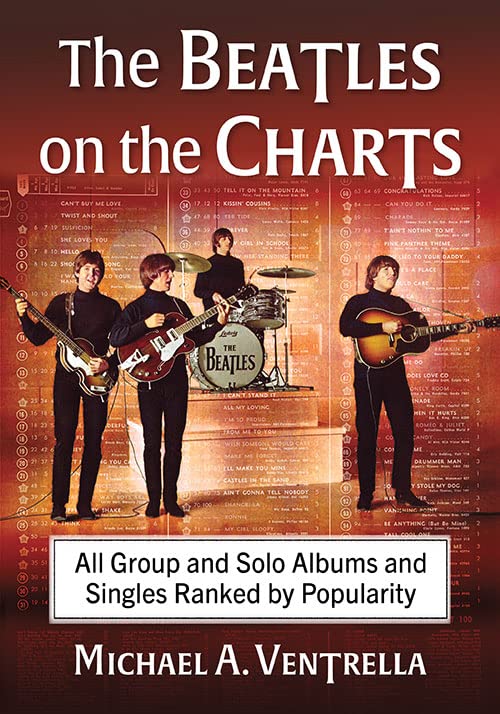
Another one we’ve been informed about but haven’t seen as yet is The Beatles On The Charts. This is by Michael Ventrella who has combed through nearly 60 years of Billboard to compile a list of every song and album that made an appearance in that fabled magazine’s music charts. The end result is an intriguing look at the band’s influence, including their solo efforts. Ventrella assigns points to the positions of each song and album in order to create a list ranging from the least successful to the most successful. Each entry includes a picture of the album cover or single sleeve, along with an analysis of the song or album. It looks like it’d make a great reference book to have in the library:
Looking ahead to June 13 there is 1964: Eyes of the Storm – Photographs and Reflections by Paul McCartney. This features a selection of Paul McCartney’s own photographs and memories from six of the key cities visited by The Beatles across the year 1964. It captures the craziness of the band’s intense life on the road as they steadily rose to fame, with many never-before-seen portraits and snapshots of John, George and Ringo.
As with McCartney’s 2021 book, The Lyrics: 1956 to the Present, a special, extremely limited boxed and cloth-bound edition (175 copies worldwide) of 1964: Eyes of the Storm has been made available as part of an effort to support independent booksellers. You’ll have to be fast and have deep pockets to secure one of these. Check out your local independent store to see if they scored a copy and how they intend to sell it:
In October comes Bruce Spizer’s latest installment in his Beatles Album Series and it is now available for pre-order. The book, the seventh to be published in the series, covers the albums Please Please Me and With The Beatles, as well as their associated singles and the American albums Introducing The Beatles and Meet The Beatles!
And finally worth noting, for release later in the year (November 14 to be precise), is the much-anticipated book by respected author Kenneth Womack on the life and times of famous Beatle roadie, friend, fixer, confidante, and sometimes co-composer, Mal Evans.
This one will be worth the wait as it is an authorised biography, with Womack being given access by the Evans estate to Mal’s diaries and the treasure trove of his vast, never before seen archive including hundreds of drawings and photographs, memorabilia and ephemera from inside the Beatle camp. Living the Beatles Legend: The Untold Story of Mal Evans is published by Harper Collins’ Dey Street Books. Pre-orders for are currently available on Amazon here. Tantalizingly, it will be followed in 2024 with a fully illustrated version. Cannot wait for that one.
Of course if you’re interested in Beatles books generally you must listen to The Beatles Books Podcast. It’s available on Apple Podcast, Spotify and Podbean, or wherever you get good podcasts. Host Joe Wisbey regularly chats to a wide variety of Beatle authors and writers and it is always interesting and informative as he seeks to discover what inspired them to add their particular entry into the 1000’s of books about The Beatles out there. Check it out.
The Record Store Day 2023 release list has just come out and come April 23 there’ll be at least three titles of interest to Beatle collectors.
Probably the most interesting and hard-to-get will be a re-imagining of John Lennon’sGimme Some Truth best-of compilation which is being re-issued as a boxset containing 9 x 10” white vinyl EPs. Each EP will feature four tracks. Only 500 copies of this will be produced, hence the ‘hard-to-get’ moniker….
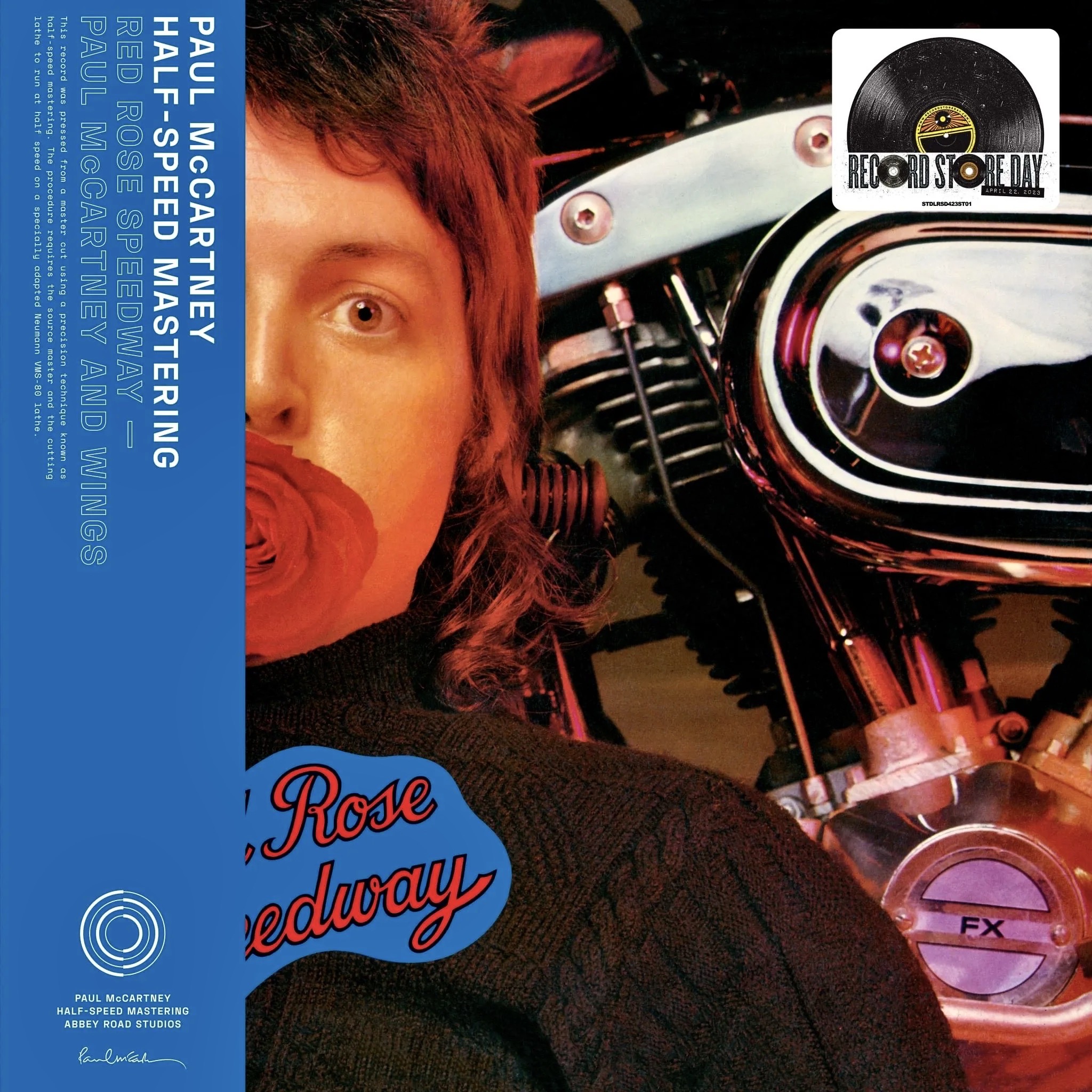
Next is the highly speculated 50th anniversary release of Paul McCartney’sRed Rose Speedway in limited edition, Half Speed Master vinyl form:
According to the RSD list there will be 5,000 pressed so this should be much easier to secure. It follows similar Half Speed Master editions of McCartney, Wings Wild Life and RAM.
Then there’s a re-issue of the 1981 Ringo Starr title Stop and Smell the Roses. This is being re-issued on vinyl as a 2LP with six bonus tracks for the first time. It will come in a gatefold with printed inner sleeves, original record labels and specialty color vinyl described as lava lamp effect clear red/white for LP1 and lava lamp effect clear red/pink for LP2. There are 2,500 copies being pressed.
Stop and Smell the Roses will also be issued on RSD as a CD (500 copies).
But wait, there is a George connection too. Dark Horse, the record label he started up (now run by son Dhani Harrison) is releasing not one but two LPs.
The first is by Stairsteps, a band originally signed to the label back in 1975. For Record Store Day 2023 we’ll see their 1976 album 2nd Resurrection re-issued on black vinyl. Billy Preston played synthesizer and served as co-producer alongside Robert Margouleff.
Dark Horse will also have a 20th Anniversary edition of the Joe Strummer & The Mescaleros album Streetcore as a limited edition pressing on white vinyl for RSD:
It’s not often we get to bring you news relating to The Beatles directly from here (down under in Australia) – but there is some today.
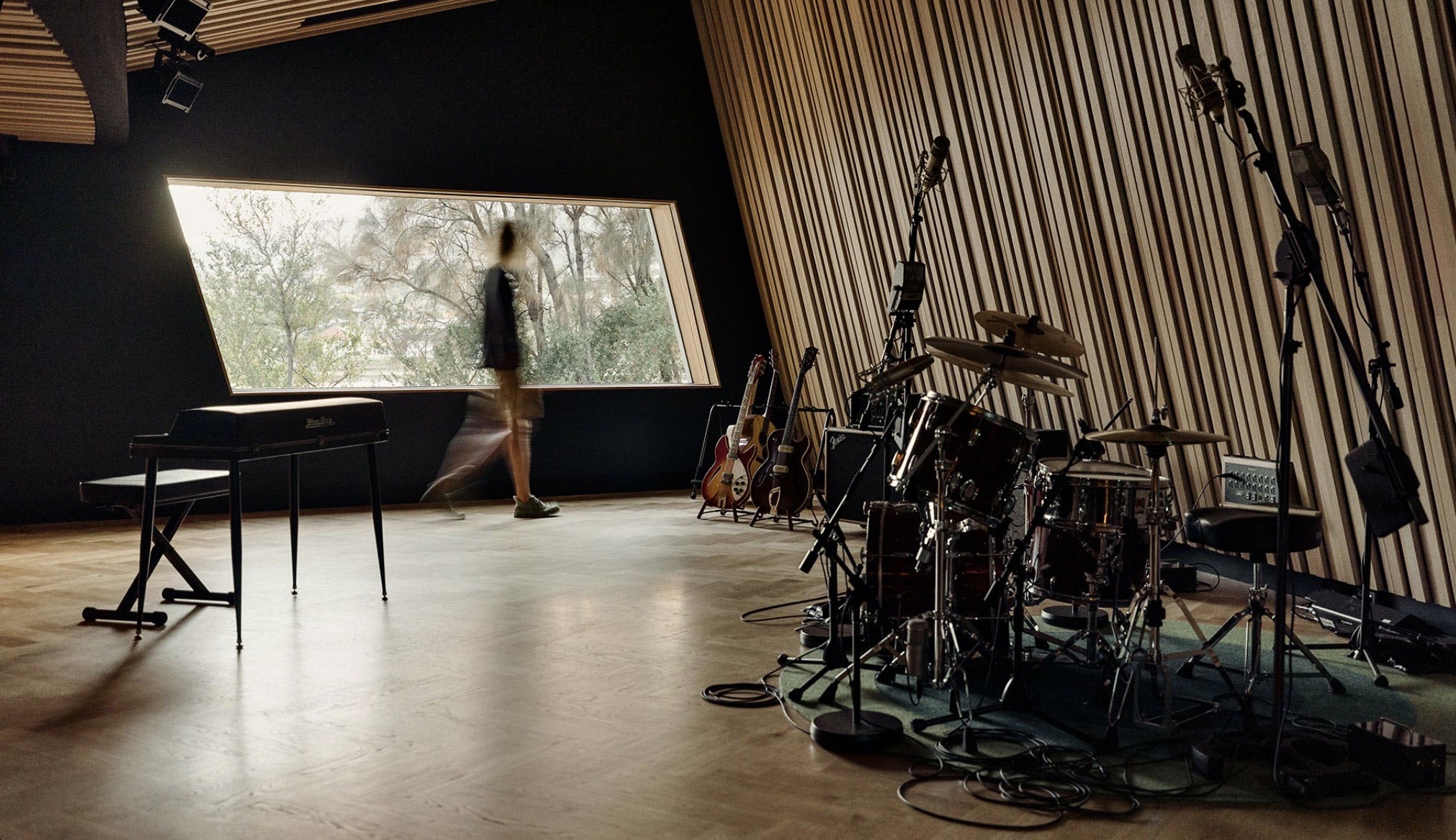
It’s been announced that an original REDD.17 mixing console, used to record and mix music at the famous Abbey Road Studios studios in London, is now the centrepiece of a brand new new recording studio at the amazing Museum of New and Old Art (MONA) located just outside Hobart, Tasmania.
The vintage console, one of only four ever built, was one of those used to mix several Beatle albums. It is now part of Frying Pan Studios on the grounds of the museum, and has become the first working recording studio housed by a museum in Australia.
The console was purchased back in 2014 by Australian businessman David Roper. He started discussions with MONA’s artistic director of music (and Violent Femmes bassist) Brian Ritchie about the studio-in-a-museum idea. They took it to flamboyant MONA founder David Walsh who liked the concept and funded the creation of Frying Pan Studios, so named because it sits opposite Frying Pan Island right next to the museum and the beautiful Derwent River.
Frying Pan is a working studio and so it’s bookable facility. You can find more details here. Maybe you’d like to record your own album using the very same mixing desk that John, Paul, George and Ringo used!
You can also visit the studio as part of your ticketed entry into MONA and, if you time it right, actually see musicians at work. It does look like an incredible place to work and create:
Frying Pan Studios have built a great interactive website that gives you more on the history, the facilities, and the amazing location.
You can also check out this article from the Australian Broadcasting Corporation (ABC) for more.
Is it just us who completely missed this, or did Dark Horse Records surreptitiously slip an additional title into Record Store Day Black Friday last Friday?
We’re pretty sure when we published this heads-up post back in September detailing which records might be of interest to Beatle completists, this listing definitely wasn’t there:
But when we looked on 25 November, there it was: a Joe Strummer LP Live at Music Millennium, 3600 copies, on the Dark Horse label:
This is a soundboard recording of Strummer’s solo acoustic in-store performance at a record store called Music Millennium in Portland, Oregon on November 2, 1999. It is getting its first ever release for RSD Black Friday and features the songs “Junco Partner,” “X-Ray Style” “Island Hopping,” “The Road to Rock N Roll,” and “Trash City.” The record continues the ongoing celebration this year of what would have been Joe Strummer’s 70th birthday.
While on the subject of Dark Horse, their other title for RSD, Dark Horse Records: The Best of 1974-1977, looks like a great collection:
Side A 1. Ravi Shankar – I Am Missing You 2. Ravi Shankar – Dispute & Violence 3. Splinter – Costafine Town 4. Splinter – Lonely Man 5. Attitudes – Ain’t Love Enough 6. Attitudes – Sweet Summer Music
Side B 1. Stairsteps – From Us To You 2. Stairsteps – Time 3. Keni Burke – Give All You Can Give 4. Henry McCullough – Lord Knows 5. Henry McCullough – Mind Your Own Business 6. Jiva – Take My Love
One of our long-time readers and avid Beatles and Beatle-related collector – see his selection of McCartney III variations for example! – has sent us this photo with the simple caption:
“Dark Horse Records: Best of 1974-1977 THE HARD WAY”
Last year saw the release of the lavish Let It Be box set. It celebrated the final Beatle LP, their swansong after a ten-year run as the biggest band in the world. The box set was accompanied by Peter Jackson’s extended 8-hour documentary Get Back, detailing the creation of the album. Despite the fact that Let It Be had been recorded more than a year earlier, its May 1970 release has forever seen it associated with the news that The Beatles were to continue no longer.
However, with an organisation as tight and complicated as The Beatles (along with their company Apple Records), things weren’t destined to cleanly end for them overnight.
It would take until the close of 1974 before all four members had signed the contracts that dissolved their immense, famous and complex partnership.
This, argues author Terry Wilson, makes the period from 1970 to 1974 a “second phase” for the band. Despite each member pursuing solo careers, technically they were still The Beatles and this continued on across that four-year span. As individuals they were tied together legally and financially. And they worked together collaboratively on many solo and other projects.
Wilson’s book is called Four Sides of the Circle. In it he details this often overlooked “second half” in the history of the band. It was an era of huge creativity and output. An era that gave us absolute standout releases like Lennon’sJohn Lennon/Plastic Ono Band and Imagine LPs, McCartney’sRAM and Band on the Run, Harrison’s All Things Must Pass, and Starr’sRingo, along with a myriad of other great and sometimes lesser-known songs and recordings.
These happened because band member collaborations continued in a variety of forms throughout this distinct “Phase II”. Their paths inevitably crossed both in and out of the studio despite the huge dissolution process looming over them.
Four Sides Of The Circle uses a very accessible song-by-song format, stepping through (in chronological order) all the formal recordings the individual Beatles made between1970-1974. It actually begins slightly earlier with John Lennon’s ‘Give Peace A Chance’ from June 1969, and concludes with Wings ‘Love In Song’, recorded in November, 1974. Every song – released and unreleased – has production details, recording location, who played what and (where applicable) the US and UK release dates. The song is then discussed by Wilson and critiqued with an appreciative eye. Each song is given a context with a clear emphasis on the music being made. This detailed and sequenced approach presents a true chronology of the period for the first time.
This is a book with something for even the most well-informed Beatle fan. Wilson is comprehensive and knowledgeable. There’s great detail here. In many ways he takes quite a scholarly approach – but the research never gets in the way of making Four Sides Of The Circle very readable. It finally completes the fascinating, long and winding story that was the Beatles. A story where – right to the last – they remained at the top of their game.
As Wilson writes on the final page of his book: “The legal conclusion of the Beatles technically occurred on 9 January 1975, when McCartney’s four-year-old case was settled, the completed paperwork having been sent back to London for the court to make its formal declaration. A cursory glance at the current edition of Billboard shows that on this day, Lennon was at 47 on the singles chart with ‘#9 Dream’; Harrison was at 16 with ‘Dark Horse’; Starr was at 7 with ‘Only You’ and McCartney was at 4 with ‘Junior’s Farm’. Appropriately, Lennon and McCartney were at number 1, courtesy of Elton John’s version of ‘Lucy In The Sky With Diamonds’ on which Lennon sang and played.”
“They ended at the very top.”
Four Sides of the Circle is a great read and a fantastic reference book. Not only does it contain extensive background and historic notes on each song, in the appendices there’s a complete song list, record release details (complete with US and UK chart positions), a bibliography, and what we always like to see in books like this: an Index. It is the sort of book you can dip in and out of endlessly. Here’s the blurb on the rear cover:
At over 420 pages Four Sides of the Circle is very reasonably priced. You can find it on Amazon Australia, Amazon US and on the Amazon UK site as well. The US and UK sites also have a “Look Inside” feature so you can check out sections of the book in more detail. It will give you an idea of the format and content. You won’t be disappointed.
To celebrate the 20th anniversary of the Concert for George event at London’s Royal Albert Hall on November 29 2002, the Harrison Estate, film distribution company Abramorama, and Craft Recordings have announced a global theatrical screening of the film of the same name.
The Concert for George is to be shown – for one night only – in select theatres around the world on November 29, 2022:
First released in 2003, the GRAMMY®-winning concert film captures the concert event which celebrated in spectacular style the life and music of George Harrison. It features performances by Eric Clapton, Paul McCartney, Tom Petty, Ravi Shankar, Ringo Starr, Billy Preston and many others.
You now have the opportunity to experience the concert on the big screen in immersive Dolby Atmos sound for the first time – newly remastered by GRAMMY-winning engineer Paul Hicks. The anniversary screenings will also feature a brand-new introduction by Olivia and Dhani Harrison.
Paul Hicks has also produced a new Dolby Atmos mix for the film’s accompanying Concert for George soundtrack album – available now on digital platforms. Listen here.
Certified 8 x Platinum by the RIAA, the acclaimed 27-track album is also still available in a variety of existing physical formats including a 180-gram 4-LP box set; 2-CD/2-DVD and 2-CD/2-Blu-Ray box set; and a 2-CD package. Order here.
This is a really special film of what was an amazing, star-studded tribute to George filled with top performances of his songs. It would be well worth seeing again on the big screen, and with great sound.












 Beatles Blog