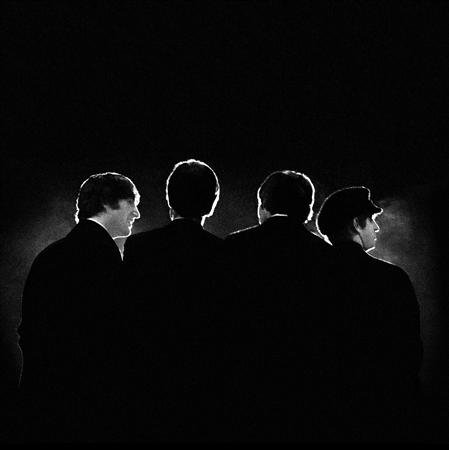
The Beatles are up for the fight against music pirates. The surviving members of the band, and the estates of the late members, have pledged support for the anti-piracy campaign Music Matters by sanctioning a special animated short film featuring a selection of original Beatles music.
Tag Archives: Ringo Starr
The Beatles With Records – Part Two
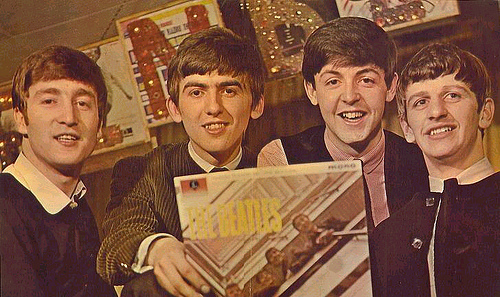
Since my earlier post about the Beatles being photographed actually holding the things they sold so many of – LP and single records – a few more photos have come to light. This first one is a very early publicity shot of the band with a copy of their very first album for Parlophone Records – from 1963 “Please Please Me“:
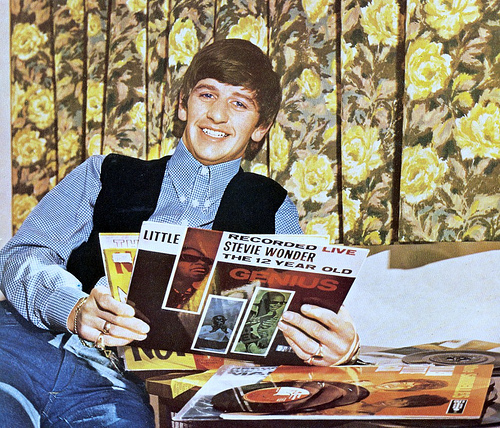
Trawling the web I came across a great photo of an obviously happy Ringo Starr with a pile of LPs and singles:
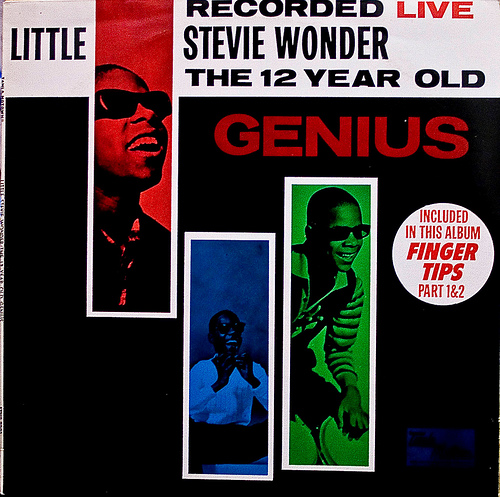
Here you can clearly see Ringo holding the Motown Record “Little Stevie Wonder – The 12 Year Old Genius” (from 1963):
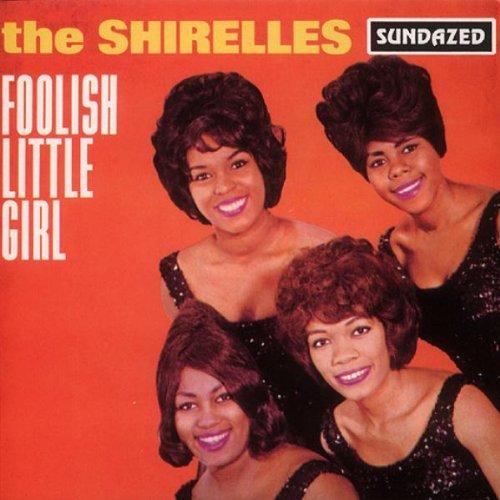
He’s also got a copy of The Shirelles “Foolish Little Girl“, which again dates from 1963 leading to the conclusion that this photograph was taken in that year. The record is lying down, just near Ringo’s left hand:
And on top of that LP are a couple of 45 rpm singles. Its impossible to make out the title of the one we can see, but you can clearly make out the distinctive red and white label of Top Rank records. I wonder if it’s also The Shirelles? In Britain they were released on Top Rank – so it could very possibly be a copy of “Baby Its You“, a song the Shirelles recorded in 1961 and which the Beatles themselves covered on “Please Please Me“:
I’ve also found a photograph of Ringo with wife Maureen. They’re sitting at home in a flat they rented for some time in London’s Montague Square. Behind Ringo you can see on the shelf quite a large collection of LP’s, and if I’m nor mistaken Maureen is sitting on what, for the times, would have been quite a sophisticated “radiogram” or record player:
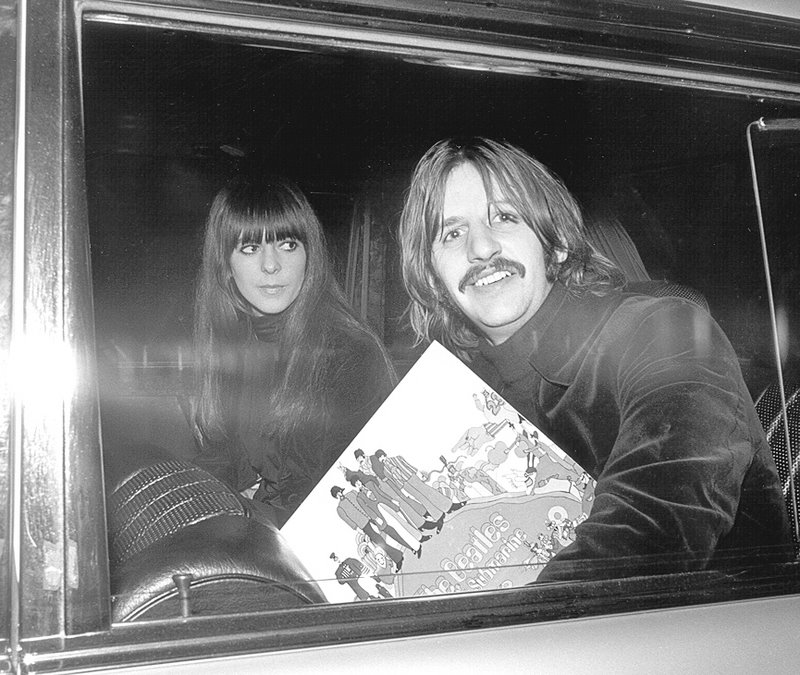
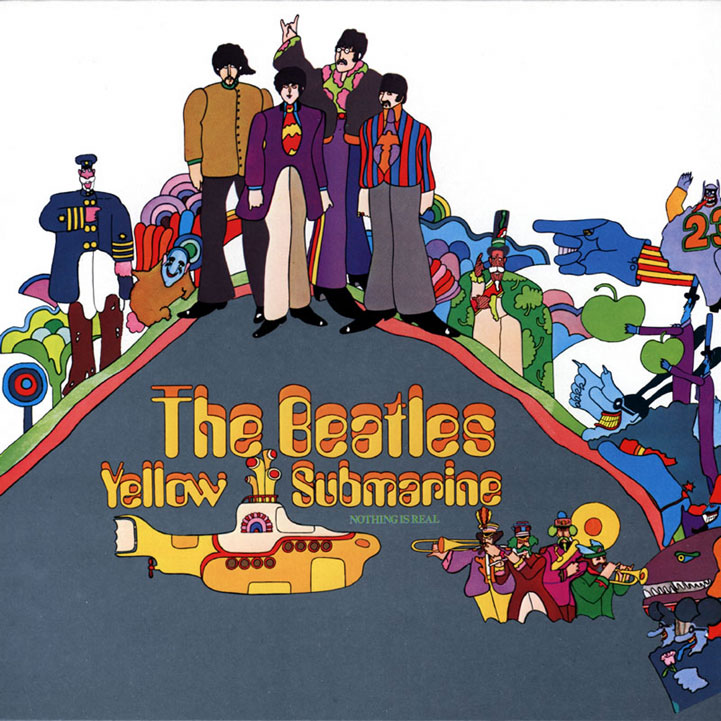
Here’s another of Ringo, once again with Maureen, clutching a copy of the Beatles “Yellow Submarine” LP:
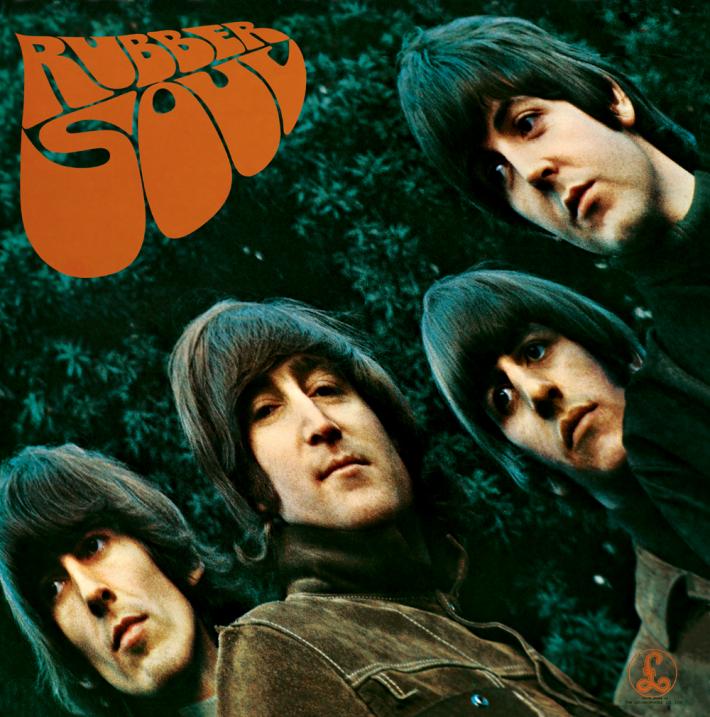
I had a a photo sent to me after the earlier blog post. It’s Paul with a copy of 1965’s “Rubber Soul“:
George Harrison features on the web photographed with records, some with easily identifiable discs and some not. This one is pretty easy to see. Its a lucky fan getting an autographed copy of “Help“:
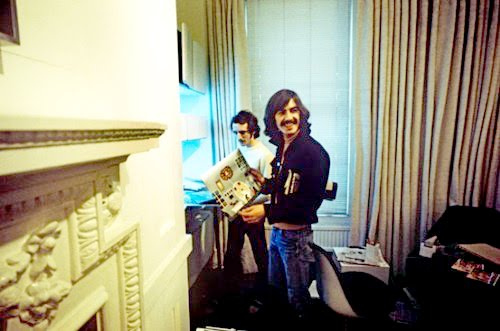
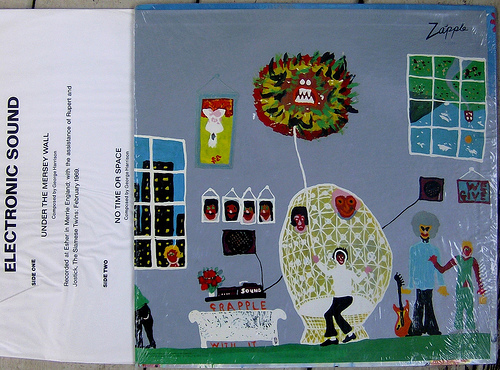
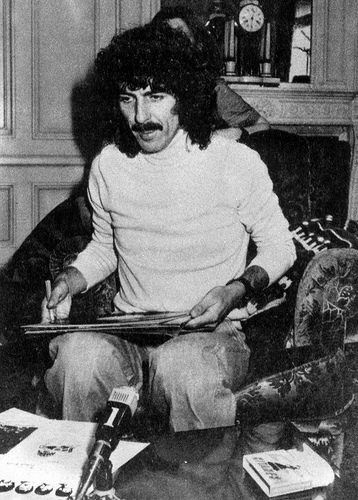
Here’s George again, this time a shot taken in what looks to be the Apple offices. It’s him holding a copy of his second solo outing “Electronic Sound“, released on the Zapple label:
You can clearly see the rear artwork for the LP in the photo above. Below is a shot of the back cover of the LP:
And here’s another one of George again signing albums, but this time its very difficult to see just what they are:
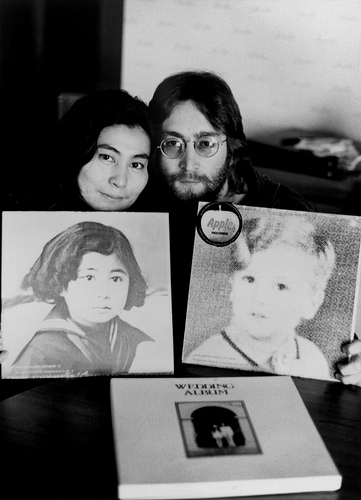
In 1970 John and Yoko posed for some photographs to publicise their new records. John had “John Lennon/Plastic Ono Band”, and Yoko had “Yoko Ono/Plastic Ono Band”. Both titles, on Apple Records, were released simultaneously. The front covers were almost identical, but the rear artwork of Yoko’s album showed her as a young girl, while John’s showed him as a young boy:
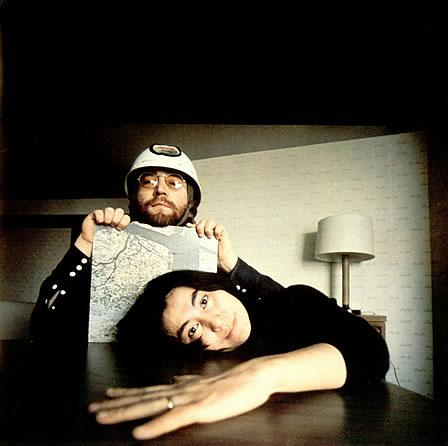
In the photo is also “The Wedding Album” box set, which came out in 1969. The photo below is taken at the same session:
As I said, the front cover artwork of these two LP’s is difficult to tell apart. “John Lennon/Plastic Ono Band” has John leaning against Yoko:
While “Yoko Ono/Plastic Ono Band” has Yoko leaning against John:
Very subtle.
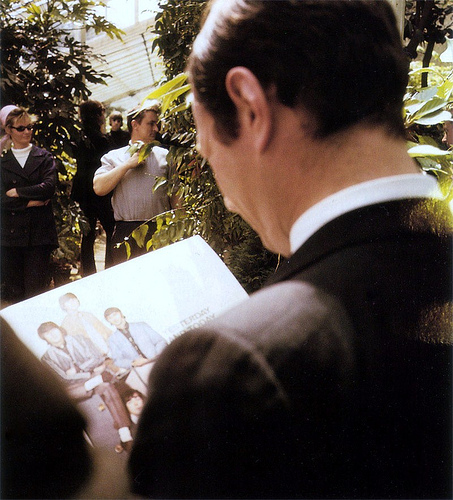
Finally, a photograph of Beatles’ manager Brian Epstein. He’s holding a copy of the controversial 1966 US Capitol Records release “Yesterday and Today“. This is the famous “Butcher Cover” LP. Maybe he’s contemplating the new photograph that Capitol was forced to paste over all the original issues of the album:
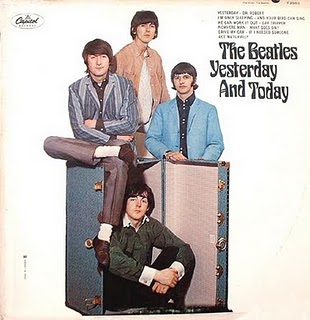
This is the more acceptable “trunk” cover shot that Capitol put on over the top of the original artwork:
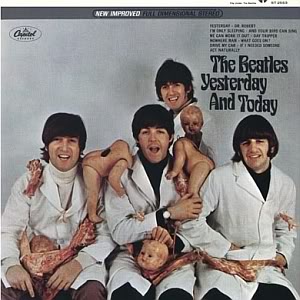
And this is what it replaced:
The interesting thing about the Epstein photograph is that what he is holding appears to be an early mock-up of the replacement artwork. If you look closely there is no song list at the top and the font for the words “Yesterday and Today” is different to that used on the final version. Interesting.
Don’t forget, if you have any other photographs of the Beatles actually listening to or holding singles or LP’s you can send them to me at: beatlesblogger@gmail.com
You can see the other parts in “The Beatles with Records” series here: Parts 1, 3, 4, 5 , 6, 7 , 8, 9 , 10 , 11, 12, 13, 14, 15, 16 and 17.
Thinking About Abbey Road Studios at 80
I stumbled today upon an article on (of all places) the computer/gadget specialist site CNet. It is about the famed EMI Abbey Road studios in St. John’s Wood, London – the site of so much fantastic recorded music including just about all the songs recorded, in one way or another, by the Beatles. The studios have just turned 80 years old and it got me thinking about what an important role this particular pile of bricks and mortar on a nondescript street has played in the history of popular and classical music – not the least of which is the music of the the Beatles.
If George Martin is often referred to as “the fifth Beatle” then surely Abbey Road could be regarded as one of the instruments they played – with as much importance to the Beatles sound as the Gibson acoustics, the Gretsch and Epiphone electrics, the Ludwig drums, and the famous Hofner bass.
The CNet article has some very interesting observations made during a recent tour of the famous building and it’s numerous rooms – so many of which are associated with Beatles tracks. You have got to scroll through the thirty photographs taken during CNet’s visit. Its a terrific tour with some great shots for both Beatles fans and technical nerds alike.
The studio itself has a website which is worth a visit every now and again to catch up on their news – one of the latest of which is the remastering of the Beatles “Anthology” series for digital download.
So much happened at this one address – including the Beatles themselves honoring their home-away-from-home with an album bearing the studio’s name.
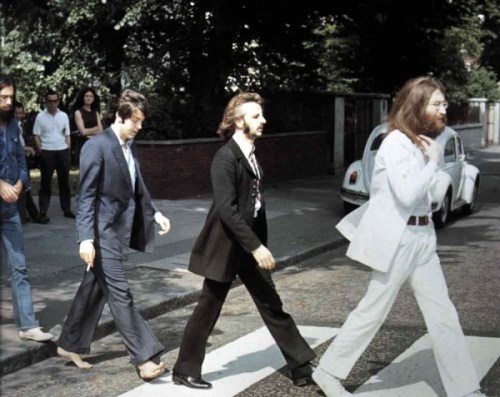
Then there was the heritage listing for that famous zebra crossing out the front….and the zebra crossing web cam, now complete with live street sounds. Its no longer in exactly the same spot as the photo on the front of the “Abbey Road” album having been moved down the road a bit from the studios – but countless fans still come each day, month, and year to be photographed striding across it.
Happy 80th birthday Abbey Road Studios. Here’s to 80 more years.
The Beatles Forever

Nicholas Schaffner wrote this book in 1977, and I gather from what I’m reading on the web that it was, in it’s time, something of a Beatles “bible” for readers back then. So far this book has eluded me – so its good to have an original paperback copy now in the collection.
“The Beatles Forever” has subsequently been reprinted numerous times and the current cover looks like this. But the copy I found last weekend in an old-wares/antiques/records and second-hand book shop has the original cover above. This is a paperback copy.
It is genuinely one of the first really comprehensive survey’s of the band’s output in terms of their record releases, rarities and memorabilia – all accompanied by fairly detailed text describing the history of the Beatles and giving the context in which records were released and the collectable nature of a wide range of Beatles items. There are extensive photographs of the band as well as photos of albums, singles and memorabilia – but all in black and white. I won’t go into a detailed analysis of the contents because this has already been done by a range of writers who have reviewed and critiqued “The Beatles Forever”. Probably the most comprehensive is by Donald Sauter – who has written extensively on his Beatles collection and reminiscences from his youth. His article also contains a small selection of the many photos from the book. There is another interesting page on the book here.
Its a handy reference book to have in the collection – even though it came out more than 30 years ago. It still has lots of information and insights.
Previously Unseen Beatles Photographs
The fine art auctioneers Christie’s in New York will next month auction some pretty impressive and previously unseen Beatles photographs from 1964.
They come from a collection of photos of the group shot by photographer Mike Mitchell. At age 18 he was at the Washington Coliseum in Washington, D.C. for the Beatle’s first US concert, two days after their historic Ed Sullivan appearance.
Christie’s is calling the event “The Beatles Illuminated: The Discovered Works of Mike Mitchell“. Their website says it’s:
“….a sale comprised of nearly 50 lots of unpublished and never-before-seen photographs of the Beatles’ first hysteria-inducing visits to America in 1964. Shot in black and white by photographer Mike Mitchell when he was just 18 years old, the images have been filed away for nearly fifty years. The complete rediscovered collection is expected to realize in the region of $100,000.
Over eight thousand fans packed into the Washington Coliseum on February 11th, 1964 and they were treated to the Beatles at their very best. The Washington Coliseum was not only their first American concert but also by far the largest venue in which the Beatles had ever played. Its unique setup – it was often used for boxing matches – meant that the Beatles were surrounded on all sides by an adoring, cheering audience. The Beatles were clearly delighted and having a great time on stage, sharing all of the enthusiasm of the crowd. Here they were, performing in America, the land of their musical heroes and cultural icons, the home of Elvis and Chuck Berry – who’s “Roll Over Beethoven” was chosen by the Beatles to begin the show – and Little Richard, who’s “Long Tall Sally” was chosen to end it. The concert given at the Washington Coliseum was part of a defining moment in the Beatles’ career, and it remains both an important event and a notable place in their story. And Mike Mitchell was there to capture it.”
Yahoo has quite a nice photo gallery here. There’s an absolute ripper shot of Ringo in full flight and absolutley enjoying himself:
Tittenhurst Park
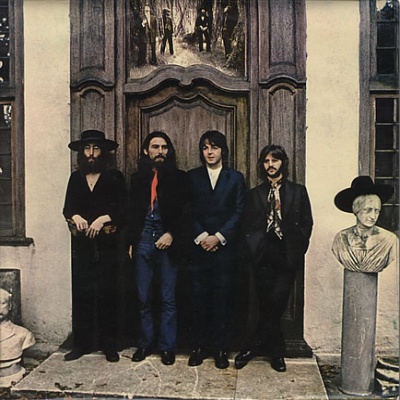
Stumbled upon an interesting article on the BBC website about John Lennon’s former home Tittenhurst Park near Ascot, Berkshire in England. It reminded me how much it has formed a part of the imagery surrounding record covers in my collection, and probably in yours. These albums, along with videos and publicity shots taken at Tittenhurst, have gone into the collective consciousness. Fans will know of this mansion house because although Lennon and Yoko Ono only lived there for around two years it featured in many a photo session, song video and documentary about John Lennon and the Beatles. There were in fact a huge number of photographs taken there – probably the most famous being the front and rear cover images for the Beatles best-of album known variously as The Beatles Again/Hey Jude (released in 1970 in the USA), and as Hey Jude (released in 1979 in the UK):
This image, also taken at the house, was used for the rear cover:
The next most famous images from Tittenhurst Park (which by the way is on London Road at a place called Sunningdale – one blogger has dedicated an entire blog to the house) came about when Lennon recorded his Imagine album there in 1971. When the song ‘Imagine’ was released as a single it was accompanied by this now legendary video which begins with John and Yoko walking through the fog-filled extensive grounds of Tittenhurst, and ends in an all-white main room inside the house:
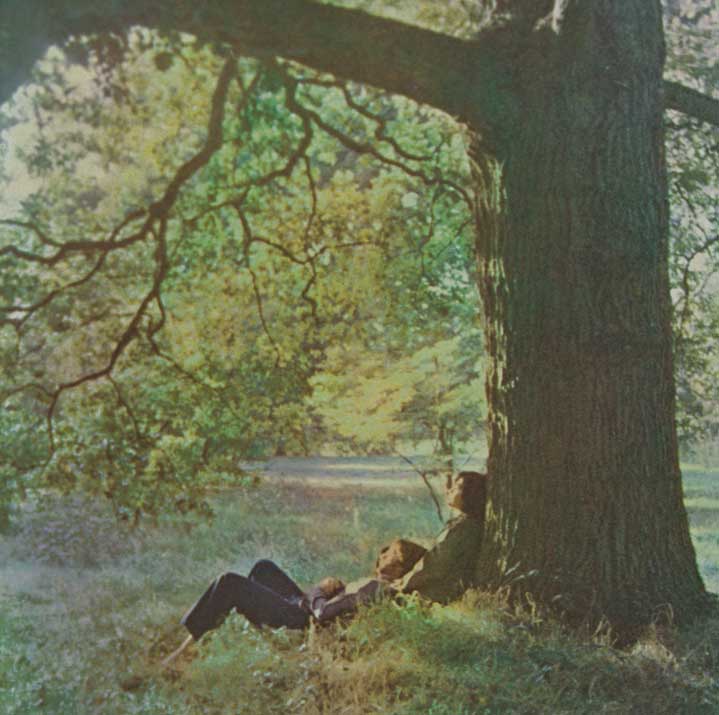
There’s also a fantastic scene from Gimme Some Truth, the documentary on the making of the Imagine album, where John talks to a young man who turns up at the house and invites him in for breakfast. And of course the cover photograph for Plastic Ono Band (1970) was also taken in the grounds of the manor – beside the man-made lake the Lennon’s had constructed on the property:
There’s a fairly comprehensive article about Tittenhurst Park in Wikipedia. John subsequently sold the property to Ringo Starr. Lennon biographer Philip Norman wrote:
“Ringo had…recently bought Tittenhurst Park, in the same obliging spirit that a Liverpool pal might take over some old banger of a car. John hated the thought that his rolling parklands and lake had gone forever, and drew comfort from Ringo’s promise that a bedroom would always be kept for him there.” (“John Lennon – The Life”. Harper Collins, 2008)
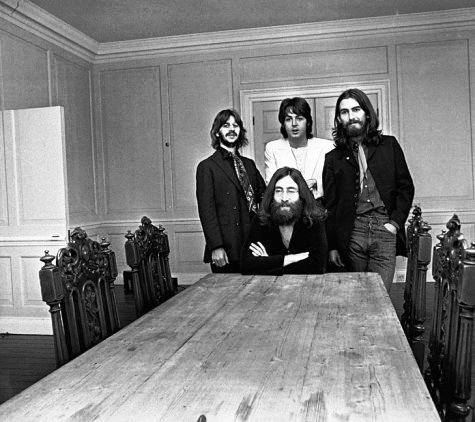
Sadly the events of 1980 meant that was no longer a requirement. The house and grounds were again sold in 1988 to present owner, Sheikh Zayed bin Sultan Al Nahyan, President of the United Arab Emitrates and ruler of Abu Dhabi. On Friday, August 22, 1969 the Beatles final photo session as a band was at Tittenhurst. The dream was over.
(See also “John Lennon’s Rolls Royce“, and the Kenwood site which goes into great detail about the house Lennon owned prior to purchasing Tittenhurst Park)
Budget Beatles
For many years now Apple Records have pursued a deliberate policy of maintaining the entire Beatles recorded catalogue as a premium product and brand.
Compact Discs (and vinyl LP’s in an earlier time) are very rarely discounted or put on “sale” with discounted prices. They always come with a high recommended retail price. The long-running fight with iTunes (which saw Beatle songs unavailable for download for years) only added to this perception in the marketplace giving the Beatles product an aura of exclusivity stretching right back through their entire back-catalogue.
However, that doesn’t mean that the Beatles music, both as a group and as individual artists, has never been re-packaged and offered at a discount prices over the years.
In the vinyl days this came in the form of a small number of selected albums being re-issued on the Music for Pleasure label in Britain and Europe, on the Fame label in Britain and Europe, and on the Axis label here in Australia. Many of these titles came with unique covers and labels, making them collectable items for fans.
The Music for Pleasure (or MFP) label was set up in Britain as a joint venture between EMI Records and the Paul Hamlyn group – which was better known as a book publisher. The result of the deal meant that these titles were largely sold in supermarkets and department stores rather than the traditional record shops of the day. As a result of the EMI connection most titles on the label came from the rich and extensive EMI back-catalogue of artists, both classical, jazz and popular. The complete listing of all releases can be found here.
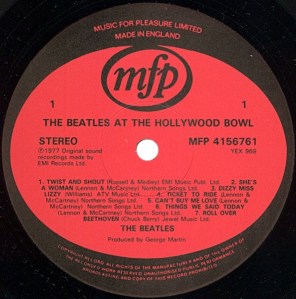
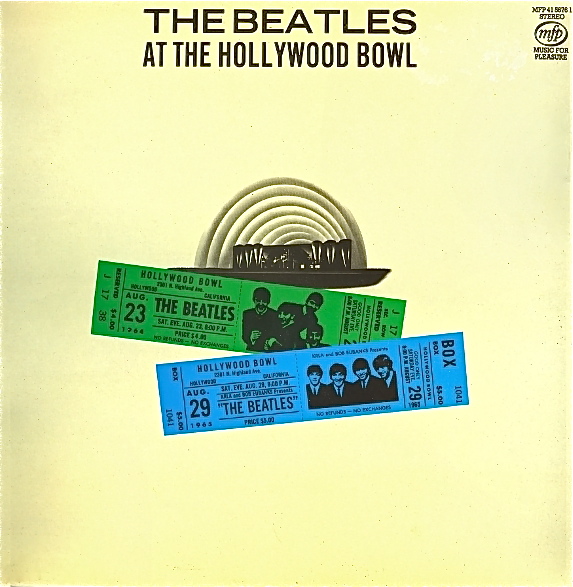
The first Beatles album to be re-released as an MFP title was “At the Hollywood Bowl” from 1977. The cover has a variation in the typeset and the way the title is displayed, and of course there’s that MFP logo in the top right-hand corner:
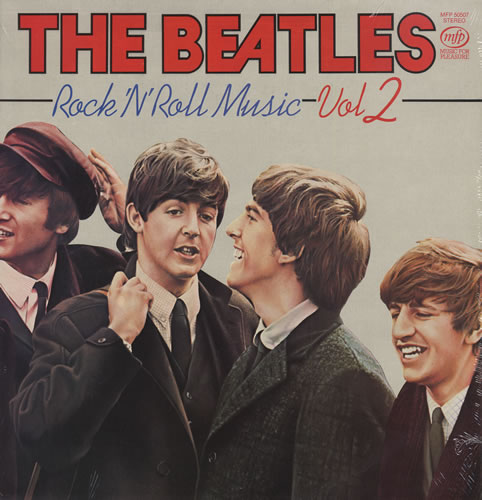
The Beatles album “Rock’n’Roll Music”, initially issued as a gatefold double album on the Parlophone (UK) and Capitol (US) in 1976 was re-issued on the MFP budget label in Britain in 1980 and instead of being a double LP, you could buy these as two separate discs, “Rock’n’Roll Music Vol. 1” and “Rock’n’Roll Music Vol. 2”:
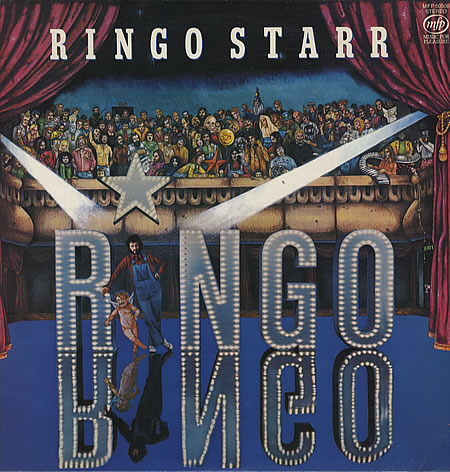
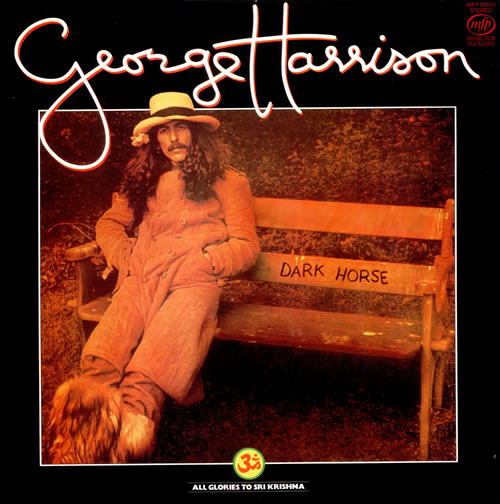
Also in 1980 came three re-issues of solo Beatles work. John Lennon’s “Mind Games” (originally released in 1973); George Harrison’s “Dark Horse” (originally from 1974); and Ringo Starr’s self-titled “Ringo” (also originally from 1973). Lennon’s “Mind Games” had a unique cover – a kind of mash up image from the original LP:
George’s “Dark Horse” got a unique treatment (using the image from the rear of the 1974 release), while Ringo’s LP front cover looked much the same, with the addition of his name in large letters across the top:
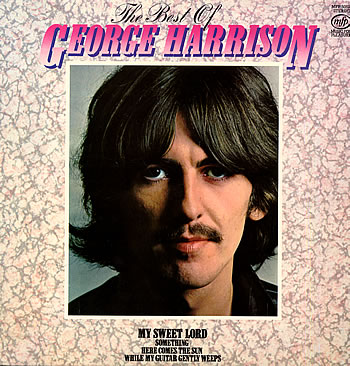
1981 saw an MFP re-issue of Lennon’s “Rock’n’Roll” album (with a slightly different cover to the original – the neon sign above his head was larger). Also in 1981 came Ringo’s compilation “Blast From Your Past”, and a second George Harrison MFP release “The Best of George Harrison” – with quite a different cover:
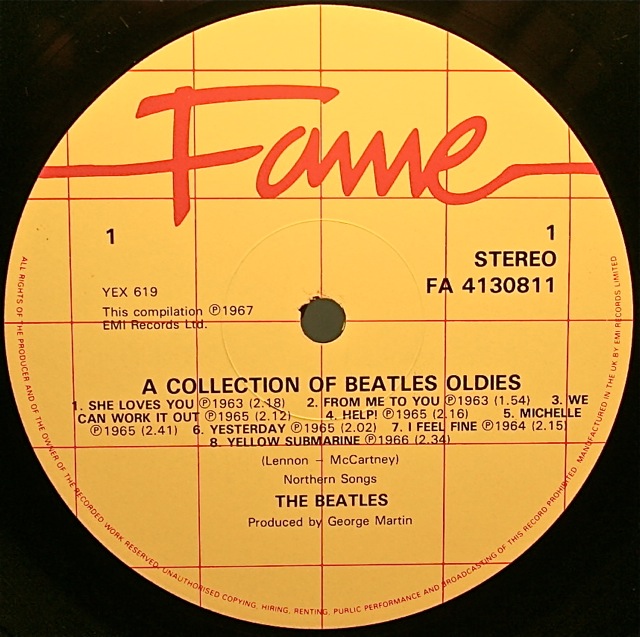
The budget Fame label (another EMI subsidiary which released both vinyl and CD’s as budget items between 1983 and 1994 in Britain and in Europe) issued just one actual Beatles title, the compilation “A Collection of Beatles Oldies”. This appeared on vinyl in 1983 and the front cover is distinguished only by a very small “Fame” logo written diagonally across the top right-hand corner of the LP. The rear cover is also the same as the original Parlophone one (but with Fame logo at the bottom), and the LP came out with a Fame label:
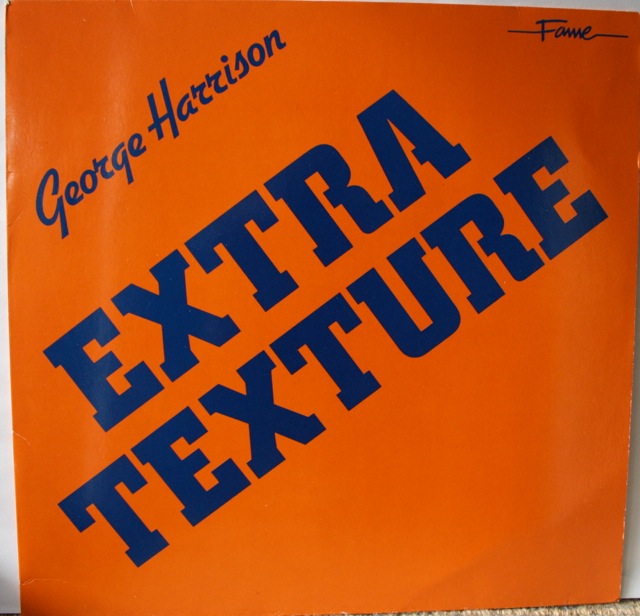
Fame also re-issued three Beatles solo works on vinyl: the John Lennon “Plastic Ono Band” (in 1984); Paul McCartney’s self-titled “McCartney”; and George Harrison’s “Extra Texture”. Each of these came out using the green Apple label on the record itself. Here’s the cover of a German Fame pressing of “Extra Texture”. Again, note the Fame logo on the top right-hand side:
In 1987 and 1988 Fame also released the Paul McCartney and Wings titles “Wildlife”, “Red Rose Speedway”, “Venus and Mars” and “London Town” – all these (as far as I can tell) were issued on CD only.
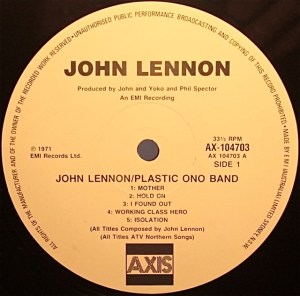
In Australia EMI’s budget label was called Axis Records and it followed along the same lines as MFP. Axis released a range of very similar Beatles and solo titles, although it had some interesting and unique cover variations – and of course a label variation. The Beatles “A Collection of Beatles Oldies” was joined on Axis Records by their “Rock’n’Roll Music” compilation – again made available in two separate volumes like the MFP release – but with a slightly different cover to the British releases:
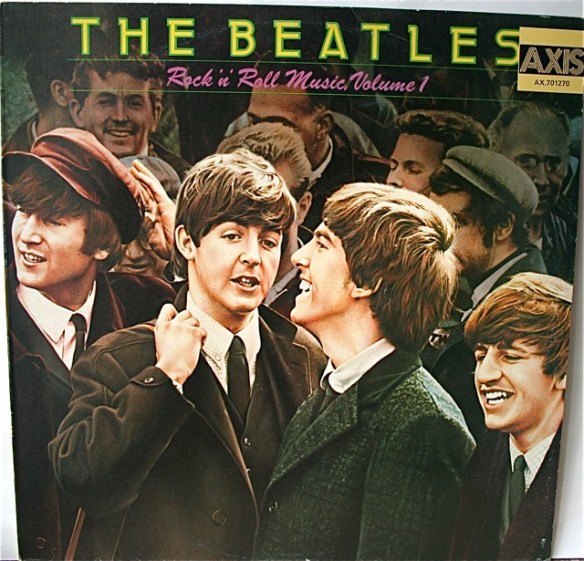
The Australian Axis “Rock’n’Roll Music” LP covers are pretty much the same as the budget Capitol US releases of these titles. There were a couple of Axis label variations for this title as well.
Axis also produced vinyl re-issues of Lennon’s “Plastic Ono Band”, “Mind Games” and “Rock’n’Roll” albums; Harrison’s “Dark Horse” and “The Best Of George Harrison”; McCartney and Wings “Wildlife”; and Ringo Starr’s “Ringo”. Note the Axis logo top right-hand side, and the title of the LP is printed as well on the top left:
The Axis “Best of George Harrison” got the same cover as the US Capitol records budget release. This cover image was also used by Parlophone/EMI for the official Australian LP, but is different to the UK’s Music For Pleasure re-issue, and different again from the CD release of the same title:
So, that’s a quick trawl through the collection for budget Beatles items. It’s not exhaustive, and if you’d like to add or comment please do by using the email beatlesblogger@gmail.com or by using the comment box below, or now by tweeting us onTwitter. We’re at beatleblogger.
Concert For George – Win a Free New Blu-ray
This week a new 2-disc Blu-ray version of “Concert for George” was released. It’s the first time we get to see this spectacular memorial concert in all its true high-definition glory. And you can win a free copy of the set – see below for details.
The “Concert for George” took place at London’s Royal Albert Hall on November 29, 2002 – one year to the day after the sad passing of George Harrison. Olivia Harrison and longtime friend Eric Clapton organized a performance tribute in his honor. It was a celebration of his music on a number of levels. The concert begins with a spectacular Indian orchestra performance of a composition called “Arpan”, specially composed for the occasion by Ravi Shankar who was a friend and mentor to George since he first discovered Indian music and began incorporating it into his Beatles music in the mid-1960s. “Arpan” means offering and within the piece Ravi Shankar expresses aspects of George’s moods and spiritual aspirations. The work includes Eric Clapton playing a haunting acoustic solo.
Disc One of the new Blu-ray “Concert for George” set contains the concert in its entirety. A second disc features the original theatrical version of the film. There are also concert highlights, interviews with the performers, rehearsals and behind-the-scenes footage. The second disc also contains a previously unreleased interview segment entitled “Drummers,” featuring Ringo Starr, Jim Keltner and legendary percussionist Ray Cooper.
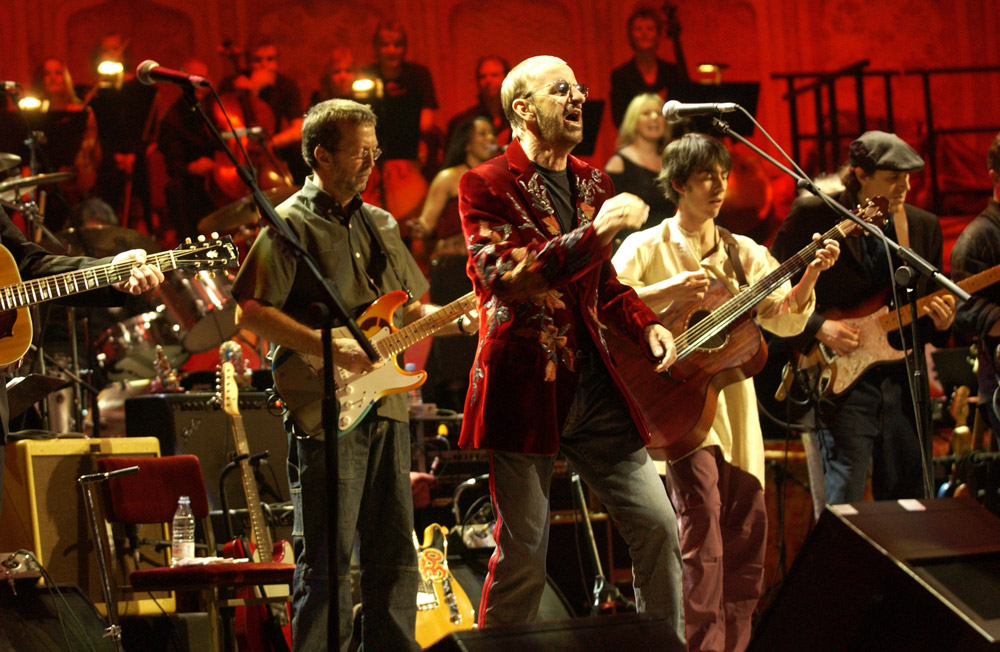
This very special evening featured many of George’s original compositions (both as a solo artist and as a Beatle) and the music he loved – all performed by a lineup including Eric Clapton, Jeff Lynne, Paul McCartney, the Monty Python team, Tom Petty, Billy Preston, Ravi Shankar and his daughter Anoushka, Ringo Starr, and George’s son Dhani Harrison.
The concert focusses very much on George’s writing and features songs like “While My Guitar Gently Weeps” (with Eric Clapton on guitar, Paul McCartney on piano and Ringo Starr on drums), “Taxman” (performed by Tom Petty and the Heartbreakers), “My Sweet Lord” (by Billy Preston), “Old Brown Shoe” (Gary Brooker), and “The Inner Light” (covered by Jeff Lynne and Anoushka Shankar). Jeff Lynne was George’s longtime friend and collaborator and he produced the recording of the concert, while Eric Clapton oversaw the entire proceedings as Musical Director. The concert film is directed by David Leland.
Now – here’s your chance to win a copy of the new Blu-ray 2-disc release. All you have to do is be the first person to email me at beatlesblogger.gmail.com with the correct answer to this “Concert for George” question:
In the “Concert for George” singer Sam Brown (daughter of Joe Brown, who is also in the concert) performs a version of a George Harrison/Dhani Harrison composition called “Horse to the Water”. What is the name of the album on which this song was first released?
Its a little bit tricky but the first correct entry sent to my email address above will win a Blu-ray copy of the “Concert for George” set – released just this week.
The “Concert for George” Blu-ray is courtesy of Rhino Entertainment.
Here’s a promotional trailer for the film.
George Harrison – When We Was Fab (Box Set)
Just got a copy of the 1988 limited edition, box set single “When We Was Fab” by George Harrison. Here’s the outer cover:
Inside the little box is the vinyl single in a picture sleeve:
As you can see, the picture used for the outer box is slightly different in a number of areas to the one used for the record picture sleeve inside. If the artwork for the both the box and the picture sleeve looks familiar its because part of it is taken from the drawings of the Beatles for the “Revolver” cover – done by long-time friend of the band, Klaus Voormann.
There’s also a fun cutout sheet of George in his Sgt Pepper uniform in the box (which is obviously paying homage to the Sgt Pepper cutout sheet); and also a fold-out colour poster:
The box set label for the “When We Was Fab” single is different to the one used for the standard vinyl single release – notice on the standard issue there are multiple Dark Horse logos as opposed to the single Dark Horse logo on the box set version:
There was also a 12″ extended play vinyl single and a CD single release of this song as well. Graham Calkin’s Beatle pages has all the details on these.
And just to remind you of the song and the official video (directed by Godley and Creme):
“The Beatles” – An Interesting Book
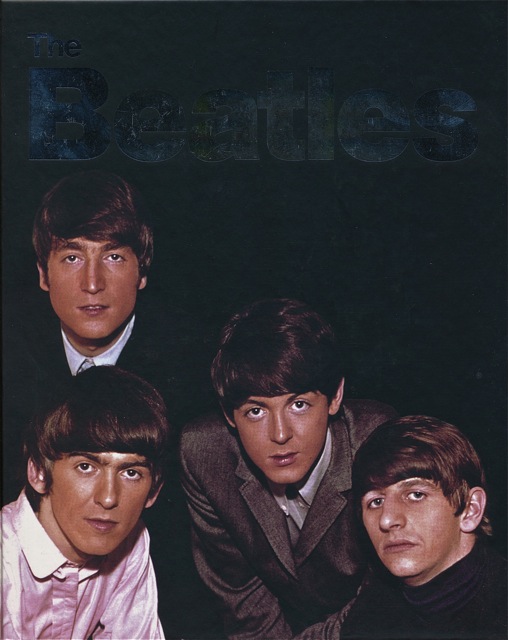
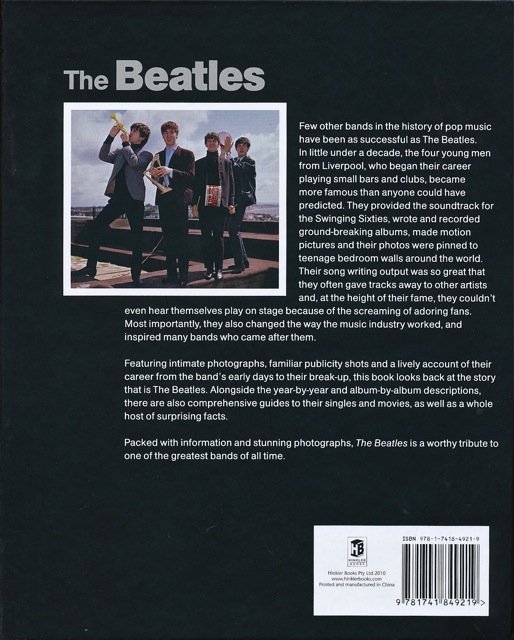
Another Beatles book has recently come into the collection. Again, it’s from a discount book store that is just near where I work. They specialise in selling remaindered stock at greatly reduced prices and I’ve picked up some interesting titles from there over the years. This one is simply called “The Beatles“:
There’s a great photo of the band on the front cover – it’s highly colourised but quite striking in its effect. The title words “The Beatles” are printed in silver and so don’t show up too well in this scanned image. Interestingly, nowhere on the front or rear covers, or even the spine, is there mention of the author. You have to go to the publishers details page inside where in the fine print it says “Written by Mike Evans”. I’m not sure why Mike doesn’t get a mention anywhere on the outside of the book. A quick Google search reveals Evans is actually quite prolific having written or edited, amongst many other titles, “The Beatles: Paperback Writer: 40 Years of Classic Writing“, “The Art of British Rock: 50 Years of Rock Posters, Flyers and Handbills“, and “The Beatles: On Camera, Off Guard 1963 – 1969“, so the guy has form.
“The Beatles” is chronological in nature and, over 21 chpaters and 224 pages traces the evolution of the band from the early years through to the final chapter called “The Beatles’ Legacy” which brings the story up to 2009 and the release of the newly remastered CD sets – so I’d say it came out in late 2009, although again the book itself does not have a publication date on it. Strange.
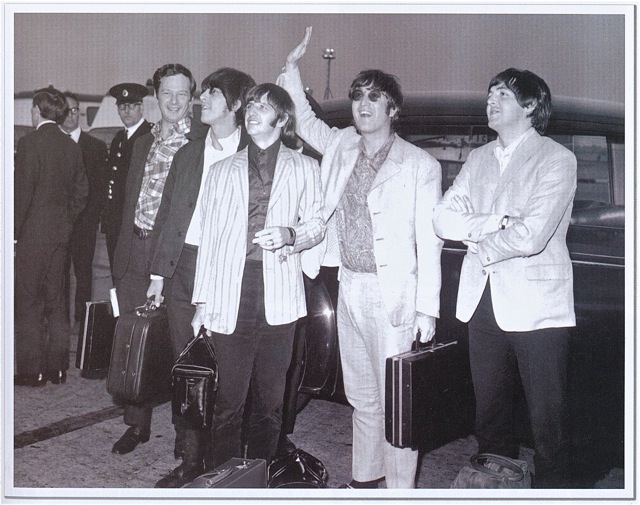
In a lot of ways its a pretty standard Beatles book – but a nicely produced one – one that has at least been done with some care. Its a hardback with lots and lots of photographs (some of them unusual and interesting), and quite detailed text covering each important Beatle release, from “Please Please Me” (1963) through to “Let It Be” (1970). Mike Evans deals with the tours as well – including the troubled 1966 tour to Japan and Philippines where the Beatles were lucky to escape with their lives. In this news photo in the book they, along with manager Brian Epstein, look pretty happy to be back in London in one piece, their smiles belying the danger they faced after a perceived offense to the President of the Philippines and his wife:
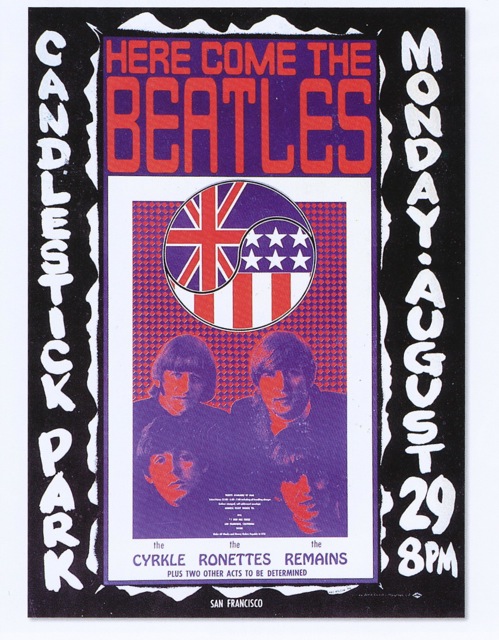
As well as terrific photos there are lots of other worthwhile visual additions scattered throughout, like colour reproductions of Beatles memorabilia like movie posters, concert tickets, Beatles stamps, and this US concert poster from August, 1966 for the concert at Candlestick Park, San Francisco:
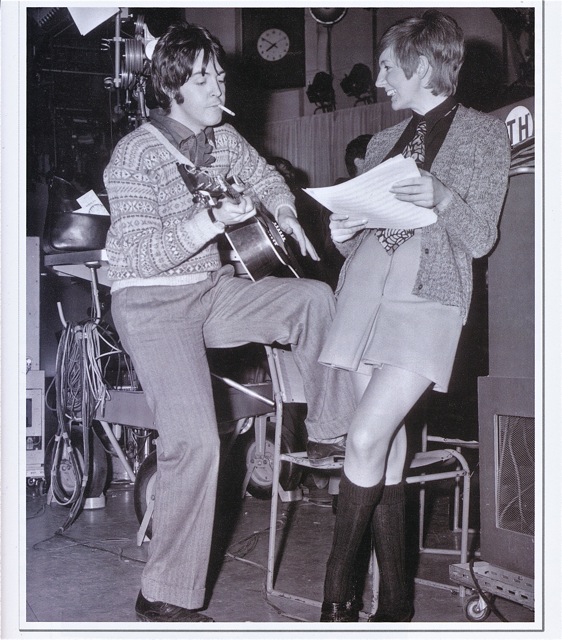
The photos inside are often unusual, like this one of Paul in the studio in January, 1968 with Cilla Black, taking her through the song he’d written for her called “Step Inside Love“. It became the theme for Black’s successful TV show of the same name:
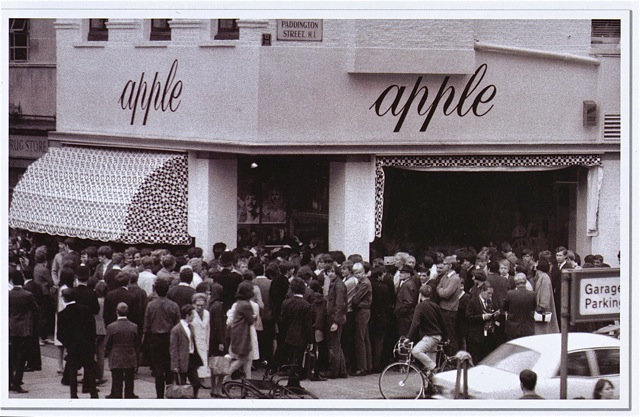
Author Mike Evans deals with both the up-side of the Beatles’ success, and the down-side, including the ill-fated Beatles foray into selling fashion. Described by Evans as “..the biggest disaster for Apple….The idea was to sell trendy items; Paul McCartney described it as “a beautiful place where beautiful people can buy beautiful things.” In reality, though, it was a clothes store, and became known as the “Apple Boutique”. By the middle of 1968, the shop had made a loss of nearly US$500,000/£250,000, a fortune in those days and on July 30 it closed.” In this photo crowds gather outside to grab a bargain and to witness the Apple Boutique’s last day of business:
“The Beatles” is published in Australia by Hinkler Books.